Category Archives: Electors

Florida courts corrupt biased incompetent?, Voeltz v Obama eligibility case, Obama not natural born citizen, AL VT Supreme Courts eligibility hearings, Election officials ignore laws duties

Florida courts corrupt biased incompetent?, Voeltz v Obama eligibility case, Obama not natural born citizen, AL VT Supreme Courts eligibility hearings, Election officials ignore laws duties

“Why has Obama, since taking the White House, used Justice Department Attorneys, at taxpayer expense,  to avoid presenting a legitimate birth certificate and college records?”…Citizen Wells

“Why do state election officials continue to ignore the US Constitution, federal election code and their own state election statutes?”…Citizen Wells

“Why does a judge swear to discharge his duties agreeably to the constitution of the United States, if that constitution forms no rule for his government? if it is closed upon him, and cannot be inspected by him?”… Marbury versus Madison

I have reported on the Obama eligibility hearings in the Alabama and Vermont Supreme Courts. The reason that I have not written about an eligibility hearing in the Florida Supreme Court is because one has not been scheduled there yet.

Why?

Good question.

The answer appears to be some combination of corruption bias and incompetence.

Here are some crucial points of law and fact. More details will be forthcoming.

Let’s start at the beginning.

The states are responsible for the primaries, general election and events through the Electoral College vote.

US Constitution
Article II
Section 1

“Each state shall appoint, in such manner as the Legislature thereof may direct, a number of electors, equal to the whole number of Senators and Representatives to which the State may be entitled in the Congress: but no Senator or Representative, or person holding an office of trust or profit under the United States, shall be appointed an elector.”

All state officials take an oath to uphold or defend the US Constitution.

In Florida they take the following oath.

“I do solemnly swear (or affirm) that I will support, protect, and defend the Constitution and Government of the United States and of the State of Florida; that I am duly qualified to hold office under the Constitution of the State, and that I will well and faithfully perform the duties of”

From page 2 of the Florida “2012 Federal Qualifying Handbook”

“PART II: PRESIDENT AND VICE PRESIDENT

Qualifications

1. Must be a natural born citizen of the United States.
2. Must be at least 35 years of age.
3. Must be a resident of the United States for 14 years.”

“Must be” is not a suggestion.

Florida Election statutes

“Title IX

102.168 Contest of election.–
“(1) Except as provided in s. 102.171, the certification of election or nomination of any person to office, or of the result on any question submitted by referendum, may be contested in the circuit court by any unsuccessful candidate for such office or nomination thereto or by any elector qualified to vote in the election related to such candidacy, or by any taxpayer, respectively.

(2) Such contestant shall file a complaint, together with the fees prescribed in chapter 28, with the clerk of the circuit court within 10 days after midnight of the date the last board responsible for certifying the results officially certifies the results of the election being contested.

(3) The complaint shall set forth the grounds on which the contestant intends to establish his or her right to such office or set aside the result of the election on a submitted referendum. The grounds for contesting an election under this section are:”

“(b) Ineligibility of the successful candidate for the nomination or office in dispute.”

AMENDMENT X

“The powers not delegated to the United States by the Constitution, nor prohibited by it to the states, are reserved to the states respectively, or to the people.”

Many of the Secretaries of State or other election officials claim to have only a “ministerial” duty in the elections.

In the recent Vermont Supreme Court hearing with appellant H. Brooke Paige, state attorney Todd Doloz stated that the VT Secretary of State has only a ministerial duty in the elections.

Ministerial defined.

Merriam Webster.

a : being or having the characteristics of an act or duty prescribed by law as part of the duties of an administrative office
b : relating to or being an act done after ascertaining the existence of a specified state of facts in obedience to a legal order without exercise of personal judgment or discretion.

Legal dictionary.

“Ministerial describes an act or a function that conforms to an instruction or a prescribed procedure. It connotes obedience. A ministerial act or duty is a function performed without the use of judgment by the person performing the act or duty.”

Obedience is the common denominator. To a legal order or conforming “to an instruction or a prescribed procedure.”

The US Constitution makes this clear.

The Secretary of State swears an oath to the Constitution.

Florida law explicitly states the requirements for the eligibility of the president.

The attorney for Vermont, in his obfuscation efforts, raised the spectre of each Secretary of State or chief election official proactively verifying the eligibility of each candidate.

No reasonable person is requesting that.

However, there is a clear distinction between that and knowingly, after being alerted of a candidate’s eligibility deficiency, taking no action, ignoring a clear mandate from the US Constitution and allowing a candidate to remain on the ballot potentially disenfranchising thousands if not millions of voters.

This is what should have taken place in FL and all of the states:

Once alerted or challenged on a potential deficiency in eligibility of a candidate, the Secretary of State or other election official should investigate.

In the case of Obama and his natural born citizen status, if there is confusion about the definition, the state attorney general should be queried and if there is still confusion, a court ruling requested.

Passing the buck is dereliction of duty.

In Florida, the situation is much worse.

Not only did the FL Secretary of State fail in their constitutional duty, subsequent court hearings have been delayed and failed in their judicial duties.

Why has the judicial system failed the citizens in Florida?

More details to come.

Vermont Supreme Court appeal on Obama natural born citizen status, H. Brooke Paige standing, Attorney Todd Daloz flawed arguments, Standing non issue, Constitution and duties ignored

Vermont Supreme Court appeal on Obama natural born citizen status, H. Brooke Paige standing, Attorney Todd Daloz flawed arguments, Standing non issue, Constitution and duties ignored

“Why has Obama, since taking the White House, used Justice Department Attorneys, at taxpayer expense,  to avoid presenting a legitimate birth certificate and college records?”…Citizen Wells

“Why does a judge swear to discharge his duties agreeably to the
constitution of the United States, if that constitution forms no
rule for his government? if it is closed upon him, and cannot be
inspected by him?”… Marbury versus Madison

“The Elections division protects the integrity of campaigning and elections in Vermont.”…Vermont Secretary of State website

H. Brooke Paige, whose case challenging Obama’s natural born citizen deficiency was rejected by Washington Superior Court Judge Robert Bent on November 2012, appealed his case before the following Vermont Supreme Court Justices on April 23, 2013.

Honorable Paul Reiber, Chief Justice
Honorable John Dooley, Associate Justice
Honorable Marilyn Skoglund, Associate Justice
Honorable Brian Burgess, Associate Justice
Honorable Beth Robinson, Associate Justice

Assistant Attorney General Todd Daloz represented Secretary of State James Condos.

The issue of standing dominated the hearing. Mr. Paige presented a clear definition of natural born citizen. His documentation was minimal. A further analysis of his argument will be provided later.

It is clear that the majority of citizens, including judges, attorneys and politicians do not understand what a Natural Born Citizen is as included in the
Constitution for presidential eligibility.

It is furthermore clear that status quo is passing the buck instead of fulfilling implied and explicit constitutional duties.

It is also clear that Secretary of State James Condos and other secretaries of state and election officials, when confronted by similar challenges about natural born citizen status should have requested clarification from their Attorney Generals and the courts.

Courts have shirked their responsibility, from the US Supreme Court to the state courts.

Marbury v Madison makes this clear.

“It is emphatically the province and duty of the judicial
department to say what the law is. Those who apply the rule to
particular cases, must of necessity expound and interpret that
rule. If two laws conflict with each other, the courts must
decide on the operation of each.”

“If then the courts are to regard the constitution; and the
constitution is superior to any ordinary act of the legislature;
the constitution, and not such ordinary act, must govern the
case to which they both apply.”
“The judicial power of the United States is extended to all
cases arising under the constitution. Could it be the intention
of those who gave this power, to say that, in using it, the
constitution should not be looked into? That a case arising
under the constitution should be decided without examining the
instrument under which it arises?  This is too extravagant to
be maintained.”

“Why does a judge swear to discharge his duties agreeably to the
constitution of the United States, if that constitution forms no
rule for his government? if it is closed upon him, and cannot be
inspected by him?

Assistant Attorney General Todd Daloz makes the argument that Secretary of State James Condos has no power or duty to vet a candidate.

Oh really?

The states are responsible for the primaries, general election and events leading up to the Electoral College vote.

US Constitution
Article II
Section 1

“Each state shall appoint, in such manner as the Legislature thereof may direct, a number of electors, equal to the whole number of Senators and
Representatives to which the State may be entitled in the Congress: but no Senator or Representative, or person holding an office of trust or profit under
the United States, shall be appointed an elector.”

Manner of voting

§ 8. The electors shall vote for President and Vice President, respectively, in the manner directed by the Constitution.

All state election officials swear an oath to uphold or defend the US Constitution.

Article VI of the US Constitution.

“The Senators and Representatives before mentioned, and the Members of the several State Legislators, and all executive and judicial Officers, both of the
United States and of the several States, shall be bound by Oath or Affirmation, to support this Constitution;”

Some states explicitly provide for challenges by the secretary of state.

GEORGIA CODE
“*** Current Through the 2012 Regular Session ***

TITLE 21. ELECTIONS
CHAPTER 2. ELECTIONS AND PRIMARIES GENERALLY
ARTICLE 1. GENERAL PROVISIONS

O.C.G.A. § 21-2-5 (2012)

§ 21-2-5. Qualifications of candidates for federal and state office; determination of qualifications
(a) Every candidate for federal and state office who is certified by the state executive committee of a political party or who files a notice of candidacy
shall meet the constitutional and statutory qualifications for holding the office being sought.

(b) The Secretary of State upon his or her own motion may challenge the qualifications of any candidate at any time prior to the election of such candidate.
Within two weeks after the deadline for qualifying, any elector who is eligible to vote for a candidate may challenge the qualifications of the candidate by
filing a written complaint with the Secretary of State giving the reasons why the elector believes the candidate is not qualified to seek and hold the public
office for which he or she is offering. Upon his or her own motion or upon a challenge being filed, the Secretary of State shall notify the candidate in
writing that his or her qualifications are being challenged and the reasons therefor and shall advise the candidate that he or she is requesting a hearing on
the matter before an administrative law judge of the Office of State Administrative Hearings pursuant to Article 2 of Chapter 13 of Title 50 and shall inform the candidate of the date, time, and place of the hearing when such information becomes available. The administrative law judge shall report his or her findings to the Secretary of State.

(c) The Secretary of State shall determine if the candidate is qualified to seek and hold the public office for which such candidate is offering. If the
Secretary of State determines that the candidate is not qualified, the Secretary of State shall withhold the name of the candidate from the ballot or strike
such candidate’s name from the ballot if the ballots have been printed. If there is insufficient time to strike the candidate’s name or reprint the ballots,
a prominent notice shall be placed at each affected polling place advising voters of the disqualification of the candidate and all votes cast for such
candidate shall be void and shall not be counted.”

Explicit or implied,

Secretary of State James Condos took an oath to uphold the US Constitution.

One of the justices asked if all of the state election officials should be required to vet all of the candidates. That was not the question at hand.

In this case, the Vermont Secretary of State was notified of the problem and refused to act.

Once again, an American courtroom, despite the caution from Marybury v Madison, shirked their duty and tried their best to make this about standing.

Standing is a non issue in this case and they damn well know it!

In fact, at least one justice questioned this.

There are at least 3 reasons why H. Brooke Paige has standing.

1. Vermont election statutes clearly give him standing as a voter. Mr. Paige complied with the protocol.

2. Ruling from a lower court, the Superior Court.

3. The Tenth Amendment. If their argument is that the state does not have the power to challenge, then any citizen does.

Tenth Amendment

The powers not delegated to the United States by the Constitution, nor prohibited by it to the states, are reserved to the states respectively, or to the
people.

Attorney Daloz tries to obfuscate and minimize the VT elections statutes in regard to Mr. Paige having standing.

Quite the contrary. They are crystal clear.

§ 2603. Contest of elections

“(a) The result of an election for any office, other than for the general assembly, or public question may be contested by any legal voter entitled to vote on the office or public question to be contested.

(b) A contest is initiated by filing a complaint with a superior court alleging:

(1) that errors were committed in the conduct of the election or in count or return of votes, sufficient to change the ultimate result;

(2) that there was fraud in the electoral process, sufficient to change the ultimate result; or

(3) that for any other reason, the result of the election is not valid.

(c) The complaint shall be filed within 15 days after the election in question, or if there is a recount, within 10 days after the court issues its judgment on the recount. In the case of candidates for state or congressional office, for a presidential election, or for a statewide public question, the complaint shall be filed with the superior court, Washington County. In the case of any other candidate or public question, the complaint shall be filed with the superior court in any county in which votes were cast for the office or question being challenged.

(d) The Vermont Rules of Civil Procedure shall apply to contests of elections, except that such cases shall be placed upon a special calendar, and hearings shall be scheduled on a priority basis, as public policy demands that such questions be resolved promptly.

(e) After hearing, the court shall issue findings of fact and a judgment, which shall supersede any certificate of election previously issued. If the court finds just cause, the court shall grant appropriate relief, which may include, without limitation, ordering a recount, or ordering a new election. If during the hearing the court receives credible evidence of criminal conduct, the court shall order a transcript of all or part of the testimony to be forwarded to the proper state’s attorney. If a new election is ordered, the court shall set a date for it, after consulting with the secretary of state; in ordering a new election, the court shall have authority to issue appropriate orders, either to provide for special cases not covered by law, or to supersede provisions of law which may conflict with the needs of the particular situation.

(f) The court shall send a certified copy of its findings of fact and judgment to the secretary of state.”

Here are segments from the court proceedings that relate to Mr. Paige’s argument and compliance and attorney Daloz attempting to prove that Mr. Paige has no standing. Attorney Daloz even further tries to dilute the standing issue by implying that congress should be the arbiter. The states control the election process until the certification of the electoral votes by congress. Only then can congress question eligibility. They have failed to do so.

The entire proceedings can be heard here.

Mr. Paige’s inaccurate statements about Obama’s birth certificate will for the moment be assumed to be based on ignorance and not agenda. This will be explored later.

Yes Florida there is a sanity clause, Judges may be removed from office by impeachment, Judicial qualifications commission, Judge Kevin Carroll removal, Leon County circuit court

Yes Florida there is a sanity clause, Judges may be removed from office by impeachment, Judicial qualifications commission, Judge Kevin Carroll removal, Leon County circuit court

“Why has Obama, since taking the White House, used Justice Department Attorneys, at taxpayer expense,  to avoid presenting a legitimate birth certificate and college records?”…Citizen Wells

“Why do state election officials continue to ignore the US Constitution, federal election code and their own state election statutes?”…Citizen Wells

“Why does a judge swear to discharge his duties agreeably to the constitution of the United States, if that constitution forms no rule for his government? if it is closed upon him, and cannot be inspected by him?”… Marbury versus Madison

Judge Kevin Carroll, a Leon County Florida Circuit Court Judge, recently dismissed an Obama eligibility case. Judge Carroll made reference to a fictional ruling on Santa Clause in the movie “Miracle on 34th Street.”

I have a Sanity Clause ruling for Judge Carroll.

Removal from office.

In Florida there are 2 ways to remove a judge:

1. On the recommendation of the judicial qualifications commission, the supreme court may discipline, retire, or remove a judge.

2. Judges may be impeached by a two-thirds vote of the house of representatives and convicted by a two-thirds vote of the senate.

From WND December 22, 2012.

“ELIGIBILITY JUDGE QUOTES FAMOUS SANTA CASE
Cites paraphrased decision in ‘Miracle on 34th Street’ in Florida Democrat’s challenge”

“A real-life Florida judge has paraphrased a statement from the fictional Judge Henry X. Harper in “Miracle on 34th Street” to justify his sudden decision to dismiss a challenge under state law to Barack Obama’s eligibility to occupy the Oval Office.

The ruling from Kevin Carroll of the Florida circuit court for Leon County dismissed the case brought on behalf of Democratic voter Michael C. Voeltz, who raised the issue of Obama’s qualifications under a state law that allows voters to challenge candidates’ eligibility.

Carroll, who had given the plaintiffs until Dec. 23 to respond to Obama’s motion to dismiss the case, changed his mind and abruptly Thursday ordered the case dismissed.

He explained that the fact the government says Obama is qualified to be president is more than enough for him.

“This court notes that President Obama lives in the White House. He flies on Air Force One. He has appeared before Congress, delivered State of the Union addresses and meets with congressional leaders on a regular basis. He has appointed countless ambassadors to represent the interests of the United States throughout the world,” Carroll wrote.

“As this matter has come before the court at this time of the year it seems only appropriate to paraphrase the ruling rendered by the fictional Judge Henry X. Harper from New York in open court in the classic holiday film ‘Miracle on 34th St.’ ‘Since the United States Government declares this man to be president, this court will not dispute it. Case dismissed.’”

It was the second time in eligibility cases that a judge appears to have abandoned legal fundamentals and simply ruled for Obama on no particular basis.

Several years ago it was Judge James Robertson in Washington who dismissed a case because, he wrote, “The issue of the president’s citizenship was raised, vetted, blogged, texted, twittered, and otherwise massaged by America’s vigilant citizenry during Mr. Obama’s two-year campaign for the presidency.”

Carroll’s ruling also did not address the fact that in the movie, the judge was determining that a resident of a nursing home hired to play Santa Claus at a Macy’s store was, in fact, Santa Claus. His ‘proof” was a pile of mail addressed to Santa Claus that the post office delivered to him, confirming his identity.

Attorney Larry Klayman, representing Voeltz in the case, immediately responded with a motion for rehearing, contending that the judge “prematurely and precipitously” dismissed the complaint without a hearing as outlined under state law.

“This act also flies in the face of this court’s own order of Dec. 13, 2012, which was law of the case,” noted Klayman, founder of FreedomWatchUSA.

“This court had a statutory duty under the Florida Election laws, the Florida and U.S. Constitutions, and 3 U.S.C. Section 5, to adjudicate defendant Obama’s eligibility and his alleged fraudulent acts expeditiously, timely, and before the electors met on Dec. 17, 2012, and before the Electoral College votes on Jan. 6, 2013, Klayman explained. “Thus, this court also violated these law is dismissing the complaint summarily.”

Klayman suggested to the court its order “at a minimum creates an appearance that it simply jettisoned this case not only on the extrajudicial and non-legal premise that President Obama was president during the prior four year term, and has already performed many ‘presidential’ acts but also because this court did not want to be ‘inconvenienced’ by holding an evidentiary hearing.”

Klayman also questioned Carroll’s “off-the-cuff” remarks about a friend being appointed to a federal post by Obama as inappropriate.

He said the remarks about fictional judge Henry X. Harper in “Miracle on 34th St.” also were “inappropriate” and showed “a mindset simply to rid the court of this case.”

“This court seems to want to sidestep having to reach these serious and important matters before it,” Klayman said.

Klayman is seeking a rehearing and an evidentiary hearing in the dispute. He’s also seeking a temporary restraining order to halt the delivery of the Florida electoral votes to Obama until the court case is resolved.

He has submitted evidence by way of a sworn statement from Investigator Mike Zullo of Sheriff Joe Arpaio’s Cold Case Posse in Arizona that there probably were two crimes committed in the creation and display of Obama’s long-form birth certificate, which was released by the White House and posted online.

Zullo’s testimony is that forgery was used to create the document, and fraud was used in “presenting to the residents of Maricopa County and to the American public at large a forgery the White House represents as “proof positive” of President Obama’s” birth documentation.

Arpaio’s affidavit also was presented to the judge.

The sheriff said: “My investigators and I believe that President Obama’s long-form birth certificate is a computer-generated document, was manufactured electronically, and that it did not originate in a paper format, as claimed by the White House. … There is probable cause that the document is a forgery.”

Klayman has argued that Obama “has never established his eligibility for the presidency of the United States … the only evidence of defendant Obama’s alleged birth within the United States has come in the form of a belatedly filed electronic version of a claimed long-form birth certificate posted on the Internet.”

He told the judge that the evidence suggests, however, the document is fraudulent.

The case claims that should the judge not address the facts, the plaintiff “can never be made whole again.”

“If defendant Obama is found to be ineligible, which is likely to happen since there is no evidence … Obama was born in the United States to U.S. citizen parents, the plaintiff’s vote in the 2012 presidential election will be nullified.”

He suggested state law calls for an expedited hearing in such cases.

Carroll, however, said the state of Florida does not have jurisdiction to “determine the issue of qualification for the office of president of the United States, particularly at this late date in the process.”

His comments came after another challenge filed by Voeltz earlier this year was dismissed because the judge ruled it couldn’t be addressed until after the election.”

“Klayman said he also will be trying to go directly to the Florida Supreme Court if Carroll does not reconsider.

“It’s truly ‘remarkable’ and an affront to the rule of law and all our founding fathers and colonial America fought and risked and gave their lives for. This type of conduct by the establishment, which thinks it can do as it pleases without consequences, is why we have entered into a revolutionary state 236 years after we declared independence from the king. They will soon from We the People learn that there are consequences,” he said.

Read more:

http://www.wnd.com/2012/12/eligibility-judge-quotes-famous-santa-case/#HSid5ipo2b70BbeE.99

Judge Kevin Carroll is either biased, incompetent or insane or some combination and should be removed.

Florida’s Sanity Clause.

Florida House of Representatives.

“The Governor, Lieutenant Governor, members of the Cabinet, justices of the Supreme Court, and judges may be removed from office by impeachment. The House of Representatives has the sole power to impeach. It may do so by a two-thirds vote of the members voting. The Senate tries all impeachments, with the Chief Justice of the Florida Supreme Court presiding. A two-thirds vote of the Senate is required to convict. If convicted, the officer is removed from office.”

http://www.myfloridahouse.gov/Sections/glossary/glossary.aspx?Filter=I

Florida 2011 Court Reform.

“What the Joint Resolution Does:

House Joint Resolution 7111 proposes a Constitutional Amendment to
address reforms to Florida’s court system. The Joint Resolution passed the
Florida House with a vote of 80-38 on May 3, 2011, and later passed the
Senate with a vote of 24-11 on May 5, 2011. Among other things, the Joint
Resolution:”

“As the body responsible for judicial impeachment proceedings,
grants the Speaker of the Florida House of Representatives, at his
or her request, access to the complaint files of the Judicial
Qualifications Commission at any time. The bill requires the
complaint files be kept confidential until the information is used in
the pursuit of impeachment.”

http://www.myfloridahouse.gov/Handlers/LeagisDocumentRetriever.ashx?Leaf=housecontent/opi/Lists/Announcements/Attachments/35/OPI%20Pulse%20-%20Court%20Reform%205-23-11.pdf&Area=House

Florida Code of Judicial Conduct.

“CODE OF JUDICIAL CONDUCT
For the State of Florida
Online Version

Reports of misconduct by judges must be made to the Judicial Qualifications Commission at (850) 488-1581.

Print the Entire Code of Judicial Conduct in PDF.

The opinions of the Judicial Ethics Advisory Committee
are available on the Sixth Judicial Circuit Website.
Visit the web site to search the opinions.

Preamble

Definitions

Canon 1. A Judge Shall Uphold the Integrity and Independence of the Judiciary

Canon 2. A Judge Shall Avoid Impropriety and the Appearance of Impropriety in all of the Judge’s Activities

Canon 3. A Judge Shall Perform the Duties of Judicial Office Impartially and Diligently

Canon 4. A Judge Is Encouraged to Engage in Activities to Improve the Law, the Legal System, and the Administration of Justice

Canon 5. A Judge Shall Regulate Extrajudicial Activities to Minimize the Risk of Conflict With Judicial Duties

Canon 6. Fiscal Matters of a Judge Shall be Conducted in a Manner That Does Not Give the Appearance of Influence or Impropriety; etc.

Canon 7. A Judge or Candidate for Judicial Office Shall Refrain From Inappropriate Political Activity”

http://www.floridasupremecourt.org/decisions/ethics/index.shtml

Mission of the Florida Judicial Branch.

“The mission of the judicial branch is to protect rights and liberties, uphold and interpret the law, and provide for the peaceful resolution of disputes.

Vision of the Florida Judicial Branch
Justice in Florida will be accessible, fair, effective, responsive, and accountable.

To be accessible, the Florida justice system will be convenient, understandable, timely, and affordable to everyone.

To be fair, it will respect the dignity of every person, regardless of race, class, gender or other characteristic, apply the law appropriately to the circumstances of individual cases, and include judges and court staff that reflect the community’s diversity.

To be effective, it will uphold the law and apply rules and procedures consistently and in a timely manner, resolve cases with finality, and provide enforceable decisions.

To be responsive, it will anticipate and respond to the needs of all members of society, and provide a variety of dispute resolution methods.

To be accountable, the Florida justice system will use public resources efficiently, and in a way that the public can understand.”

http://www.flcourts.org/gen_public/mi_vi/index.shtml

Procedures for filing a complaint.

http://www.floridasupremecourt.org/pub_info/jqc.shtml

Judge Kevin Carroll Ruling.

Click to access 12CA3857.pdf

Florida military absentee ballot not counted, Non matching signature most common reason, Marine recruit Wesley Layman Clemons disenfranchised, FL election controversies

Florida military absentee ballot not counted, Non matching signature most common reason, Marine recruit Wesley Layman Clemons disenfranchised, FL election controversies

“Late last night Congressman West maintained a district wide lead of nearly 2000 votes until the St. Lucie County Supervisor of Elections “recounted” thousands of early ballots. Following that “recount” Congressman West trailed by 2,400 votes. In addition, there were numerous other disturbing irregularities reported at polls across St. Lucie County including the doors to polling places being locked when the polls closed in direct violation of Florida law, thereby preventing the public from witnessing the procedures used to tabulate results. The St. Lucie County Supervisor of Elections office clearly ignored proper rules and procedures, and the scene at the Supervisor’s office last night could only be described as complete chaos. Given the hostility and demonstrated incompetence of the St. Lucie County Supervisor of Elections, we believe it is critical that a full hand recount of the ballots take place in St. Lucie County. We will continue to fight to ensure every vote is counted properly and fairly, and accordingly we will pursue all legal means necessary.”…Allen West campaign

“Freedom is the freedom to say that two plus two make four. If that is granted, all else follows.”…George Orwell, “1984″

“It’s not who votes that counts, it’s who counts the votes”…Joseph Stalin

The 2012 Florida presidential election was very close. So was Allen West’s congressional race.

The known issues in the Florida elections should be reason enough for a recount and investigation.

Documented voter fraud, sloppy precinct operations, violation of rules, hundreds of ballots found in a warehouse, over 800,000 undocumented aliens and realistic cause for concern about absentee military ballots.

From the Orlando Sentinel December 11, 2012.

“1,400 absentee ballots rejected for bad signatures in Central Florida”

“Marine recruit Wesley Layman Clemons thought he’d done everything possible to vote while he was in training at U.S. Marine Corps Recruit Depot Parris Island in South Carolina this fall. He requested an Orange County absentee ballot, filled it out, signed it, sealed it, stamped it and mailed it.

Tuesday, he found out from a reporter that his ballot was thrown out — and his vote didn’t count in the Nov. 6 election. The reason: His signature on the ballot didn’t match an earlier one that was on file in the election office, a problem that caused more than 1,400 ballots to be rejected across Central Florida this fall.

“I did my so-called patriotic duty and voted, but apparently someone didn’t think it was a legitimate vote … ,” said Clemons, who is 23 and returned to Orlando last month after a medical discharge. “I’m just ready to toss this phone through the freakin’ window. …”

Clemons said his signature has never changed, and he’s stumped as to why the county’s canvassing board would think otherwise. But it’s too late to do anything about it.

He’s one of 603 Orange County voters whose absentee ballots were rejected by the three-member canvassing board in the Nov. 6 election because of non-matching signatures. Another 579 absentee signatures were rejected in Seminole County, 159 in Osceola County and 142 in Lake County.

A non-matching signature was by far the most common reason for absentee ballot rejection, say Central Florida election officials. The next most common: the failure to sign the ballot at all, which disqualified 672 more ballots in the four counties.

Though the numbers of rejected signatures are relatively small — the four counties received more than 246,000 absentee ballots for the November election, a record — the rejection rate here and elsewhere has climbed dramatically since new statewide rules regarding absentee-ballot signatures were approved by the Florida Legislature in 2011.

Those rules require elections officials to compare absentee-ballot signatures only to signatures on voter-registration applications, which could be decades old. Previously, elections officials could turn to other documents such as the precinct logs that voters sign each time they vote in person, which likely are far more current.

Elections officials insist close calls are not rejected. They must be “clearly, clearly, clearly different,” said Seminole County Supervisor of Elections Mike Ertel, who also sat on his county’s canvassing board.

“You could tell when people were just getting fancy” with their signature, said Orange County Canvassing Board member Tiffany Moore Russell, a county commissioner. “But the majority were just obvious.”

In 2008, the last time there was a presidential election, Orange’s canvassing board rejected 15 out of every 10,000 signatures. This year, the rate tripled — to 44 out of every 10,000. Seminole’s board rejected 65 out of every 10,000 in 2008 and 110 out of 10,000 this year.

Osceola and Lake counties’ 2008 rejection rates were not available. But Lake’s 2012 absentee-ballot signature rejection rate doubled its rate in the 2010 state election, and Osceola’s tripled.

Depending on where the voters lived, their rejected votes could have made a difference. In the Orange County Commission District 3 race, Pete Clarke beat Lui Damiani by 70 votes. In the Florida House of Representatives race in Seminole County, Mike Clelland defeated Chris Dorworth by 146 votes.

Moore Russell, a Democrat, said she didn’t see any problem that needed a fix by lawmakers.

“People didn’t update their signature,” Moore Russell said. “At the end of the day, there has to be some responsibility on that voter to update their signatures. You can’t legislate responsibility.”

Philip Kobrin, for one, doesn’t disagree. Kobrin, 76 and retired, of Winter Park, said he went down to the elections office to check after he was informed his absentee ballot was rejected. He realized then that he had signed his voter-registration application with his usual stylized script and his absentee ballot with careful lettering so that it would be legible.

“I must take half the blame for myself,” Kobrin said. “When they showed it to me, I wasn’t happy about it, but they had a legitimate beef.”

After the new law passed, elections officials in many counties tried hard to contact voters and ask them to renew their signatures. Orange County Supervisor of Elections Bill Cowles sent notices last spring to 214,000 absentee and longtime voters urging them to do so. Though some voters protested, thinking he was demanding new proof of their eligibility, 55,000 voters renewed their signatures, Cowles said.

But it was not enough.

Audrey McWhite said her elderly mother, Elizabeth, has suffered a trio of strokes, two this year. The last one disabled her right side. Elizabeth McWhite’s Nov. 6 ballot was rejected, according to Orange elections officials.

“That’s why her signature is off,” Audrey McWhite said. “They should call and find out and not just reject it like that.””

http://www.orlandosentinel.com/news/politics/os-absentee-ballots-thrown-out-20121211,0,6699784.story

Alabama Obama eligibility challenge, AL election statutes Section 17-13-6, Only qualified candidates to be listed on ballots, Democrat party certified Obama, Judge Roy Moore

Alabama Obama eligibility challenge, AL election statutes Section 17-13-6, Only qualified candidates to be listed on ballots, Democrat party certified Obama,  Judge Roy Moore

“Why has Obama, since taking the White House, used Justice Department Attorneys, at taxpayer expense,  to avoid presenting a legitimate birth certificate and college records?”…Citizen Wells

“Why do state election officials continue to ignore the US Constitution, federal election code and their own state election statutes?”…Citizen Wells

“Why does a judge swear to discharge his duties agreeably to the constitution of the United States, if that constitution forms no rule for his government? if it is closed upon him, and cannot be inspected by him?”… Marbury versus Madison

From Obama Ballot Challenge October 30, 2012.

“Two Motions were filed on October 18, 2012 with the first being Alabama’s Democratic Party Motion to Intervene (MTI). Make special note of Item 5 in the Motion—The Alabama Secretary of State does not object to this motion to intervene. (See link to Motion to Intervene below)

The Alabama Democratic Committee MTI argues their nominee, Mr. Obama, is “eligible, qualified and entitled” to gain access to the taxpayer supported Alabama ballot and that Alabama’s Secretary of State “does not have a duty to independently investigate the qualifications of candidates nominated by the political parties.” Their motion wouldn’t be complete without the usual “pontification on high” that their candidate’s questionable natural born citizenship status is based on “discredited conspiracy theories and outlandish claims of fraudulent and forged birth certificates.”

Attorney General Strange filed the second motion which was a Motion to Dismiss (MTD). Strange offers the following arguments:

The Secretary of State has no legal duty to investigate the qualifications of a candidate;
In regard to candidates for President, the authority to adjudge qualifications rests with Congress;
Plaintiffs have failed to join necessary parties; and
Plaintiffs’ claim is filed too late.
According to Strange the Secretary of State aka the Chief Election Officer for the state of Alabama holds no responsibility whatsoever to ensure any and/or all presidential candidates working to gain access to Alabama’s electorate meet the necessary constitutional qualifications to be on their state ballot. (See link to Defendant’s Motion to Dismiss below)

Plaintiffs’ responded to Defendant’s Motion to Dismiss on October 24, 2012 by reiterating their Motion for Summary Judgment filed on or about October 15, 2012 “in which Plaintiffs submitted sworn affidavits that set forth evidence demonstrating that Barack H. Obama is not eligible to serve as President of the United States.” These sworn affidavits are from Sheriff Joseph Arpaio, Maricopa County, Arizona and Lead Investigator Mike Zullo, Maricopa County’s Cold Case Posse unit (see link Response to Motion to Dismiss below).

Plaintiff argues that it is clearly the legal duty of Alabama’s Chief Election Officer to “verify the eligibility of those seeking office” and when eligibility of a candidate comes into question it is their responsibility to verify and remove said party from the ballot if necessary. A recent Opinion by Alabama’s Attorney General cited by the plaintiff states –

“The Secretary of state does not have an obligation to evaluate all of the Qualifications of the nominees of political parties and independent candidates for state offices prior to certifying such nominees and candidates to the probate judges pursuant to sections1 7-7-l and l7-16-40 of the Code of Alabama. If the Secretary of State has knowledge gained from an official source arising from the performance of duties prescribed by law, that a candidate has not met a certifying qualification [such as a candidate’s failure to file a public statement of Economic Interest], the Secretary of State should not certify the candidate.”

Clearly the sworn affidavits from Arpaio and Zullo serve as an “official source” placing into doubt at least the certifying qualifications necessary for Mr. Obama to gain access to the Alabama general election ballot. As for the remaining presidential candidates, no such “official source” has presented itself challenging their certifying qualifications.

The Plaintiff’s conclude “It is time — finally — to ensure that the person we are entrusting the highest and most powerful office of our country is eligible to serve for that office. The issue of eligibility has become a political hot potato, in effect a sticky matter for judges and courts around the nation. But the rule of law must eventually govern, without regard to politics, and cannot and should not be sidestepped through legally convenient and politically correct court rulings which ignore the plain language of the U.S. Constitution.””

http://obamaballotchallenge.com/alabamas-goode-mcinnish-v-chapman-ballot-challenge-case-update

From Judge Roy Moore.

“Judge Roy Moore will be having his Investiture (swearing in ceremony) at the Judicial Building in Montgomery on January 11 at 1:30 PM. If you would like to come I need you to give me your name and address so I can send you the ticket and info. Feel free to message me….Thanks!”

https://www.facebook.com/JudgeRoyMoore

Will newly elected AL Chief Justice Roy Moore review this case?

Let’s review Alabama election statutes.

From above:

“According to Strange the Secretary of State aka the Chief Election Officer for the state of Alabama holds no responsibility whatsoever to ensure any and/or all presidential candidates working to gain access to Alabama’s electorate meet the necessary constitutional qualifications to be on their state ballot.”

“Section 17-13-6

Only qualified candidates to be listed on ballots.
The name of no candidate shall be printed upon any official ballot used at any primary election unless such person is legally qualified to hold the office for which he or she is a candidate and unless he or she is eligible to vote in the primary election in which he or she seeks to be a candidate and possesses the political qualifications prescribed by the governing body of his or her political party.”

Legally qualified means as defined by the US Constitution, US election code and Alabama election statutes.

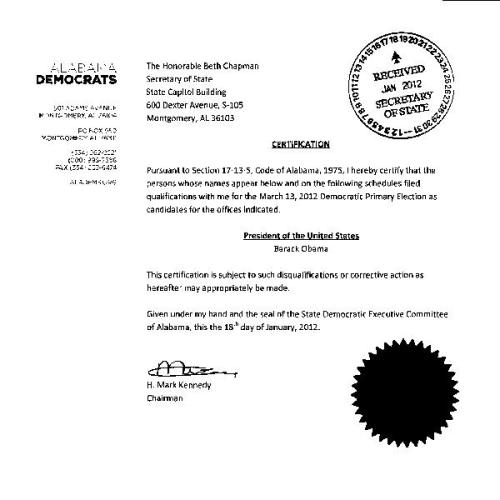
The Alabama Democrat Party made this certification on January 18, 2012.

“CERTIFICATION

Pursuant to Section 17-13-5, Code of Alabama, 1975, I hereby certify that the persons whose names appear below and on the following schedules filed qualifications with me for the March 13, 2012 Democratic Primary Election as candidates for the offices indicated.
President of the United States
Barack Obama

This certification is subject to such disqualifications or corrective action as hereafter may appropriately be made.
Given under my hand and the seal ofthe State Democratic Executive Committee of Alabam

a, this the 18th day of January, 2012.

H. Mark Kennedy Chairman”

http://www.sos.state.al.us/downloads/election/2012/primary/Primary_Candidate_Certification-Democratic_Party-2012-01-18.pdf

ALprimaryCert2012

What part of “qualified” from the statutes or “This certification is subject to such disqualifications or corrective action” do they not understand.

2012 US Presidential Election, Electoral College, Electors, US Constitution, Federal Election Law, State Election Laws, State officers, State Election Officials, Judges, US Supreme Court Justices, Questions and answers

2012 US Presidential Election, Electoral College, Electors, US Constitution, Federal Election Law, State Election Laws, State officers, State Election Officials, Judges, US Supreme Court Justices, Questions and answers

“Our Constitution is in actual operation; everything appears to promise
that it will last; but nothing in this world is certain but death and
taxes.”     Benjamin Franklin

Reprinted from Citizen Wells December 13, 2008.

Presidential Election

ELECTORAL COLLEGE QUESTIONS AND ANSWERS

Q: What is the Electoral College?:

A: The Electoral College was established by the founding fathers
as a compromise between election of the president by Congress and
election by popular vote. The people of the United States vote for
the electors who then vote for the President. Read more

Q: Frequently asked questions:

A: Read more here

Q: Why did the Founding Fathers create the Electoral College?:

A:  The Founding Father’s intent

Here is a quote by Alexander Hamilton who, like many of the founding
fathers, was “afraid a tyrant could manipulate public opinion and come
to power.” Hamilton wrote in the Federalist Papers:

“It was equally desirable, that the immediate election should be made
by men most capable of analyzing the qualities adapted to the station,
and acting under circumstances favorable to deliberation, and to a
judicious combination of all the reasons and inducements which were
proper to govern their choice. A small number of persons, selected by
their fellow-citizens from the general mass, will be most likely to
possess the information and discernment requisite to such complicated
investigations. It was also peculiarly desirable to afford as little
opportunity as possible to tumult and disorder. This evil was not least
to be dreaded in the election of a magistrate, who was to have so
important an agency in the administration of the government as the
President of the United States. But the precautions which have been so
happily concerted in the system under consideration, promise an
effectual security against this mischief.”

Q: What are the state laws governing Electors?:

A: List of states and restrictions on Electors

Q: What are so called “Faithless Electors”?:

A: “The Supreme Court has held that the Constitution does not require
that electors be completely free to act as they choose and therefore,
political parties may extract pledges from electors to vote for the
parties’ nominees. Some State laws provide that so-called “faithless
electors” may be subject to fines or may be disqualified for casting
an invalid vote and be replaced by a substitute elector. The Supreme
Court has not specifically ruled on the question of whether pledges
and penalties for failure to vote as pledged may be enforced under
the Constitution. No elector has ever been prosecuted for failing to
vote as pledged.” Read more here

The US Supreme Court Obviously has not given Electors the option to
violate the US Constitution. Therefore, obviously, if the presidential
candidate is qualified, party pledges and state laws are permissable.

Q: What must an Elector be aware of when voting for a presidential candidate?:

 A: The following are important considerations when casting a vote. Voting
as instructed by a political party, another person, or a state law in
conflict with the US Constitution or Federal Election Laws is a serious
matter. Those not voting in accordance with higher laws are subject to
prosecution and may be guilty of “High Crimes and Misdemeanors.”
High Crimes and Misdemeanors

UNITED STATES ELECTION LAW

“The following provisions of law governing Presidential Elections are contained in Chapter 1 of Title 3, United States Code (62 Stat. 672, as amended):”

“§ 8.   The electors shall vote for President and Vice President, respectively, in the manner directed by the Constitution.”

ARE ELECTORS REQUIRED TO VOTE ACCORDING TO POPULAR VOTE?

“There is no Constitutional provision or Federal law that requires
electors to vote according to the results of the popular vote in
their States. Some States, however, require electors to cast their
votes according to the popular vote. These pledges fall into two
categories—electors bound by State law and those bound by pledges
to political parties.”   (From US National Archives)

SO CALLED “FAITHLESS ELECTORS”

“It turns out there is no federal law that requires an elector to
vote according to their pledge (to their respective party). And so,
more than a few electors have cast their votes without following the
popular vote or their party. These electors are called “faithless
electors.”

In response to these faithless electors’ actions, several states
have created laws to enforce an elector’s pledge to his or her party
vote or the popular vote. Some states even go the extra step to
assess a misdemeanor charge and a fine to such actions. For example,
the state of North Carolina charges a fine of $10,000 to faithless
electors.

It’s important to note, that although these states have created these
laws, a large number of scholars believe that such state-level laws
hold no true bearing and would not survive constitutional challenge.”
Read more here

STATE LAW EXAMPLE: PENNSYLVANIA

“§ 3192. Meeting of electors; duties.
The electors chosen, as aforesaid, shall assemble at the seat
of government of this Commonwealth, at 12 o’clock noon of the
day which is, or may be, directed by the Congress of the United
States, and shall then and there perform the duties enjoined upon
them by the Constitution and laws of the United States
.”

“The mysteries of the Electoral College has enabled Pennsylvania
to play an unusually major role in determining who is President.
In 1796, Thomas Jefferson defeated John Adams in Pennsylvania’s
popular election by only 62 votes, but the Pennsylvania electors
gave Jefferson 14 votes and Adams 1, though Adams did win the
Electoral vote, 71 to 68.” Read more here

ELECTORS HELPED SAVE THE UNION

1860 election: 4 electors in New Jersey, pledged for Stephen Douglas,
voted for Republican candidate Abraham Lincoln.

Q: What happens after the Electoral College vote?:

A: Electoral College procedures

Q: What is the significance of your vote?:

A: The US Constitution clearly gives the states the power
and duties associated with electing a qualified president.
It is also clear that the states have not performed their
duties to ensure that the Electoral College votes will be
for a Qualified candidate. The Electors have a constitutional
duty to perform that supersedes any party contract or state
law. Each day that passes without verification of eligibility
of any candidate being voted for by Electors, brings us closer
to a constitutional crisis. There are pending court cases before
the US Supreme Court and state courts. Congress will meet in
January to count and certify votes and there will certainly be
challenges in Congress. If Congress or the courts shall fail to
do their duty, a Supreme Court Justice will be faced with a
decision to uphold the Constitution. The crisis will increase
in intensity.

Disclaimer: The views expressed in this article are those of the
Citizen Wells blog. Every effort has been made to ensure the
accuracy of the content. Readers are encouraged to visit source
material such as the US Constitution, Federal Election law and
state laws.

Ohio stimulus fraud discovered by inspector general audit, Ohio election fraud revealed by audit?, Ohio 2012 election certification includes absentee and provisional ballots

Ohio stimulus fraud discovered by inspector general audit, Ohio election fraud revealed by audit?, Ohio 2012 election certification includes absentee and provisional ballots

“What do you think a stimulus is? It’s spending – that’s the whole point! Seriously.”…Barack Obama

“An additional 2,735 were cast by people who elections officials believe were not registered in Ohio”…The Columbus Dispatch Nov. 21, 2012

“It’s not who votes that counts, it’s who counts the votes”…Joseph Stalin

From The Columbus Dispatch November 27, 2012.

“$255K in stimulus spending questioned by Ohio inspector general”

“than a quarter million dollars in federal stimulus money administered by a state agency may have been improperly spent, the Ohio inspector general found in a report released today.

The Ohio Department of Job and Family Services Office of Workforce Development “failed to adequately oversee” a $1 million federal grant for a jobs training initiative for southwest Ohio and $255,000 in spending was questioned by the inspector general.

The grant was used to pay cell phone bills, buy gift cards and rent an office from the company – shut down after it didn’t pay taxes – of a man on the board of the agency overseeing the grant, the probe found. The president of the group managing the grant got a salary that would have had her working 15.5 hours a day, seven days a week, investigators discovered. And more than $75,000 in wages were improperly documented.”

http://dispatchpolitics.dispatch.com/content/blogs/the-daily-briefing/2012/11/27-november-2012—odjfs-ig-report.html

After processing over 300,000 absentee and provisional ballots the Ohio 2012 election results were supposed to be certified yesterday, November 27, 2012. Some of the counties checked appear to have completed their counts.

From Citizen Wells November 27, 2012.

“Over 300,000 ballots were being processed recently in Ohio. 204,927 provisional ballots and 119,535 absentee ballots.

http://www2.sos.state.oh.us/pls/enrpublic/f?p=212:52:653548358565003::NO:::

How many provisional ballots were discarded?

The Ohio canvass for vote certification is supposed to end today.

Excessive confusion has abounded in Ohio due to most registered voters being sent absentee ballots and voter registration mismatches. Documented voter fraud and mistakes have been documented in many counties. Will the Ohio audit remedy this?

Here is another example of voter fraud or malfeasance.”

https://citizenwells.wordpress.com/2012/11/27/ohio-canvass-vote-certification-november-27-2012-provisional-ballots-counted-and-counted-correctly-hamilton-county-voter-fraud-double-votes-ohio-audit-trustworthy/

Hopefully the 2012 election audits in Ohio will be as vigilant as the Inspector General.

From Citizen Wells November 22, 2012.

“Ohio Secretary of State Directive 2012-56, 2012 post election audits.

DIRECTIVE 2012-56
November 20, 2012
To: All County Boards of Elections
Directors, Deputy Directors, and Board Members
Re: Post-Election Audits
SUMMARY
In 2009, the previous administration entered into a settlement agreement in the case of League of Women Voters, et al. v. Brunner [formerly Blackwell], N.D. Ohio No. 3:05-cv-7309. As explained in Advisory 2009-09, the League of Women Voters settlement agreement requires that county boards of elections conduct post-election audits of all ballots cast following general elections in even-numbered years and following presidential primary elections.
POST-ELECTION AUDIT PROCEDURES

A. Timeline

Each board of elections must conduct a post-election audit beginning no sooner than six days after the official certification of election results by the board of elections, unless there is an automatic recount (declared by the Board or, in the case of a multi-county district election, declared by the Secretary of State) or the board of elections has received a valid application for a recount. If a recount is conducted, the post-election audit shall begin immediately after the Board certifies the results of the recount. A board of elections must not conduct the audit before the Board’s certification of its official canvass of the election.
The Board must complete the post-election audit between the seventh day after the Board declares its official certification and the 28th day after the Secretary of State declares the official certification in a statewide election.”

https://citizenwells.wordpress.com/2012/11/22/ohio-2012-election-audit-november-20-2012-post-election-audit-procedures-secretary-of-state-directive-2012-56-absentee-military-ballots/


Ohio canvass vote certification November 27, 2012, Provisional ballots counted and counted correctly?, Hamilton County voter fraud double votes, Ohio audit trustworthy?

Ohio canvass vote certification November 27, 2012, Provisional ballots counted and counted correctly?, Hamilton County voter fraud double votes, Ohio audit trustworthy?

“An additional 2,735 were cast by people who elections officials believe were not registered in Ohio”…The Columbus Dispatch Nov. 21, 2012

“Eighty-one voters in Hamilton County, Ohio, cast more than one ballot in the Nov. 6 election, officials said, bringing calls for investigation and prosecution.”...UPI Nov. 21, 2012

“It’s not who votes that counts, it’s who counts the votes”…Joseph Stalin

Over 300,000 ballots were being processed recently in Ohio. 204,927 provisional ballots and 119,535 absentee ballots.

http://www2.sos.state.oh.us/pls/enrpublic/f?p=212:52:653548358565003::NO:::

How many provisional ballots were discarded?

The Ohio canvass for vote certification is supposed to end today.

Excessive confusion has abounded in Ohio due to most registered voters being sent absentee ballots and voter registration mismatches. Documented voter fraud and mistakes have been documented in many counties. Will the Ohio audit remedy this?

Here is another example of voter fraud or malfeasance.

From UPI November  21, 2012.

“Eighty-one voters in Hamilton County, Ohio, cast more than one ballot in the Nov. 6 election, officials said, bringing calls for investigation and prosecution.

The disclosure came as the Hamilton County Board of Elections agreed to count nearly 15,000 provisional and absentee ballots which could potentially change the outcome of several local ballot measures, The Columbus Dispatch reported Wednesday.

Election board staffers reported 63 voters cast both an early absentee ballot and a provisional ballot on Election Day, and 18 others voted twice on Nov. 6, typically by casting a regular vote in one precinct and a provisional ballot in another.

The double votes would not have changed the outcome of any election in Hamilton County, which includes the city of Cincinnati and where 420,000 votes were cast, the newspaper said.

“This is a dangerous situation,” elections board member and county Republican Chairman Alex Triantafilou said, noting 81 people “thought it appropriate to go and vote twice,” a situation meriting a possible referral to the county prosecutor’s office.”

Read more:

http://www.upi.com/Top_News/US/2012/11/21/81-Ohioans-voted-twice-board-discloses/UPI-80351353531538/#ixzz2DRBgqME7

Obama vote changing machines to be examined by FBI, Maryland state delegate Kathryn Afzali, Touchscreen machines suspect in other states, 100 percent Obama votes suspect

Obama vote changing machines to be examined by FBI, Maryland state delegate Kathryn Afzali, Touchscreen machines suspect in other states, 100 percent Obama votes suspect

“An additional 2,735 were cast by people who elections officials believe were not registered in Ohio”…The Columbus Dispatch Nov. 21, 2012

“If the voter turnout in Ohio matches the 2008 level of 67 percent, some 5,226,000 votes would be cast. Under that scenario, 250,000 provisional ballots would amount to 4.8 percent of the entire vote — well over the current difference between the two candidates, according to RealClearPolitics poll average.”…NewsMax Nov. 1, 2012

“It’s not who votes that counts, it’s who counts the votes”…Joseph Stalin

From WND November 26, 2012.

“FBI ASKED TO PROBE OBAMA ‘VOTE-CHANGING’ MACHINES”

“A state lawmaker in Maryland has asked the FBI to impound two voting machines used in the 2012 election to determine whether there was a malfunction or something nefarious going on.

“I just feel it is my duty to try to get to the bottom of this,” state Delegate Kathryn Afzali told WND today.“We’re not making any accusations. The Board of Elections are good people. They have checks and balances … but we want to make sure everything is fair.”

She said a number of people contacted her after the Nov. 6 election to report that they pressed a touch-screen button for GOP candidate Mitt Romney, but the vote registered for Barack Obama.

WND has reported a number of first-hand accounts of similar anomalies during the election. One touch-screen technician reported that voters in another state were getting error messages on their touch-screens when they tried to vote for Romney.

Also, suspiciously, a number of precincts reported a 100-percent vote for Obama, and some even reported beyond 100 percent.

“My request [to the FBI] is … I want them to take these machines. Let an FBI computer expert analyze them,” she said.

She said that among those who contacted her with concerns were two  officials, including a state lawmaker who personally experienced a vote machine changing his vote three times to the party whose agenda he opposed.

The lawmaker told her that his computer background left him confident that the problem was beyond a technical glitch, and he insisted that the election judge take the machine out of service and lock it up.

Another concern was raised by Carroll County Commissioner Richard Rothschild. who said it’s critical that the machines be analyzed properly to determine what happened.

“We need to freeze them in their current state, not wipe out data,” he said.

He said his constituent reported the same scenario as has been reported: hitting the touch-screen button for Romney but finding that that it registered for Obama.

Rothschild said it’s a major problem that has to be addressed in order for Americans to continue trusting their election system.

He said the constituent noticed the vote changes on the summary screen.

“It showed Obama as being selected,” Rothschild told WND, even though his constituent reported voting for the GOP ticket.

“After talking with a few other people, this concern seems to be increasing,” Rothschild told WND. “There are just two possible answers. Either he made a mistake, or something caused that machine to switch the vote.”

He said given that his constituent has experience with computers, the contention that he didn’t know how to use the machine seems a stretch.

“I know how easy it would be to introduce a single spurious line of code,” Rothschild told WND, noting a programmer could easily instruct the machine to change the vote periodically, so a routine test wouldn’t reveal any problems.

He said he was told the county had no jurisdiction over the issue and that it would be up to the state, which is why he discussed the concerns with Afzali.

“It’s very scary,” Rothschild told WND. “It creates a sense of helplessness and hopelessness.”

That, in turn, he said, results in people feeling desperate about their failure to impact government.

“If American people feel they cannot trust their voting system, there’s the possibility of more desperate action,” he said. “There are a number of possibilities [for reaction] in nullifications, secession, including throwing off such governments.

“If people think their voting processes do not work, [if] they conclude they are not being afforded constitutional protections, they may conclude their only option is to throw off such government,” he said.

He said the forensics of voting machine examination would be very important, but a good investigatory review could provide a lot of answers.

“We have all seen little pieces of the problem,” he said.

But to determine what is a problem, he said some sort of overview perspective would be needed.

Not only do authorities need to do a review, future elections need to be done so that every voter is given a printed copy of his or her own vote. The copies could be compiled by clerks to provide a point of reference if questions arise, he said.

Afzali told WND that because she’s on the state elections committee, a number of people came directly to her with their complaints.

She said the two machines that were identified now are locked up with all the other equipment, but she’s asked the FBI step in and take custody of them.

WND previously reported in U.S. Rep. Allen West’s re-election fight in Florida, a surge of thousands of votes went to his opponent late in the evening.

“If we do not have integrity in our election process then we don’ t have the exceptionalism as a constitutional republic, we don’t have a rule of law,” West said.

WND also reported a forensic profiler whose previous cases have included the Natalie Holloway disappearance and the O.J. Simpson double-murder case said Obama is confessing to stealing the 2012 president election.

“Obama appears to unconsciously confess on multiple occasions that in his secret fury he stole the 2012 presidential election – continuing his attacks on our nation,” Andrew G. Hodges, M.D., told WND in an assessment of Obama.”

Read more:

FBI asked to probe Obama ‘vote-changing’ machines

Ohio 2012 election audit, November 20, 2012, Post election audit procedures, Secretary of State Directive 2012-56, Absentee military ballots?

Ohio 2012 election audit, November 20, 2012, Post election audit procedures, Secretary of State Directive 2012-56, Absentee military ballots?

“An additional 2,735 were cast by people who elections officials believe were not registered in Ohio”…The Columbus Dispatch Nov. 21, 2012

“If the voter turnout in Ohio matches the 2008 level of 67 percent, some 5,226,000 votes would be cast. Under that scenario, 250,000 provisional ballots would amount to 4.8 percent of the entire vote — well over the current difference between the two candidates, according to RealClearPolitics poll average.”…NewsMax Nov. 1, 2012

“It’s not who votes that counts, it’s who counts the votes”…Joseph Stalin

Ohio Secretary of State Directive 2012-56, 2012 post election audits.

DIRECTIVE 2012-56
November 20, 2012
To: All County Boards of Elections
Directors, Deputy Directors, and Board Members
Re: Post-Election Audits
SUMMARY
In 2009, the previous administration entered into a settlement agreement in the case of League of Women Voters, et al. v. Brunner [formerly Blackwell], N.D. Ohio No. 3:05-cv-7309. As explained in Advisory 2009-09, the League of Women Voters settlement agreement requires that county boards of elections conduct post-election audits of all ballots cast following general elections in even-numbered years and following presidential primary elections.
POST-ELECTION AUDIT PROCEDURES

A. Timeline

Each board of elections must conduct a post-election audit beginning no sooner than six days after the official certification of election results by the board of elections, unless there is an automatic recount (declared by the Board or, in the case of a multi-county district election, declared by the Secretary of State) or the board of elections has received a valid application for a recount. If a recount is conducted, the post-election audit shall begin immediately after the Board certifies the results of the recount. A board of elections must not conduct the audit before the Board’s certification of its official canvass of the election.
The Board must complete the post-election audit between the seventh day after the Board declares its official certification and the 28th day after the Secretary of State declares the official certification in a statewide election.

B. Observers

The post-election audit must be open to the public and to duly appointed observers. Each board of elections must give public notice of the time and place of the post-election audit in the same manner that the Board notifies the public of a board of elections meeting.

1. Throughout the audit, ballots may be handled only by boards of elections members, directors, deputy directors, or other designated employees of the Board. No other person, including an observer, may handle a ballot under any circumstances.

2. Any entity having appointed observers pursuant to R.C. 3505.21 or 3505.32(B) (referred to herein as “statutory observers”) may appoint observers to the post-election audit no later than five days after the Board gives notice of the date and time of the post-election audit in accordance with this directive. Substitutes may be appointed if notice of substitution is made in writing and filed with the board of elections at least one day before the post-election audit begins.

3. The general public may observe the post-election audit and, to the extent practicable, must be given the same access as statutory observers, subject to the limitations in B4. Observers are permitted to observe the selection process and to observe the count.

4. Depending on the number of individuals who may be appointed or desire to observe the post-election audit and the available resources of the Board (i.e., physical space, number of counting stations, etc.), the Board may limit the number of observers. However, statutory observers must be allowed to participate regardless of Board resources. If the Board must limit the number of observers, at least two members of the general public, randomly selected from those expressing an interest to observe must also be allowed to observe the audit. As a general rule, Boards must do their best to accommodate the
general public to the extent practicable.

5. Representatives of the media are permitted to attend any portion of the post-election audit.

C. Preparations for the Post-Election Audit

1. After Election Day, the Secretary of State will randomly select at least one other statewide contest to be included in the post-election audit in addition to the “top of the ticket” contest (e.g., President). Further, in addition to any contest selected by the Secretary of State, the board of elections must randomly select at least one other contest (candidate contest or question/issue contest), preferably from the universe of all countywide contests, unless circumstances (i.e., no, or only one, countywide contest) necessitate the selection of some other contest. The Board shall exclude any contest in which the number of candidates for that contest (including eligible write-in candidates)
does not exceed the number of candidates to be elected or nominated in that contest.

2. At the time the Board meets to certify the official results of the election (or within ten days of certification, if the Board has already met to certify the official results, the Board should determine whether it will conduct its post-election audit by precinct, by polling place, or by individual voting machine
1 (herein collectively referred to as “units to be  audited”); the date and location that the selection of units to be audited will take place; and the date and place that the audit will commence. It is preferable to audit the smallest unit available to the Board. A Board should conduct a post-election audit by polling
place only if, on Election Day, the voting machines in a multiple-precinct polling place were not precinct-specific (i.e., a voter could cast his or her ballot on any voting machine in the multiple-precinct polling place without regard to the precinct in which the voter was registered to vote).

3. On the date the Board selects the units to be audited, the Board must randomly select a sufficient number of units to be audited until the number of votes cast (machine public count) on all selected units to be audited equals at least 5% of the total number of votes cast for the county (countywide voter turnout).

a. If the Board is auditing by precinct, and the randomly selected precinct’s public count is greater than or equal to 5%, the Board must randomly select an additional precinct to be audited.

b. If the Board is auditing by polling place, and the public count from the selected polling place is greater than or equal to 5%, the Board must randomly select an additional polling place to be audited.
Note: While it is reasonable for the Board to organize its materials and ballots
between the date the selection is made and the date the audit begins (i.e., it
may take time to sort through comingled absentee ballots to segregate those
from the selected precincts, etc.), the Board should both allow observers to be
present during these preparations and should take great care to prevent a preaudit from inadvertently taking place, either in fact or in perception, before the actual audit.

4. In General:

a. When determining the public count, the Board must include all relevant categories of ballots, including regular ballots (VVPAT and/or optical scan paper ballots), counted provisional ballots (whether cast in person before, or on, Election Day), and counted absentee ballots of all types for the precinct or polling place. The Board is permitted to open sealed VVPAT canisters for the purpose of conducting the post-election audit, even if there is not a recount in the precinct.

b. If absentee ballots are accumulated and reported as a single precinct, then the Board must conduct the audit using defined batches of absentee ballots equaling 5% of all absentee ballots cast. If the ballots are not already kept as defined batches, the Board must first batch the ballots into batches of 50 and then randomly select batches equaling 5% of all absentee ballots cast.

c. Selection of units to be audited must be random (meaning that each possible unit to be audited has the same chance of being selected). The Board need not follow any particular method to ensure random selection of units to be audited. The casting of differently colored multi-sided die (with each die representing a different numeral in the precinct number) or drawing numbered slips of paper from a transparent container are both acceptable methods.

d. A board of elections may choose to audit a universe greater than 5%. For contests where the margin is above the statutory threshold for an automatic recount but is close, selecting a greater percentage of ballots to be audited is advisable.

e. Elections records generally are public records and must be available for public inspection, including to observers during a post-election audit. Records that may be of interest to observers, and that should be available for inspection, include documents that show the number of ballots ordered and received by the Board; the number of ballots that were voted, remade, spoiled, and uncounted; the number of absentee and provisional ballots issued, returned, validated, and invalidated; poll worker and board reconciliation sheets; and chain of custody logs.

D. Conducting the Post-Election Audit

This Directive requires the use of either a simple, percentage-based post-election audit or a “risk-limiting audit.” Risk-limiting audits are recommended. For more information about risk-limiting audits, go to http://cuyahogaelectionaudits.com/audit/post-election/risklimiting.
2 If you have questions about risk-limiting audits, please contact Matt Damschroder or Matt Masterson in the Elections Division.

1. The post-election audit must be conducted by teams of elections officials equally divided among the state’s two major political parties (e.g., 2, 4, 6, etc.).

2. A post-election audit team of at least two election officials must compare the total number of votes cast in the contests being audited to the number of voters listed in the poll book, poll list or signature poll book. If more votes appear for a particular contest in a precinct (including precincts contained in multi-precinct polling locations) than the number of marked names in the poll book, poll list or signature poll book (indicating which electors voted, including absentee and provisional voters), such discrepancy must be documented.

3. Ballots must be checked to verify that each contest has been properly identified on the ballot. Observers and members of the public may observe the inspection of the ballots but may not handle ballots.
Note: “Ballot” refers to both:

• A paper ballot that is optically scanned and counted at the precinct polling
place or centrally tabulated, and
• The Voter Verified Paper Audit Trail (VVPAT) produced by any Direct
Recording Electronic (DRE) touch screen voting machine.

4. For each contest to be audited, the Board must physically examine and hand count the ballots for each randomly selected unit to be audited and must hand count the votes cast on the ballots. The Board then must compare the hand count to the recorded electronic summary of the votes contained in the official certification of the votes for that contest in that precinct or polling location. The Board must make a record of the comparison for each precinct (including precincts contained in a polling location if conducting the audit by polling place) included in the post-election audit. The Board shall document this process using the audit reporting work book.
Note: If any comparison of the hand count and official certification tally as noted above results in a difference between the hand count and the official certified tally, the Board must determine if a mistake occurred in the hand count. If the Board determines that no hand-counting mistake occurred, the hand count of the ballots shall be taken to be the accurate count. The Board shall provide written notification to the Secretary of State of any such discrepancy.

5. At the conclusion of the post-election audit, the Board must calculate the individual accuracy rate of each contest included in the audit by taking the sum of any discrepancies for each contest audited and dividing it by the sum of all ballots audited for that contest, then subtracting the resulting number from 100 to return the accuracy rate as a percentage.

Note: The Board should use the absolute value of each discrepancy so that offsetting discrepancies (a one vote gain and a one vote loss) do not net out as zero discrepancies.

6. A county is required to escalate the audit if its accuracy rate is less than 99.5% in a contest with a certified margin that is at least 1% (calculated as a percentage of ballots cast on which the contest appeared), or less than 99.8% in a contest with a certified margin that is smaller than 1%. Escalation entails drawing a second random sample of at least 5% of votes cast, selected from units that were not audited in the original sample, and auditing the ballots (using the same procedures) with respect to any such contest. If, after the second round of auditing, the accuracy rate from the two samples is below 99.5%, the county shall investigate the cause of the discrepancy and report its findings to
the Secretary of State’s Office within the same time for completing the post election audit. In such cases, the Secretary of State’s Office may require a 100% hand-count.

E. Reporting Results after the Post-Election Audit is Complete

If the post-election audit results in change of vote totals reported in the official canvass, the Board shall amend its certification of the official results of the affected contest and submit it to the Secretary of State within the time limits set forth in this directive, in the same manner required for making of the original official declaration of the result of such election, pursuant to R.C. 3505.32(A).
After a board of elections has completed its post-election audit, the Board must file the following with the Secretary of State’s Office:

1. All final results from the audit using the audit reporting work book; and
2. If vote totals in the randomly selected contest change, a certified amended abstract that shows both:

a. The votes cast in each precinct in the county in which the contest was submitted to electors, and
b. The votes of the precincts in which the ballots were audited as shown by the audit documents.

Boards must transmit their post-election audit results no later than five days after completion of the post-election audit to Kathy Malott at the Secretary of State’s Office:

• via fax: (614) 485-7590 (include a cover sheet), or
• via email: kmalott@ohiosecretaryofstate.gov (subject: Post-Election Audit)

If you have any questions regarding this Directive, please contact the Secretary of State election’s attorney assigned to your county at (614) 466-2585.

Sincerely,
Jon Husted

Click to access Dir2012-56.pdf

Citizen Wells: I am conducting my own audit. The vast numbers of provisional ballots generated by sending out so many absentee ballots and by  registered voter status confusion are  a concern. Possibly of more concern is the drop in military absentee votes.