Category Archives: Electoral College

Significance of McInnish V Chapman AL Supreme Court Decision, US Supreme Court ruling?, Justices Moore and Parker clarify state duties, Serious questions about Obama birth certificates

Significance of McInnish V Chapman AL Supreme Court Decision, US Supreme Court ruling?, Justices Moore and Parker clarify state duties, Serious questions
about Obama birth certificates

“Why has Obama, since taking the White House, used Justice Department Attorneys, at taxpayer expense,  to avoid presenting a legitimate birth certificate and college records?”…Citizen Wells

“Moore said he’s seen no convincing evidence that Obama is a “natural born citizen” and a lot of evidence that suggests he is not.”…Judge Roy Moore interview by WND

“Why does a judge swear to discharge his duties agreeably to the
constitution of the United States, if that constitution forms no
rule for his government? if it is closed upon him, and cannot be
inspected by him?”… Marbury versus Madison

Regardless of how this plays out, we have ensconced in writing, on the internet and available for other legal reference and quotation, a document with well
researched dissenting opinions by the AL Chief Justice Moore and Justice Parker regarding the duties and responsibilities of state election officials.
Perhaps just as important is the mention of documentation provided by the Arpaio Zullo investigation raising serious questions about Obama birth
certificates.

Judge Parker wrote:

“(Case no. 1110665.) As I noted in my unpublished special concurrence to this Court’s order striking McInnish’s petition for a writ of mandamus: “McInnish
attached certain documentation to his mandamus petition, which, if presented to the appropriate forum as part of a proper evidentiary presentation, would
raise serious questions about the authenticity of both the ‘short form’ and the ‘long form’ birth certificates of President Obama that have been made
public.”

On March 6, 2012, the Secretary of State was served with McInnish’s petition for a writ of mandamus, including the attached documentation raising questions
about President Obama’s qualifications. That documentation served by McInnish on the Secretary of State was sufficient to put the Secretary of State on
notice and raise a duty to investigate the qualifications of President Obama before including him as a candidate on an Alabama election ballot.”

The McInnish V Chapman case should proceed to the US Supreme Court, the justices should rule and clarify the duties and roles of state election officials.
The poorly reasoned opinions of the consenting justices should be denigrated and the well reasoned, well written and constitutionally sound arguments of
Chief Justice Roy Moore should be upheld. This case, while highlighting eligibility deficiencies of Obama, focuses on the role of the AL Secretary of State,
and that is what the SCOTUS would focus on. The mootness aspect could also be addressed

Mootness could also be addressed by another case before the SCOTUS. Paige V State of Vermont. Central to this case is Obama’s natural born citizen status. If
this case is selected for full court review, we would expect a clarification of the definition of natural born citizen. This is mandatory as even many
constitutional scholars are divided on the definition.

We have in McInnish v Chapman, the most extensive and comprehensive delineation and definition of the duties of Alabama state election officials including
the Secretary of State. Many of us, including Citizen Wells, have addressed this adequately beginning in 2008. Though not rocket science, nor requiring a
legal degree to understand, it was beneficial to have a strong constitutional defender such as Chief Justice Moore to explain it with so much documentation.

To sum up the gist of Chief Justice Moore’s argument which is mine as well. Clearly the responsibility for presidential elections is that of the states up to
the certification of electoral college votes. The US Constitution requires that the president be a natural born citizen. The states are given some leeway in
procedural matters. The state laws and procedures vary considerably. There is no law stating that all presidential candidates must be preemptively
investigated to insure being qualified. However, since only a qualified candidate can legally be elected, it is imperative that the states take all
appropriate measures. The states in general have failed miserably at this. Some states have explicit laws and procedures to remedy a non qualified candidate.
Some have provisions for challenges. New Hampshire requires a natural born citizen certification.

From Justice Bolin:

“I concur with this Court’s no-opinion affirmance of this case. However, I write specially because I respectfully disagree with Chief Justice Moore’s dissent
to the extent that it concludes that the Secretary of State presently has an affirmative duty to investigate the qualifications of a candidate for President
of the United States of America before printing that candidate’s name on the general-election ballot in this State. I fully agree with the desired result;
however, I do not agree that Alabama presently has a defined means to obtain it.”

I read this with a certain amount of incredulity. After pondering it for a while I am wondering if this was intentional. A set up?

There are 2 simple steps that could have been and should have been taken. Immediately contact the AL Attorney General and request guidance. Get clarification
on the definition of natural born citizen and request a certified copy of the birth certificate. You know, one like I have a copy of, a copy of the original
certified by the governing office.

After comparing the ludicrous concuring opinions with the well reasoned, constitutionally sound opinion of Chief Justice Moore, one has to wonder if this was
a set up for the SCOTUS.

On the topic of mootness, I somewhat disagree with Chief Justice Moore as well others on remedies for removal of Obama if he is not qualified. Mootness only applies in the context of state duties since they did end with the electoral college certification. However, the clarification of state duties in AL and the other states is just as if not more important. Impeachment in the general since would apply but not in the presidential removal through congress. If Obama is not qualified he is not president. No ceremony or adulation by brainwashed school children effects that.

If Obama is not qualified, he should immediately be arrested and tried for treason.

Few are willing to state this, but it is the truth.

Of course with the Obama controlled USDOJ this would be tricky.

However, Eric Holder and others in the USDOJ were selected by Obama and perhaps they could be removed first.

Other states and state election officials should take notice. If Obama is proven to be ineligible, many of those officials have committed treason as well. Not to mention enablers like Nancy Pelosi, et al.

I and others contacted NC and other state election officials in 2008 as well as 2012 to warn them of probable Obama eligibility deficiencies. They were warned and have no excuse.

It is on the record now. From a state supreme court.

State election official duties.

Probable Obama eligibility deficiencies.

The results of the Arpaio Zullo investigation now take on more significance.

Florida election corruption bias incompetence, Secretary of State, Judges, Voeltz v Obama treatment obstruction of justice, Obama eligibility case ignored obfuscated and delayed

Florida election corruption bias incompetence, Secretary of State, Judges, Voeltz v Obama treatment obstruction of justice, Obama eligibility case ignored obfuscated and delayed

“Why has Obama, since taking the White House, used Justice Department Attorneys, at taxpayer expense,  to avoid presenting a legitimate birth certificate and college records?”…Citizen Wells

“It is emphatically the province and duty of the judicial
department to say what the law is. Those who apply the rule to
particular cases, must of necessity expound and interpret that
rule. If two laws conflict with each other, the courts must
decide on the operation of each.”

“If then the courts are to regard the constitution; and the
constitution is superior to any ordinary act of the legislature;
the constitution, and not such ordinary act, must govern the
case to which they both apply.”
“The judicial power of the United States is extended to all
cases arising under the constitution. Could it be the intention
of those who gave this power, to say that, in using it, the
constitution should not be looked into? That a case arising
under the constitution should be decided without examining the
instrument under which it arises?  This is too extravagant to
be maintained.”

“Why does a judge swear to discharge his duties agreeably to the
constitution of the United States, if that constitution forms no
rule for his government? if it is closed upon him, and cannot be
inspected by him?”… Marbury versus Madison

“As a general rule the law contemplates the Secretary of State is to accept qualifying instruments from anyone who swears he is eligible and pays the qualifying fees. This rule should not be construed to require the Secretary of State to place the name of a person on the ballot who is obviously not eligible and when such lack of eligibility is known to him as the state’s chief elections officer.”…Justice Boyd, STATE EX REL. SHEVIN v. STONE, FL, August 10, 1972

I was asked recently why I had not included Florida with Alabama and Vermont supreme court challenges to Obama’s eligibility.

The reasons are simple.

First, no eligibility hearing has yet been scheduled for the FL Supreme Court. Why has the Voeltz v Obama eligibility challenge not reached the FL Supreme Court, unlike AL and VT?

Some combination of corruption, bias and incompetence within the executive, judicial and perhaps even legislative bodies of the State of Florida.

Secretary of State duty.

From the Florida statutes.

“97.012 Secretary of State as chief election officer.–The Secretary of State is the chief election officer of the state, and it is his or her responsibility to:

(1) Obtain and maintain uniformity in the interpretation and implementation of the election laws.”

OATH OF OFFICE
(Art. II. § 5(b), Fla. Const.)

“I do solemnly swear (or affirm) that I will support, protect, and defend the Constitution and Government of the United States and of the State of Florida; that I am duly qualified to hold office under the Constitution of the State, and that I will well and faithfully perform the duties of”

THE STATES ARE RESPONSIBLE FOR THE PRIMARIES, GENERAL ELECTION AND EVENTS THROUGH THE ELECTORAL COLLEGE VOTE.

US Constitution
Article II
Section 1

“Each state shall appoint, in such manner as the Legislature thereof may direct, a number of electors, equal to the whole number of Senators and Representatives to which the State may be entitled in the Congress: but no Senator or Representative, or person holding an office of trust or profit under the United States, shall be appointed an elector.”

From page 2 of the Florida “2012 Federal Qualifying Handbook”

“PART II: PRESIDENT AND VICE PRESIDENT

Qualifications

1. Must be a natural born citizen of the United States.
2. Must be at least 35 years of age.
3. Must be a resident of the United States for 14 years.”

“Must be” is not a suggestion.

Florida Election statutes

“Title IX

102.168 Contest of election.–
“(1) Except as provided in s. 102.171, the certification of election or nomination of any person to office, or of the result on any question submitted by referendum, may be contested in the circuit court by any unsuccessful candidate for such office or nomination thereto or by any elector qualified to vote in the election related to such candidacy, or by any taxpayer, respectively.

(2) Such contestant shall file a complaint, together with the fees prescribed in chapter 28, with the clerk of the circuit court within 10 days after midnight of the date the last board responsible for certifying the results officially certifies the results of the election being contested.

(3) The complaint shall set forth the grounds on which the contestant intends to establish his or her right to such office or set aside the result of the election on a submitted referendum. The grounds for contesting an election under this section are:”

“(b) Ineligibility of the successful candidate for the nomination or office in dispute.”

The FL Secretary of State has a ministerial duty in the elections.

Ministerial defined.

Merriam Webster.

a : being or having the characteristics of an act or duty prescribed by law as part of the duties of an administrative office
b : relating to or being an act done after ascertaining the existence of a specified state of facts in obedience to a legal order without exercise of personal judgment or discretion.

Legal dictionary.

“Ministerial describes an act or a function that conforms to an instruction or a prescribed procedure. It connotes obedience. A ministerial act or duty is a function performed without the use of judgment by the person performing the act or duty.”

Obedience is the common denominator. To a legal order or conforming “to an instruction or a prescribed procedure.”

This includes the US Constitution and US Code.

Furthermore.

Justice Boyd in STATE EX REL. SHEVIN v. STONE from August 10, 1972 states:

“As a general rule the law contemplates the Secretary of State is to accept qualifying instruments from anyone who swears he is eligible and pays the qualifying fees. This rule should not be construed to require the Secretary of State to place the name of a person on the ballot who is obviously not eligible and when such lack of eligibility is known to him as the state’s chief elections officer. The burden of litigating the matter should be upon the one seeking to qualify.”

Response from FL elected officials and judges.

From Citizen Wells February 1, 2012.

A  challenger discovered this recently.

“Below and attached is a scanned copy of the letter I just received from the Secretary of State, AKA Florida Supervisor of Elections, in response to the Obama Ballot Challenge I filed 9 January 2012 with him and Attorney General Pam Bundi. The Constitution of the State of Florida (1838) and as amended through 2008 and by adoption of the 2012 Federal Qualifying Handbook (October 2011) the State of Florida has accepted the qualifications for President and Vice President listed therein, based solely on the Certifications of Qualifications from the Political Parties.Read carefully, looks like we have no protection from fraud by either Party. Still waiting for response from the Attorney General.

Vern H. Goding, Ret. OathKeeper.
Melbourne Village, Fl 32904″

Response from Gary Holland, Assistant General Counsel.

“After an election, section 102.168, Florida Statutes, provides that any unsuccessful candidate for the office being sought, any voter qualified to vote in the election, or any taxpayer may file an election contest in the circuit court based upon the successful candidates’s ineligibility for the office sought. Such contest must be brought within 10 days of the date the last board responsibe for certifiying the results officially ceetified the results of the election being contested.”

https://citizenwells.wordpress.com/2012/02/01/fl-primary-opens-door-to-obama-eligibilty-challenge-florida-statutes-allow-contest-10-day-window-circuit-court-obama-natural-born-citizen-deficiency/

Read the entire response from Assistant General Counsel Holland here:

http://obamaballotchallenge.com/sunshine-state-shenanigans

Voeltz v Obama was presented before 2 courts in FL. I will leave it to the reader to decide what combination of corruption, bias and incompetence applies to the judges.

Michael Voeltz filed a contest of election in Leon County Circuit Court on February 15, 2012.

A motion to dismiss from Obama and Secretary of State Ken Detzner was granted by Judge Terry Lewis on June 29, 2012.

The entire response from Judge Lewis will not be evaluated at this time. However, enough of the judge’s suspect reasoning will be presented to raise eyebrows.

Judge Lewis presents a flawed description of Natural Born Citizen and quotes a flawed decision in Akeny v Governor of Indiana. That is scary enough.

The next example is clearly more black and white.

Judge Lewis quotes a small portion of Cherry v Stone from August 4, 1972. This is not the better ruling to quote and not the latest.

From STATE EX REL. SHEVIN v. STONE from August 10, 1972.
“The resign law is not Secretary Stone’s to administer by such a determination, any more than the campaign spending law. His charge under the constitution and statute does not extend to the substance or correctness or enforcement of a sworn compliance with the law — with “matters in pais”, as it were. Once the candidate states his compliance, under oath, the Secretary’s ministerial determination of eligibility for the office is at an end. Any challenge to the correctness of the candidate’s statement of compliance is for appropriate judicial determination upon any challenge properly made, as here.”

Justice Boyd adds

“I agree with the majority opinion disposing of Miller and Wright.

As a general rule the law contemplates the Secretary of State is to accept qualifying instruments from anyone who swears he is eligible and pays the qualifying fees. This rule should not be construed to require the Secretary of State to place the name of a person on the ballot who is obviously not eligible and when such lack of eligibility is known to him as the state’s chief elections officer. The burden of litigating the matter should be upon the one seeking to qualify.

The Attorney General is properly bringing this action as the Attorney for the State. Few matters in a democracy can be of greater importance to the people than those relating to qualifications of candidates for public office.”

From above:

“Once the candidate states his compliance, under oath, the Secretary’s ministerial determination of eligibility for the office is at an end.”

No oath, no written compliance with the law was provided by Obama.

Plaintiff Voeltz took the case to the Second Judicial Circuit Court of Leon County.

On December 20, 2012 Judge Kevin Carroll dismissed the complaint with prejudice.

Judge Carroll states that “the Electoral College met and voted on December 17, 2012.”

“this court cannot now alter the Electoral College process.”

How convenient, the state of FL dragged out this process instead of acting and expediting it.

Judge Carroll also states:

“the Circuit Court of the Second Judicial Circuit, in and for Leon County, Florida does not have jurisdiction to determine the issue of qualification for the Office of President of the United States, particularly at this date in the process.”

Judge Carroll paraphrases “Miracle on 34th Street”, that the US government recognizes Obama as president and again with the element of elapsed time as if that was prohibitive.

Judge Carroll is wrong and should be impeached!

Let’s go through some of the references to the president and candidates in general not being qualified. There are mechanisms in place for removing them from office.

At the state level, the federal government gives the states the power to control elections through the submission of the electoral count to congress.

The State election officials are not prohibited from questioning eligibility.

Even in FL, as noted above:

“Once the candidate states his compliance, under oath, the Secretary’s ministerial determination of eligibility for the office is at an end.”

From 2 southeastern states:

NORTH CAROLINA

NC Statute § 163-114.  Filling vacancies among party nominees occurring after nomination and before election.

“If any person nominated as a candidate of a political party for one of the offices listed below (either in a primary or convention or by virtue of having no opposition in a primary) dies, resigns, or for any reason becomes ineligible or disqualified before the date of the ensuing general election, the vacancy shall be filled by appointment according to the following instructions:
Position

President 

Vacancy is to be filled by appointment of national executive
committee of political party in which vacancy occurs”

GEORGIA

§ 21-2-5.  Qualifications of candidates for federal and state office; determination of qualifications
“(a) Every candidate for federal and state office who is certified by the state executive committee of a political party or who files a notice of candidacy shall meet the constitutional and statutory qualifications for holding the office being sought.

(b) The Secretary of State upon his or her own motion may challenge the qualifications of any candidate at any time prior to the election of such candidate. Within two weeks after the deadline for qualifying, any elector who is eligible to vote for a candidate may challenge the qualifications of the candidate by filing a written complaint with the Secretary of State giving the reasons why the elector believes the candidate is not qualified to seek and hold the public office for which he or she is offering. Upon his or her own motion or upon a challenge being filed, the Secretary of State shall notify the candidate in writing that his or her qualifications are being challenged and the reasons therefor and shall advise the candidate that he or she is requesting a hearing on the matter before an administrative law judge of the Office of State Administrative Hearings pursuant to Article 2 of Chapter 13 of Title 50 and shall inform the candidate of the date, time, and place of the hearing when such information becomes available. The administrative law judge shall report his or her findings to the Secretary of State.”

Electoral college vote.

UNITED STATES CODE

TITLE 3 THE PRESIDENT

Manner of voting

§ 8.   The electors shall vote for President and Vice President, respectively, in the manner directed by the Constitution.

Congress certifies electoral count.

“If any objections to the Electoral College vote are made, they must be submitted in writing and be signed by at least one member of the House and one Senator. If objections are presented, the House and Senate withdraw to their respective chambers to consider their merits under procedures set out in federal law.”

After the certification, the Constitution reveals the protocol for dealing with a president or candidate who is not qualified.

AMENDMENT XX

“Section 1. The terms of the President and Vice President shall
end at noon on the 20th day of January, and the terms of Senators
and Representatives at noon on the 3d day of January,
of the years in which such terms would have ended if this article
had not been ratified; and the terms of their successors shall
then begin.

Section 2. The Congress shall assemble at least once in every
year, and such meeting shall begin at noon on the 3d day of
January, unless they shall by law appoint a different day.

Section 3. If, at the time fixed for the beginning of the term of
the President, the President elect shall have died, the Vice
President elect shall become President. If a President shall not
have been chosen before the time fixed for the beginning of his
term, or if the President elect shall have failed to qualify, then
the Vice President elect shall act as President until a President
shall have qualified; and the Congress may by law provide for the
case wherein neither a President elect nor a Vice President elect
shall have qualified, declaring who shall then act as President,
or the manner in which one who is to act shall be selected, and
such person shall act accordingly until a President or Vice
President shall have qualified.”

AMENDMENT XXV

“Section 1. In case of the removal of the President from office or
of his death or resignation, the Vice President shall become
President.

Section 2. Whenever there is a vacancy in the office of the Vice
President, the President shall nominate a Vice President who shall
take office upon confirmation by a majority vote of both Houses of
Congress.

Section 3. Whenever the President transmits to the President pro
tempore of the Senate and the Speaker of the House of
Representatives his written declaration that he is unable to
discharge the powers and duties of his office, and until he
transmits to them a written declaration to the contrary, such
powers and duties shall be discharged by the Vice President as
Acting President.

Section 4. Whenever the Vice President and a majority of either
the principal officers of the executive departments or of such
other body as Congress may by law provide, transmit to the
President pro tempore of the Senate and the Speaker of the House
of Representatives their written declaration that the President is
unable to discharge the powers and duties of his office, the Vice
President shall immediately assume the powers and duties of the
office as Acting President.

Thereafter, when the President transmits to the President pro
tempore of the Senate and the Speaker of the House of
Representatives his written declaration that no inability exists,
he shall resume the powers and duties of his office unless the
Vice President and a majority of either the principal officers of
the executive department or of such other body as Congress may by
law provide, transmit within four days to the President pro tempore
of the Senate and the Speaker of the House of Representatives their
written declaration that the President is unable to discharge the
powers and duties of his office. Thereupon Congress shall decide
the issue, assembling within forty-eight hours for that purpose if
not in session. If the Congress, within twenty-one days after
receipt of the latter written declaration, or, if Congress is not
in session, within twenty-one days after Congress is required to
assemble, determines by two-thirds vote of both Houses that the
President is unable to discharge the powers and duties of his
office, the Vice President shall continue to discharge the same as
Acting President; otherwise, the President shall resume the powers
and duties of his office.”

As you see, there are laws and procedures in place from early in the nomination process and past inauguration to remedy a president or candidate who is not eligible.

It is a damn shame that we have judges and election officials in Florida and other states who shirk their constitutional duties and make such idiotic statements.

For more information and commentary visit.

http://obamaballotchallenge.com/

http://obamareleaseyourrecords.blogspot.com/

Vermont Supreme Court appeal on Obama natural born citizen status, H. Brooke Paige standing, Attorney Todd Daloz flawed arguments, Standing non issue, Constitution and duties ignored

Vermont Supreme Court appeal on Obama natural born citizen status, H. Brooke Paige standing, Attorney Todd Daloz flawed arguments, Standing non issue, Constitution and duties ignored

“Why has Obama, since taking the White House, used Justice Department Attorneys, at taxpayer expense,  to avoid presenting a legitimate birth certificate and college records?”…Citizen Wells

“Why does a judge swear to discharge his duties agreeably to the
constitution of the United States, if that constitution forms no
rule for his government? if it is closed upon him, and cannot be
inspected by him?”… Marbury versus Madison

“The Elections division protects the integrity of campaigning and elections in Vermont.”…Vermont Secretary of State website

H. Brooke Paige, whose case challenging Obama’s natural born citizen deficiency was rejected by Washington Superior Court Judge Robert Bent on November 2012, appealed his case before the following Vermont Supreme Court Justices on April 23, 2013.

Honorable Paul Reiber, Chief Justice
Honorable John Dooley, Associate Justice
Honorable Marilyn Skoglund, Associate Justice
Honorable Brian Burgess, Associate Justice
Honorable Beth Robinson, Associate Justice

Assistant Attorney General Todd Daloz represented Secretary of State James Condos.

The issue of standing dominated the hearing. Mr. Paige presented a clear definition of natural born citizen. His documentation was minimal. A further analysis of his argument will be provided later.

It is clear that the majority of citizens, including judges, attorneys and politicians do not understand what a Natural Born Citizen is as included in the
Constitution for presidential eligibility.

It is furthermore clear that status quo is passing the buck instead of fulfilling implied and explicit constitutional duties.

It is also clear that Secretary of State James Condos and other secretaries of state and election officials, when confronted by similar challenges about natural born citizen status should have requested clarification from their Attorney Generals and the courts.

Courts have shirked their responsibility, from the US Supreme Court to the state courts.

Marbury v Madison makes this clear.

“It is emphatically the province and duty of the judicial
department to say what the law is. Those who apply the rule to
particular cases, must of necessity expound and interpret that
rule. If two laws conflict with each other, the courts must
decide on the operation of each.”

“If then the courts are to regard the constitution; and the
constitution is superior to any ordinary act of the legislature;
the constitution, and not such ordinary act, must govern the
case to which they both apply.”
“The judicial power of the United States is extended to all
cases arising under the constitution. Could it be the intention
of those who gave this power, to say that, in using it, the
constitution should not be looked into? That a case arising
under the constitution should be decided without examining the
instrument under which it arises?  This is too extravagant to
be maintained.”

“Why does a judge swear to discharge his duties agreeably to the
constitution of the United States, if that constitution forms no
rule for his government? if it is closed upon him, and cannot be
inspected by him?

Assistant Attorney General Todd Daloz makes the argument that Secretary of State James Condos has no power or duty to vet a candidate.

Oh really?

The states are responsible for the primaries, general election and events leading up to the Electoral College vote.

US Constitution
Article II
Section 1

“Each state shall appoint, in such manner as the Legislature thereof may direct, a number of electors, equal to the whole number of Senators and
Representatives to which the State may be entitled in the Congress: but no Senator or Representative, or person holding an office of trust or profit under
the United States, shall be appointed an elector.”

Manner of voting

§ 8. The electors shall vote for President and Vice President, respectively, in the manner directed by the Constitution.

All state election officials swear an oath to uphold or defend the US Constitution.

Article VI of the US Constitution.

“The Senators and Representatives before mentioned, and the Members of the several State Legislators, and all executive and judicial Officers, both of the
United States and of the several States, shall be bound by Oath or Affirmation, to support this Constitution;”

Some states explicitly provide for challenges by the secretary of state.

GEORGIA CODE
“*** Current Through the 2012 Regular Session ***

TITLE 21. ELECTIONS
CHAPTER 2. ELECTIONS AND PRIMARIES GENERALLY
ARTICLE 1. GENERAL PROVISIONS

O.C.G.A. § 21-2-5 (2012)

§ 21-2-5. Qualifications of candidates for federal and state office; determination of qualifications
(a) Every candidate for federal and state office who is certified by the state executive committee of a political party or who files a notice of candidacy
shall meet the constitutional and statutory qualifications for holding the office being sought.

(b) The Secretary of State upon his or her own motion may challenge the qualifications of any candidate at any time prior to the election of such candidate.
Within two weeks after the deadline for qualifying, any elector who is eligible to vote for a candidate may challenge the qualifications of the candidate by
filing a written complaint with the Secretary of State giving the reasons why the elector believes the candidate is not qualified to seek and hold the public
office for which he or she is offering. Upon his or her own motion or upon a challenge being filed, the Secretary of State shall notify the candidate in
writing that his or her qualifications are being challenged and the reasons therefor and shall advise the candidate that he or she is requesting a hearing on
the matter before an administrative law judge of the Office of State Administrative Hearings pursuant to Article 2 of Chapter 13 of Title 50 and shall inform the candidate of the date, time, and place of the hearing when such information becomes available. The administrative law judge shall report his or her findings to the Secretary of State.

(c) The Secretary of State shall determine if the candidate is qualified to seek and hold the public office for which such candidate is offering. If the
Secretary of State determines that the candidate is not qualified, the Secretary of State shall withhold the name of the candidate from the ballot or strike
such candidate’s name from the ballot if the ballots have been printed. If there is insufficient time to strike the candidate’s name or reprint the ballots,
a prominent notice shall be placed at each affected polling place advising voters of the disqualification of the candidate and all votes cast for such
candidate shall be void and shall not be counted.”

Explicit or implied,

Secretary of State James Condos took an oath to uphold the US Constitution.

One of the justices asked if all of the state election officials should be required to vet all of the candidates. That was not the question at hand.

In this case, the Vermont Secretary of State was notified of the problem and refused to act.

Once again, an American courtroom, despite the caution from Marybury v Madison, shirked their duty and tried their best to make this about standing.

Standing is a non issue in this case and they damn well know it!

In fact, at least one justice questioned this.

There are at least 3 reasons why H. Brooke Paige has standing.

1. Vermont election statutes clearly give him standing as a voter. Mr. Paige complied with the protocol.

2. Ruling from a lower court, the Superior Court.

3. The Tenth Amendment. If their argument is that the state does not have the power to challenge, then any citizen does.

Tenth Amendment

The powers not delegated to the United States by the Constitution, nor prohibited by it to the states, are reserved to the states respectively, or to the
people.

Attorney Daloz tries to obfuscate and minimize the VT elections statutes in regard to Mr. Paige having standing.

Quite the contrary. They are crystal clear.

§ 2603. Contest of elections

“(a) The result of an election for any office, other than for the general assembly, or public question may be contested by any legal voter entitled to vote on the office or public question to be contested.

(b) A contest is initiated by filing a complaint with a superior court alleging:

(1) that errors were committed in the conduct of the election or in count or return of votes, sufficient to change the ultimate result;

(2) that there was fraud in the electoral process, sufficient to change the ultimate result; or

(3) that for any other reason, the result of the election is not valid.

(c) The complaint shall be filed within 15 days after the election in question, or if there is a recount, within 10 days after the court issues its judgment on the recount. In the case of candidates for state or congressional office, for a presidential election, or for a statewide public question, the complaint shall be filed with the superior court, Washington County. In the case of any other candidate or public question, the complaint shall be filed with the superior court in any county in which votes were cast for the office or question being challenged.

(d) The Vermont Rules of Civil Procedure shall apply to contests of elections, except that such cases shall be placed upon a special calendar, and hearings shall be scheduled on a priority basis, as public policy demands that such questions be resolved promptly.

(e) After hearing, the court shall issue findings of fact and a judgment, which shall supersede any certificate of election previously issued. If the court finds just cause, the court shall grant appropriate relief, which may include, without limitation, ordering a recount, or ordering a new election. If during the hearing the court receives credible evidence of criminal conduct, the court shall order a transcript of all or part of the testimony to be forwarded to the proper state’s attorney. If a new election is ordered, the court shall set a date for it, after consulting with the secretary of state; in ordering a new election, the court shall have authority to issue appropriate orders, either to provide for special cases not covered by law, or to supersede provisions of law which may conflict with the needs of the particular situation.

(f) The court shall send a certified copy of its findings of fact and judgment to the secretary of state.”

Here are segments from the court proceedings that relate to Mr. Paige’s argument and compliance and attorney Daloz attempting to prove that Mr. Paige has no standing. Attorney Daloz even further tries to dilute the standing issue by implying that congress should be the arbiter. The states control the election process until the certification of the electoral votes by congress. Only then can congress question eligibility. They have failed to do so.

The entire proceedings can be heard here.

Mr. Paige’s inaccurate statements about Obama’s birth certificate will for the moment be assumed to be based on ignorance and not agenda. This will be explored later.

Florida military absentee ballot not counted, Non matching signature most common reason, Marine recruit Wesley Layman Clemons disenfranchised, FL election controversies

Florida military absentee ballot not counted, Non matching signature most common reason, Marine recruit Wesley Layman Clemons disenfranchised, FL election controversies

“Late last night Congressman West maintained a district wide lead of nearly 2000 votes until the St. Lucie County Supervisor of Elections “recounted” thousands of early ballots. Following that “recount” Congressman West trailed by 2,400 votes. In addition, there were numerous other disturbing irregularities reported at polls across St. Lucie County including the doors to polling places being locked when the polls closed in direct violation of Florida law, thereby preventing the public from witnessing the procedures used to tabulate results. The St. Lucie County Supervisor of Elections office clearly ignored proper rules and procedures, and the scene at the Supervisor’s office last night could only be described as complete chaos. Given the hostility and demonstrated incompetence of the St. Lucie County Supervisor of Elections, we believe it is critical that a full hand recount of the ballots take place in St. Lucie County. We will continue to fight to ensure every vote is counted properly and fairly, and accordingly we will pursue all legal means necessary.”…Allen West campaign

“Freedom is the freedom to say that two plus two make four. If that is granted, all else follows.”…George Orwell, “1984″

“It’s not who votes that counts, it’s who counts the votes”…Joseph Stalin

The 2012 Florida presidential election was very close. So was Allen West’s congressional race.

The known issues in the Florida elections should be reason enough for a recount and investigation.

Documented voter fraud, sloppy precinct operations, violation of rules, hundreds of ballots found in a warehouse, over 800,000 undocumented aliens and realistic cause for concern about absentee military ballots.

From the Orlando Sentinel December 11, 2012.

“1,400 absentee ballots rejected for bad signatures in Central Florida”

“Marine recruit Wesley Layman Clemons thought he’d done everything possible to vote while he was in training at U.S. Marine Corps Recruit Depot Parris Island in South Carolina this fall. He requested an Orange County absentee ballot, filled it out, signed it, sealed it, stamped it and mailed it.

Tuesday, he found out from a reporter that his ballot was thrown out — and his vote didn’t count in the Nov. 6 election. The reason: His signature on the ballot didn’t match an earlier one that was on file in the election office, a problem that caused more than 1,400 ballots to be rejected across Central Florida this fall.

“I did my so-called patriotic duty and voted, but apparently someone didn’t think it was a legitimate vote … ,” said Clemons, who is 23 and returned to Orlando last month after a medical discharge. “I’m just ready to toss this phone through the freakin’ window. …”

Clemons said his signature has never changed, and he’s stumped as to why the county’s canvassing board would think otherwise. But it’s too late to do anything about it.

He’s one of 603 Orange County voters whose absentee ballots were rejected by the three-member canvassing board in the Nov. 6 election because of non-matching signatures. Another 579 absentee signatures were rejected in Seminole County, 159 in Osceola County and 142 in Lake County.

A non-matching signature was by far the most common reason for absentee ballot rejection, say Central Florida election officials. The next most common: the failure to sign the ballot at all, which disqualified 672 more ballots in the four counties.

Though the numbers of rejected signatures are relatively small — the four counties received more than 246,000 absentee ballots for the November election, a record — the rejection rate here and elsewhere has climbed dramatically since new statewide rules regarding absentee-ballot signatures were approved by the Florida Legislature in 2011.

Those rules require elections officials to compare absentee-ballot signatures only to signatures on voter-registration applications, which could be decades old. Previously, elections officials could turn to other documents such as the precinct logs that voters sign each time they vote in person, which likely are far more current.

Elections officials insist close calls are not rejected. They must be “clearly, clearly, clearly different,” said Seminole County Supervisor of Elections Mike Ertel, who also sat on his county’s canvassing board.

“You could tell when people were just getting fancy” with their signature, said Orange County Canvassing Board member Tiffany Moore Russell, a county commissioner. “But the majority were just obvious.”

In 2008, the last time there was a presidential election, Orange’s canvassing board rejected 15 out of every 10,000 signatures. This year, the rate tripled — to 44 out of every 10,000. Seminole’s board rejected 65 out of every 10,000 in 2008 and 110 out of 10,000 this year.

Osceola and Lake counties’ 2008 rejection rates were not available. But Lake’s 2012 absentee-ballot signature rejection rate doubled its rate in the 2010 state election, and Osceola’s tripled.

Depending on where the voters lived, their rejected votes could have made a difference. In the Orange County Commission District 3 race, Pete Clarke beat Lui Damiani by 70 votes. In the Florida House of Representatives race in Seminole County, Mike Clelland defeated Chris Dorworth by 146 votes.

Moore Russell, a Democrat, said she didn’t see any problem that needed a fix by lawmakers.

“People didn’t update their signature,” Moore Russell said. “At the end of the day, there has to be some responsibility on that voter to update their signatures. You can’t legislate responsibility.”

Philip Kobrin, for one, doesn’t disagree. Kobrin, 76 and retired, of Winter Park, said he went down to the elections office to check after he was informed his absentee ballot was rejected. He realized then that he had signed his voter-registration application with his usual stylized script and his absentee ballot with careful lettering so that it would be legible.

“I must take half the blame for myself,” Kobrin said. “When they showed it to me, I wasn’t happy about it, but they had a legitimate beef.”

After the new law passed, elections officials in many counties tried hard to contact voters and ask them to renew their signatures. Orange County Supervisor of Elections Bill Cowles sent notices last spring to 214,000 absentee and longtime voters urging them to do so. Though some voters protested, thinking he was demanding new proof of their eligibility, 55,000 voters renewed their signatures, Cowles said.

But it was not enough.

Audrey McWhite said her elderly mother, Elizabeth, has suffered a trio of strokes, two this year. The last one disabled her right side. Elizabeth McWhite’s Nov. 6 ballot was rejected, according to Orange elections officials.

“That’s why her signature is off,” Audrey McWhite said. “They should call and find out and not just reject it like that.””

http://www.orlandosentinel.com/news/politics/os-absentee-ballots-thrown-out-20121211,0,6699784.story

Alabama Obama eligibility challenge, AL election statutes Section 17-13-6, Only qualified candidates to be listed on ballots, Democrat party certified Obama, Judge Roy Moore

Alabama Obama eligibility challenge, AL election statutes Section 17-13-6, Only qualified candidates to be listed on ballots, Democrat party certified Obama,  Judge Roy Moore

“Why has Obama, since taking the White House, used Justice Department Attorneys, at taxpayer expense,  to avoid presenting a legitimate birth certificate and college records?”…Citizen Wells

“Why do state election officials continue to ignore the US Constitution, federal election code and their own state election statutes?”…Citizen Wells

“Why does a judge swear to discharge his duties agreeably to the constitution of the United States, if that constitution forms no rule for his government? if it is closed upon him, and cannot be inspected by him?”… Marbury versus Madison

From Obama Ballot Challenge October 30, 2012.

“Two Motions were filed on October 18, 2012 with the first being Alabama’s Democratic Party Motion to Intervene (MTI). Make special note of Item 5 in the Motion—The Alabama Secretary of State does not object to this motion to intervene. (See link to Motion to Intervene below)

The Alabama Democratic Committee MTI argues their nominee, Mr. Obama, is “eligible, qualified and entitled” to gain access to the taxpayer supported Alabama ballot and that Alabama’s Secretary of State “does not have a duty to independently investigate the qualifications of candidates nominated by the political parties.” Their motion wouldn’t be complete without the usual “pontification on high” that their candidate’s questionable natural born citizenship status is based on “discredited conspiracy theories and outlandish claims of fraudulent and forged birth certificates.”

Attorney General Strange filed the second motion which was a Motion to Dismiss (MTD). Strange offers the following arguments:

The Secretary of State has no legal duty to investigate the qualifications of a candidate;
In regard to candidates for President, the authority to adjudge qualifications rests with Congress;
Plaintiffs have failed to join necessary parties; and
Plaintiffs’ claim is filed too late.
According to Strange the Secretary of State aka the Chief Election Officer for the state of Alabama holds no responsibility whatsoever to ensure any and/or all presidential candidates working to gain access to Alabama’s electorate meet the necessary constitutional qualifications to be on their state ballot. (See link to Defendant’s Motion to Dismiss below)

Plaintiffs’ responded to Defendant’s Motion to Dismiss on October 24, 2012 by reiterating their Motion for Summary Judgment filed on or about October 15, 2012 “in which Plaintiffs submitted sworn affidavits that set forth evidence demonstrating that Barack H. Obama is not eligible to serve as President of the United States.” These sworn affidavits are from Sheriff Joseph Arpaio, Maricopa County, Arizona and Lead Investigator Mike Zullo, Maricopa County’s Cold Case Posse unit (see link Response to Motion to Dismiss below).

Plaintiff argues that it is clearly the legal duty of Alabama’s Chief Election Officer to “verify the eligibility of those seeking office” and when eligibility of a candidate comes into question it is their responsibility to verify and remove said party from the ballot if necessary. A recent Opinion by Alabama’s Attorney General cited by the plaintiff states –

“The Secretary of state does not have an obligation to evaluate all of the Qualifications of the nominees of political parties and independent candidates for state offices prior to certifying such nominees and candidates to the probate judges pursuant to sections1 7-7-l and l7-16-40 of the Code of Alabama. If the Secretary of State has knowledge gained from an official source arising from the performance of duties prescribed by law, that a candidate has not met a certifying qualification [such as a candidate’s failure to file a public statement of Economic Interest], the Secretary of State should not certify the candidate.”

Clearly the sworn affidavits from Arpaio and Zullo serve as an “official source” placing into doubt at least the certifying qualifications necessary for Mr. Obama to gain access to the Alabama general election ballot. As for the remaining presidential candidates, no such “official source” has presented itself challenging their certifying qualifications.

The Plaintiff’s conclude “It is time — finally — to ensure that the person we are entrusting the highest and most powerful office of our country is eligible to serve for that office. The issue of eligibility has become a political hot potato, in effect a sticky matter for judges and courts around the nation. But the rule of law must eventually govern, without regard to politics, and cannot and should not be sidestepped through legally convenient and politically correct court rulings which ignore the plain language of the U.S. Constitution.””

http://obamaballotchallenge.com/alabamas-goode-mcinnish-v-chapman-ballot-challenge-case-update

From Judge Roy Moore.

“Judge Roy Moore will be having his Investiture (swearing in ceremony) at the Judicial Building in Montgomery on January 11 at 1:30 PM. If you would like to come I need you to give me your name and address so I can send you the ticket and info. Feel free to message me….Thanks!”

https://www.facebook.com/JudgeRoyMoore

Will newly elected AL Chief Justice Roy Moore review this case?

Let’s review Alabama election statutes.

From above:

“According to Strange the Secretary of State aka the Chief Election Officer for the state of Alabama holds no responsibility whatsoever to ensure any and/or all presidential candidates working to gain access to Alabama’s electorate meet the necessary constitutional qualifications to be on their state ballot.”

“Section 17-13-6

Only qualified candidates to be listed on ballots.
The name of no candidate shall be printed upon any official ballot used at any primary election unless such person is legally qualified to hold the office for which he or she is a candidate and unless he or she is eligible to vote in the primary election in which he or she seeks to be a candidate and possesses the political qualifications prescribed by the governing body of his or her political party.”

Legally qualified means as defined by the US Constitution, US election code and Alabama election statutes.

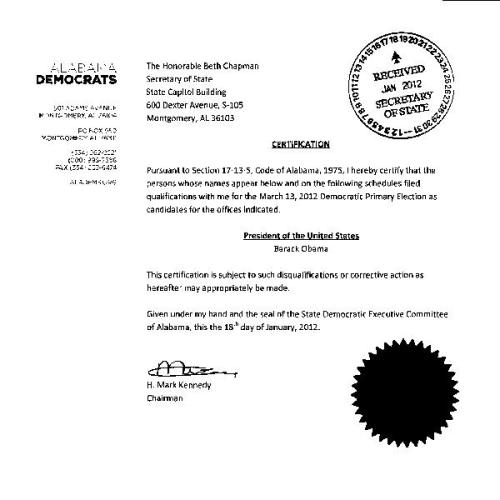
The Alabama Democrat Party made this certification on January 18, 2012.

“CERTIFICATION

Pursuant to Section 17-13-5, Code of Alabama, 1975, I hereby certify that the persons whose names appear below and on the following schedules filed qualifications with me for the March 13, 2012 Democratic Primary Election as candidates for the offices indicated.
President of the United States
Barack Obama

This certification is subject to such disqualifications or corrective action as hereafter may appropriately be made.
Given under my hand and the seal ofthe State Democratic Executive Committee of Alabam

a, this the 18th day of January, 2012.

H. Mark Kennedy Chairman”

http://www.sos.state.al.us/downloads/election/2012/primary/Primary_Candidate_Certification-Democratic_Party-2012-01-18.pdf

ALprimaryCert2012

What part of “qualified” from the statutes or “This certification is subject to such disqualifications or corrective action” do they not understand.

Judge Roy Moore swearing in ceremony Judicial Building Montgomery Alabama January 11, 2013, AL Supreme Court Chief Justice Moore to hear Obama eligibility challenge?, Secretary of State Beth Chapman

Judge Roy Moore swearing in ceremony Judicial Building Montgomery Alabama January 11, 2013, AL Supreme Court Chief Justice Moore to hear Obama eligibility challenge?, Secretary of State Beth Chapman

“Why has Obama, since taking the White House, used Justice Department Attorneys, at taxpayer expense,  to avoid presenting a legitimate birth certificate and college records?”…Citizen Wells

“Barack Obama, show me the college loans.”…Citizen Wells

“Why does a judge swear to discharge his duties agreeably to the
constitution of the United States, if that constitution forms no
rule for his government? if it is closed upon him, and cannot be
inspected by him?”… Marbury versus Madison

Will the newly elected Alabama Supreme Court Chief Justice Roy Moore review the recently dismissed Obama eligibility challenge filed against AL Secretary of State Beth Chapman?

From Judge Roy Moore.

“Judge Roy Moore will be having his Investiture (swearing in ceremony) at the Judicial Building in Montgomery on January 11 at 1:30 PM. If you would like to come I need you to give me your name and address so I can send you the ticket and info. Feel free to message me….Thanks!”

“Just found out that in the race for Chief Justice the largest vote spread ever to win was Judge Moore in 2000 with 152,000 votes and the second largest was Tuesday when Judge Moore won by 80,000 votes! “Moore’s victory was part of a Republican sweep of statewide offices in Alabama on Tueday. It was the 1st time since the post-Civil War Reconstruction even in the late 19th century that Democrats were shut out of office on the state level”. (Reuters)”

http://www.facebook.com/JudgeRoyMoore

From WND December 9, 2012.

“A longstanding eligibility case challenging Barack Obama’s presence in the White House soon could be headed to the state Supreme Court in Alabama, where one justice already in a court filing has questioned the authenticity of Obama’s documentation, and the incoming chief justice is a dyed-in-the-wool Constitution supporter with little tolerance for those who want to bypass the document.

The move is pending in an eligibility challenge brought by Hugh McInnish and others against the Alabama Secretary of State Beth Chapman.

The case most recently was turned down by a state district judge, Eugene Reese, who got his opinion into the mix by determining that the case was “ordered, adjudged and decreed” to be dismissed.

The case calls for a determination that Chapman “has a duty to verify the eligibility of those seeking office.”

In a recent brief in the case, attorney Larry Klayman, founder of Judicial Watch and now of the Klayman Law Firm in Washington, noted that while the state is arguing it should not be tasked with making sure candidates are eligible, the submission by the state itself suggests otherwise.

“[An attorney general’s opinion] is not case precedent binding on this court … Nevertheless, it constitutes an admission by Alabama’s chief law enforcement officer on behalf of the state that if the Secretary of State has knowledge gained from an official source about a candidate’s eligibility then she ‘should not’ certify the candidate.”

The issue is the conflict over the requirements of the U.S. Constitution, which demands, “No Person except a natural born citizen, or a citizen of the United States, at the time of the adoption of this Constitution, shall be eligible to the office of president…”

While Obama’s campaign first released a representation of a short-form birth document from Hawaii, and the White House later officially posted online a representation of a long-form certificate, the authenticity of both of those documents has been questioned.

A special Cold Case Posse assembled by Maricopa County, Ariz., Sheriff Joe Arpaio concluded that the long-form document was a fabricated image built on a computer.

At last word, it was investigating the possibility of forgery and fraud charges.

“Plaintiffs have shown, backed by sworn affidavits from an ‘official source,’ Sheriff Joseph M. Arpaio and his investigator, Mike Zullo, that Barack H. Obama is not a natural born citizen eligible to be president. … There is credible evidence that Mr. Obama was not born within the United States and that his birth certificate or other identifying documents are fraudulent,” Klayman argued.

For one thing, a publisher promoting Obama as an author for years promoted in a biography of Obama that he was a native Kenyan.

“The secretary of state, having the power to certify candidates, can surely de-certify – in effect disqualify – them if they are found to be ineligible. Mr. Obama proceeded at his own risk. He defrauded the people of the state of Alabama as well as the other voters in this country, and incredibly has served an entire presidential term without once having to prove that he was indeed a natural born citizen, despite all the evidence to the contrary,” the plaintiffs argued.

The brief said even though the dispute is a “hot potato,” “the rule of law must eventually govern, without regard to politics, and cannot and should not be sidestepped through legally convenience and politically correct court rulings which ignore the plain language of the U.S. Constitution.”

But many court cases have made such arguments, and have prompted dismissals by “hot potato”-wary judges.

This one, should it appear before the state Supreme Court as Klayman plans, would be before a panel where one judge at an earlier step in the case already has raised doubts about Obama’s authenticity.

It was when the majority of the high court denied a petition filed by McInnish seeking to require an original copy of Obama’s birth certificate before the sitting president would be allowed on the state’s ballot this year, Justice Tom Parker filed a special, unpublished concurrence in the case arguing that McInnish’s charges of “forgery” were legitimate cause for concern.”

Read more:

http://www.wnd.com/2012/12/2nd-bite-to-challenge-obamas-eligibility/#RO5MOEVeWM15k3XV.99


Thanks to commenter observer

2012 US Presidential Election, Electoral College, Electors, US Constitution, Federal Election Law, State Election Laws, State officers, State Election Officials, Judges, US Supreme Court Justices, Questions and answers

2012 US Presidential Election, Electoral College, Electors, US Constitution, Federal Election Law, State Election Laws, State officers, State Election Officials, Judges, US Supreme Court Justices, Questions and answers

“Our Constitution is in actual operation; everything appears to promise
that it will last; but nothing in this world is certain but death and
taxes.”     Benjamin Franklin

Reprinted from Citizen Wells December 13, 2008.

Presidential Election

ELECTORAL COLLEGE QUESTIONS AND ANSWERS

Q: What is the Electoral College?:

A: The Electoral College was established by the founding fathers
as a compromise between election of the president by Congress and
election by popular vote. The people of the United States vote for
the electors who then vote for the President. Read more

Q: Frequently asked questions:

A: Read more here

Q: Why did the Founding Fathers create the Electoral College?:

A:  The Founding Father’s intent

Here is a quote by Alexander Hamilton who, like many of the founding
fathers, was “afraid a tyrant could manipulate public opinion and come
to power.” Hamilton wrote in the Federalist Papers:

“It was equally desirable, that the immediate election should be made
by men most capable of analyzing the qualities adapted to the station,
and acting under circumstances favorable to deliberation, and to a
judicious combination of all the reasons and inducements which were
proper to govern their choice. A small number of persons, selected by
their fellow-citizens from the general mass, will be most likely to
possess the information and discernment requisite to such complicated
investigations. It was also peculiarly desirable to afford as little
opportunity as possible to tumult and disorder. This evil was not least
to be dreaded in the election of a magistrate, who was to have so
important an agency in the administration of the government as the
President of the United States. But the precautions which have been so
happily concerted in the system under consideration, promise an
effectual security against this mischief.”

Q: What are the state laws governing Electors?:

A: List of states and restrictions on Electors

Q: What are so called “Faithless Electors”?:

A: “The Supreme Court has held that the Constitution does not require
that electors be completely free to act as they choose and therefore,
political parties may extract pledges from electors to vote for the
parties’ nominees. Some State laws provide that so-called “faithless
electors” may be subject to fines or may be disqualified for casting
an invalid vote and be replaced by a substitute elector. The Supreme
Court has not specifically ruled on the question of whether pledges
and penalties for failure to vote as pledged may be enforced under
the Constitution. No elector has ever been prosecuted for failing to
vote as pledged.” Read more here

The US Supreme Court Obviously has not given Electors the option to
violate the US Constitution. Therefore, obviously, if the presidential
candidate is qualified, party pledges and state laws are permissable.

Q: What must an Elector be aware of when voting for a presidential candidate?:

 A: The following are important considerations when casting a vote. Voting
as instructed by a political party, another person, or a state law in
conflict with the US Constitution or Federal Election Laws is a serious
matter. Those not voting in accordance with higher laws are subject to
prosecution and may be guilty of “High Crimes and Misdemeanors.”
High Crimes and Misdemeanors

UNITED STATES ELECTION LAW

“The following provisions of law governing Presidential Elections are contained in Chapter 1 of Title 3, United States Code (62 Stat. 672, as amended):”

“§ 8.   The electors shall vote for President and Vice President, respectively, in the manner directed by the Constitution.”

ARE ELECTORS REQUIRED TO VOTE ACCORDING TO POPULAR VOTE?

“There is no Constitutional provision or Federal law that requires
electors to vote according to the results of the popular vote in
their States. Some States, however, require electors to cast their
votes according to the popular vote. These pledges fall into two
categories—electors bound by State law and those bound by pledges
to political parties.”   (From US National Archives)

SO CALLED “FAITHLESS ELECTORS”

“It turns out there is no federal law that requires an elector to
vote according to their pledge (to their respective party). And so,
more than a few electors have cast their votes without following the
popular vote or their party. These electors are called “faithless
electors.”

In response to these faithless electors’ actions, several states
have created laws to enforce an elector’s pledge to his or her party
vote or the popular vote. Some states even go the extra step to
assess a misdemeanor charge and a fine to such actions. For example,
the state of North Carolina charges a fine of $10,000 to faithless
electors.

It’s important to note, that although these states have created these
laws, a large number of scholars believe that such state-level laws
hold no true bearing and would not survive constitutional challenge.”
Read more here

STATE LAW EXAMPLE: PENNSYLVANIA

“§ 3192. Meeting of electors; duties.
The electors chosen, as aforesaid, shall assemble at the seat
of government of this Commonwealth, at 12 o’clock noon of the
day which is, or may be, directed by the Congress of the United
States, and shall then and there perform the duties enjoined upon
them by the Constitution and laws of the United States
.”

“The mysteries of the Electoral College has enabled Pennsylvania
to play an unusually major role in determining who is President.
In 1796, Thomas Jefferson defeated John Adams in Pennsylvania’s
popular election by only 62 votes, but the Pennsylvania electors
gave Jefferson 14 votes and Adams 1, though Adams did win the
Electoral vote, 71 to 68.” Read more here

ELECTORS HELPED SAVE THE UNION

1860 election: 4 electors in New Jersey, pledged for Stephen Douglas,
voted for Republican candidate Abraham Lincoln.

Q: What happens after the Electoral College vote?:

A: Electoral College procedures

Q: What is the significance of your vote?:

A: The US Constitution clearly gives the states the power
and duties associated with electing a qualified president.
It is also clear that the states have not performed their
duties to ensure that the Electoral College votes will be
for a Qualified candidate. The Electors have a constitutional
duty to perform that supersedes any party contract or state
law. Each day that passes without verification of eligibility
of any candidate being voted for by Electors, brings us closer
to a constitutional crisis. There are pending court cases before
the US Supreme Court and state courts. Congress will meet in
January to count and certify votes and there will certainly be
challenges in Congress. If Congress or the courts shall fail to
do their duty, a Supreme Court Justice will be faced with a
decision to uphold the Constitution. The crisis will increase
in intensity.

Disclaimer: The views expressed in this article are those of the
Citizen Wells blog. Every effort has been made to ensure the
accuracy of the content. Readers are encouraged to visit source
material such as the US Constitution, Federal Election law and
state laws.

Ohio 2012 election audit, November 20, 2012, Post election audit procedures, Secretary of State Directive 2012-56, Absentee military ballots?

Ohio 2012 election audit, November 20, 2012, Post election audit procedures, Secretary of State Directive 2012-56, Absentee military ballots?

“An additional 2,735 were cast by people who elections officials believe were not registered in Ohio”…The Columbus Dispatch Nov. 21, 2012

“If the voter turnout in Ohio matches the 2008 level of 67 percent, some 5,226,000 votes would be cast. Under that scenario, 250,000 provisional ballots would amount to 4.8 percent of the entire vote — well over the current difference between the two candidates, according to RealClearPolitics poll average.”…NewsMax Nov. 1, 2012

“It’s not who votes that counts, it’s who counts the votes”…Joseph Stalin

Ohio Secretary of State Directive 2012-56, 2012 post election audits.

DIRECTIVE 2012-56
November 20, 2012
To: All County Boards of Elections
Directors, Deputy Directors, and Board Members
Re: Post-Election Audits
SUMMARY
In 2009, the previous administration entered into a settlement agreement in the case of League of Women Voters, et al. v. Brunner [formerly Blackwell], N.D. Ohio No. 3:05-cv-7309. As explained in Advisory 2009-09, the League of Women Voters settlement agreement requires that county boards of elections conduct post-election audits of all ballots cast following general elections in even-numbered years and following presidential primary elections.
POST-ELECTION AUDIT PROCEDURES

A. Timeline

Each board of elections must conduct a post-election audit beginning no sooner than six days after the official certification of election results by the board of elections, unless there is an automatic recount (declared by the Board or, in the case of a multi-county district election, declared by the Secretary of State) or the board of elections has received a valid application for a recount. If a recount is conducted, the post-election audit shall begin immediately after the Board certifies the results of the recount. A board of elections must not conduct the audit before the Board’s certification of its official canvass of the election.
The Board must complete the post-election audit between the seventh day after the Board declares its official certification and the 28th day after the Secretary of State declares the official certification in a statewide election.

B. Observers

The post-election audit must be open to the public and to duly appointed observers. Each board of elections must give public notice of the time and place of the post-election audit in the same manner that the Board notifies the public of a board of elections meeting.

1. Throughout the audit, ballots may be handled only by boards of elections members, directors, deputy directors, or other designated employees of the Board. No other person, including an observer, may handle a ballot under any circumstances.

2. Any entity having appointed observers pursuant to R.C. 3505.21 or 3505.32(B) (referred to herein as “statutory observers”) may appoint observers to the post-election audit no later than five days after the Board gives notice of the date and time of the post-election audit in accordance with this directive. Substitutes may be appointed if notice of substitution is made in writing and filed with the board of elections at least one day before the post-election audit begins.

3. The general public may observe the post-election audit and, to the extent practicable, must be given the same access as statutory observers, subject to the limitations in B4. Observers are permitted to observe the selection process and to observe the count.

4. Depending on the number of individuals who may be appointed or desire to observe the post-election audit and the available resources of the Board (i.e., physical space, number of counting stations, etc.), the Board may limit the number of observers. However, statutory observers must be allowed to participate regardless of Board resources. If the Board must limit the number of observers, at least two members of the general public, randomly selected from those expressing an interest to observe must also be allowed to observe the audit. As a general rule, Boards must do their best to accommodate the
general public to the extent practicable.

5. Representatives of the media are permitted to attend any portion of the post-election audit.

C. Preparations for the Post-Election Audit

1. After Election Day, the Secretary of State will randomly select at least one other statewide contest to be included in the post-election audit in addition to the “top of the ticket” contest (e.g., President). Further, in addition to any contest selected by the Secretary of State, the board of elections must randomly select at least one other contest (candidate contest or question/issue contest), preferably from the universe of all countywide contests, unless circumstances (i.e., no, or only one, countywide contest) necessitate the selection of some other contest. The Board shall exclude any contest in which the number of candidates for that contest (including eligible write-in candidates)
does not exceed the number of candidates to be elected or nominated in that contest.

2. At the time the Board meets to certify the official results of the election (or within ten days of certification, if the Board has already met to certify the official results, the Board should determine whether it will conduct its post-election audit by precinct, by polling place, or by individual voting machine
1 (herein collectively referred to as “units to be  audited”); the date and location that the selection of units to be audited will take place; and the date and place that the audit will commence. It is preferable to audit the smallest unit available to the Board. A Board should conduct a post-election audit by polling
place only if, on Election Day, the voting machines in a multiple-precinct polling place were not precinct-specific (i.e., a voter could cast his or her ballot on any voting machine in the multiple-precinct polling place without regard to the precinct in which the voter was registered to vote).

3. On the date the Board selects the units to be audited, the Board must randomly select a sufficient number of units to be audited until the number of votes cast (machine public count) on all selected units to be audited equals at least 5% of the total number of votes cast for the county (countywide voter turnout).

a. If the Board is auditing by precinct, and the randomly selected precinct’s public count is greater than or equal to 5%, the Board must randomly select an additional precinct to be audited.

b. If the Board is auditing by polling place, and the public count from the selected polling place is greater than or equal to 5%, the Board must randomly select an additional polling place to be audited.
Note: While it is reasonable for the Board to organize its materials and ballots
between the date the selection is made and the date the audit begins (i.e., it
may take time to sort through comingled absentee ballots to segregate those
from the selected precincts, etc.), the Board should both allow observers to be
present during these preparations and should take great care to prevent a preaudit from inadvertently taking place, either in fact or in perception, before the actual audit.

4. In General:

a. When determining the public count, the Board must include all relevant categories of ballots, including regular ballots (VVPAT and/or optical scan paper ballots), counted provisional ballots (whether cast in person before, or on, Election Day), and counted absentee ballots of all types for the precinct or polling place. The Board is permitted to open sealed VVPAT canisters for the purpose of conducting the post-election audit, even if there is not a recount in the precinct.

b. If absentee ballots are accumulated and reported as a single precinct, then the Board must conduct the audit using defined batches of absentee ballots equaling 5% of all absentee ballots cast. If the ballots are not already kept as defined batches, the Board must first batch the ballots into batches of 50 and then randomly select batches equaling 5% of all absentee ballots cast.

c. Selection of units to be audited must be random (meaning that each possible unit to be audited has the same chance of being selected). The Board need not follow any particular method to ensure random selection of units to be audited. The casting of differently colored multi-sided die (with each die representing a different numeral in the precinct number) or drawing numbered slips of paper from a transparent container are both acceptable methods.

d. A board of elections may choose to audit a universe greater than 5%. For contests where the margin is above the statutory threshold for an automatic recount but is close, selecting a greater percentage of ballots to be audited is advisable.

e. Elections records generally are public records and must be available for public inspection, including to observers during a post-election audit. Records that may be of interest to observers, and that should be available for inspection, include documents that show the number of ballots ordered and received by the Board; the number of ballots that were voted, remade, spoiled, and uncounted; the number of absentee and provisional ballots issued, returned, validated, and invalidated; poll worker and board reconciliation sheets; and chain of custody logs.

D. Conducting the Post-Election Audit

This Directive requires the use of either a simple, percentage-based post-election audit or a “risk-limiting audit.” Risk-limiting audits are recommended. For more information about risk-limiting audits, go to http://cuyahogaelectionaudits.com/audit/post-election/risklimiting.
2 If you have questions about risk-limiting audits, please contact Matt Damschroder or Matt Masterson in the Elections Division.

1. The post-election audit must be conducted by teams of elections officials equally divided among the state’s two major political parties (e.g., 2, 4, 6, etc.).

2. A post-election audit team of at least two election officials must compare the total number of votes cast in the contests being audited to the number of voters listed in the poll book, poll list or signature poll book. If more votes appear for a particular contest in a precinct (including precincts contained in multi-precinct polling locations) than the number of marked names in the poll book, poll list or signature poll book (indicating which electors voted, including absentee and provisional voters), such discrepancy must be documented.

3. Ballots must be checked to verify that each contest has been properly identified on the ballot. Observers and members of the public may observe the inspection of the ballots but may not handle ballots.
Note: “Ballot” refers to both:

• A paper ballot that is optically scanned and counted at the precinct polling
place or centrally tabulated, and
• The Voter Verified Paper Audit Trail (VVPAT) produced by any Direct
Recording Electronic (DRE) touch screen voting machine.

4. For each contest to be audited, the Board must physically examine and hand count the ballots for each randomly selected unit to be audited and must hand count the votes cast on the ballots. The Board then must compare the hand count to the recorded electronic summary of the votes contained in the official certification of the votes for that contest in that precinct or polling location. The Board must make a record of the comparison for each precinct (including precincts contained in a polling location if conducting the audit by polling place) included in the post-election audit. The Board shall document this process using the audit reporting work book.
Note: If any comparison of the hand count and official certification tally as noted above results in a difference between the hand count and the official certified tally, the Board must determine if a mistake occurred in the hand count. If the Board determines that no hand-counting mistake occurred, the hand count of the ballots shall be taken to be the accurate count. The Board shall provide written notification to the Secretary of State of any such discrepancy.

5. At the conclusion of the post-election audit, the Board must calculate the individual accuracy rate of each contest included in the audit by taking the sum of any discrepancies for each contest audited and dividing it by the sum of all ballots audited for that contest, then subtracting the resulting number from 100 to return the accuracy rate as a percentage.

Note: The Board should use the absolute value of each discrepancy so that offsetting discrepancies (a one vote gain and a one vote loss) do not net out as zero discrepancies.

6. A county is required to escalate the audit if its accuracy rate is less than 99.5% in a contest with a certified margin that is at least 1% (calculated as a percentage of ballots cast on which the contest appeared), or less than 99.8% in a contest with a certified margin that is smaller than 1%. Escalation entails drawing a second random sample of at least 5% of votes cast, selected from units that were not audited in the original sample, and auditing the ballots (using the same procedures) with respect to any such contest. If, after the second round of auditing, the accuracy rate from the two samples is below 99.5%, the county shall investigate the cause of the discrepancy and report its findings to
the Secretary of State’s Office within the same time for completing the post election audit. In such cases, the Secretary of State’s Office may require a 100% hand-count.

E. Reporting Results after the Post-Election Audit is Complete

If the post-election audit results in change of vote totals reported in the official canvass, the Board shall amend its certification of the official results of the affected contest and submit it to the Secretary of State within the time limits set forth in this directive, in the same manner required for making of the original official declaration of the result of such election, pursuant to R.C. 3505.32(A).
After a board of elections has completed its post-election audit, the Board must file the following with the Secretary of State’s Office:

1. All final results from the audit using the audit reporting work book; and
2. If vote totals in the randomly selected contest change, a certified amended abstract that shows both:

a. The votes cast in each precinct in the county in which the contest was submitted to electors, and
b. The votes of the precincts in which the ballots were audited as shown by the audit documents.

Boards must transmit their post-election audit results no later than five days after completion of the post-election audit to Kathy Malott at the Secretary of State’s Office:

• via fax: (614) 485-7590 (include a cover sheet), or
• via email: kmalott@ohiosecretaryofstate.gov (subject: Post-Election Audit)

If you have any questions regarding this Directive, please contact the Secretary of State election’s attorney assigned to your county at (614) 466-2585.

Sincerely,
Jon Husted

Click to access Dir2012-56.pdf

Citizen Wells: I am conducting my own audit. The vast numbers of provisional ballots generated by sending out so many absentee ballots and by  registered voter status confusion are  a concern. Possibly of more concern is the drop in military absentee votes.

Ohio races undecided, Absentee and provisional ballots create nightmare, To count or not to count that is the question, Military votes counted?

Ohio races undecided, Absentee and provisional ballots create nightmare, To count or not to count that is the question, Military votes counted?

“Late last night Congressman West maintained a district wide lead of nearly 2000 votes until the St. Lucie County Supervisor of Elections “recounted” thousands of early ballots. Following that “recount” Congressman West trailed by 2,400 votes. In addition, there were numerous other disturbing irregularities reported at polls across St. Lucie County including the doors to polling places being locked when the polls closed in direct violation of Florida law, thereby preventing the public from witnessing the procedures used to tabulate results. The St. Lucie County Supervisor of Elections office clearly ignored proper rules and procedures, and the scene at the Supervisor’s office last night could only be described as complete chaos. Given the hostility and demonstrated incompetence of the St. Lucie County Supervisor of Elections, we believe it is critical that a full hand recount of the ballots take place in St. Lucie County. We will continue to fight to ensure every vote is counted properly and fairly, and accordingly we will pursue all legal means necessary.”…Allen West campaign

“Freedom is the freedom to say that two plus two make four. If that is granted, all else follows.”…George Orwell, “1984″

“It’s not who votes that counts, it’s who counts the votes”…Joseph Stalin

Ballots are still being counted across the country. Fraud and poor procedures have occurred in Florida and elsewhere. Does anyone have a warm and fuzzy feeling about the elections? I do not.

Massive numbers of mail in or absentee ballots have been or could have been sent. As of Monday, November 19, 2012, over 1.5 million ballots in California had not been processed. 580,071 mail in, 923,768 provisional and 56,293 other.

Due to a court ruling delay, Ohio just began counting provisional ballots, apparently a large number of ballots created by the confusion of mailing so many absentee ballots.

From the Royalton Post November 20, 2012.

“Ohio House District 7 race awaiting provisional ballots count”

“As famed New York Yankee Yogi Berra once said, “It’ ain’t over until it’s over.” And the Ohio House District 7 race between Mike Dovilla (R-Berea) and Matt Patten (D-Strongsville) is far from over.

The Nov. 6 election results had Dovilla winning the election with 50.3 percent (27,091 votes) to Patten’s 49.7 percent (26,786 votes), a difference of only 305 votes.

There are 1,930 provisional ballots to be counted, however. The breakdown of these as yet to be counted votes looks like this: Berea – 356; North Royalton – 488; Olmsted Falls – 146; Olmsted Township – 242 and Strongsville – 698.

Provisional ballots were to have begun to be counted on Nov. 16 or 10 days after Election Day. Final results were to have been released on Nov. 27 at the Cuyahoga County Board of Elections certification meeting.

The Board of Elections, as of this writing, was still in the process of determining which provisional ballots are valid.

Ohio Secretary of State Jon Husted issued a directive to local election officials on Nov. 2 that gave them new instructions to reject certain provisional ballots from voters who did not properly fill out the portion of the ballot application that asks for a form of identification.

U.S. District Judge Algenon Marbley issued a scathing 17-page ruling stating the directive issued on Nov. 2 was “a flagrant violation of a state elections law” that could disenfranchise voters.

Provisional ballots are given to voters whose eligibility is in question at the polls. Voters have up to 10 days after the election to prove their eligibility in order to ensure that their vote is counted.

Throughout his ruling, Marbley criticized the provisional ballot application Husted designed for the presidential election. Marbley questioned whether the poor drafting was “by design or accident.”

Marbley said the form illegally shifted the responsibility for recording identification information on the provisional ballot application from the poll worker to the voter. He also said the form makes it difficult for election officials to determine if erroneous applications are the fault of the poll worker or the voter.

Husted spokesman Matt McClellan said the Secretary of State would appeal the ruling “because it allows potentially fraudulent votes to be counted. By eliminating the ID requirement on provisional ballots, the ruling is contrary to Ohio law and undermines the integrity of the election.”

Pending any further legal actions, the Board of Elections was to meet on Nov. 20 (past The Post Newspapers deadline) to determine the validity and invalidity of all provisional ballots and review any provisional ballots recommended by the Board of Elections staff for review.

Following the Nov. 20 meeting Board meeting, all provisional voter envelopes were to be opened and the ballots reviewed to ensure the voter cast a ballot in the correct precinct.

In addition to the provisional ballots, there are 175 vote by mail ballots in District 7 that have not been counted. This takes the total of uncounted ballots over to the 2,105 mark when added to the provisionals.

During the 10 days following Election Day, the Board of Elections could receive vote by mail ballots that could be accepted and counted if the return envelopes were postmarked by Nov. 5.

“You would need about 58 percent of everything remaining to flip this in the other direction,” Dovilla said. “He’ll (Patten) pick up a few hundred and I’ll pick up a few hundred I would guess. I think the margin will remain the same. We’re cautiously optimistic that the verdict will hold.”

There is a chance that determination of final numbers could be delayed into December. Even after all the provisional votes are counted, there could very well be an automatic recount of the votes if the difference between the votes cast for the two candidates is equal to or less than one quarter of one percent of the total votes in the race. Either candidate can request a recount if the difference is equal to or less than one half of one percent.

“This is wide open. I’m sure that both of us agree it would be nice to have this done with,” Patten said. “You have to put your life on hold because you just don’t know. I think he and I are both learning more than we ever wanted to about provisionals.””

http://www.thepostnewspapers.com/north_royalton/local_news/article_471b10f8-c38b-5c50-8217-3114132a0744.html

From NewsMax November 1, 2012.

“Ohio Voting Count ‘Nightmare’ Looms”

“With the presidential election expected to hinge on Ohio, the state’s former secretary of state, GOP stalwart Kenneth Blackwell, is warning that a little-known change in the Buckeye State’s absentee-ballot process could lead to a “nightmare scenario.”

And that scenario could force the entire country to wait 10 days after the election to find out who will be the next president of the United States. It’s a complicated situation, to say the least, but one that could have a far-reaching impact on the Nov. 6 election process.

For the first time in the key swing state’s history, Blackwell says, virtually all Ohio voters this year were mailed an application for an absentee ballot. In previous elections, most Ohio voters had to request an application for an absentee ballot to receive one.

The concern is that thousands of Ohio voters may complete the absentee-ballot application and receive an absentee ballot, but not bother to complete and mail in the ballot.

Anyone who is sent an absentee ballot — including those who do not complete it and mail it in — and later shows up at the polls on Election Day to cast their ballot in person will be instructed to instead complete a provisional ballot.

And under Ohio election law, provisional ballots cannot be opened until 10 days after an election.

“I would just say that this is a potential nightmare-in-waiting,” says Blackwell.

Blackwell believes that could result in an unprecedented number of provisional ballots being filed – some 250,000 or more. Such a large number of ballots being held, presumably under armed guard, for 10 days until they can be opened, would bring to mind the historic 2000 post-election battle in Florida. That recount was marked by ballot disputes — and inevitably, lawsuits.

“You’re talking about craziness for 10 days,” Blackwell tells Newsmax in an exclusive interview. “They won’t even be opened to be counted for 10 days.”
According to a report by Barry M. Horstman of the Cincinnati Enquirer, absentee-ballot applications were mailed to 6.9 million of Ohio’s 7.8 million registered voters.

As of Oct. 26, Ohio election officials had mailed out 1.3 absentee ballots. Of those absentee ballots, 950,000 had been completed and mailed back in.
That leaves some 350,000 absentee ballots that had been requested and sent to voters, but had not yet been received.

Ohio voters who requested an absentee ballot, but did not complete it and mail it back in, will not be allowed to vote normally.

Explains Blackwell: “So they go to the polls and say, ‘I want my ballot.’ And [poll workers] say, ‘Oh, we see you applied for an absentee ballot.’ The voter says, ‘Oh, I changed my mind.’ And they say, ‘That’s well and good, but we have to guarantee that you don’t vote twice. You have to fill out a provisional ballot.’”

Provisional ballots are used whenever someone shows up at the polls whose eligibility to vote cannot be immediately verified. Their name may not show up on the voter rolls, for example.

Rather than turn them away, state election officials typically have those individuals indicate their voting preference with a provisional ballot. Once their eligibility to vote has been established, the vote can be counted.

The use of provisional ballots is intended to prevent any voter from casting one ballot by mail, and then a second ballot at the polling place.

Ohio’s current secretary of state, Republican Jon Husted, pushed for the absentee-ballot applications to go out to all voters, according to Blackwell.
In previous Ohio elections, a few counties would automatically send out absentee-ballot applications to all their residents, while the vast majority of counties would not. Husted sought to make the absentee ballot process uniform across Ohio’s 88 counties.

In a news release, Husted said the new system would “help reduce the chance of long lines at the polls during the presidential election, and voters in smaller counties will have the same conveniences as voters in larger counties.”

No one can say how many absentee ballots will remain outstanding as of Election Day. Ohio voters have until Nov. 3 to request an absentee ballot. Election officials will accept and count absentee ballots as long as they are postmarked by Nov. 5, the day before the election.

Ordinarily, the number of provisional ballots outstanding in Ohio probably would be inconsequential. In 2008, according to the Enquirer, only about 70,000 were actually cast.

But uncertainly over perhaps a quarter-million votes would be a serious concern in Ohio, given the historically close margins of victory there.

Democrat Jimmy Carter carried Ohio by only about 11,000 votes over incumbent Republican President Gerald Ford in 1976. In 2004, GOP President George W. Bush carried the state by 118,775 votes over Democratic Sen. John Kerry, in a controversial finish that occurred during Blackwell’s tenure as secretary of state.

As of Wednesday, the RealClearPolitics average of polls in Ohio showed President Barack Obama leading GOP presidential nominee Mitt Romney by 2.4 percent. That site, and many others, rate the contest as a toss-up.

No Republican has ever won the presidency without carrying Ohio. The Obama campaign has rested its re-election hopes on a firewall strategy that hinges on winning Ohio’s 18 Electoral College votes. Doing so would greatly complicate Romney’s path to garnering the 270 Electoral College votes needed to capture the presidency.

If the voter turnout in Ohio matches the 2008 level of 67 percent, some 5,226,000 votes would be cast. Under that scenario, 250,000 provisional ballots would amount to 4.8 percent of the entire vote — well over the current difference between the two candidates, according to RealClearPolitics poll average.

Other than Horstman’s report in the Cincinnati Enquirer, Ohio’s provisional ballot issue has largely flown under the radar of the national political press.

Blackwell tells Newsmax that given the uncertainty over how voters may respond to the widespread, unsolicited invitation to obtain an absentee ballot, the potential for a 10-day delay “is a major concern in terms of the management of a process that is perceived as being free, fair, and as unsuspenseful as possible.”

Hamilton County Board of Elections director Amy Searcy echoes Blackwell’s concern. She told the Enquirer that a 10-day lag while the entire nation waited for Ohio to declare who won its election “would be called my nightmare scenario.”

Matt McClellan, press secretary for the Ohio Secretary of State’s office, tells Newsmax it will be late Tuesday or early Wednesday morning before a final tally is available of how many absentee provisional ballots have been cast.
He confirmed that 2012 marks the first election year in which virtually all registered voters in Ohio were sent absentee ballot applications.

He said the department has not made any projections on how that change might impact absentee and provisional ballot voting trends. However, he emphasized that the vote-counting process in Ohio will be reliable, secure, and in accord with the state’s election laws.

“I disagree with the Enquirer story,” said McClellan. “There is not a nightmare scenario for Ohio.

“If the margin is too close, and we’re just not able to tell definitely at that point, that doesn’t mean anything bad has happened in Ohio. It means the process is proceeding as is required under law. So, will we have outstanding absentees and provisional ballots? Yes. We don’t know how many yet; we won’t know until Election Day.”

McClellan emphasized that every legal ballot will be counted.

Blackwell agrees there is no way to know yet how many provisional ballots Ohio will ultimately have to count, or if the nation might have a 10-day cliffhanger before the winner of the presidential election is known.

But he adds, “It is not an unreasonable scenario to plan against, given that this is the first time in the history of the state that every registered voter got mailed – unrequested – an absentee ballot [application].””

http://www.newsmax.com/Newsfront/ohio-provisional-ballots-delay/2012/11/01/id/462413

I am still concerned about our overseas military personnel being disenfranchised. I will continue to evaluate vote counts, especially those from military absentee ballots.

2012 election extremely close, Citizen Wells analysis, Congressional races too close to call, Florida must have recount, Low turnout fraud or both help Obama

2012 election extremely close, Citizen Wells analysis, Congressional races too close to call, Florida must have recount, Low turnout fraud or both help Obama

“Late last night Congressman West maintained a district wide lead of nearly 2000 votes until the St. Lucie County Supervisor of Elections “recounted” thousands of early ballots. Following that “recount” Congressman West trailed by 2,400 votes. In addition, there were numerous other disturbing irregularities reported at polls across St. Lucie County including the doors to polling places being locked when the polls closed in direct violation of Florida law, thereby preventing the public from witnessing the procedures used to tabulate results. The St. Lucie County Supervisor of Elections office clearly ignored proper rules and procedures, and the scene at the Supervisor’s office last night could only be described as complete chaos. Given the hostility and demonstrated incompetence of the St. Lucie County Supervisor of Elections, we believe it is critical that a full hand recount of the ballots take place in St. Lucie County. We will continue to fight to ensure every vote is counted properly and fairly, and accordingly we will pursue all legal means necessary.”…Allen West campaign

“Freedom is the freedom to say that two plus two make four. If that is granted, all else follows.”…George Orwell, “1984″

“It’s not who votes that counts, it’s who counts the votes”…Joseph Stalin

The 2012 elections were hardly a mandate for Barack Obama. Even if the elections counts were fair, and I do not believe that they were, the presidential election was closer than most people realize. Here are the results, based on recent counts, by county.

The preponderance of the geographical area of the US went for Romney. Obama dominated in  many large cities and in  areas with large black and hispanic populations. A good example is Cuyahoga County Ohio. Obama won by 420,953 to 184,475 for Romney. Obama won Ohio by 103,481 votes.

To show you just how close this election was at the presidential level, here are 4 states with the vote spreads and electoral votes. In each state, if the number of people shown had voted for Romney instead of Obama or if Obama got the votes instead of Romney due to voter fraud or voting machine irregularities, the result would have been a Romney win.

State            Vote difference   One half         Electoral votes

Florida              73,189                36,595                       29

Virginia           115,910               57,955                       13

Ohio                  103,481               51,741                       18

Nevada               66,379               33,190                        6

Totals                                             179,481                      66

You read it correctly. Approximately 179, 481 votes could have made the difference in the election.

Do I believe that voter fraud occurred. Yes. The question is how much. We know for a fact that there were numerous machine malfunctions, errors in counts and ballots that were not counted. One of my biggest concerns is absentee ballots being processed and counted. I have been looking over NC reports and they do not make sense.

Our biggest chance for rectifying election results is in congressional races such as Allen West in Florida. The latest news indicates he may have to seek remedy in the FL Supreme Court.

Another extremely close race is in NC District 7 between Democrat Mike McIntyre who currently leads Republican  David Rouzer by 655 votes. I have concerns about voting machine problems in that district as well as absentee ballots from soldiers who live in the area. The following comment was placed here on October 24 in response to the article about touch screen voting machines defaulting to Obama:

“Same thing happened to me in fayetteville”

This is not over. The states have certification periods and various remedies for challenging election results. Let’s make sure that we at least keep the congressional races as clean as possible and in a case like Florida, based on all of the issues that have arisen, that the entire state do a recount.