Category Archives: Civil Complaint

Aaron Rich worked with Seth Rich to steal DNC data and give it to Wikileaks allegation maintained by Ed Butowsky in May 28, 2019 answer to Rich legal complaint

Aaron Rich worked with Seth Rich to steal DNC data and give it to Wikileaks allegation maintained by Ed Butowsky in May 28, 2019 answer to Rich legal complaint

“The facts that we know of in the murder of the DNC staffer, Seth Rich, was that he was gunned down blocks from his home on July 10, 2016. Washington Metro police detectives claim that Mr. Rich was a robbery victim, which is strange since after being shot twice in the back, he was still wearing a $2,000 gold necklace and watch. He still had his wallet, key and phone. Clearly, he was not a victim of robbery.”…Retired Admiral James A. Lyons March 1, 2018

“Mueller, as a matter of determined policy, omitted key steps which any honest investigator would undertake. He did not commission any forensic examination of the DNC servers. He did not interview Bill Binney. He did not interview Julian Assange. His failure to do any of those obvious things renders his report worthless.”…Craig Murray May 9, 2019

“We are being lied to on a scale unimaginable by George Orwell.”…Citizen Wells


From the Ed Butowsky answer to the Aaron Rich complaint.

Filed May 28, 2019.

“1. Paragraph 1 is denied to the extent that it accuses me of lying about the Plaintiff or calling him a criminal. I admit that I am aware of evidence suggesting that the Plaintiff helped his brother leak emails from the Democratic National Committee (“DNC”) to the Wikileaks.”

https://www.courtlistener.com/recap/gov.uscourts.dcd.194794/gov.uscourts.dcd.194794.60.0.pdf

From the Aaron Rich complaint against Ed Butowsky, et al filed March 26, 2018.

“1. For close to a year, Defendants Edward “Ed” Butowsky, Matthew “Matt” Couch, and Couch’s organization known as America First Media (“AFM”), have falsely and repeatedly alleged in public statements that Plaintiff Aaron Rich (“Aaron”) is a criminal. Specifically, Defendants have claimed to have “proof” that Aaron (i) worked with his deceased brother Seth Rich to steal data from the Democratic National Committee (“DNC”), (ii) provided that stolen data to the hostile intelligence service WikiLeaks in exchange for payment into Aaron’s bank
account, and (iii) engaged in deceit and obstruction of justice to cover his tracks after Seth was murdered. There is no proof that Aaron engaged in any of the alleged conduct—nor could there be, because none of it happened. But Defendants are not interested in the truth. Instead,
Defendants are motivated by personal notoriety, financial gain, and naked partisan aims—namely, a desire to discredit allegations that the Trump Campaign colluded with the Russian Government in the 2016 hack of the DNC and the subsequent dissemination of DNC documents on WikiLeaks. In their blind pursuit of these objectives, Defendants have willfully trampled
Aaron’s reputation and emotional wellbeing.”

https://www.courtlistener.com/recap/gov.uscourts.dcd.194794/gov.uscourts.dcd.194794.3.0.pdf


More here:

https://citizenwells.com/

http://citizenwells.net/


Ed Butowsky v Folkenflik et al plaintiff response to defendant objection to report and recommendation of Magistrate Judge Craven, May 29, 2019, Defamation in Seth Rich reports alleged

Ed Butowsky v Folkenflik et al plaintiff response to defendant objection to report and recommendation of Magistrate Judge Craven, May 29, 2019, Defamation in Seth Rich reports alleged

“The facts that we know of in the murder of the DNC staffer, Seth Rich, was that he was gunned down blocks from his home on July 10, 2016. Washington Metro police detectives claim that Mr. Rich was a robbery victim, which is strange since after being shot twice in the back, he was still wearing a $2,000 gold necklace and watch. He still had his wallet, key and phone. Clearly, he was not a victim of robbery.”…Retired Admiral James A. Lyons March 1, 2018

“Mueller, as a matter of determined policy, omitted key steps which any honest investigator would undertake. He did not commission any forensic examination of the DNC servers. He did not interview Bill Binney. He did not interview Julian Assange. His failure to do any of those obvious things renders his report worthless.”…Craig Murray May 9, 2019

“We are being lied to on a scale unimaginable by George Orwell.”…Citizen Wells


From the “REPORT AND RECOMMENDATION OF THE UNITED STATES MAGISTRATE JUDGE” by Magistrate Craven April 17, 2019.

“Here, Plaintiff has sufficiently alleged conduct on the part of Defendants sufficient to constitute civil conspiracy. The Court recommends this part of Defendants’ motion to dismiss be denied.”

https://www.courtlistener.com/recap/gov.uscourts.txed.183024/gov.uscourts.txed.183024.58.0.pdf

From Ed Butowsky, plaintiff response to defendant objection to report and recommendation of Magistrate Judge Craven, May 29, 2019.

“● Plaintiff alleges facts that plausibly show Defendants’ actual malice.
“Putting aside the Court’s above concerns as to the applicability of the common
law and statutory privileges – something Defendants must demonstrate – there are other reasons for recommending Defendants’ Rule 12(b)(6) motion to dismiss based on the common law and statutory privileges and the third-party allegations rule be denied. First, even if the conditional privileges do apply, Plaintiff can overcome the privileges by pleading actual malice … Plaintiff alleges facts which plausibly allege actual malice (that Folkenflik knew the statements were false or did not act for the purpose of protecting the interest for which the privileges exist).”
[R&R, pp. 45-46; id., pp. 78-88 (“Even if the Court were to assume, for purposes of this Report and Recommendation only, that Plaintiff is a limited-purpose public figure, the Court would agree with Plaintiff that he has sufficiently alleged actual malice …
Plaintiff’s allegations are sufficient at this stage to create a ‘plausible inference’ that Folkenflik and NPR published the reports with actual malice … Plaintiff’s allegations sufficiently indicate at this stage in the litigation that Folkenflik purposefully avoided learning the truth … Plaintiff plausibly alleges when Folkenflik published the statements, he knew the statements were false, had serious doubts as to their truth, or had a high degree of awareness of their probable falsity … Thus, the Court finds Plaintiff plausibly
alleges Folkenflik and NPR published statements with actual malice.”)].

● Plaintiff sufficiently alleges that Defendants’ reports were not fair,
true, or impartial. “Second, regardless of whether Defendants are seeking to establish the common law or statutory privileges or both, those conditional privileges only protect publications which are fair, true and impartial accounts … The Court finds Plaintiff has alleged facts which plausibly allege the reports were not fair, true, and impartial accounts of the Wheeler Complaint … The Court disagrees with Defendants that they have established their entitlement to dismissal under §73.002(b) (fair report and fair comment privileges) at this stage of the proceedings.”

● Plaintiff sufficiently alleges material falsity.
“Here, as will be discussed in detail below, the Court finds, at this stage of the
case and under the facts as alleged in the Complaint, Plaintiff has sufficiently
alleged the gist of the publications was not substantially true. The Court is not
convinced the publications place Plaintiff in no worse light than the underlying
allegations contained in the Wheeler Complaint, as urged by Defendants. Thus,
the Court is not convinced the third-party allegations rule codified in Texas Civil
Practices and Remedies Code § 73.005(b) applies, and as a matter of law, bars
Plaintiff’s claims.”
[R&R, pp. 50-51, 52-53; id., p. 74, n. 28 (“At this stage of the case and under the facts as alleged in the Complaint (including that Defendants acted in concert and conspiracy with Wigdor to publish and republish false and defamatory statements), the Court also finds Plaintiff has sufficiently alleged the falsity element of his defamation claim. In addition to [his] allegations that Defendants and Wigdor manufactured the false and ‘preconceived’ story, Plaintiff has also sufficiently alleged the gist of the reports was not substantially true – that is, that the reports were not fair, true, and impartial accounts of the Wheeler Complaint.”)].

● NPR’s statements are reasonably capable of a defamatory meaning.
“As previously noted, Plaintiff argues the ‘gist’ of the publications is that
Plaintiff, a ‘Dallas investment manager’ and ‘financial talking head,’ concocted,
spearheaded and actively participated with Fox News and the White House in a
concerted scheme to promote ‘fake news.’ … Evaluating the August 1 Report as a
whole, the Court finds because of material additions and misleading
juxtapositions, an objectively reasonable reader could conclude the report
mischaracterized Plaintiff’s role in the Seth Rich investigation and ‘thereby cast
more suspicion on [Plaintiff’s] actions than an accurate account would have
warranted.’ … The August 1 Report as a whole is reasonably capable of a
defamatory meaning because it goes ‘beyond merely reporting materially true
facts.’ … The August 1 Report also juxtaposed facts in a possibly misleading way
… The Court finds the August 1 Report, as a whole, can be reasonably understood
as stating the meaning Plaintiff proposes and is capable of defamatory meaning.””

Read more:

https://www.courtlistener.com/recap/gov.uscourts.txed.183024/gov.uscourts.txed.183024.64.0.pdf


More here:

https://citizenwells.com/

http://citizenwells.net/


Seth Rich murder and possible involvement in DNC leaks to get witness testimony?, Butowsky Vs Folkenflik and NPR, et al scheduling order revelations

Seth Rich murder and possible involvement in DNC leaks to get witness testimony?, Butowsky Vs Folkenflik and NPR, et al scheduling order revelations

“On March 1, 2017, Wheeler told Butowsky that he (Wheeler) had independently acquired some “dynamic information” from one of his sources, the “lead detective” on the Seth Rich murder case. Wheeler also claimed that he had learned and knew who was “blocking the [murder] investigation”…Butowsky Vs Folkenflik, NPR, et al

“And if all others accepted the lie which the Party imposed
–if all records told the same tale–then the lie passed into
history and became truth. “Who controls the past,” ran the
Party slogan, “controls the future: who controls the present
controls the past.”…George Orwell, “1984″

“We are being lied to on a scale unimaginable by George Orwell.”…Citizen Wells


From Citizen Wells May 5, 2019.

“Seth Rich murder investigation lives, Ed Butowski lawsuits Ty Clevenger efforts, Court docs ref Seymour Hersh statements Fake News Media lies, Wild cards: Assange knowledge & Barr investigations”

https://citizenwells.com/2019/05/05/seth-rich-murder-investigation-lives-ed-butowski-lawsuits-ty-clevenger-efforts-court-docs-ref-seymour-hersh-statements-fake-news-media-lies-wild-cards-assange-knowledge-barr-investigations/

From the Scheduling Order.

EDWARD BUTOWSKY v. DAVID FOLKENFLIK, ET AL.

“DEADLINES

March 27, 2019 Deadline for motions to transfer.

May 1, 2019 Deadline to add parties.

July 1, 2019 Disclosure of expert testimony pursuant to FED. R. CIV. P.
26(a)(2) and Local Rule CV-26(b) on issues for which the
party bears the burden of proof.

July 15, 2019 Deadline for parties to file amended pleadings.
(A motion for leave to amend is required.)

September 16, 2019 Deadline for motions to dismiss, motions for summary
judgment, or other dispositive motions.

September 30, 2019 Disclosure of expert testimony pursuant to FED. R. CIV. P.
26(a)(2) and Local Rule CV-26(b) on issues for which the
party does not bear the burden of proof.

6 weeks after disclosure Deadline to object to any other party’s expert witnesses.
of an expert is made Objection shall be made by a motion to strike or limit expert
testimony and shall be accompanied by a copy of the expert’s report in order to provide the court with all the information necessary to make a ruling on any objection.

October 6, 2019 Deadline to file any evidence that is solely contradictory or
rebuttal evidence to another party’s expert disclosure.

October 6, 2019 All discovery shall be commenced in time to be completed by
this date.2

November 29, 2019 Date by which the parties shall notify the Court of the name,
address, and telephone number of the agreed-upon mediator,
or request that the Court select a mediator, if they are unable
to agree on one.

December 13, 2019 Notice of intent to offer certified records.”

https://www.courtlistener.com/recap/gov.uscourts.txed.183024/gov.uscourts.txed.183024.57.0.pdf

The final pretrial conference is scheduled for January 31, 2020.

The Ed Butowsky lawsuit filed June 21, 2018 is loaded with facts and allegations regarding Seth Rich and his possible involvement in the DNC leak.

From the lawsuit:

“65. On March 1, 2017, Wheeler told Butowsky that he (Wheeler) had independently acquired some “dynamic information” from one of his sources, the “lead detective” on the Seth Rich murder case. Wheeler also claimed that he had learned and knew who was “blocking the [murder] investigation”. Wheeler texted Butowsky as follows:
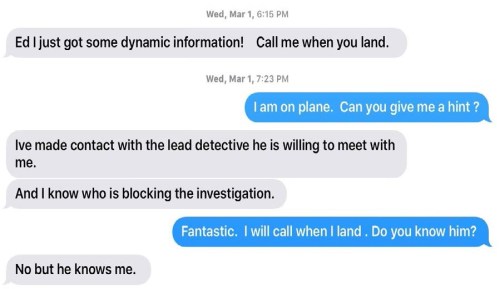
Wheeler told Butowsky that he was meeting with “2 inside contacts” on March 2, 2017.”

“69. In the interview, Wheeler claimed that he had been investigating the murder of Seth Rich over the “past three weeks”.
“[T]here has been a lot of reward money that’s been offered for any information. No one has come forward. So here is the thing that is so important to realize whenever you have a lot of reward money, in this case it is over $125,000, and you don’t have anyone coming forward with information. Then what that tells you as an investigator is that maybe you need to start looking at another cause or another reason as to why this guy was killed and that’s what we’re doing now. We’re looking at uh possibly of course a street robbery, but it could, and I underline the word could, it could have been related, his death to his job, it could have been related to something else. what I don’t think it was related to though Allison is this Russian hacking thing.”
(Emphasis added). After the interviewer pointed out to Wheeler that people were “hinting at the fact that perhaps Seth Rich may have given some documents [to Wikileaks]”, Wheeler, voluntarily and of his own free will, stated as follows:
“Well a lot of people have made that same observation and you have to ask yourself what is the motivation behind a person wanting to get involved and offer reward money, maybe he’s just a good guy and he has a lot of money laying around so this how he wants to spend his money, but you have to be careful though when you start throwing out these conspiracy theories, they actually don’t help the investigation at all… I haven’t found one shred of evidence at all that indicates that Seth’s death is the result of any Russian hacking or anything like that. I do think it’s possible and I underline the word possible that it could have been related to his job to some degree or relationships with the job, don’t know that for sure but for investigators we have to go down every path until we can determine who was responsible for his death”.”

“WHEELER: Absolutely, yeah, and that’s confirmed. Actually, I have a source in the police department that has looked at me straight in the eye and said ‘Rod we were told to stand down in this case and I can’t share any information with you’. Now that is highly unusual for a murder investigation, especially from a police department. Again, I don’t think it comes from the Chief’s office, but I do believe there is a correlation between the Mayor’s office and the DNC, and that’s the information that is going to come out tomorrow.”
(Emphasis added). When asked by a Fox 5 DC anchor whether there would be “evidence” to prove the statements made by Wheeler, Marraco stated as follows:
“MARINA MARRACO: … Rod Wheeler, the investigator, assures us Fox 5 and assures Fox News that there’s a full report that contains information that will show how many times Seth Rich made contact with Wikileaks and will show exactly when this communication took place.””

“128. In an audio recording published on July 11, 2017, Hersh provided the following statement:

“What I know comes off an FBI Report … The kid [Seth Rich was] … a nice boy, twenty-seven. He was not an IT expert, but he learned stuff. He was a data programmer … Here’s what nobody knows … when you have a death like that, DC cops … have to get to the kid’s apartment and see what you can find … so they get a warrant … They go in the house and they can’t do much with his computer … They have a cyber unit in DC, and they’re more sophisticated. They come and look at it. The idea is that maybe he’s had a series of exchanges with somebody who’s said ‘I’m going to kill you, you motherfucker’ … and they can’t get in … So, they call the FBI cyber unit. The DC … Washington Field Office is a hot shit unit … There’s a cyber unit there that’s excellent … The Feds get through and here’s what they find. This is according to the FBI Report … What the Report says is that sometime in late Spring … early Summer, he [Seth Rich] makes contact with WikiLeaks. That’s in his computer … They found what he had done. He had submitted a series of documents … juicy emails from the DNC … He [Seth Rich] offered a sample, an extensive sample … of emails, and said I want money. Later, WikiLeaks did get the password. He had a … protected dropbox … He also, and this is in the FBI Report, he also let people know with whom he was dealing … The word was passed, according to the FBI Report, ‘I also shared this box with a couple of friends, so if anything happens to me, it’s not going to solve your problems’ … WikiLeaks got access before he was killed.””

Read more:

https://www.courthousenews.com/wp-content/uploads/2018/06/EdButowsky.pdf

This lawsuit will probably be settled out of court.

However, it is significant because in a legal document, filed with the court, unsealed, in the light of day, we have extensive allegations of the attempts made by the Fake News Media, the DNC, et al to cover up the truth behind the murder of Seth Rich and his possible involvement in the DNC leaks.

Heard much about this from the Fake New Media?


More here:

https://citizenwells.com/

http://citizenwells.net/

 

Mandated arbitration has no place in insurance policies for individuals, NAIC reviewing, McCarran- Ferguson Act allows states to regulate arbitration in insurance over Federal Arbitration Act FAA

Mandated arbitration has no place in insurance policies for individuals, NAIC reviewing, McCarran- Ferguson Act allows states to regulate arbitration in insurance over Federal Arbitration Act FAA

“Thrivent contends that its commitment to individual arbitration is ‘”important to the membership because it reflects Thrivent’s Christian Common Bond, helps preserve members’ fraternal relationships, and avoids protracted and adversarial litigation that could undermine Thrivent’s core mission.’”…Thrivent v. Acosta Nov. 3, 2017

“pre-dispute mandatory arbitration provisions are inappropriate in insurance policies and incompatible with the legal duties insurers owe policyholders when handling their claims.”…NAIC, National Association of Insurance Commissioners, August 15, 2016

“Our organization was founded to help Lutherans care for and support one another in time of need, guided by the principles of the Christian faith.”…Thrivent Code of Conduct


From Insurance Business Magazine.

Clicking “accept” on a company’s terms and conditions – something we do daily to use and pay for products and services – usually subjects us to lengthy contractual agreements, many of which contain mandatory arbitration clauses. Proponents of arbitration might think it’s the greatest thing since whole wheat artisanal sliced bread, but mandating arbitration in consumer contracts is troublesome, and it has no place in insurance policies for individuals and small businesses.

Over the last 10 to 15 years, the practice of requiring individuals to agree to arbitrate rather than litigate any future disputes (or forgo the product, service or employment altogether) has been heavily criticized by government agencies, the media, academics and consumer groups. Arbitration, it turns out, is not always faster and cheaper (the two major benefits claimed), and it can suppress the number of consumers pursuing legal remedies, the likelihood of success and the amount of damages.”

“However, placing mandatory arbitration clauses in insurance policies restructures this crucial aspect of the insurer-insured relationship. Companies presumably employ pre-dispute mandatory arbitration provisions because they believe arbitration generally benefits them – and a growing amount of research suggests they are right. In addition, arbitration proceedings are usually confidential, not subject to judicial or regulatory review (absent fraud), and may contractually limit remedies and damages policyholders would otherwise have under their state law. Manipulating the dispute resolution process in this manner in insurance is in conflict with the duties insurers owe their policyholders and is not holding their policyholders’ interests “at least equal to their own.”

These concerns are why NAIC consumer representatives have requested the NAIC amend the Model Unfair Trade Practices Act to prohibit mandatory pre-dispute arbitration clauses in insurance policies sold to individuals, and ideally small businesses. An NAIC working group is now considering this action.”

“Thanks to the strong presumption favoring state insurance regulation in the McCarran- Ferguson Act, states can regulate arbitration in insurance despite the Federal Arbitration Act [FAA], which otherwise pre-empts most state laws restricting arbitration. Every court considering the application of McCarran Ferguson to the FAA has acknowledged that states can ban or restrict arbitration clauses in insurance contracts as long as the state prohibition “regulates the business of insurance” and the proposed arbitration provision would prejudice that law’s purpose.”

Read more:

https://www.insurancebusinessmag.com/us/opinion/arbitration-no-thanks-105347.aspx

From the NAIC, The National Association of Insurance Commissioners, August 15, 2016.

“Why arbitration clauses should be banned”

“Insurers that would insist on mandatory arbitration of policyholder disputes have selected the forum that they believe will be more favorable to them than to their policyholders, if not on each individual claim then in the aggregate. However, manipulating the dispute resolution process in this manner conflicts with the duties insurers owe their policyholders and is not holding their policyholders’ interests “at least equal to their own.”

If arbitration was truly a neutral forum rather than one favoring insurers, then there would be no need for an insurer to insist on its use before a dispute has even arisen. Insurers should utilize arbitration only when the policyholder has consented to do so after an actual dispute occurs (which is what the suggested amendment to the Model Unfair Trade Practices Act should accomplish), rather than requiring it in boilerplate language that the policyholder is very
unlikely to read, could not bargain over the provision even if she did, and could not make an informed decision at the point of sale on the merits. True freedom of contract, combined with the fundamental right to a trial, requires a knowing relinquishment of that right, which can only occur voluntarily once a specific dispute has materialized.”

http://eachstorytold.com/2018/07/16/naic-banning-arbitration-clauses-in-insurance-policies-why-arbitration-clauses-should-be-banned-companies-that-include-pre-dispute-mandatory-arbitration-clauses-do-so-because-it/

From the NAIC 2018 Adopted Committee Charges.

“8. The Pre-Dispute Mandatory Arbitration Clauses (D) Working Group will:
A. Consider the use of: 1) pre-dispute mandatory arbitration clauses; and 2) choice-of-law and choice-of-venue clauses and, if appropriate, prohibit their use in any individual or commercial insurance policies by amending the Unfair Trade Practices Model Act (#880), developing a new model act or developing other guidance regarding their usage.”

https://www.naic.org/documents/index_committees_2018_committee_charges.pdf


More here:

https://citizenwells.com/

http://citizenwells.net/
 

Thrivent Financial vs Perez Department of Labor Acosta DOL, Status of lawsuits, Defense of alternative dispute resolution with mandated arbitration

Thrivent Financial vs Perez Department of Labor Acosta DOL, Status of lawsuits, Defense of alternative dispute resolution with mandated arbitration

“The MDRP is the sole means for presenting and resolving grievances, complaints, or disputes between Members, insureds, certificate owners or beneficiaries and Thrivent or Thrivent’s directors, officers, agents and employees. The MDRP reflects Thrivent’s Christian belief system and strives to preserve Members’ fraternal relationship.”…Thrivent v. Perez Sept. 29, 2016

“Thrivent contends that its commitment to individual arbitration is ‘”important to the membership because it reflects Thrivent’s Christian Common Bond, helps preserve members’ fraternal relationships, and avoids protracted and adversarial litigation that could undermine Thrivent’s core mission.’”…Thrivent v. Acosta Nov. 3, 2017

“pre-dispute mandatory arbitration provisions are inappropriate in insurance policies and incompatible with the legal duties insurers owe policyholders when handling their claims.”…NAIC, National Association of Insurance Commissioners, August 15, 2016


From Bloomberg  Sept. 29, 2016.

“Thrivent Financial for Lutherans is accusing the Department of Labor of exceeding its statutory authority by attempting, with its new fiduciary rule, to force all disputes into federal court rather than allowing for alternative dispute resolution methods (Thrivent Financial for Lutherans v. Perez, D. Minn., 0:16-cv-03289, complaint filed 9/29/16).

Thrivent’s lawsuit, filed Sept. 29 in the U.S. District Court for the District of Minnesota, takes aim at the rule’s “best interest contract” (BIC) exemption”

https://news.bloomberglaw.com/employee-benefits/thrivent-financial-joins-fray-in-challenging-dols-fiduciary-rule?context=article-related

From the lawsuit.

“Thrivent’s Member Dispute Resolution Program
42. Thrivent’s MDRP is incorporated into all of Thrivent’s fraternal insurance contracts through the open contract provision by which Thrivent’s Articles of Incorporation and Bylaws are incorporated into all Thrivent insurance contracts, as required under state law. The MDRP Bylaw was adopted by Thrivent’s Member-elected Board of Directors as a part of Thrivent’s Articles of Incorporation and Bylaws in 1999 (at which time Thrivent was known as AAL). In so doing, Thrivent’s Board of Directors determined that the MDRP is in the best interests of Thrivent’s Membership.

43. The MDRP Bylaw, which is Section 11 of Thrivent’s Bylaws, requires binding, mandatory arbitration for any Member disputes with Thrivent. Section 11 “applies to all past, current and future benefit certificates, members, insureds, certificate owners, beneficiaries and the Society. It applies to all claims, actions, disputes and grievances of any kind or nature whatsoever. It includes, but is not limited to, claims based on breach of benefit contract[.]” Bylaws, § 11(b). “No lawsuits or any other actions may be brought for any claims or disputes covered by” Section 11. Id. § 11(c).

44. The MDRP is the sole means for presenting and resolving grievances, complaints, or disputes between Members, insureds, certificate owners or beneficiaries and Thrivent or Thrivent’s directors, officers, agents and employees. The MDRP reflects Thrivent’s Christian belief system and strives to preserve Members’ fraternal relationship.”

“47. A key benefit of the MDRP is that it preserves the fraternal relationship between Thrivent and its Members by avoiding adversarial litigation that could threaten to undermine the organization’s core mission. Thrivent’s Bylaws provide that no lawsuits or other actions are permitted for claims or disputes covered by the MDRP. Thrivent’s MDRP provides for resolution of disputes on an individual basis, involving Thrivent and the Members. Representative or class actions are not permitted under the MDRP Bylaw, which provides that “no disputes may be brought forward in a representative group or on behalf of or against any ‘class’ of persons, and the disputes of multiple members, insureds, certificate owners or beneficiaries (other than immediate family) may not be joined together for purposes of these procedures.” See Bylaws, § 11(e).
48. The MDRP is consistent with Thrivent’s fraternal nature, consistent with the Christian belief system of its Members, and reflects the careful balancing between Thrivent’s and its Members’ desire for a prompt, fair and efficient resolution of disputes, on the one hand, and the protection of the interests of all Members on the other. As such, the MDRP is an integral part of Thrivent’s governance structure. Experience has shown that the MDRP not only provides a fair and efficient process for dispute resolution, but is also in the best interest of Members.”

https://www.bloomberglaw.com/public/desktop/document/Thrivent_Financial_for_Lutherans_v_Perez_et_al_Docket_No_016cv032?1552582945

DOL temporarily stopped enforcing anti-arbitration provision.

“Thrivent Financial for Lutherans convinced a federal judge in Minnesota to temporarily stop the Labor Department from enforcing the fiduciary rule’s anti-arbitration provision against the nonprofit financial entity.

Thrivent showed the threat of irreparable harm to its business model, both now and in the future, was sufficient to have its request for a preliminary injunction granted, Judge Susan Richard Nelson held Nov. 3 (Thrivent Fin. for Lutherans v. Acosta, 2017 BL 396118, D. Minn., No. 0:16-cv-03289-SRN-DTS, order granting preliminary injunction 11/3/17″

https://news.bloomberglaw.com/employee-benefits/thrivent-financial-wins-battle-over-labor-dept-arbitration-ban?context=article-related

Status report January 2, 2018.

“While the administrative process continues forward, it is not yet complete. On November 29, 2017, the Department published in the Federal Register a final rule extending the transition period and delay of applicability dates for the relevant prohibited transaction exemptions from January 1, 2018 to July 1, 2019. See 82 Fed. Reg. 56545 (Nov. 29, 2017). The Department believes that this administrative delay will provide the Department time to complete its review of the underlying Fiduciary Rule and related exemptions and its intended proposal of “a new streamlined class exemption.” Id. at 56548. The Department believes that both its review and any proposed changes can be implemented before July 1, 2019. See id. at 56552 (explaining the Department’s belief that the additional time “is sufficient to complete review of the new information in the record and to implement changes to the Fiduciary Rule and/or PTEs, if any, including opportunity for notice and comment and coordination with other regulatory agencies”) ”

https://www.dolfiduciaryrule.com/portalresource/ThriventvPerez2018-01-02ECF112JointStatusReport.pdf

Status report July 2, 2018.

“Pursuant to the Court’s Memorandum Opinion and Order dated November 3, 2017, the parties submit this joint status report to address whether a continued stay of proceedings is necessary. The parties agree that a continued stay of proceedings is appropriate and anticipate providing a subsequent report to the Court on September 4, 2018.

In its Memorandum Opinion and Order, the Court granted a preliminary injunction prohibiting the “implementation and enforcement of the BIC Exemption’s anti-arbitration condition against Thrivent . . . until the conclusion of this litigation or such time as the Court so orders.” ECF No. 111 at 19. The Court also stayed the case, concluding that “[s]taying this matter will allow the administrative process to fully develop, possibly resolving this dispute, and thereby promoting judicial economy.””

https://www.napa-net.org/sites/napa-net.org/files/uploads/thrivent-dol-status-report.pdf

A status report for September 2018 has not been located.

However, the following suggests the Department of Labor is continuing to work on the “Fiduciary Rule and Prohibited Transaction Exemptions.”

RIN Data

DOL/EBSA RIN: 1210-AB82 Publication ID: Fall 2018
Title: Fiduciary Rule and Prohibited Transaction Exemptions
Abstract:The Department of Labor in 1975 issued a regulation defining who is “fiduciary” under section 3(21)(A)(ii) of the Employee Retirement Income Security Act (ERISA) as a result of giving investment advice for a fee or other compensation.  On April 8, 2016, the Department replaced the 1975 regulation with a new regulatory definition.  The new regulatory definition was vacated in toto in Chamber of Commerce v. Department of Labor, 885 F.3d 360 (5th Cir. 2018).  The Department is considering regulatory options in light of the Fifth Circuit opinion.
Agency: Department of Labor(DOL) Priority: Other Significant
RIN Status: Previously published in the Unified Agenda Agenda Stage of Rulemaking: Final Rule Stage
Major: No Unfunded Mandates: No
EO 13771 Designation: Deregulatory
CFR Citation: Not Yet Determined     (To search for a specific CFR, visit the Code of Federal Regulations.)
Legal Authority: 29 U.S.C. 1002 (ERISA sec. 3(21))    29 U.S.C. 1108 (ERISA sec. 408)
Legal Deadline:  None
Timetable:

Action Date FR Cite
Request for Information (RFI) 07/06/2017 82 FR 31278
RFI Comment Period End 08/08/2017
Final Rule 09/00/2019

https://www.reginfo.gov/public/do/eAgendaViewRule?pubId=201810&RIN=1210-AB82

How will this play out? Who knows.

The NAIC in 2016 stated: “pre-dispute mandatory arbitration provisions are inappropriate in insurance policies and incompatible with the legal duties insurers owe policyholders when handling their claims.”

Hopefully justice will prevail.

***  Update Mar 15, 2019  ***

According to a USDOJ attorney who worked on the lawsuit, it has ended.


More here:

https://citizenwells.com/

http://citizenwells.net/


Binding arbitration game is rigged against customers, New analysis of almost 9000 arbitration cases confirms biased against consumers, Incentives to slant toward the business

Binding arbitration game is rigged against customers, New analysis of almost 9000 arbitration cases confirms biased against consumers, Incentives to slant toward the business

“pre-dispute mandatory arbitration provisions are inappropriate in insurance policies and incompatible with the legal duties insurers owe policyholders when handling their claims.”…NAIC, National Association of Insurance Commissioners, August 15, 2016

“Companies don’t want to go to court because it puts them on a level playing field. Courts are ruled by law, legal precedent, and legal discovery, which allows litigants to obtain information and evidence from their opponents or from third parties. Discovery is a privilege in arbitration, but not a right. Arbitrators can’t enforce subpoenas, meaning you have to file a lawsuit just to get a third party or a piece of information into the hearing. In open court, you don’t have to jump through nearly as many hoops. Further, judgments in court are often more favorable to the consumer, both in the rate of success and the dollar amount of judgments.”…North Carolina Consumers Council

“Thrivent contends that its commitment to individual arbitration is ‘”important to the membership because it reflects Thrivent’s Christian Common Bond, helps preserve members’ fraternal relationships, and avoids protracted and adversarial litigation that could undermine Thrivent’s core mission.’”…Thrivent v. Acosta Nov. 3, 2017


From Stanford Business March 8, 2019.

“Why the Binding Arbitration Game Is Rigged against Customers

A new study documents how companies shop for sympathetic arbitrators, and how the arbitrators compete for their business.”

“It’s the “mandatory arbitration” clause, and it’s in contracts that cover trillions of dollars of business. In the event you have a dispute with the company, it says, you agree in advance to surrender your right to sue and to submit your grievance to a supposedly neutral private arbitrator.

Almost every financial firm insists on mandatory arbitration, but so do legions of businesses in other realms: AT&T and Verizon, Amazon and Apple, Blue Cross and Blue Shield, even Spotify and Shazam.

Now, a new analysis of almost 9,000 arbitration cases from the securities industry confirms what many have long suspected: The system is biased against consumers — and not just because big companies have more money to spend on lawyers.

When it comes to arbitration, the study finds, companies have a big information advantage in fishing for arbitrators who are likely to rule in their favor.

Making matters worse, the arbitrators themselves know that being pro-company in one case greatly increases their chances of being picked for future cases.

An Incentive to Slant

“This is not like having judges, who get paid the same no matter what happens,” says Stanford Graduate School of Business finance professor Amit Seru, who collaborated on the study with Mark Egan at Harvard Business School and Gregor Matvos at the University of Texas at Austin. “Here, you only get paid if you’re selected as an arbitrator. They have incentives to slant toward the business side, because they know that those who don’t do so won’t get picked. Everyone knows what’s happening.”

In their study, the researchers scrutinized thousands of customer disputes with stockbrokers and investment advisors. The data came from the Financial Industry Regulatory Authority, which oversees the industry’s arbitration process.

The researchers began by confirming that some arbitrators are measurably more business-friendly than others. Comparing cases on an apples-to-apples basis, the researchers estimated that business-friendly arbitrators awarded customers about 12% less money than their more pro-consumer counterparts. On an average case, that equates to about $90,000.

That was just the start, however. Even though the list from which arbitrators are picked is random, pro-business arbitrators were about 40% more likely to be chosen, so their bias had a disproportionate impact. If the arbitrators had been picked purely at random, the researchers estimated, the average award to each customer would have been $50,000 higher.”

Read more:

https://www.gsb.stanford.edu/insights/why-binding-arbitration-game-rigged-against-customers


More here:

https://citizenwells.com/

http://citizenwells.net/


Companies and CEOs rarely admit to wrongdoing,  Lawyers won’t let them, An apology helps to subtract the insult from the injury, thereby minimizing the injured party’s anger toward the offender

Companies and CEOs rarely admit to wrongdoing,  Lawyers won’t let them, An apology helps to subtract the insult from the injury, thereby minimizing the injured party’s anger toward the offender

“How might my behavior be perceived if it appeared in social media feeds, on the news or in tomorrow’s headlines?”...Thrivent “Code of Conduct”

“do unto others as you would have them do unto you”… Matthew 7:12

“An apology helps to subtract the insult from the injury, thereby minimizing the injured party’s anger toward the offender.”…Jonathan R. Cohen, Assistant Professor of Law


From NPR.

“Companies And CEOs Rarely Admit To Wrongdoing”

“SONARI GLINTON, BYLINE: Here’s a lesson we’ve all probably learned from our parents: When you’re wrong, say you’re sorry; fess up, admit it. These are toddler lessons – “Sesame Street,” “Mister Rogers.” So why do companies and CEOs so rarely admit that they screwed up?

KATHERINE PHILIPS: My cynical answer is, the lawyers won’t let them.

GLINTON: Katherine Philips is a professor of leadership and ethics at Columbia’s business school. She says one of the main reasons companies like JPMorgan don’t usually admit to wrongdoing, is because that will open them to crushing liabilities from plaintiff’s lawyers.

But Philips says there’s another element at play.

PHILIPS: One of the basic kind of psychological needs of human beings is to save face – right? – and to not look stupid, and not look like they don’t know what they’re doing. And people who are in powerful positions, and in charge, oftentimes feel that pressure even more so.”

Read more:

https://www.npr.org/2013/09/20/224296660/why-companies-and-ceos-rarely-admit-to-wrongdoing

ADVISING CLIENTS TO APOLOGIZE

Jonathan R. Cohen, Assistant Professor, University of Florida, Frederic G. Levin College of Law.

“Such factors prompt a question: Should lawyers discuss the possibility
of apology with clients more often? In this Article I argue that, in civil
cases, lawyers should discuss with clients the possibility of apology more
often than they now do.11 Not only is apology morally right and socially
beneficial, but in many cases making an apology is in the client’s (defendant’s)
best interest. This is not to say that there are no risks associated
with apology, not the least of which is the fear that an apology can be used
against one’s client in court as an admission of fault. However, when attention
is paid to the context in which an apology is offered and how it is
made, often “safe” apologies posing relatively little risk of increased liability
can be offered. Further, the possible benefits of apology to the client
(defendant) are under-recognized.”

“An apology can be an important step in preventing future antagonistic
behavior, including litigation. When an injury has occurred, there is a root
question to be resolved: Are you (the offender) my friend or my foe? An
apology signals that the offender wishes to establish or re-establish a
friendly relationship. It is a way of saying to the injured party: “I am your
friend, not your foe.” Implicit in this statement is often a second one, “I
want to have constructive future interactions, not destructive ones.” As
one might expect, this approach frequently works: The offender’s apology
often catalyzes the injured party’s forgiveness.”

“Indignity can be a large barrier to compromise, and in many cases, an
apology is needed before other aspects of the dispute, such as monetary
compensation, can be settled. As Goldberg, Green, and Sander write,
“[At] times, an apology alone is insufficient to resolve a dispute, but will
so reduce tension and ease the relationship between the parties that the issues
separating them are resolved with dispatch.”30 This observation has a
public policy corollary to which I shall return later: If we want to encourage the private settlement of, rather than the litigation of, disputes, allowing
parties to make apologies soon after an injury is critical.”

“Apology and forgiveness may also offer paths for spiritual and psychological
growth. By apologizing for, rather than denying or avoiding,
the damage he caused to his neighbor’s window, Hank becomes a better
person. By failing to apologize, Mr. Tiller may no longer be able to look at
himself in the mirror, or, should he meet her again, look Ms. Jones in the
eye. Responsibility and respect, rather than denial and avoidance, lie at
apology’s core. Within many religious and ethical systems, offering an
apology for one’s wrongdoing is an important part of moral behavior, as is
forgiving those who have caused offense.”

“One strategic benefit of an apology is that, if the injured party receives
the apology early enough, she may decide not to sue. For a legal
dispute to occur, injury alone is not sufficient. The injured party must also
decide to bring a legal claim.36 Taking the step to make a legal claim is
often triggered by the injured party’s anger. An early apology can help defuse
that anger and thereby prevent a legal dispute.37 The lesson here is an
important one. While there are risks to making an apology, there are also
risks to not making an apology. Accordingly, even if an apology could be
used against the offender at trial as proof of the offender’s liability (a topic
I will address shortly), in some cases it may still make sense for the offender
to apologize. The economically oriented might describe such an
apology as a gamble that an offender should take if and only if the expected
benefits from doing so, which depend upon the extent to which an
apology would decrease the likelihood of suit, exceed the expected costs,
which depend upon the extent to which an apology would harm the offender’s
case at trial.”

“VI. CONCLUSION
It is easy to see our world the way it is, and lose sight of the way it
should be. When an offender injures another, one would hope that, to the
extent that the offender feels at fault, he would apologize. This is not only
sound morality, it is a good way to prevent protracted disputes. An apology
helps to subtract the insult from the injury, thereby minimizing the injured
party’s anger toward the offender. Without an apology, what might
have been a minor offense may escalate into a major dispute.

While one could argue that lawyers should discuss the possibility of
apology with clients more often because apologizing when one has injured
another is the right thing to do, which is true, or because society would be
better off if more offenders apologized, which is also true, I have not done
so here. Rather, I have argued that lawyers should discuss apology more
often with their clients because often doing so would make their clients
better off. (Discussing apology with clients may make many lawyers
worse off, but that is another matter.) In many cases, the potential benefits
of apology are great, and when care is taken in how the apology is made—
within a “safe” legal mechanism like mediation, and with attention to nuances
such as admitting fault without assuming liability if insurance coverage
is at issue—the risks of apology are small. While our laws could be
and should be reworked to make “safe” apology easier, our existing legal
rules allow apologies to play a much larger role in legal disputes than they
now do.”

Read more:

https://www-bcf.usc.edu/~usclrev/pdf/072402.pdf


More here:

https://citizenwells.com/

http://citizenwells.net/


Justice Dept. enema required, Strzok firing not enough, J Christian Adams warning, Attorney Ty Clevenger FOIA requests and Transparency Project, DOJ blocking Set Rich info release

Justice Dept. enema required, Strzok firing not enough, J Christian Adams warning, Attorney Ty Clevenger FOIA requests and Transparency Project, DOJ blocking Set Rich info release

“Why was Tony West, who helped Obama keep his records hidden at taxpayer expense, promoted to Acting Associate Attorney General, the third highest official at the Justice Department?”…Citizen Wells

“Why has the Department of Justice not been cleansed (given an enema)?”…Citizen Wells

“I know that Seth Rich was involved in the DNC leak.”…Kim Dotcom


J. Christian Adams, former Justice Department attorney, warned us in 2010.

“On the day President Obama was elected, armed men wearing the black berets and jackboots of the New Black Panther Party were stationed at the entrance to a polling place in Philadelphia. They brandished a weapon and intimidated voters and poll watchers. After the election, the Justice Department brought a voter -intimidation case against the New Black Panther Party and those armed thugs. I and other Justice attorneys diligently pursued the case and obtained an entry of default after the defendants ignored the charges. Before a final judgment could be entered in May 2009, our superiors ordered us to dismiss the case.

The New Black Panther case was the simplest and most obvious violation of federal law I saw in my Justice Department career. Because of the corrupt nature of the dismissal, statements falsely characterizing the case and, most of all, indefensible orders for the career attorneys not to comply with lawful subpoenas investigating the dismissal, this month I resigned my position as a Department of Justice (DOJ) attorney.”
“Based on my firsthand experiences, I believe the dismissal of the Black Panther case was motivated by a lawless hostility toward equal enforcement of the law. Others still within the department share my assessment. The department abetted wrongdoers and abandoned law-abiding citizens victimized by the New Black Panthers. The dismissal raises serious questions about the department’s enforcement neutrality in upcoming midterm elections and the subsequent 2012 presidential election.”

https://citizenwells.com/2014/06/09/j-christian-adams-explains-obama-use-of-alinsky-rules-for-radicals-challengers-to-obama-labeled-marginalized-compartmentalized-birthers-impeachment-proponents-made-to-look-crazy/

I have probably spent the greatest amount of time researching relative to reporting on the Seth Rich murder.

I vowed I would not forget it.

We deserve the truth.

There have been a number of FOIA requests for release of information regarding the Seth Rich murder and “investigations.”

I kept looking for a followup on the Judicial Watch request.

Attorney Ty Clevenger has made a number of FOIA requests as well as filing lawsuits and provided updates.

http://lawflog.com/wp-content/uploads/2017/10/2017.09.01-Seth-Rich-FOIA-request.pdf

“Federal lawsuit seeks records about Seth Rich murder”

“This morning I filed a Freedom of Information Act lawsuit that asks a federal judge in Brooklyn to order the FBI and U.S. Department of Justice to release records concerning the murder of former Democratic National Committee employee Seth Rich.

Back in October, I wrote about the U.S. Department of Justice ordering the U.S. Attorney’s Office in D.C. to release records about the murder, but since that time not a single record has been produced.  Around the same time, the FBI refused to search for records in its Washington Field Office, even though that is where the records are most likely to be found.  The lawsuit notes that the FBI has a history of trying to hide records from FOIA requestors and Congress.

I also asked the court to order the National Security Administration to release all of its communications with members of Congress regarding Seth Rich, Julian Assange, and Kim Dotcom, among others.

As you are probably aware, Mr. Rich’s parents filed suit this week against Fox News, producer Malia Zimmerman, and frequent guest Ed Butowsky.  I think that was a serious tactical error.  All of the defendants now have the legal right to subpoena documents and witnesses, and you can be sure they will use that power aggressively.

THE TRANSPARENCY PROJECT

With help from several supporters, I’ve organized The Transparency Project, a nonprofit corporation headquartered in Texas. If you want to support the Seth Rich litigation, you can find out how at Tproject.org. The website is a little primitive, but I plan to update it soon.”

Read more:

http://lawflog.com/?p=1912

The Transparency Project

“The Transparency Project is a nonprofit organization that fights political corruption, particularly in the judiciary and the legal profession. TTP was organized by Ty Clevenger, an attorney who grew tired of watching judges and lawyers get away with things that would send most people to prison.  Ty has forced two federal judges into retirement, triggered a grand jury investigation of the Texas Attorney General (who was subsequently indicted), prompted the indictment and conviction of a corrupt district attorney, and sued bar prosecutors to force them to investigate Hillary Clinton’s lawyers for their roles in destroying email evidence.  TTP intends to purse similar cases.”

Read more:

http://tproject.org/


More here:

https://citizenwells.com/

http://citizenwells.net/


My disability how it affected me and how I was treated by the disability insurance company and social security disability, Delay and deny incompetence and evil, What I will eventually write will shock and infuriate you

My disability how it affected me and how I was treated by the disability insurance company and social security disability, Delay and deny incompetence and evil, What I will eventually write will shock and infuriate you

“Insurance Companies Practice Deny & Delay Tactics”…The Deutermann Law Group

“Some critics say being barred from court discourages complaints, and some of those barred from court say they don’t trust the arbitration system enough to pursue it. Joseph Belth, a retired professor of insurance at Indiana University and editor of a widely read industry newsletter, calls the ability of fraternals to unilaterally change dispute-resolution rules for policyholders “an outrage.””…WSJ May 30, 2006

“For we wrestle not against flesh and blood, but against principalities, against powers, against the rulers of the darkness of this world, against spiritual wickedness in high places.”…Ephesians 6:12


My disability, how it affected me and how I was treated by the Disability insurance company and Social Security Disability.

Prior to my disability, I had been active all of my life, had only been to the hospital for sports injuries and had worked hard mentally and physically.

My disability event happened on February 27, 2009.

After 2 initial filings for disability claims and a letter from an attorney, my claim was denied.

The claim has been ongoing since then and I have had legal representation for over a year.

I vowed that no matter how this played out, I would expose the mistreatment I received from the disability insurance company.

Since the claim process is ongoing, I will report what I am able to reveal.

Here is the general sequence of events:

I was upstairs and alone.

I felt a numbness beginning in my right foot which began to spread up my right side.

I walked a short distance to the bedroom and laid down.

I was thinking stroke but tried to remain calm.

I called my lady friend who called her physician father on the west coast.

She arrived home and immediately took me to the emergency room a short distance away.

They triaged me for stroke which thank God it wasn’t, ran some more tests and kept me overnight.

The numbness all along my right side began to go away overnight except for my right foot, which remains with me today.

It wasn’t just numbness but there was also pain. The closest analogy I can think of is when your hands get numb and painful from making snowballs too long.

From the time that I left the hospital I was forced to keep my right leg propped up and pretty soon my lower back beagn hurting.

I was in pain during the day and my sleep was difficult at night.

A few days later I had an appointment with the attending physician, who I had never met before the hospital visit. He began talking about taking vitamins and quite frankly did not impress me.

After the second visit and my insistence, he referred me to a podiatrist.

The podiatrist was competent and immediately referred me to a spine specialist.

The spine spcialists examined me and took xrays. They found compression and fusion in my lower back. They also gave me an injection for pain which did little to help.

On the next visit they ran point to point tests from my lower spine to my foot.
.
Their conclusion was atypical neuropathy.

I had contacted my disability insurance company earlier to inform them of what had happened and they sent claim forms.

I filed claims with them twice and on both occasions the spine specialists indicated “no work.”

After the second denial I had an attorney write an excellent letter to no avail (except for documentation).

I also filed an online claim with Social Security Disability. More on this later.

Knowing what I know now, I would have immediately contacted an attorney to handle this case.

There were multiple reasons why I did not.

First of all, this was a fraternal plan I had paid on for 25 years. I was in disbelief, shock as well as pain. I could not trust them.

Also in the contract you agree to go through a process of appeal, mediation and binding arbitration. I should have had an attorney handle that.

After months of diagnosis, filing claims and dealing with the pain I had to protect myself. Thank God I had assets. I got by on savings, disposal of assets and eventually early Social Security retirement at a reduced amount.

I was able to make payments on the house I moved back into after my lady (fair weather) friend broke things off and my car.

I am one of the fortunate ones.

The TV ads daily reveal those who were helped by an attorney or they would have gone under financially.

Once again, I am blessed. But I was devastated financially.

Medicare was a blessing. With the great supplement a friend recommended, I was able to get a knee replacement for my other knee.

Exercise became part of my therapy to reduce the pain. I was then able to resume it.

What the disability company did was wrong, evil.

I am not going to let them get away with this, for myself and others.

More on this when I am able.


More here:

https://citizenwells.com/

http://citizenwells.net/

Vermont eligibility challenge update January 5, 2016, H. Brooke Paige v State of Vermont, Attorney General’s office failed to inform Secretary of State’s Election Office of their failure to respond in Superior Court

Vermont eligibility challenge update January 5, 2016, H. Brooke Paige v State of Vermont, Attorney General’s office failed to inform Secretary of State’s Election Office of their failure to respond in Superior Court

“Moore said he’s seen no convincing evidence that Obama is a “natural born citizen” and a lot of evidence that suggests he is not.”…Judge Roy Moore interview by WND

“no Person except a natural born Citizen, or a Citizen of the United States, at the time of the Adoption of this Constitution, shall be eligible to the Office of President . . . .”…US Constitution

“We are being lied to on a scale unimaginable by George Orwell.”…Citizen Wells


Just in from Mr. H. Brooke Paige, plaintiff in the complaint against the State of Vermont, Secretary of State James Condos and Attorney General William Sorrell.

“Well this was an unexpected turn of events.  As a result of their
negligence in Answering or otherwise entering an appearance in Superior
Court, a series of events are unfolding that could result in profound
changes in the Vermont Primary this March.  What those changes will be is
difficult to predict. There are structural and legal problems with Vermont
Election Laws (Title 17) which has been thrown together “piecemeal” over
the years and this case should focus attention on the shortcomings of the
current law.

Mr. Paige visited the Secretary of State’s Office today to hand deliver a
copy of the latest filings that requested a Temporary Restraining Order to
prevent the “publication and distribution” of the Presidential Primary
Ballots until the “troubles” complained in the Plaintiff’s pleadings are
resolved or an accommodation can be found that would avoid injuring or
disenfranchising the various candidates.

Sadly, the Attorney General’s office has failed to inform the Secretary of
State’s Election Office of their failure to respond in Superior Court. The
Director of Elections appeared “shell shocked” as Mr. Paige filled him in
on the case, the default and the resolution he intends to propose to the
Court relating to the Primary.  The General Election and the “natural-born
Citizen” question will require additional consideration in order to find
an equable resolution which hopefully will include defining “nbC”
precisely as part of the ruling (rather than mere dicta unrelated to the
resolution).

Mr. Paige informs that the gross negligence of the Defendants exhibited by
their failure to respond reduces the A/G opportunities to stall and
“sidetrack” the case.  The expedited resolution of the questions relating
to the Primary could produce an interesting civics lesson for Vermont
voters.

CitizenWells  will continue to follow this case and provide all the
details here as they become available !”

The complaint:

https://citizenwells.com/2015/12/30/ted-cruz-rubio-and-jindal-eligibility-challenged-in-vermont-h-brooke-paige-complaint-filed-december-9-2015-natural-born-citizen-status-requires-us-birth-and-2-citizen-parents-attorney-mario-apuzz/