Category Archives: Board of Elections

Sullivan v. NC Secretary of State and Board of Elections, Update March 20, 2009, Lt Col Donald Sullivan, Obama not eligible, NC lawsuit, Judge W. Osmond Smith, III, Wake County Superior Court, Raleigh, NC, US Constitution, First Lieutenant Scott Easterling, US Military

I just received this update from Lt. Col. Donald Sullivan:

“Personal Transcript of Hearing:  Sullivan v. NC Secretary of State and Board of Elections; Case #08-CVS-021393

SUBJECT: Obama Eligibility

On March 16, 2009, the calendar was called by Judge W. Osmond Smith, III, presiding, in Wake County Superior Court, Raleigh, NC.  My case was #23 on the calendar and required the hearing of three separate “motions”:  My demand for class action certification; my demand for leave to amend; and the State’s motion to dismiss.  When he got to #23, the judge said he would pass over this item until he had completed calling the calendar.  (Odd, this.  It was apparent there had been discussion of my case prior to the hearing.  I am not at all sure these discussions did not include the defendant State.) Upon completion of calling the calendar, and after dividing the calendar between himself and another superior court judge, A. Leon Stanback, Jr., Judge Smith called the first case without mentioning mine again.  I stood and called his attention to his oversight, and he apologized.  The case was then scheduled for hearing last.  

When my case was called (actually next to last as it worked out), the judge asked the parties how long the arguments would take.  I answered it would depend upon which of the three “motions” he decided to hear first.  After a brief discussion, the judge chose to hear my demand to amend first.  It being my action with the burden of proof on my shoulders, I began my arguments in support of my demand with a statement of the justification for my amendment to the original pleadings. The original filing was a demand for injunctive relief which the court had decided to consider only a “routine” case.  The case was filed on November 7th, 2008, and in anticipation of an expedited ruling to take place prior to the inauguration on January 20th, 2009.  By considering the case “routine”, the court had condemned the action to becoming moot upon the completion of the inauguration.  Thus, it was necessary to amend the complaint to prevent the necessity of filing a completely new action.  It was only due to the scheduling by the court that the case had taken three months to be heard.  I also was demanding I be allowed to add the Governor and the State of NC as defendants, since the necessary actions required in my demand for injunctive relief were interstate actions and would necessitate the Governor be a party.

I then presented that it was the sworn duty of the court to support the Constitution of the United States in accordance with the court’s ( and all others involved in this action) Article VI, Section 7, (NC Constitution) oath, in accordance with Article VI, Section 2, (US Constitution), and in accordance with Article 1, Section 5, of the NC Constitution.  I admitted there was no statutory requirement for the State to do as I had demanded, but that the obligation and responsibility was a constitutional one, this being both an equity court and a constitutional court.  I listed the evidentiary facts which appeared to assert the ineligibility of Barack Obama to hold the office of President in contravention to Article IV, Section 2, Clause 5, of the US Constitution including, but not limited to, his failure to reveal his original birth certificate from Hawaii; his apparent use of an Indonesian passport in 1981, his multiple citizenships by birth and residence, none of which he has renounced; his failure to release his collegiate records which allegedly show he attended as a foreign student under an FS-1 foreign student visa; statements by the ambassador to the US from Kenya and his paternal grandmother which attest to his being born in Mombasa, Kenya; his having given false information on his application for an Illinois license to practice law in 1989, in that he averred he had no other names than Barack Hussein Obama, Jr., when, in fact, he has used at least four other names over his lifetime; and the apparent falsity of his selective service registration.  I also showed the court the current issue of “Globe” magazine I had purchased that morning on the way to the courthouse, which highlighted on its cover, and in the article inside, the peril faced by the US military in its confusion over whether to execute the orders of a “President” who may in fact not be qualified.  The cover pictured 43-year-old First Lieutenant Scott Easterling, in uniform and in Iraq, one of many US soldiers who are questioning the authority of Obama’s presidency.  I explained that, should Obama survive the first four years of his presidency and decide to run again (a likelihood for which I admitted having very little hope), the issue of his eligibility would most certainly come up again; and, in the event he was proven ineligible, every action, appointment, order and law he had committed to during his first four years would be invalidated.   I tried to impress upon the court that this constitutional crisis could be averted by nipping the “rumors”, if in fact that is what we are dealing with here, of Obama’s ineligibility in the bud by allowing my amendment so that the complaint could continue.

Having exhausted my arguments to the court, I turned it over to the defense, which merely argued that the case against the Secretary of State was res judicata (judged previously), having been heard in my prior filing against her and dismissed; that my arguments were moot, since the inauguration had passed, and there was no claim upon which relief could be granted by the court; and that I lacked standing before the court to pursue this case.  Their arguments were brief, and the judge listened.  When the two attorneys for the State sat down, the judge denied my motion to amend.

We then proceeded directly to the State’s motion to dismiss.  They presented the same arguments in brief that had already been presented in the first hearing on the demand to amend, except they added that the ruling should be “with prejudice”.  Part of my defense against the motion to dismiss had already been presented as to the res judicata claim in the form of my prior complaint had been dismissed “without prejudice”, such that I could file the same complaint again. They also argued the issues of standing, mootness and jurisdiction.  When it was my turn, I repeated most of my arguments as well in the rebuttal, adding that mootness was not a valid defense because the offense of Obama’s illegitimacy was a continuing offense against the Constitution, not degraded nor invalidated merely on the grounds that he was now inaugurated falsely as President.  My argument against “standing” was my filing as a “class action”, and the argument against jurisdiction was, of course, the constitutional obligations of the court.  As to res judicata,
I explained to the judge that a ruling “without prejudice” did not deny leave to refile the case at a later date.

The judge didn’t buy any of it and allowed the motion to dismiss, along with the prayer for finding “with prejudice”, due to “mootness” (the inauguration issue); “failure to state a claim against which relief could be granted” (the “No State statute requires it” issue, which denies any constitutional duty or obligation); and “res judicata”.  Conspicuously absent from this list was the issue of “standing” which has killed all the other suits around the country, of which I am aware.  This last supports my theory that I had resolved the “standing” issue by filing a class action suit”, for which I offered myself as the representative of the registered voter “class” of North Carolina. I advised the court that I intended to appeal, but would appeal in writing within the allotted 30 days after the order is signed. 

I have no intention of appealing this ruling.  I will file a new case and improve on that one as I did from the first one filed in October to the second one filed in November.  It is ironic that, had the judge allowed my demand to amend the names of the Governor and the State of NC to the defendant list, I would be precluded from filing a new case against them as it would be “res judicata”. 

It is important that we continue to push this issue of legitimacy in government, if only because we are currently involved in two foreign armed conflicts with more on the horizon, and the economy is on the edge of collapse.  Our military cannot continue to question the orders of the Commander-in-Chief because of the confusion of his nationality, and the “Stimulus Plan” is not going to help the economy.  As Sun Tsu told us, we must know the enemy and ourselves, or we can never be victorious in battle.  In the case of the United States government, the enemy is a mystery who changes with the tide; and, with Obama in the White House, even we ourselves are an unknown quantity.  We cannot win if we continue on this course.
END
March 20, 2009
DS”
Lightfoot v Bowen, Dr Orly Taitz, Chief Justice John Roberts, US Supreme Court, March 12, 2009, Application For Emergency Stay AND/OR Injunction, Gail Lightfoot, Debra Bowen, Secretary of The State Of California

From Dr. Orly Taitz, March 12, 2009:

“No. 08A524
In The
 
Supreme Court of the United States
 
 
Gail Lightfoot, Neil B. Turner, Kathleen Flanagan, James M. Oberschain, Camden W. McConnell, Pamela Barnett, Evelyn Bradley
 
 
v.
 
 
Debra Bowen, Secretary of The State Of California
 
 
APPLICATION FOR EMERGENCY STAY AND/OR INJUNCTION AS TO THE 2008 ELECTORAL COLLEGE MEETING AND ALTERNATIVELY AS TO CALIFORNIA ELECTORS
 
 
Orly Taitz, DDS.
Attorney for the Petitioners
26302 La Paz
Mission Viejo CA 92691
949-683-5411
 
TO: THE HONORABLE  JOHN J. ROBERTS, CHIEF JUSTICE                                 
Motion to Reconsider
Petitioners, by and through their undersigned counsel of record, submit this motion for reconsideration due to the following reasons:
The Clerk of this Court, Danny Bickel, of his own volition and on his own authority refused to file of record, docket, and forward to the Chief Justice and Associate Justices Petitioners’ Supplemental Brief presented on January 15, 2009.
The Rules of this Court provide that supplemental briefs are allowed, when there is a new law or changed circumstance in the case.
On January 8, 2009, Barack Obama was confirmed as President by the Congress, at which time it was timely to file a supplemental brief, requesting this Court to determine that Mr. Obama is not eligible to serve, according to the terms of the Constitution.
 According to the 20th amendment Mr. Biden must be appointed president pro tempore, until the president qualifies or new president is chosen.
This supplemental motion has made the underlining petition proper and timely according to the changed circumstances of the electoral vote and subsequent confirmation of Congress.
The Clerk of this Court, Mr. Bickel categorically refused to file this brief in the docket, stating that he would send it back to the undersigned counsel with an explanation. Nothing was sent back and no explanation provided.
Due to the fact that all mention of this case was erased from the docket of the Supreme Court on January 21,  2009, one day after the inauguration and two days before this Court was to meet regarding this matter, this sua sponte by someone  prejudiced the cause of the petitioners.
Only after numerous phone calls from outraged citizens, members of the media and state representatives, was the case reentered on the docket in the evening of January the 22nd, shortly before the meeting of the Justices held on the morning of January 23rd.
No explanation was provided by the Supreme Court for this occurrence.
When an attorney, licensed with the Supreme Court, Ms. Teresa Ward, called the court to inquire about the location online of the docket, a deputy clerk put her on hold for several minutes, then claimed that all dockets were unavailable due to a computer error that affected all cases.  However Ms. Ward could clearly see other case dockets, going back years, including closed cases which had not been erased,  This was done by performing a name search using ‘Lightfoot,’ as the search term.
 Similarly, after the case was reentered on the docket, Mr. Bickel claimed, that the case never disappeared.  However, a number of citizens have written affidavits and screenshots were made of the case disappearing from the docket and reappearing at a later date. 
Further, a few days before hearing this petition in the conference of the full Supreme Court, eight out of nine Supreme Court Justices had a private closed door meeting with Mr. Obama, who was a party of interest and subject of this petition, wherein there may have been ex parte communication that prejudiced the petitioners.
Further, on March 9,  2009 at a book signing ceremony in Los Angeles, California the undersigned counsel had an opportunity to talk to Associate Justice Scalia and had an opportunity to ask about this case and inquired , as to why the case was not forwarded from the conference to the oral argument. Justice Scalia had no knowledge about my case. Similarly he had no knowledge about any cases brought in front of the Supreme Court, that challenged Obama’s eligibility for presidency. The only reasonable explanation is that the clerks of the court did not provide the case to the Justices at all or summarized them in a light, that is unfavorable to the petitioners, which is prejudicial to the plaintiffs.
At a reception held in Los Angeles, California , on March 9th, Justice Scalia has told the audience of some 300 attorneys, members of the media, business and entertainment industries, that the cases are heard in the Supreme Court based on importance. He reiterated that it is not the beauty of the argument and legal reasoning, but importance of the case.
The instant case, dealing with a fundamental Constitutional question, affecting each and every citizen of these United States, in alleging a complete lack of legitimacy in the presidency of Barack Obama is a question of great public importance.
  It was supposedly heard by the full conference of nine justices on January 23rd and yet, the Justices did not think this issue to be important enough to forward to the next step, to the open court for argument on the merits of the case.
At the same time it was announced on the radio that the Supreme Court has heard a case dealing with the rights of smokers of light cigarettes to sue tobacco industry; and two Justices, including Chief Justice Roberts, have written lengthy opinions on this issue.
 The undersigned reiterates that at issue is the probable illegal usurpation of our highest elected office by a foreign national, a citizen of Indonesia and possibly still a citizen of Kenya and Great Britain, Barry Soetoro, a/k/a Barack Hussein Obama.
Were these allegations the case, and taken true as pled for the purposes of this Motion, any party illegally usurping the position of the President of the United States and Commander in Chief of all the US Armed forces and assuming control of our nuclear arsenal would be in a position to devastate not only the United States but the world.
The  only explanation that would provide any sanity to this fact, is that the clerks that are sorting some 80,000 cases that are submitted to the Supreme Court each year and helping pick 0.1%, roughly 80 most deserving cases; the clerks that are preparing the summaries for the justices, have never shown this case Lightfoot v Bowen to the Justices or have summarized it in false light.
21.             Attached hereto and incorporated by reference  is a letter from the magazine World Net Daily, showing that 326,841 American Citizens have signed the petition to hear this matter. Aside from the petition, World Net Daily has delivered to the Supreme Court 540,000 individual form petitions: 60,000 for each Justice, times nine. Additionally, it is estimated that some 100,000 Americans have faxed or mailed petitions drafted by themselves, not form petitions. This means that each Justice should have heard from roughly  half a million American citizens, urging them to hear this case on the merits. While undersigned counsel questioned Justice Scalia during above mentioned book signing in Los Angeles, as to what happened, why the case was not forwarded to the open court hearing on the merits, he had absolutely no clue about the case, not this, nor similar cases by Wrotnowski and Donofrio. It is astounding that the Justice would get letters from half a million American citizens, urging him to hear the case on the merits, and wouldn’t remember one thing about the case. Again, the only reasonable explanation is that the clerks have never shown the Justices either this case Lightfoot v Bowen or letters from half a million American citizens supporting this issue. Due to the fact, that above mentioned became known to the under signed counsel only on March 9th 2009, a motion for reconsideration is filed at this late date due to special circumstances. 
22.             Due to the fact that there is evidence of sabotage within the Supreme Court, and there is no guarantee this petition will be forwarded to the Justices through regular channels; this petition will be hand delivered to Chief Justice Roberts at his appearance with students at the University of Moscow, Idaho, on Friday, March 13th, 4 PM. In case something happens to the under signed counsel and the counsel is prevented from hand delivering this motion, it is being posted on the blog DefendOurFreedoms.US; it is being mailed to each and every Justice by certified mail with restricted signature delivery, to be personally signed by the Justices; and it is being forwarded as a press release to Congress, Senate, State Houses of Representatives, State Senates, Governors of all 50 States,  FBI, Secret Service, Department of Justice, Department of Defense, Homeland security, Attorney Generals of all 50 states and 26,000 outlets of US and World media in order to bring awareness of the above to the World Community.
23.             At the same meeting at the Unversity of Idaho the under signed counsel will be forwarding to Chief Justice Roberts a Petition for Quo Warranto and a Petition for Leave of Court to File as Original Jurisdiction her second case Easterling et al v Obama and State of Hawaii, whereby due to the fact that the Attorney General of the United states, Eric Holder, did not agree to institute Quo Warranto Proceedings against Mr. Obama, the petitioners led by active duty officer, currently serving in Iraq, Scott Easterling, Major General Carroll D. Childers, officers from all branches of the military, State Representatives and an elector are seeking the leave of court to file quo warranto as ex relators on behalf of the US government.
 
Attachments
APPLICATION FOR EMERGENCY STAY AND/OR INJUNCTION AS TO THE  2008 ELECTORAL COLLEGE MEETING AND ALTERNATIVELY AS TO CALIFORNIA ELECTORS WITH REQUEST THAT APPLICATION BE TREATED AS PETITION FOR WRIT OF CERTIORARI AND/OR MANDAMUS AND/OR PROHIBITION. Filed December 11th, 2008.
SUGGESTION FOR RECUSAL OF HONORABL E CHIEF JUSTICE ROBERTS AND HONORABLE ASSOCIATE JUSTICES FROM SWEARING OF BARAK HUSSEIN OBAMA AS THE PRESIDENT OF THE UNITED STATESON JANUARY 20TH DUE TO DUE TO CONFLICT OF INTEREST WITH THE FULL COURT CONFERENCE HEARING ON THE 23RD OF JANUARY OF LIGHTFOOT V BOWEN, SEEKING TO FIND BARACK HUSSEIN OBAMA NOT ELIGIBLE FOR PRESIDENCY. Filed January 12th 2009.
SUPPLEMENT, MOTION TO DECLARE THE PRESIDENT ELECT RESPONDENT BARACK HUSSEIN OBAMA HAS FAILED TO QUALIFY BY DEFAULT UNDER US CONSTITUITON ARTICLE 2, §1, AND AMENDMENT20, PER RULE 21 (2)(B) AND (4). Duly filed January 15, 2009, not docket and not distributed to the Justices due to the refusal by clerk Bickel.
SUPPLEMENT TO APPLICATION FOR EMEGENCY STAY AND/OR INJUNCTION AS TO THE 2008 ELECTORAL COLLEGE MEETING AND ALTERNATIVELY AS TO CALIFORNIA ELECTORS. Supplement is based on the Executive Order by President Bush, issued January16, 2009. EXECUTIVE ORDER; GRANTING RECIPROCITY ON EXCEPTED SERVICES AND FEDERAL CONTRACTOR EMPLOYEES FITNESS AND REINVESTIGATING INDIVIDUALS IN POSITIONS OF PUBLIC TRUST.  Filed January 21, 2009. 
Petition letter from World Net Daily to the Supreme Court signed by 326,841 American citizens.
“I hereby certify that the foregoing statements made by me are true.  I am aware that if any of the foregoing statements made by me are willfully false, I am subject to punishment.”
 
___________________________, March 12, 2009
Dr. Orly Taitz, ESQ”

Read more:

http://defendourfreedoms.us/2009/03/12/motion-to-reconsider-lightfoot-v-bowen.aspx

West Virginia Election Complaint, WV Secretary of State, Obama not eligible, Federal Elections Commission lawsuit, WV residents participating

I was asked to post the following:
“Subject: I am the Lady in WV filing Election Complaint


re: Searching for Lady in West Virginia filing Federal
Elections Comm. suit

(Ed, Please forward this to anyone contacting you from WV
to get involved.  Thanks.)

My name is XXXXX XXXXXX.
I called into to Ed’s show on Feb 13 asking for residents of
WV who are interesting in doing something in their state to
question Barack Obama’s eligibility for the office of president.
I am preparing to file an Election Complaint with the WV Secretary
of State concerning Barack Obama.  WV has some unique laws in this
regard and there may be an opening to get this issue out in the
open.
I am looking for WV residents who would consider participating
in this.  I will email you information to educate you on the issue,
possibly speak with you on the phone, and we will go from there. 
At this point, this is not a suit.  WV allows ‘ANY PERSON’ to file
an election complaint with the secretary of state.
Please contact me at ubrevera1@gmail.com .
Let’s get this citizenship issue settled once and for all!”

2008 Electoral College votes, Certification of Voters, State laws, US Constitution, Electors signed Certification, Certifications invalid, Obama ineligible, Violators should be prosecuted, Constitution violated

The ultimate objective of a presidential election to inaugurate a
constitutionally qualified president that as closely as possible
reflects the will of the people.
The states have been given the power and the duty to control presidential
elections by the US Constitution.

The pervasive attitudes of the state officers and election officials is
that they, incorrectly, have no power to qualify presidential candidates
and/or they depend on political parties to vet the candidates.

The political parties have evolved and changed since the creation of the
US Consitution and are given no powers. However, members of the parties,
as US Citizens have an implied duty to uphold the Constitution and party
officers typically have taken oaths as elected officials to uphold the
US Constitution.

Clearly, the intent of the US Constitution and Federal Election Law is
for an eligible candidate to move through this election process to allow
for a constitutionally valid vote by Electors.

All officers and election officials, most judges and most Electoral
College Electors were informed prior to the general election and
particularly prior to the Electors meeting and voting, of compelling
evidence that Barack Obama is not eligible to be president. Despite
these warnings, Electors met and voted on the basis of party loyalty or
perceived directives from the states. State or party policies dictating
how an Elector votes violate the spirit and letter of constitutional
and federal law.

Even though the manner of Electoral College voting in clearly defined by
the US Constitution and Federal Election Law, some states have included
explicit references to law in their Certificates of Voters that are
signed by Electors and state officers. Below are certificates from 2004.

http://www.archives.gov/federal-register/electoral-college/2004_certificates/

Alabama

“pursuant to the Constitution and the laws of the United States
and this state, certify”

Alaska

“by authority of law vested in us”

Arizona

“by authority of law in us vested”

Arkansas

“as provided by law”

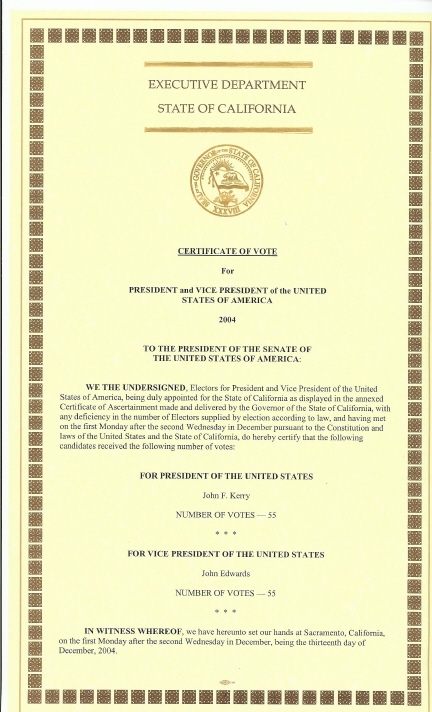
California

“pursuant to the Constitution and the laws of the United States
and the state of california, do hereby certify”

Connecticut

“in pursuance of the Constitution and laws of the United States
and in the manner provided by the laws of the state of Connecticut”

Hawaii

“in pursuance of the Constitution and laws of the United States”

Idaho

“having met agreeably to the provisions of law”

Illinois

“as provided by law”

Indiana

“as required by the Twelfth Amendment to the Constitution of
the United States”

Iowa

“in accordance with law”

Kansas

“agreeably to the provisions of law”

Kentucky

“In accordance with the Twelfth Amendment to the United States
Constitution, and with sections 7-11 of Title III of the
United States Code”

UNITED STATES CODE

TITLE 3 THE PRESIDENT

Manner of voting

§ 8.   The electors shall vote for President and Vice President, respectively, in the manner directed by the Constitution.

US Constitution

Article. II.

Section. 1.
“No Person except a natural born Citizen, or a Citizen of the United States, at the time of the Adoption of this Constitution, shall be eligible to the Office of President; neither shall any Person be eligible to that Office who shall not have attained to the Age of thirty five Years, and been fourteen Years a Resident within the United States.”
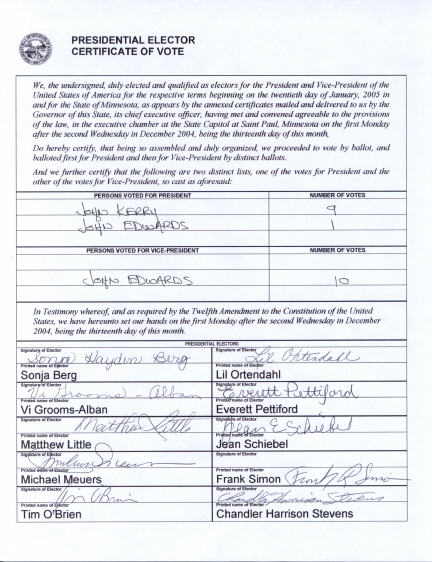
Minnesota

“In testimony whereof, and as required by the Twelth Amendment
to the Constitution of the United States we have hereunto set
our hands”

Montana

“agreeable to the provisions of law”

Nevada

“agreeably to the provisions of law”

New Jersey

“proceeded to perform the duties required of us by the Constitution
and laws of the United States.”

North Carolina

“by authority of law in us vested”

Pennsylvania

“agreeably to the provisions of law”

Rhode Island

“in pursuance of law”

South Carolina

“pursuant to the Constitution and laws of the United States and of
this state”

Tennessee

“pursuant to the Constitution and laws of the United States and of
this state”

Utah

“in pursuance of the statutes of the United States and of the statutes
of the State of Utah”

Virginia

“in pursuance of the Constitution and laws of the United States”

Washington

“pursuant to the provisions of federal and state law”

Conclusion

  • The US Constitution is clear on presidential eligibility and how
    Electoral Colleges Electors are to vote.
  • Ignorance is no excuse. Everyone involved was forewarned. Voting
    party line over law will not be tolerated.
  • Electors and state officers have signed or will sign Certificates of Voters
    for the 2008 Election. As you can see from the above, they will
    certify that they are aware of the law and are abiding by the law.
  • Kentucky gets the award for the most constitutionally clear wording
    and should be applauded for doing so.
  • There are consequences for false attesting.
  • One of the consequences is that the votes of many Electors are now
    null and void.
  • Impeachment, recall, firing, criminal charges forthcoming?

Constitution 101 classes will begin soon.

State officers, election officials, judges and, of course,
US Supreme Court Justices will be invited. Stay tuned for a
class near you. I suppose Washington DC should be first.

2008 Election Certificate of Vote, Electoral College Electors, Minnesota Certificate, Secretary of State, US Constitution, Twelfth Amendment, Governor, Obama not eligible, Citizen Wells, Democratic Disaster, December 16, 2008, Al Franken, Norm Coleman controversy

“Ignorance is not bliss.”

“Knowledge is Power.”

Minnesota could soon be famous for another 2008 Election
controversy aside from the Al Franken, Norm Coleman
senate race controversy. The Certificate of Voters must
be signed and mailed to the US Senate. If Minnesota uses
the same Certificate that was used in 2004, they had better
rethink sending it in without complying with the reference
to the Twelfth Amendment to the US Constitution. There are
2 places in the Twelfth Amendment that refer to presidential
eligibility:

“as in the case of the death or other
constitutional disability of the President.”

“But no person constitutionally ineligible to the office of
President shall be eligible to that of Vice-President of the
United States.”

Everyone involved in the presidential election has an obligation
to uphold the US Constitution. MN has taken it one step further
and explicitly included it in their certificate.

One might ask how MN Electoral College Electors would know this.
The Citizen Wells blog along with organizations like Democratic
Disaster and many other people have been notifying election
officials in all 50 states regarding the serious eligibility
issues surrounding Barack Obama and the duties of all responsible.
In addition there are many court cases in state courts as well
as before the US Supreme Court. So, ignorance of the facts or
duties will be no excuse. Check the Certificate for signatures.
Those signing the 2008 Certificate without ensuring they are
complying with the Twelfth Amendment, are most certainly
guilty of “High Crimes and Misdemeanors” and certainly removal
from office.

California Certificate of Voters is questionable

Do we have any takers?

Anyone want to call the Governor or Secretary of State’s office in Minnesota?

Recall initiatives, impeachment, removal from office?

2004 MN Certificate of Vote

mncertofvote

2008 Election Certificate of Vote, Electoral College Electors, California example, Secretary of State, US Constitution, Governor, Alan Keyes, Lawsuit, Obama not eligible, Citizen Wells, Democratic Disaster, December 16, 2008

“Ignorance is not bliss.”

“Knowledge is Power.”

The Citizen Wells blog and many other citizens have been busy for months
informing state officers, election officials, Electoral College Electors
and judges of eligibility issues surrounding Barack Obama and reminding
those people of their duty under the US Constitution, federal and state
laws. Despite these warnings and reminders, the states have plodded along
based on tradition, ignorance and party politics. Numerous lawsuits in
state and federal courts as well as the US Supreme court should have served
as a huge warning that something was wrong. We need someone like Harry
Truman to remind everyone that “The buck stops here.”

The Electoral College met yesterday and the next step in the process is for
state officials to prepare a certificate of vote and send it to the US Senate
and other locations described below. This is a very important document and in
highest sense of the word a legal document. The format of the document is
left up to the states. Remember, all of those people involved in the election
process are sworn to uphold the US Constitution. However, some of the states
have wording in their documents as a reminder of the obligation to uphold
the various laws.

We will focus on California for multiple reasons.

The following is taken from the 2004 certificate of vote:

“pursuant to the Constitution and the laws of the United States
and the state of california, do hereby certify”

From the dictionary:

pursuant to

in conformance to or agreement with; “pursuant to our agreement”; “pursuant to the dictates of one’s conscience”  

Now consider the following:

Electoral College Questions and Answers

Citizen Wells letter to Electoral College Electors

The Alan Keyes lawsuit is still alive questioning the eligibility
of Barack Obama.

The CA Secretary of State was contacted by the Citizen Wells blog,
the Democratic Disaster organization and numerous other entities.

It is clear to even a casual observer that Barack Obama is not
eligible to be president and that Electors in CA and throughout
the nation, despite compelling evidence that Obama is not eligible,
plodded along and engaged in the worst kind of party politics, and
violated the US Constitution.

2004 CA Certificate of Vote

cacertofvote2004

Electoral College Vote and subsequent procedures:

4.   Hold the Meeting of Electors
On the first Monday after the second Wednesday in December (December 15, 2008), the electors meet in their respective States. Federal law does not permit the States to choose an alternate date for the meeting of electors – it must be held on December 15, 2008. The State legislature may designate where in the State the meeting will take place, usually in the State capital. At this meeting, the electors cast their votes for President and Vice President.

If any electors are unable to carry out their duties on the day of the Electoral College meeting, the laws of each State would govern the method for filling vacancies. Any controversy or contest concerning the appointment of electors must be decided under State law at least six days prior to the meeting of the electors.

See Title 3, Section 6 of the U.S. Code
There is no Constitutional provision or Federal law requiring electors to vote in accordance with the popular vote in their States. Some States have such requirements.

5.   Prepare the Certificate of Vote
Federal law does not govern the general appearance of the Certificate of Vote. The format is determined under the law or custom of the submitting State. The electors must execute six Certificates of Vote. Federal law requires that the Certificates be prepared and authenticated in the following manner:
The Certificates of Vote must contain two distinct lists, one for President and one for Vice President.
The Certificates must list all persons who received electoral votes for President and the number of electors who voted for each person.
The Certificates must list all persons who received votes for Vice President and the number of electors who voted for each person.
The Certificates do not contain the names of persons who did not receive electoral votes.
Each of the six Certificates of Vote must be signed by all of the electors.

One of the six Certificates of Ascertainment provided to the electors by the Governor must be attached to each of the six Certificates of Vote.

Finally, each of the six pairs of Certificates must be sealed and certified by the electors as containing the list of electoral votes of that State for President and Vice President.
6.   Distribute the Paired Certificates of Vote and Certificates of Ascertainment
The six pairs of Certificates must be sent to the designated Federal and State officials as follows:
One is sent by registered mail to:
The Honorable Richard B. Cheney
President of the United States Senate
The Capitol
Washington, DC 20510

Two are sent by registered mail to:
Allen Weinstein
Archivist of the United States
National Archives and Records Administration
c/o Office of the Federal Register (NF)
8601 Adelphi Road
College Park, MD 20740-6001

Two are sent to:

The Secretary of State of each State.

One of these is held subject to the order of the President of the United States Senate or the Archivist of the United States in case the electoral votes fail to reach the Senate or the Archivist.
The other one is to be preserved by the Secretary of State for public inspection for one year.
One is sent to:

The Chief Judge of the Federal District Court located where the electors meet.

It is held subject to the order of the President of the United States Senate or the Archivist of the United States in case the electoral votes fail to reach the Senate or the Archivist.
The statutory deadline for the designated Federal and State officials to receive the electoral votes is December 24, 2008. Because of the very short time between the meetings of the electors in the States on December 15 and the December 24 statutory deadline, followed closely by the counting of electoral votes in Congress on January 6, 2009, it is imperative that the Certificates be mailed as soon as possible.

We strongly recommend that the sealed pairs of Certificates be taken to the Post Office on December 15, or no later than the morning of December 16, to minimize delays that could occur during the holiday mail season. Some States may find it useful to alert their local Postmaster to the extraordinarily important nature of the mailing. When the paired Certificates of Vote and Certificates of Ascertainment have been delivered to the designated Federal and State officials, the States’ Electoral College duties are complete.

Prior to the election this year, the Legal Staff of the Office of the Federal Register will telephone Secretaries of State and other election officials to establish contact with the States and assure the smooth operation of the Electoral College process.

Read more here:

http://www.archives.gov/federal-register/electoral-college/state_responsibilities.html#vote


Illinois Electors, Electoral College votes, December 15, 2008, Cspan coverage, Chicago IL and Democrat party in IL are revolting, IL corruption

I just observed on of the most sickening spectacles of my life.
One of the great commenters on this blog, ms. helga, notified
me that the IL Electors voting was being covered live on Cspan.
The first Elector that I heard presenting her praise, Lauren Beth
Gash, nauseated me. She lavished such undue praise on Obama that
I stood their incredulous in disbelief. Another one spoke of
knowing Obama since he was from Illinois. Most Electors that I
observed said a few obligatory party line words. After about six
Electors, I could stomach no more. No wonder Chicago and Illinois
are such a cesspool of crime and corruption. Democratic Party
Politics in IL is void of integrity. Electors are putting party
politics above the US Constitution and the American People.
Is it any wonder that the Democrat Governor of IL, Rod Blagojevich,
has been arrested and urged to resign. Obama should be next.

If someone out there was able to stomach the entire debacle,
please let us know if all Electors followed the party dictate.

Perhaps there will be electors in other states that will put
country first. If not, let’s pursue some legal remedies to
begin the huge enema that needs to be given to this country.

Wrotnowski V Bysiewicz, US Supreme Court, December 15, 2008, Justices decide Cort Wrotnowski versus Connecticut Secretary of State Bysiewicz, Writ of Mandamus, Obama not eligible, Stay denied

The US Supreme Court today, Monday, December 15, 2008, the same day
that the Electoral College is meeting to vote for president and vice
president, has decided:


08A469


WROTNOWSKI, CORT V. BYSIEWICZ, CT SEC. OF STATE


The application for stay and/or injunction addressed


to Justice Scalia and referred to the Court is denied.


Most of the Electors believe, falsely, that they have an overriding
obligation to vote base on political party dictates and/or state laws
dictating they must vote based on the popular vote. The Electors owe
allegiance only to the US Constitution and the American public.

Electoral College Questions and Answers

Citizen Wells letter to Electoral College Electors

This is the opinion of Citizen Wells and I will stand by the following:

The US Supreme Court, on multiple occasions, in regard to several
lawsuits challenging Obama’s eligibility to be president, have not
addressed three distinct constitutional issues that need to either
be ruled on or clarified:

  • Obama’s eligibility to be president and the relevance of natural
    born citizen.
  • Clarification of state powers and duties to ensure that Electoral
    College Electors have a qualified candidate on the ballot to vote for.
  • Applicability of oaths taken to uphold and defend the Constitution
    to the election process. Marbury V Madison is clear on oaths. Why are
    the states ignoring this?

I respect the institution of the US Supreme Court. That respect does
not automatically flow to the individual Justices. Respect must be
earned. Every citizen of this country has a duty to uphold the US
Constitution. Supreme Court Justices have the highest duty to
uphold the US Constitution. They are not above the law. We will hold
them accountable.

Unless I read something soon that encourages me to believe that the
US Supreme Court is functioning as it should, I am compelled to
believe that some or all of the Supreme Court Justices are guilty of
dereliction of duty, if not “High Crimes and Misdemeanors.”

Here is the heart of the complaint

“HOLDING BY THE PLAINTIFF


Holding Regarding the Role of the State Supreme Court
 

The plaintiff asserts that Connecticut law is not explicit with respect to taking action against potential election fraud at the national level.  It neither authorizes nor prohibits.  In fact, it is silent on this important issue.  The only statutes providing direction are 9-323, and for Federal Election Disputes, sec. 10-13, 10-14, 10-15, and 10-17(a) (as found in  Connecticut Appellate Practice and Procedure, 3rd Edition, chapter titled:  Original Proceedings in the Supreme Court, pages 385-387.)

We do not have a federal ballot controlled by the federal government, we have Connecticut state election for electors who are pledged for a particular candidate which allows each state to determine how and in what manner they choose to project their power at the National Electoral College.

 
In the special case of individuals seeking the office of President of the United States, the US constitution prescribes a system of electors where citizens of the respective state have a state controlled election wherein electors representing the interest of the named individual on the state ballot are so elected as to represent the interests of the respective state at the Electoral College.
 

State law determines how the electors are determined and act. Since this is in actual fact a state election, our Secretary of State has prevue over certification of not just the counts of the ballots so cast for the named candidate for President, but also the veracity of the system which including publishing and promoting the ballot and for certifying or decertifying challenged candidates; in this case the electors who act as proxies for the candidate.
 

The plaintiff argues that the Connecticut constitution and statutes and enforcement should be consistent with the principles of the U.S. constitution.  When Connecticut law provides no guidance, then an electoral duty ascribed at the national level applies at the state level as well.  If there are national standards for preventing fraud in an election, then there need to be similar standards at the state level.  The state Supreme Court is responsible for ensuring that that Connecticut laws follows the U.S. Constitution.  In particular, Sec. 10-17(a) sets forth how the State Supreme Court can provide remedy.


Holding regarding Responsibility of the Secretary of State in National Elections
 

It is argued that the lack of language in the state law does not preclude the Secretary of State, as the Chief of Elections, from verifying national candidates for whom her constituents will vote especially so when allegations of blatant profound fraud is widely asserted.


She has threaded a path to inaction by her selective choice of words.  Hers is a “sin of omission” argument.  Estopple argument would say otherwise. Furthermore, without explicate legislative direction, there are still very clear “implied duties” that follow from Connecticut Statutes, Connecticut Constitution and  the U.S. Constitution that demand consideration and action from this independent branch of Government charged with action.


There are at least four statutes that set forth the duties of the Secretary of  State.  Plaintiff bolded passages in Sec. 9-3 for emphasis.


From:  Connecticut General Statutes


Sec. 3-77. General duties; salary. Office of Secretary full time.

…  provisions of section 11-4c. The Secretary may give certified copies of any entries in such records, files, books or other papers and of the files and records of said Superior Court and of the Supreme Court, remaining in the office, which copies shall be legal evidence. … The Secretary shall receive an annual salary of one hundred ten thousand dollars and shall devote full time to the duties of the office.


 Sec. 9-3. Secretary to be Commissioner of Elections. Presumption concerning rulings and opinions.

The Secretary of the State, by virtue of the office, shall be the Commissioner of Elections of the state, with such powers and duties relating to the conduct of elections as are prescribed by law and, unless otherwise provided by state statute, the secretary’s regulations, declaratory rulings, instructions and opinions, if in written form, shall be presumed as correctly interpreting and effectuating the administration of elections and primaries under this title, except for chapter 155, provided nothing in this section shall be construed to alter the right of appeal provided under the provisions of chapter 54.


The bolded language in Sec. 9-3  demonstrates that the legislature fully expected the Secretary of State to act independently and proactively to address situations germane to the task of executing elections consistent with all requirements of the constitutions and statutes.


The implied duty argument is vital for circumstances where questions about candidates remain, even up to Election Day.  She claims no such responsibility, yet the “national system” to which Secretary Bysiewicz refers to does not exist and/or has provided no remedy.  Despite popular misunderstanding, the FEC provides no verification whatsoever.  As the Chief of Elections, the Secretary of State is responsible for protecting Connecticut voters from fraud and unfair elections. Buck stops there.


Eligibility is a fundamental issue that strikes at the heart of fair elections.  Where the question of eligibility has become so obvious and clear, as in the case of Sen. Obama’s missing birth certificate, the Secretary of State must move to protect the voters, investigating the allegations of fraud or directing such agency as deemed proper such as the SEEC which would investigate and inform the Secretary of State of their findings.”

Wednesday, November 26, 2008

Citizen Wells comment

“There is apparently more chicanery going on at the US Supreme Court. First, Leo Donofrio had an unjust encounter
with clerk Danny Bickell. Now, Cort Wrotnowski has filed an emergency stay application with the US Supreme
Court and he is receiving the same unjust treatment from clerk Danny Bickell.”
Leo Donofrio


“US Supreme Court stay clerk Danny Bickell is guilty of obstruction of justice for the second time. Yesterday, Cort Wrotnowski filed an emergency stay application in the case WROTNOWSKI V. BYSIEWICZ, CONNECTICUT SECRETARY OF STATE, which is coming directly from a Connecticut Supreme Court order of Chief Justic Chase Rogers.

Mr. Wrotnowski was informed by Danny Bickell that Mr. Bickell denied Cort’s motion based on Rule 23.3, the same grounds Mr. Bickell had illegally improperly relied on to obstruct Donofrio v. Wells, the same case which is now going before the entire Supreme Court for Conference of Dec. 5th and to which Donofrio has pointed out Mr. Bickell was guilty of attemping to overturn Justice Powell’s holding in McCarthy v. Briscoe 429 U.S. 1317 n.1 (1976) and Justice O’Conner in Western Airlines, Inc. v. Teamsters, 480 U.S. 1301 (1987).”

“Donofrio (me) believes Mr. Wrotnowski’s case is at least as strong as his own, if not stronger. And Donofrio warned Wrotnowski that Bickell was going to try the same tactic again.”

“Courageously, Mr. Wrotnowski refused to back down and eventually Bickell said he would, reluctantly, docket the case.”

December 2, 2008

Leo Donofrio

“Cort Wrotnowski, (SCOTUS Docket No. 08A469), a day after facing the shock of his life when told by a SCOTUS clerk that his renewed application to Justice Scalia would be held back for 7 days due to anthrax screening, hand delivered 10 copies of his renewed application to the Security booth at SCOTUS this morning at 10:30 AM.  Cort was told by the Clerk’s office that the papers would “probably” be in the Clerk’s office by 2:00 PM.   Cort’s application, according to Supreme Court Rule 22.1, should be “transmitted promptly” to the Honorable Associate Justice Antonin Scalia.  Keep your eyes on that Docket to see if they will follow the Rules of Court.

Citizen Wells letter to Electors, Electoral College, Uphold US Constitution, December 15, 2008 Electors vote, Obama is not eligible, Demand proof, 2008 Election, Election laws, Political Party pledges, State laws unconstitutional

“These are the times that try men’s souls. The summer soldier and
the sunshine patriot will, in this crisis, shrink from the service
of their country; but he that stands now, deserves the love and
thanks of man and woman. Tyranny, like hell, is not easily conquered;
yet we have this consolation with us, that the harder the conflict,
the more glorious the triumph.” —Thomas Paine 1778

To: 2008 Presidential Election Electoral College Electors

From: Citizen Wells

Electors,
You are being put into the uncomfortable position of having to
question your vote for president of the US. In the past, this
was a much simpler decision. Party politics has always been an
issue but in the past, after the general election, the rules
were fairly simple for you. You voted based on the party pledges
and state rules without giving it much thought. The duty to vote
in the manner as directed by the US Constitution has always been
there, but you never had to be concerned about violating it.

The 2008 Election year is unique in American History. Early in
2008 questions arose about the eligibility of John McCain and
Barack Obama to be president. John McCain put to rest any doubts
by presenting to Congress a vault copy of his birth certificate.
As the year progressed and more was learned about Obama’s history
and evasive attitude, more people began questioning Obama’s
eligibility. Several attempts were made on various websites to put
the issue to rest by presenting copies of what were alleged to be
COLB, Certificate of Live Birth. A COLB is a record of birth and
is not a legal verification of location of birth and other birth
facts.

On August 21, 2008, Philip J Berg filed a lawsuit in Philadelphia
Federal Court demanding that Barack Obama provide proof of eligibility.
Mr. Berg provided many details surrounding Obama’s past such as
Obama’s probable birth in Kenya, travel forbidden to American
citizens in Pakistan and Obama’s school records and other records’
that Obama has kept hidden from scrutiny. Many lies and deception
have been initiated by the Obama camp. One of the more interesting
ones is an AP report that tried to insinuate that Hawaiian Health
Department officials stated that Obama was born in Hawaii. They
did not state that.

Many other lawsuits have developed from the Berg lawsuit including
the Alan Keyes lawsuit in CA. Obama has spents hundreds of thousands
of dollars and employed multiple law firms to avoid proving his
eligibility. Lawsuits are still alive in the US Supreme Court and
many state courts. Lawsuits place the burden of proof on the
plaintiff and require very strict legal wording.

Why are you being put in the position of questioning your vote and
complying with the US Constitution? The Constitution gives the power
and control over elections to the states through the vote of the
Electoral College. State laws vary greatly but to various degrees
define how candidates get on the ballot and other rules controlling
the election process. Some states define the method of challenging
or ensuring that a candidate is qualified. Regardless, the states
do have the power and the duty to ensure that a presidential
candidate is qualified to take office.

Why are the states not requiring that a presidential candidate is
qualified? The short answer is that they are passing the buck. The
long answer is that tradition, politics and political parties are
driving the process when in fact political parties are given no
power or authority by the US Constitution. The typical answer
given by a secretary of state or other state election official is
that they get their cue from the political party as to who gets
put on the ballot and some even state that it is the responsibility
of the party to vet the candidate. While I see no problem getting
names for ballots from the political party, that does not remove
the Constitutional duty of the states. This is a blatant violation
of duty by state officers, election officials and judges and could
fall under “High Crimes and Misdemeanors.”

To make matters worse, the US Supreme Court, on multiple occasions, in
regard to several lawsuits challenging Obama’s eligibility to be
president, has not addressed three distinct constitutional issues
that need to either be ruled on or clarified:

  • Obama’s eligibility to be president and the relevance of natural
    born citizen.
  • Clarification of state powers and duties to ensure that Electoral
    College Electors have a qualified candidate on the ballot to vote for.
  • Applicability of oaths taken to uphold and defend the Constitution
    to the election process. Marbury V Madison is clear on oaths. Why are
    the states ignoring this?

No one wants to take responsibility. Why? Many of the reasons are
obvious. Party politics, fear of offending someone, fear of riots,
ignorance, tradition.

Electors. You are in a unique position. We have a system of checks and
balances in this country that has served us well over the centuries.
Our Founding Fathers had witnessed the monarchies and totalitarian
regimes prevalent in much of their world. They did not want that. That
is why we have executive, legislative and judicial branches and that
is also why we have an Electoral College system of voting for president.
The Electoral College was set up by the founding fathers to achieve two
primary goals.To prevent smaller states and lower population areas from
being dominated by a few larger states with higher population densities
and to prevent a tyrant or usurper of power from deceiving an uninformed
populace.

Consider the following quotes:
Alexander Hamilton echoed the thoughts of many of the founding
fathers when he wrote in the Federalist Papers: “afraid a tyrant could
manipulate public opinion and come to power.”
“The people are uninformed, and would be misled by a few designing men.”
Delegate Gerry, July 19, 1787.

Electors, you have a duty to uphold the US Constitution. As Harry Truman
said, “The buck stop here.” You can blindly follow party propaganda or
you can act as concerned Americans and do the right thing. What do other
concerned Americans expect from you? That you make certain that the
candidate that you vote for is qualified under the US Constitution,
nothing more, nothing less.

This is so simple a school child can understand it. Why would Barack
Obama spend so much money, time and resources to avoid proving his
eligibilty. The answer is obvious. Obama is not qualified. However,
all you have to do is demand that he provide legitimate, legal, proof
and you can rest easy knowing you have done your job, your duty to
this country and the US Constitution.

One person, one vote can make a difference:

1860 election: 4 electors in New Jersey, pledged for Stephen Douglas,
voted for Republican candidate Abraham Lincoln.

Those Electors helped save the Union and the world.

Electoral College Questions and Answers

2008 US Presidential Election, Electoral College, Electors, US Constitution, Federal Election Law, State Election Laws, State officers, State Election Officials, Judges, US Supreme Court Justices, Democratic Disaster, Questions and answers

“Our Constitution is in actual operation; everything appears to promise
that it will last; but nothing in this world is certain but death and
taxes.”     Benjamin Franklin

Presidential Election

Electoral College Questions and Answers

Q: What is the Electoral College?:

A: The Electoral College was established by the founding fathers
as a compromise between election of the president by Congress and
election by popular vote. The people of the United States vote for
the electors who then vote for the President. Read more

Q: Frequently asked questions:

A: Read more here

Q: Why did the Founding Fathers create the Electoral College?:

A:  The Founding Father’s intent

Here is a quote by Alexander Hamilton who, like many of the founding
fathers, was “afraid a tyrant could manipulate public opinion and come
to power.” Hamilton wrote in the Federalist Papers:

“It was equally desirable, that the immediate election should be made
by men most capable of analyzing the qualities adapted to the station,
and acting under circumstances favorable to deliberation, and to a
judicious combination of all the reasons and inducements which were
proper to govern their choice. A small number of persons, selected by
their fellow-citizens from the general mass, will be most likely to
possess the information and discernment requisite to such complicated
investigations. It was also peculiarly desirable to afford as little
opportunity as possible to tumult and disorder. This evil was not least
to be dreaded in the election of a magistrate, who was to have so
important an agency in the administration of the government as the
President of the United States. But the precautions which have been so
happily concerted in the system under consideration, promise an
effectual security against this mischief.”

Q: What are the state laws governing Electors?:

A: List of states and restrictions on Electors

Q: What are so called “Faithless Electors”?:

A: “The Supreme Court has held that the Constitution does not require
that electors be completely free to act as they choose and therefore,
political parties may extract pledges from electors to vote for the
parties’ nominees. Some State laws provide that so-called “faithless
electors” may be subject to fines or may be disqualified for casting
an invalid vote and be replaced by a substitute elector. The Supreme
Court has not specifically ruled on the question of whether pledges
and penalties for failure to vote as pledged may be enforced under
the Constitution. No elector has ever been prosecuted for failing to
vote as pledged.” Read more here

The US Supreme Court Obviously has not given Electors the option to
violate the US Constitution. Therefore, obviously, if the presidential
candidate is qualified, party pledges and state laws are permissable.

Q: What must an Elector be aware of when voting for a presidential candidate?:

 A: The following are important considerations when casting a vote. Voting
as instructed by a political party, another person, or a state law in
conflict with the US Constitution or Federal Election Laws is a serious
matter. Those not voting in accordance with higher laws are subject to
prosecution and may be guilty of “High Crimes and Misdemeanors.”
High Crimes and Misdemeanors

UNITED STATES ELECTION LAW

“The following provisions of law governing Presidential Elections are contained in Chapter 1 of Title 3, United States Code (62 Stat. 672, as amended):”

“§ 8.   The electors shall vote for President and Vice President, respectively, in the manner directed by the Constitution.”

Are Electors required to vote according to Popular Vote?

“There is no Constitutional provision or Federal law that requires
electors to vote according to the results of the popular vote in
their States. Some States, however, require electors to cast their
votes according to the popular vote. These pledges fall into two
categories—electors bound by State law and those bound by pledges
to political parties.”   (From US National Archives)

So called “Faithless Electors”

“It turns out there is no federal law that requires an elector to
vote according to their pledge (to their respective party). And so,
more than a few electors have cast their votes without following the
popular vote or their party. These electors are called “faithless
electors.”

In response to these faithless electors’ actions, several states
have created laws to enforce an elector’s pledge to his or her party
vote or the popular vote. Some states even go the extra step to
assess a misdemeanor charge and a fine to such actions. For example,
the state of North Carolina charges a fine of $10,000 to faithless
electors.

It’s important to note, that although these states have created these
laws, a large number of scholars believe that such state-level laws
hold no true bearing and would not survive constitutional challenge.”
Read more here

State Law Example: Pennsylvania

“§ 3192. Meeting of electors; duties.
The electors chosen, as aforesaid, shall assemble at the seat
of government of this Commonwealth, at 12 o’clock noon of the
day which is, or may be, directed by the Congress of the United
States, and shall then and there perform the duties enjoined upon
them by the Constitution and laws of the United States
.”

“The mysteries of the Electoral College has enabled Pennsylvania
to play an unusually major role in determining who is President.
In 1796, Thomas Jefferson defeated John Adams in Pennsylvania’s
popular election by only 62 votes, but the Pennsylvania electors
gave Jefferson 14 votes and Adams 1, though Adams did win the
Electoral vote, 71 to 68.” Read more here

Electors helped save the Union

1860 election: 4 electors in New Jersey, pledged for Stephen Douglas,
voted for Republican candidate Abraham Lincoln.

Q: What happens after the Electoral College vote?:

A: Electoral College procedures

Q: What is the significance of your vote?:

A: The US Constitution clearly gives the states the power
and duties associated with electing a qualified president.
It is also clear that the states have not performed their
duties to ensure that the Electoral College votes will be
for a Qualified candidate. The Electors have a constitutional
duty to perform that supersedes any party contract or state
law. Each day that passes without verification of eligibility
of any candidate being voted for by Electors, brings us closer
to a constitutional crisis. There are pending court cases before
the US Supreme Court and state courts. Congress will meet in
January to count and certify votes and there will certainly be
challenges in Congress. If Congress or the courts shall fail to
do their duty, a Supreme Court Justice will be faced with a
decision to uphold the Constitution. The crisis will increase
in intensity.

If anyone has any further questions they can be asked on this
blog or go to:

http://www.democratic-disaster.com/


Disclaimer: The views expressed in this article are those of the
Citizen Wells blog. Every effort has been made to ensure the
accuracy of the content. Readers are encouraged to visit source
material such as the US Constitution, Federal Election law and
state laws.