Tag Archives: Obama not eligible

Philip J Berg lawsuit, December 4, 2008, Update, US Supreme Court, Writ of Certiorari, Obama not eligible, Supreme Court Justices will decide, Conference review

Here is the latest update from Philip J Berg Dated December 4, 2008:

“We understand everyone is eager to learn what occurred on December 1, 2008, at the U.S. Supreme Court. There is a rumor claiming Mr. Obama was Court Ordered by Justice Souter to turn over his birth certificate by December 1, 2008. This is NOT true.

When a Petition for a Writ of Certiorari is filed the Defendants automatically are given thirty (30) days to respond. They are not required to respond. The end of thirty (30) Days in the Berg v. Obama case was December 1, 2008. Keep in mind, the Defendants could have mailed in a response to the Petition for Writ of Certiorari and the Court allows approximately a week for mail. If this is the case, the envelopes must be postmarked December 1, 2008.

In the afternoon, December 1, 2008, Lisa, Mr. Berg’s Assistant contacted the U.S. Supreme Court and spoke with the Clerk. The Clerk informed Lisa Mr. Berg’s Petition for Writ of Certiorari would be distributed to all nine (9) Justices and a conference should be set within ten (10) days. As I’m sure you are aware, during the conference the Justices will discuss Mr. Berg’s Petition for the Writ of Certiorari and decide whether or not to grant or deny the Petition. It only takes four (4) out of nine (9) Justices to agree to grant Mr. Berg’s Petition for Writ of Certiorari. The Justices can also make other Orders during the Conference.

Mr. Berg’s Office also learned the Solicitor General is only representing the Federal Election Commission

Additional documents will be filed within the next couple of days. All Legal briefs will be posted on our website, so please continue checking back for updates.”

Help Philip J Berg uphold the US Constitution:

Lightfoot v. Bowen, California lawsuit, Obama not eligible, Dr. Orly Taitz, Petition for Extraordinary Writ for Mandamus for Stay, Gail Lightfoot, Vice Presidential candidate, Ron Paul, co-Plaintiffs, Electors, Constitution Party, December 3, 2008

There is a new lawsuit before the California Supreme Court:

“Wednesday, December 3, 2008
Lightfoot v. Bowen: A new lawsuit
 
Today, December 3, 2008, Dr. Orly Taitz, DDS Esq filed a second lawsuit in the Supreme Court of California; Lightfoot v. Bowen. This is a “Petition for Extraordinary Writ for Mandamus for Stay”.

Orly hopes that the California Supreme Court will either issue an emergency stay of the voting of the electors, or decline to hear the case because it is a federal issue. Either way, Orly hopes that the California Supreme Court will make this pronouncement in a timely manner.

Anyone who is concerned about this issue and wishes to express their concern to the court can do so:

Interested parties cab contact the California Supreme Court by phone

213 830 7570 Main court number in Los Angeles

415-865-7060 (Chief Justice Ronald M. George in San Francisco)

(415) 865-7000 Main court number in San Francisco

or by FAX

415 865 7183 Main FAX number in San Francisco

to express their concern that this complaint be looked at in a timely matter.”

Dr. Orly Taitz website:

http://drorly.blogspot.com/2008/12/lightfoot-v-bowen-new-lawsuit.html

Here is the core of the allegations:

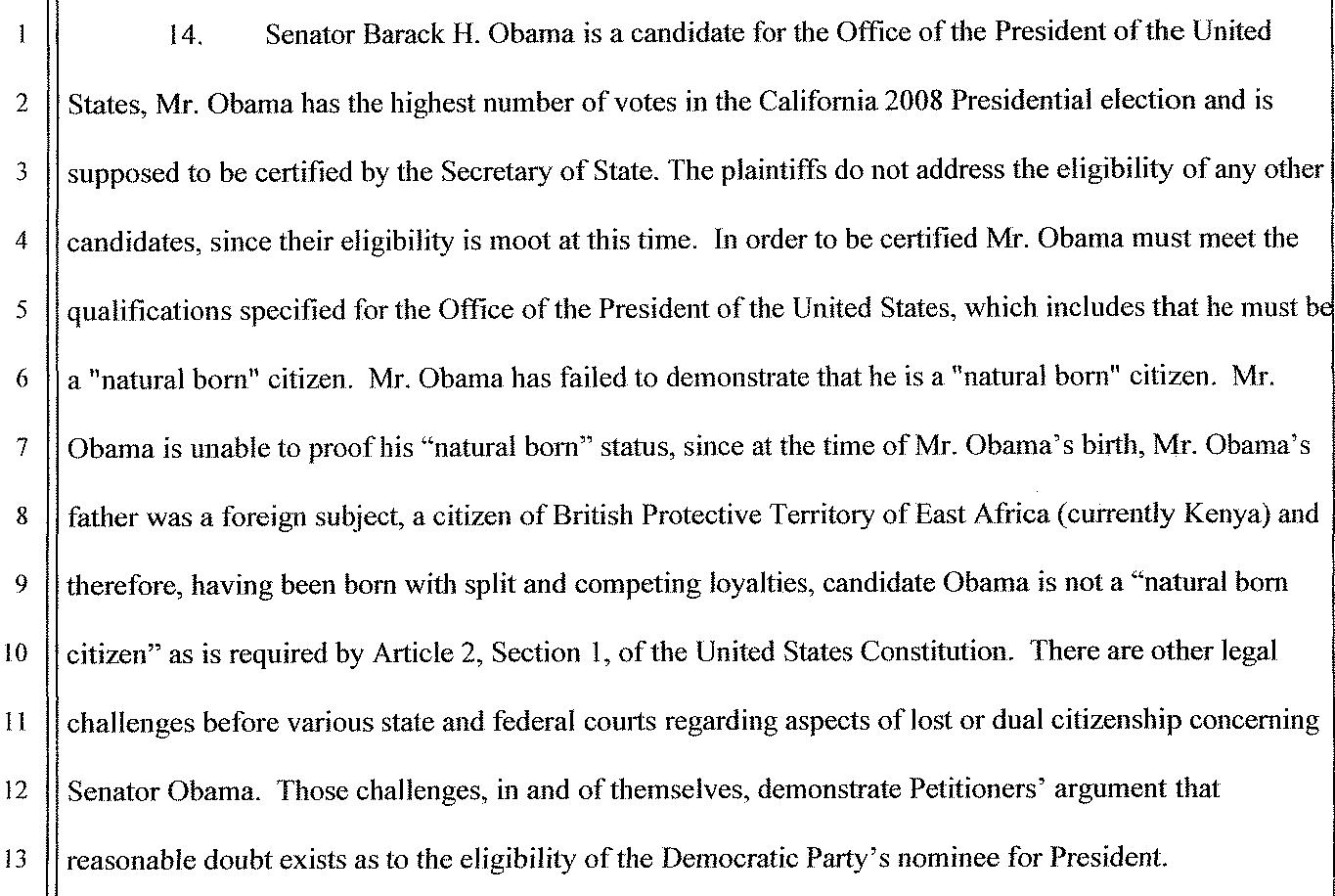
lightfootbo


View the entire Petition here:

http://www.therightsideoflife.com/?p=1481

2008 election, Obama not eligible, States have power to challenge, US Constitution, US Supreme Court, Federal Election Law, State laws, Secretary of State, Election Boards, Congress, Electoral College, Berg Donofrio Wrotnowski lawsuits, Hold accountable

The founding fathers set up guidelines for presidential elections and laid out the rules in the US
Constitution and subsequently Federal Election laws. There are two aspects that stand out about the
rules. First, the eligibility requirement for president is defined. But even more clear than
presidential eligibility, the powers given to the states are clearly defined. The states are given
control of the election process through the vote by the Electoral College Electors. The state
election laws vary widely and regardless of how explicit and detailed they are written, they all
fall under the guidelines and rules of the US Constitution. The ultimate objective is to elect a
qualified president. All laws and procedures must work to that end. The Electoral College Electors
are bound to uphold the US Constitution and therefore must only vote for a constitutionally
qualified candidate.

State laws have evolved out of tradition and indeed tradition drives many procedures and opinions
about allowing candidates on ballots and proceeding through the election process to being chosen
by Electoral College Electors. Allowing candidates to appear on ballots from instructions by major
political parties has evolved into many variations by state. The political parties are given no
special powers in the US Constitution. It is clear that each state has the full power and obligation
to ensure that a candidate running for president is qualified to hold office. To do otherwise
threatens to disenfranchise a myriad of voters. The citizens of each state expect state officers and
election officials to protect them and their votes.

It is clear that the states have been given the power to control the election process through the
Electors vote. Some states have recognized their power to challenge eligibility in state laws. It is also
clear in the Tenth Amendment to the US Constitution, part of the Bill of
Rights, that any powers not reserved for the federal government or the states, are reserved for the
people. Any state taking the position, incorrectly, that they have no power to challenge the
credentials of a presidential candidate have relinquished that power to their citizens.

One thing is clear from the research I have done. There is much confusion and misunderstanding about
the election process and responsibilities. As stated above, tradition is a huge driving force. I have
reviewed the US Constitution, Federal Election law and many state election statutes. I have also read
legal opinions and writings from constitutional experts. Below are federal and state laws and the major
players who have responsibilities in governing elections, state officers and election officials, judges
and congressmen.

Read about the US Constitution, Federal Law and Electors

Laws applicable in NC

Examples of state laws that address the issue of challenging eligibility

North Carolina

NC Statute § 163-114.  Filling vacancies among party nominees occurring after nomination and before election.

“If any person nominated as a candidate of a political party for one of the offices listed below (either in a primary or convention or by virtue of having no opposition in a primary) dies, resigns, or for any reason becomes ineligible or disqualified before the date of the ensuing general election, the vacancy shall be filled by appointment according to the following instructions:
Position

President 

Vacancy is to be filled by appointment of national executive
committee of political party in which vacancy occurs”

Georgia

§ 21-2-5.  Qualifications of candidates for federal and state office; determination of qualifications
“(a) Every candidate for federal and state office who is certified by the state executive committee of a political party or who files a notice of candidacy shall meet the constitutional and statutory qualifications for holding the office being sought.

(b) The Secretary of State upon his or her own motion may challenge the qualifications of any candidate at any time prior to the election of such candidate. Within two weeks after the deadline for qualifying, any elector who is eligible to vote for a candidate may challenge the qualifications of the candidate by filing a written complaint with the Secretary of State giving the reasons why the elector believes the candidate is not qualified to seek and hold the public office for which he or she is offering. Upon his or her own motion or upon a challenge being filed, the Secretary of State shall notify the candidate in writing that his or her qualifications are being challenged and the reasons therefor and shall advise the candidate that he or she is requesting a hearing on the matter before an administrative law judge of the Office of State Administrative Hearings pursuant to Article 2 of Chapter 13 of Title 50 and shall inform the candidate of the date, time, and place of the hearing when such information becomes available. The administrative law judge shall report his or her findings to the Secretary of State.”

Florida

102.168  Contest of election.–

“(1)  Except as provided in s. 102.171, the certification of election or nomination of any person to office, or of the result on any question submitted by referendum, may be contested in the circuit court by any unsuccessful candidate for such office or nomination thereto or by any elector qualified to vote in the election related to such candidacy, or by any taxpayer, respectively.”

Examples of ignorance, bias and tradition in positions of responsibility:

Connecticut Secretary of State
Susan Bysiewicz

“The court was satisfied that officials in Hawaii have stated that there is no doubt that the Democratic
presidential candidate was born there and that the state’s health department posseses Senator Obama’s
original birth certificate. This is now a matter of public record.”

What the Hawaii Health Officials said

Judge Surrick ruling on Philip J Berg case
Constitutional expert Ellis Washington responds:

“Constitutionally speaking, Judge Surrick’s reasoning is completely illogical and a total dereliction of his duty as a judge to substantively address this most vital constitutional controversy. Instead, in a gutless manner, Surrick dismissed Berg’s complaint 10 days before the elections on a technicality of standing, which to any rational person begs the question: If Philip J. Berg as an American citizen, a respected Democratic operative and former attorney general of Pennsylvania doesn’t have the “standing” to bring this type of lawsuit against Obama, then who in America does have standing? The good judge in all 34 pages of legal mumbo jumbo didn’t bother to answer this pivotal question.”

Read more

Senator Mel Martinez of Florida

The following is from a response from Senator Mel Martinez of Florida. Mr. Martinez clearly has no
understanding of the US Constitution  or election laws. The scary part is that Congress is part of the
last checks and balances during the election. Congress has the power to sertify the Electoral College
votes and challenge them.

“Thank you for contacting me regarding President-Elect Obama’s citizenship. I appreciate hearing from you and would like to respond to your concerns.

Like you, I believe that our federal government has the responsibility to make certain that the Constitution of the United States is not compromised. We must fight to uphold our Constitution through our courts and political processes.

Article II of the Constitution provides that “no Person except a natural born Citizen, or a Citizen of the United States, at the time of the Adoption of this Constitution, shall be eligible to the Office of President.” The Constitution, however, does not specify how that qualification for office is to be enforced. As you may know, a voter recently raised this issue before a federal court in Pennsylvania. On October 24, 2008, the United States District Court for the Eastern District of Pennsylvania released an order in the case of Berg v.Obama.In that case, the plaintiff, Phillip Berg, raised the same issue that your letter raises regarding proof of the President-Elect’s birthplace. Through his lawsuit, Mr. Berg sought to compel President-Elect Obama to produce a certified copy of his birth certificate.

The District Court dismissed Mr. Berg’s suit and held that the question of Obama’s citizenship is not a matter for a court to decide. The court further noted that voters, not courts, should decide whether a particular presidential candidate is qualified to hold office.

Presidential candidates are vetted by voters at least twice – first in the primary elections and again in the general election. President-Elect Obama won the Democratic Party’s nomination after one of the most fiercely contested presidential primaries in American history. And, he has now been duly elected by the majority of voters in the United States. Throughout both the primary and general election, concerns about Mr. Obama’s birthplace were raised. The voters have made clear their view that Mr. Obama meets the qualifications to hold the office of President.”

I contacted Senator Martinez’ office this morning and no one has responded. If Senator Martinez would like
to respond, we welcome that. If you are a citizen of the state of Florida you may want to contact Senator
Martinez and voice your concerns over his lack of knowledge. I am certain he is not the only member of
Congress to be informed.
What we have here is a failure to communicate and a real mess.

What can we do?

Continue to inform all of those involved in the election process of their legal duties and demand that
Barack Obama prove legally that he is eligible.

For those state officers, election officials, Electors, judges and congressmen that fail to do their
job and uphold the US Constitution, hold them accountable. State laws vary but their are usually remedies
available such as recall, impeachment and dismissal. Don’t forget, you have more power than is normally
recognized. The Tenth Amendment gives us plenty of power. Also, make sure you share information with
others and ask them to do the same.

God help us if the US Supreme Court fails us

Leo Donofrio lawsuit, US Supreme Court, December 5, 2008, SCOTUS, Donofrio and Wrotnowski interview, Cort Wrotnowski delayed 7 days, Anthrax facility, Update December 1, 2008, ** Breaking News **

Leo Donofrio has just announced that the Cort Wrotnowski case in the US Supreme Court has been delayed
7 days due to his renewed application being sent to an Anthrax Facility. Donofrio is outraged at this
delay tactic and behind the scenes chicanery at the Supreme Court.

Leo Donofrio’s website:

http://naturalborncitizen.wordpress.com/

Florida 2008 election, Obama not eligible, US Constitution, Florida Election Statutes, FL Secretary of State, Kurt Browning, Contest of Election, Unsuccessful candidate, Qualified Elector, Taxpayer, Patriot call, Uphold Constitution

“These are the times that try men’s souls. The summer soldier and the sunshine patriot will, in this crisis, shrink from the service of their country; but he that stands now, deserves the love and thanks of man and woman. Tyranny, like hell, is not easily conquered; yet we have this consolation with us, that the harder the conflict, the more glorious the triumph.” —Thomas Paine 1778

Call to Patriots

Defend the US Constitution

Barack Obama, who believes that the US Constitution is outdated, has thumbed his nose at the Constitution,
and instead of providing legal proof that he is elibible to be president, engaged in legal wrangling and
diversionary tactics to avoid the issue. Obama has made it past the first hurdle, the general election. We are
now left with checks and balances provided for in the US Constitution, Federal Election law and some state
statutes.

The state of Florida has a statute provision for challenging the “certification of election or nomination of any person to office…”.

Florida Election statutes

Title IX

102.168  Contest of election.–
“(1)  Except as provided in s. 102.171, the certification of election or nomination of any person to office, or of the result on any question submitted by referendum, may be contested in the circuit court by any unsuccessful candidate for such office or nomination thereto or by any elector qualified to vote in the election related to such candidacy, or by any taxpayer, respectively.

(2)  Such contestant shall file a complaint, together with the fees prescribed in chapter 28, with the clerk of the circuit court within 10 days after midnight of the date the last board responsible for certifying the results officially certifies the results of the election being contested.

(3)  The complaint shall set forth the grounds on which the contestant intends to establish his or her right to such office or set aside the result of the election on a submitted referendum. The grounds for contesting an election under this section are:”

“(b)  Ineligibility of the successful candidate for the nomination or office in dispute.”

Citizen Wells verified this statute with the office of the Secretary of State of Florida.

So, does anyone out there have the intestinal fortitude, concern over upholding and defending the US Constitution or love for this country?

Any takers for this challenge?

Perhaps Bob Barr, who ran on the Libertarian Ticket in Florida will take this challenge. Consider this video of Mr. Barr speaking about constitutional concerns:

Obama Natural Born Citizen?, Leo Donofrio explains, Donofrio lawsuit, US Supreme Court Appeal, Obama not eligible, Obama’s father Kenyan, Donofrio interprets Constitution

There has been much confusion regarding Barack Obama’s eligibility and the aspect of Leo Donofrio’s lawsuit that sets it apart is his claim that Obama does not meet the constitutional definition of Natural Born Citizen. Here is an explanation from Leo Donofrio:

“Don’t be distracted by the birth certificate and Indonesia issues. They are irrelevant to Senator Obama’s ineligibility to be President. Since Barack Obama’s father was a Citizen of Kenya and therefore subject to the jurisdiction of the United Kingdom at the time of Senator Obama’s birth, then Senator Obama was a British Citizen “at birth”, just like the Framers of the Constitution, and therefore, even if he were to produce an original birth certificate proving he were born on US soil, he still wouldn’t be eligible to be President.

The Framers of the Constitution, at the time of their birth, were also British Citizens and that’s why the Framers declared that, while they were Citizens of the United States, they themselves were not “natural born Citizens”.

Hence their inclusion of the grandfather clause in Article 2, Section 1, Clause 5 of the Constitution: No person except a natural born Citizen, or a Citizen of the United States, at the time of the Adoption of this Constitution shall be eligible to the Office of President; That’s it right there. (Emphasis added.)

The Framers wanted to make themselves eligible to be President, but they didn’t want future generations to be Governed by a Commander In Chief who had split loyalty to another Country. The Framers were comfortable making an exception for themselves. They did, after all, create the Constitution. But they were not comfortable with the possibility of future generations of Presidents being born under the jurisdiction of Foreign Powers, especially Great Britain and its monarchy, who the Framers and Colonists fought so hard in the American Revolution to be free of.

The Framers declared themselves not eligible to be President as “natural born Citizens”, so they wrote the grandfather clause in for the limited exception of allowing themselves to be eligible to the Presidency in the early formative years of our infant nation.

But nobody alive today can claim eligibility to be President under the grandfather clause since nobody alive today was a citizen of the US at the time the Constitution was adopted.

The Framers distinguished between “natural born Citizens” and all other “Citizens”. And that’s why it’s important to note the 14th Amendment only confers the title of “Citizen”, not “natural born Citizen”. The Framers were Citizens, but they weren’t natural born Citizens. They put the stigma of not being natural born Citizens on themselves in the Constitution and they are the ones who wrote the Document. Since the the Framers didn’t consider themselves to have been “natural born Citizens” due to their having been subject to British jurisdiction at their birth, then Senator Obama, having also been subject to British jurisdiction at the time of his birth, also cannot be considered a “natural born Citizen” of the United States.
Brack Obama’s official web site, Fight The Smears, admits he was a British Citizen at birth. At the very bottom of the section of his web site that shows an alleged official Certification Of Live Birth, the web site lists the following information and link thereto: FactCheck.org Clarifies Barack’s Citizenship

“When Barack Obama Jr. was born on Aug. 4,1961, in Honolulu, Kenya was a British colony, still part of the United Kingdom’s dwindling empire. As a Kenyan native, Barack Obama Sr. was a British subject whose citizenship status was governed by The British Nationality Act of 1948. That same act governed the status of Obama Sr.‘s children.

Since Sen. Obama has neither renounced his U.S. citizenship nor sworn an oath of allegiance to Kenya, his Kenyan citizenship automatically expired on Aug. 4,1982.”

That is a direct admission Barack Obama was a British citizen “at birth”.

My law suit argues that since Obama had dual citizenship “at birth” and therefore split loyalties “at birth”, he is not a “natural born citizen” of the United States. A “natural born citizen” would have no other jurisdiction over him “at birth” other than that of the United States. The Framers chose the words “natural born” and those words cannot be ignored. The status referred to in Article 2, Section 1, “natural born citizen”, pertains to the status of the person’s citizenship “at birth”.

The other numerous law suits circling Obama to question his eligibility fail to hit the mark on this issue. Since Obama was, “at birth”, a British citizen, it is completely irrelevant, as to the issue of Constitutional “natural born citizen” status, whether Obama was born in Hawaii or abroad. Either way, he is not eligible to be President.

Should Obama produce an original birth certificate showing he was born in Hawaii, it will not change the fact that Obama was a British citizen “at birth”. Obama has admitted to being a British subject “at birth”. And as will be made perfectly clear below, his being subject to British jurisdiction “at birth” bars him from being eligible to be President of the United States.

As I have argued before the United States Supreme Court, the 14th Amendment does not confer “natural born citizen” status anywhere in its text. It simply states that a person born in the United States is a “Citizen”, and only if he is “subject to the jurisdiction” of the United States.

Article 2, Section 1, Clause 5 of the Constitution of the United States:

“No person except a natural born Citizen, or a Citizen of the United States, at the time of the Adoption of this Constitution shall be eligible to the Office of President; neither shall any Person be eligible to that Office who shall not have attained to the Age of thirty-five Years, and been fourteen Years a Resident within the United States.”

The most overlooked words in that section are: “…or a Citizen of the United States, at the time of the Adoption of this Constitution…” You must recall that most, if not all, of the framers of the Constitution were, at birth, born as British subjects.

Stop and think about that.

The chosen wording of the Framers here makes it clear that they had drawn a distinction between themselves – persons born subject to British jurisdiction – and “natural born citizens” who would not be born subject to British jurisdiction or any other jurisdiction other than the United States. And so the Framers grandfathered themselves into the Constitution as being eligible to be President. But the grandfather clause only pertains to any person who was a Citizen… at the time of the Adoption of this Constitution. Obama was definitely not a Citizen at the time of the adoption of the Constitution and so he is not grandfathered in.

And so, for Obama or anybody else to be eligible to be President, they must be a “natural born citizen” of the United States “at birth”. It should be obvious that the Framers intended to deny the Presidency to anybody who was a British subject “at birth”. If this had not been their intention, then they would not have needed to include a grandfather clause which allowed the Framers themselves to be President.”

Follow Leo Donofrio’s lawsuit here:

http://thenaturalborncitizen.blogspot.com/

Electoral College facts, Obama not eligible, Electors must vote per US Constitution, Faithless Electors, Federal Election Laws, State Laws, Elector pledges, States and Electors must uphold US Constitution

“The people are uninformed, and would be misled by a few designing men.” — Delegate Gerry, July 19, 1787.

1860 election: 4 electors in New Jersey, pledged for Stephen Douglas, voted for Republican candidate Abraham Lincoln.

Electoral College must be maintained

We must adhere to spirit and intent of law

The Electoral College was set up by the founding fathers to achieve two primary goals.

  • To prevent smaller states and lower population areas from being dominated by a few larger states with
    higher population densities.
  • To prevent a tyrant or usurper of power from deceiving an uninformed populace.

I have been wading through the quagmire of the election process and in particular, the Electoral College
vote and state laws that control the election process through the Electors voting. Some aspects are
crystal clear. The US Constitution reveals the eligibility requirements for president, the responsibility
of the federal and state governments and how the electors must vote. The individual states have the
power of controlling general election ballots and orchestrating the selection, meeting and votes of the
Electoral College Electors. There is much confusion however, regarding the duties and powers of state
election officials to ensure the qualifications of candidates and in states’ power to control the way
Electors vote.

Here are the laws and facts regarding the pivotal point in the election process, the Vote by the Electoral College Electors:

US Constitution

Article. II.

Section. 1.
“No Person except a natural born Citizen, or a Citizen of the United States, at the time of the Adoption of this Constitution, shall be eligible to the Office of President; neither shall any Person be eligible to that Office who shall not have attained to the Age of thirty five Years, and been fourteen Years a Resident within the United States.”

The US Constitution gives powers to the states for the general election.
US Constitution

Article. II.

Section. 1.

“The executive Power shall be vested in a President of the United States of America. He shall hold his Office during the Term of four Years, and, together with the Vice President, chosen for the same Term, be elected, as follows:

Each State shall appoint, in such Manner as the Legislature thereof may direct, a Number of Electors, equal to the whole Number of Senators and Representatives to which the State may be entitled in the Congress: but no Senator or Representative, or Person holding an Office of Trust or Profit under the United States, shall be appointed an Elector.”

Federal Election Law: 

“The following provisions of law governing Presidential Elections are contained in Chapter 1 of Title 3, United States Code (62 Stat. 672, as amended):

§ 8.   The electors shall vote for President and Vice President, respectively, in the manner directed by the Constitution.”

From US National Archives

“There is no Constitutional provision or Federal law that requires electors to vote according to the results of the popular vote in their States. Some States, however, require electors to cast their votes according to the popular vote. These pledges fall into two categories—electors bound by State law and those bound by pledges to political parties.”

List of Electors Bound by State Law and Pledges, as of November 2000
Source:  Congressional Research Service

No Legal Requirement
Electors in these States are not bound by State Law to cast their vote for a specific candidate:

ARIZONA – 10 Electoral Votes
ARKANSAS – 6 Electoral Votes
DELAWARE – 3 Electoral Votes
GEORGIA – 15 Electoral Votes
IDAHO – 4 Electoral Votes
ILLINOIS – 21 Electoral Votes
INDIANA – 11 Electoral Votes
IOWA – 7 Electoral Votes
KANSAS – 6 Electoral Votes
KENTUCKY – 8 Electoral Votes
LOUISIANA – 9 Electoral Votes
MINNESOTA – 10 Electoral Votes
 MISSOURI – 11 Electoral Votes
NEW HAMPSHIRE – 4 Electoral Votes
NEW JERSEY – 15 Electoral Votes
NEW YORK – 31 Electoral Votes
NORTH DAKOTA – 3 Electoral Votes
PENNSYLVANIA – 21 Electoral Votes
RHODE ISLAND – 4 Electoral Votes
SOUTH DAKOTA – 3 Electoral Votes
TENNESSEE – 11 Electoral Votes
TEXAS – 34 Electoral Votes
UTAH – 5 Electoral Votes
WEST VIRGINIA – 5 Electoral Votes
 
Legal Requirements or Pledges
Electors in these States are bound by State Law or by pledges to cast their vote for a specific candidate:

ALABAMA – 9 Electoral Votes
Party Pledge / State Law – § 17-19-2
ALASKA – 3 Electoral Votes
Party Pledge / State Law – § 15.30.040; 15.30.070
CALIFORNIA – 55 Electoral Votes
State Law – § 6906
COLORADO – 9 Electoral Votes
State Law – § 1-4-304
CONNECTICUT – 7 Electoral Votes
State Law § 9-175
DISTRICT OF COLUMBIA – 3 Electoral Votes
DC Pledge / DC Law – § 1-1312(g)
FLORIDA – 27 Electoral Votes
Party Pledge / State Law – § 103.021(1)
HAWAII – 4 Electoral Votes
State Law – §§ 14-26 to 14-28
MAINE – 4 Electoral Votes
State Law – § 805
MARYLAND – 10 Electoral Votes
State Law – § 20-4
MASSACHUSETTS – 12 Electoral Votes
Party Pledge / State Law – Ch. 53, § 8, Supp.
MICHIGAN – 17 Electoral Votes
State Law – §168.47 (Violation cancels vote and elector is replaced).
MISSISSIPPI – 6 Electoral Votes
Party Pledge / State Law – §23-15-785(3)
MONTANA – 3 Electoral Votes
State Law – §13-25-104
NEBRASKA – 5 Electoral Votes
State Law – § 32-714
NEVADA – 5 Electoral Votes
State Law – § 298.050
NEW MEXICO – 5 Electoral Votes
State Law – § 1-15-5 to 1-15-9 (Violation is a fourth degree felony.)
NORTH CAROLINA – 15 Electoral Votes
State Law – § 163-212 (Violation cancels vote; elector is replaced and is subject to $500 fine.)
OHIO – 20 Electoral Votes
State Law – § 3505.40
OKLAHOMA – 7 Electoral Votes
State Pledge / State Law – 26, §§ 10-102; 10-109 (Violation of oath is a misdemeanor, carrying a fine of up to $1000.)
OREGON – 7 Electoral Votes
State Pledge / State Law – § 248.355
SOUTH CAROLINA – 8 Electoral Votes
State Pledge / State Law – § 7-19-80 (Replacement and criminal sanctions for violation.)
VERMONT – 3 Electoral Votes
State Law – title 17, § 2732
* VIRGINIA – 13 Electoral Votes
State Law – § 24.1-162 (Virginia statute may be advisory – “Shall be expected” to vote for nominees.)
WASHINGTON – 11 Electoral Votes
Party Pledge / State Law – §§ 29.71.020, 29.71.040, Supp. ($1000 fine.)
WISCONSIN – 10 Electoral Votes
State Law – § 7.75
WYOMING – 3 Electoral Votes
State Law – §§ 22-19-106; 22-19-108

http://www.archives.gov/federal-register/electoral-college/laws.html

So called “Faithless Electors”

“It turns out there is no federal law that requires an elector to vote according to their pledge (to their respective party). And so, more than a few electors have cast their votes without following the popular vote or their party. These electors are called “faithless electors.”

In response to these faithless electors’ actions, several states have created laws to enforce an elector’s pledge to his or her party vote or the popular vote. Some states even go the extra step to assess a misdemeanor charge and a fine to such actions. For example, the state of North Carolina charges a fine of $10,000 to faithless electors.

It’s important to note, that although these states have created these laws, a large number of scholars believe that such state-level laws hold no true bearing and would not survive constitutional challenge.”

Source:

http://votenovember2008.blogspot.com/2008/10/how-electoral-college-works.html


So, we have a situation where electors are referred to as “faithless” for not following the party line
or state mandate. However, the state mandates are unconstitutional. There is no such mandate from the
US Constitution or Federal Election Law. On the contrary, Electors are bound to vote in the manner defined
in the US Constitution. Following a political party or state mandate when confronted by serious concerns
regarding a presidential candidate’s eligibility, clearly violates the spirit of the law. The individual
states have the power over candidates being placed on and remaining on ballots. If they are to dictate
the manner in which Electors vote, they must exercise their powers and demand proof of eligibility
to prevent violations of constitutional law and potential voter disenfranchisement.

Let’s consider a comment from an Indiana Elector and Indiana law.

“Good Morning CW, I sent an email to all of the Electorals in Indiana asking them to support the Constitution requirements for President. This is what I received back, “Brenda I don’t represent you. I do however represent the people who voted for President Elect Barack Obama in the state of Indiana. Anthe the State did go from Red to Blue, did it not? Any think you have to further communicate with me is of no interest. Please refrain.” Cordelia Lewis-Burks. Then the next e-mail sent a picture of all the Presidents of the United States with the caption, One thing has changed” because it had Obama’s picture added. How do you get people like this to even question his qualifications? They do not care. All they care about is the fact that he is part black. By the way, this lady is black. I also have a question–why doesn’t she represent me? She is just an electoral, and I am a citizen of Indiana and the United States. Any suggestions ? Thanks. Brenda”

Electors pledge to a political party to vote for parties candidate. This is another example of party over country. The DNC did not vet Obama and now expect Electors to blindly follow.

The Indiana Elector in the above comment has pledged to the Democrat Party to vote for their candidate. I wonder if the Elector is aware of their duty to vote in the manner directed by the US Constitution. The Elector has been made aware of the eligibility issue with Barack Obama. Ignorance is not bliss. If the electors in Indiana are not made aware of their responsibilities and Obama being ineligible, then their Electoral votes must be challenged in Congress. 

Indiana Law from the Secretary of State

“After election day, each county sends its presidential vote totals to the Secretary of State in Indianapolis. It can take several weeks after the election for the final version of all these county returns to arrive. When all the county votes have been received (and any errors or omissions corrected), the Secretary of State certifies to the Governor the final, official returns for the presidential elector candidates.

The Governor then signs a “Certificate of Ascertainment.” This document officially appoints the winning presidential electors to serve as Indiana’s members of the Electoral College. Three copies of this document are immediately sent to the National Archives in Washington.”
“After an invocation and any welcoming remarks by state officials, the Certificate of Ascertainment and the roll call of the electors are read. The electors who are present then take their oath of office.”

“The presidential electors then vote for President on a paper ballot. The ballots are tabulated and the results announced. The electors then cast a separate paper ballot for Vice-President, and the result of this voting is announced. The electors then sign a Certificate that sets forth the votes each Presidential candidate and Vice-Presidential candidate received, and a transmittal cover sheet.”
INDIANA ELECTORAL COLLEGE FACTS

“Indiana has never had a “faithless” elector. Each individual has voted for the presidential and vice-presidential candidates to whom they were pledged.”

Source:

http://www.in.gov/sos/elections/voters/electors_new.html

It is obvious that we must do the following:

  • Inform Electoral College Electors, State Election Officials and congressmen of the Obama ineligibility
    issues and their duty to uphold the law and serve the citizens.
  • Educate Electors on their constitutional duty and priorities.
  • Demand that State election officials require proof of eligibility of Barack Obama and any other presidential candidates.
  • Hold all accountable.
  • However, even though some Electors have been complicit with the DNC in not vetting Obama, not all are guilty of dubious actions and all should be addressed with the proper respect.

Leo C. Donofrio NJ lawsuit, US Supreme Court Appeal, Update November 18, 2008, Obama not eligible

Below is an update on the Leo C. Donofrio NJ lawsuit that states that Obama is ineligible to be president. The lawsuit is currently appealed before the US Supreme Court:

“Applicant, Leo C. Donofrio, submitted a renewed application for emergency stay of the ’08 national election to The Honorable Associate Justice Clarence Thomas on Nov. 14, 2008 by US Postal Express Mail which was delivered at 7:46 AM, Nov. 17, 2008.

The renewed application hit the US Supreme Court on-line docket search engine sometime between noon and 2:15 PM today, Nov. 18, 2008.  Below is a copy of the docket:

_________________________________________________________________

No. 08A407
Title:
Leo C. Donofrio, Applicant
v.
Nina Mitchell Wells, New Jersey Secretary of State
Docketed:
Lower Ct: Supreme Court of New Jersey
  Case Nos.: (AM-0153-08T2 at the New Jersey Appellate Division without a docket number)
~~~Date~~~  ~~~~~~~Proceedings  and  Orders~~~~~~~~~~~~~~~~~~~~~
Nov 3 2008 Application (08A407) for stay pending the filing and disposition of a petition for a writ of certiorari, submitted to Justice Souter.
Nov 6 2008 Application (08A407) denied by Justice Souter.
Nov 14 2008 Application (08A407) refiled and submitted to Justice Thomas.

~~Name~~~~~~~~~~~~~~~~~~~~~    ~~~~~~~Address~~~~~~~~~~~~~~~~~~   ~~Phone~~~
Attorneys for Petitioner:
Leo C. Donofrio P.O. Box 93
East Brunswick, NJ  08816
Party name: Leo C. Donofrio”

Read more here:

http://blogtext.org/naturalborncitizen/

Philip J Berg lawsuit, Washington Times Ad, US Supreme Court appeal, Obama not eligible, US Constitution must be upheld, November 17, 2008

The Philip J Berg lawsuit that states that Barack Obama is not eligible to be president is still before the
Supreme Court of the United States. Mr. Berg and many citizens insist that we uphold the US Constitution.
Mr. Berg has an ad in the Washington Times for Monday, November 17, 2008.

bergad

Help Philip J Berg uphold the Constitution:

http://obamacrimes.com

Obama not eligible, NC lawsuit, Donald Sullivan, Lt Col, Elaine Marshall, NC Secretary of State, North Carolina Board of Elections, NC Electoral College, November 7, 2008, Class Action Lawsuit, Support and defend Constitution, Citizen Wells update from Lt Col Sullivan, November 16, 2008

I spoke to Lt. Col. Donald Sullivan Friday night, November 14, 2008. Mr. Sullivan confirmed that his lawsuit
challenging Barack Obama’s eligibility to be president was filed on November 7, 2008 and is awaiting being
put on the Superior Court calendar in Pender County NC. We discussed upholding the US Constitution and our reasons for being committed to ensuring that the Constitution be followed and upheld, I explained what
this blog has been involved in and offered my services.

Before the general election, Citizen Wells sent notification to all 50 states of the Philip J Berg lawsuit
and Barack Obama’s failure to provide legal proof of his eligibility to be president. I contacted the
NC Board of Elections and Secretary of State’s office on multiple occasions via telephone and email. The
Board of Elections response was that they had been aware of the Berg lawsuit for several months and they tried to compare it to a lawsuit filed earlier against John McCain. The response I received had an air of political bias.

I will cooperate with Lt. Col. Donald Sullivan as required. Independently, I am going to reestablish contact
with the NC Secretary of State’s office and remind them of their constitutional duty, go over NC election
law and relate lawsuits in California as well as 2 still before the US Supreme Court. I will also be
presenting a new article that I believe will provide some new insights into the responsibilities of
federal and state judges as well as state officials.

Here are some exerpts from the lawsuit filed on November 7, 2008, by Lt Col. Donald Sullivan against Elaine Marshall, the NC Secretary of State, and the NC Board of Elections:
“1.2 Defendant, North Carolina Board of Elections, is an appointed agency of the State of North Carolina General Assembly, with oversight authority in matters pertaining to State elections and election irregularities including, but not limited to, candidate/electee eligibility, with offices at 506 Harrington Street, Raleigh, NC, 27611, and with a mailing address of PO Box 27255, Raleigh, NC, 27611-7255. Upon information and belief, the Process Agent for said entity is Director Gary O. Bartlett of the same address.

1.2. Defendant, Elaine F. Marshall, a/k/a Elaine Marshall is an adult individual with an office address of Old Revenue Building, 2 S. Salisbury Street, PO Box 29622, Raleigh, NC, 27626-062, and the elected North Carolina State Secretary of State. Upon information and belief, the Process Agent for said individual and entity is Ann Wall at PO Box 29622, Raleigh, NC, 27626.”


 “MEMORANDUM IN SUPPORT OF PLAINTIFF’S DEMAND FOR AN ORDER FOR INJUNCTIVE RELIEF

4.1.

I, Lt. Col. Donald Sullivan, Plaintiff, hereby offer this memorandum in support of my motion for injunctive relief and to demand performance of constitutional duties related to the offices of the North Carolina Board of Elections and the North Carolina State Secretary of State, Elaine F. Marshall, a/k/a Elaine Marshall, [hereinafter Defendants”]. Upon information and belief, all my allegations and aversions herein are true and verifiable.

4.2.

My complaint challenges Mr. Barack Hussein Obama’s, eligibility to run for, or hold, the Office of President of the United States and demands that the Offices of the Board of Elections and the Secretary of State make such determination by acquisition of original documentation or by receipt of verifiable information from other government entities so charged with overseeing the election process, such as the Federal Elections Commission.

4.3.

I argue that when a challenge is received by the North Carolina State Board of Elections to the qualification for office of an individual appearing on the North Carolina State Ballot, that the entire burden of proof falls on the candidate for Office to present such information and documentation to the North Carolina State Board of Elections as would be normal and customary to establish one’s minimum qualifications for office.

4.4.

I further argue that the Office of the Board of Elections has the Constitutional and Statutory authority to make such determinations as part of certifying and executing fair and open elections.

4.5.

I further argue that it is sufficient to show only reasonable cause for complaint to the Board of Elections for that Board to require documentation of the respective individual relevant to determination of minimum qualification; that, lacking explicit statute defining the requisite documentation, the Board of Elections has the intrinsic authority to set those reasonable standards that would establish certain confidence in the people in the electoral process.

4.6.

Plaintiff seeks focused and expedited review, to protect the veracity of the electoral process, maintain the people’s confidence in the government and to support defend the Constitutions of North Carolina and of the United States of America.”