
Category Archives: Superior Court

Federal Grand Jury, 4th branch of government, Leo Donofrio, 5th Amendment, US Constitution, Constitutional power, We the people, US Supreme Court has upheld, Creighton Law Review, American Juror, Federal Rules of Criminal Procedure 1946, Rule 7

From Leo Donofrio:

The Federal Grand Jury is the 4th Branch of Government

[I originally posted this essay at my Citizenspook blog back in 2005.]

All of us may one day serve as grand jurors in federal court, and I hope this article will educate the reader to his/her true power as granted by the Constitution. For that power, despite having been hidden for many years behind the veil of a legislative fraud, still exists in all of its glory in the 5th Amendment to the Constitution. The US Supreme Court has confirmed and reinforced that power.

So please, copy this report and paste it far and wide. It is not spin. It is not false. It is not for sale, it is not copyrighted by me, so paste and quote it freely. This report is the truth and we need truth, now, more than ever.

The Constitutional power of “we the people” sitting as grand jurors has been subverted by a deceptive play on words since 1946 when the Federal Rules of Criminal Procedure were enacted. Regardless, the power I am going to explain to you still exists in the Constitution, and has been upheld by the United States Supreme Court despite the intention of the legislature and other legal scholars to make our power disappear with a cheap magic trick.

Repeat a lie with force and repetition and the lie becomes known as truth. In the case of the 5th Amendment to the Constitution, the power of the grand jury, to return “presentments” on its own proactive initiation, without reliance upon a US Attorney to concur in such criminal charges, has been usurped by an insidious play on words.

Most of this article is going to quote other scholars, judges and legislators as I piece together a brief but thorough history of the federal grand jury for your review. But the punch line is my personal contribution to the cause:

UNITED STATES CITIZENS SITTING AS FEDERAL GRAND JURORS ARE THE FOURTH BRANCH OF THE UNITED STATES GOVERNMENT.

My input into this vital fight is no more than the analysis of a few carefully used words. It only took a small sleight of pen back in 1946 to hide our power, and it won’t take more than a few words to take that power back. But a proper overview is necessary for most of you who are unfamiliar with the issue at hand. So let me provide you with some history and then we’ll see what went wrong and how to correct it.

HISTORY OF FEDERAL GRAND JURY POWER

I want to draw your attention to a law review article, CREIGHTON LAW REVIEW, Vol. 33, No. 4 1999-2000, 821, IF IT’S NOT A RUNAWAY, IT’S NOT A REAL GRAND JURY by Roger Roots, J.D.

“In addition to its traditional role of screening criminal cases for prosecution, common law grand juries had the power to exclude prosecutors from their presence at any time and to investigate public officials without governmental influence. These fundamental powers allowed grand juries to serve a vital function of oversight upon the government. The function of a grand jury to ferret out government corruption was the primary purpose of the grand jury system in ages past.”

The 5th Amendment:

“No person shall be held to answer for a capital, or otherwise infamous crime, unless on a presentment or indictment of a Grand Jury.”

An article appearing in American Juror, the newsletter of the American Jury Institute and the Fully Informed Jury Association, citing the famed American jurist, Joseph Story, explained :

“An indictment is a written accusation of an offence preferred to, and presented, upon oath, as true, by a grand jury, at the suit of the government. An indictment is framed by the officers of the government, and laid before the grand jury. Presentments, on the other hand, are the result of a jury’s independent action:

‘A presentment, properly speaking, is an accusation, made by a grand jury of its own mere motion, of an offence upon its own observation and knowledge, or upon evidence before it, and without any bill of indictment laid before it at the suit of the government. Upon a presentment, the proper officer of the court must frame an indictment, before the party accused can be put to answer it.’ “

Back to the Creighton Law Review:

“A ‘runaway’ grand jury, loosely defined as a grand jury which resists the accusatory choices of a government prosecutor, has been virtually eliminated by modern criminal procedure. Today’s “runaway” grand jury is in fact the common law grand jury of the past. Prior to the emergence of governmental prosecution as the standard model of American criminal justice, all grand juries were in fact “runaways,” according to the definition of modern times; they operated as completely independent, self-directing bodies of inquisitors, with power to pursue unlawful conduct to its very source, including the government itself.”

So, it’s clear that the Constitution intended to give the grand jury power to instigate criminal charges, and this was especially true when it came to government oversight. But something strange happened on the way to the present. That power was eroded by a lie enacted by the legislative branch. The 5th Amendment to the Constitution still contains the same words quoted above, but if you sit on a grand jury and return a “presentment” today, the prosecutor must sign it or it probably won’t be allowed to stand by the judge and the criminal charges you have brought to the court’s attention will be swept away. And the reason for this can be found in a legislative lie of epic proportions.

Mr. Roots weighs in again:

“In 1946, the Federal Rules of Criminal Procedure were adopted, codifying what had previously been a vastly divergent set of common law procedural rules and regional customs.[86] In general, an effort was made to conform the rules to the contemporary state of federal criminal practice.[87] In the area of federal grand jury practice, however, a remarkable exception was allowed. The drafters of Rules 6 and 7, which loosely govern federal grand juries, denied future generations of what had been the well-recognized powers of common law grand juries: powers of unrestrained investigation and of independent declaration of findings. The committee that drafted the Federal Rules of Criminal Procedure provided no outlet for any document other than a prosecutor-signed indictment. In so doing, the drafters at least tacitly, if not affirmatively, opted to ignore explicit constitutional language.“[88]“

Rule 7 of the Federal Rules of Criminal Procedure (FRCP):

“An offense which may be punished by death shall be prosecuted by indictment. An offense which may be punished by imprisonment for a term exceeding one year or at hard labor shall be prosecuted by indictment…”

No mention of “presentments” can be found in Rule 7. But they are mentioned in Note 4 of the Advisory Committee Notes on the Rules:

“4. Presentment is not included as an additional type of formal accusation, since presentments as a method of instituting prosecutions are obsolete, at least as concerns the Federal courts.”

The American Juror published the following commentary with regards to Note 4:

“[W]hile the writers of the federal rules made provisions for indictments, they made none for presentments. This was no oversight. According to Professor Lester B. Orfield, a member of the Advisory Committee on Rules of Criminal Procedure, the drafters of Federal Rules of Criminal Procedure Rule 6 decided the term presentment should not be used, even though it appears in the Constitution. Orfield states [22 F.R.D. 343, 346]:

‘There was an annotation by the Reporter on the term presentment as used in the Fifth Amendment. It was his conclusion that the term should not be used in the new rules of criminal procedure. Retention might encourage the use of the run-away grand jury as the grand jury could act from their own knowledge or observation and not only from charges made by the United States attorney. It has become the practice for the United States Attorney to attend grand jury hearings, hence the use of presentments have been abandoned.’ “

That’s a fascinating statement: “Retention might encourage…the grand jury [to] act from their own knowledge or observation.” God forbid, right America? The nerve of these people. They have the nerve to put on the record that they intended to usurp our Constitutional power, power that was intended by the founding fathers, in their incredible wisdom, to provide us with oversight over tyrannical government.

And so they needed a spin term to cast aspersions on that power. The term they chose was, “runaway grand jury”, which is nothing more than a Constitutionally mandated grand jury, aware of their power, and legally exercising that power to hold the federal beast in check, as in “checks and balances”.

The lie couldn’t be inserted into the Constitution, so they put it in a statute and then repeated it. And scholars went on to repeat it, and today, as it stands, the grand jury has effectively been lied into the role of submissive puppet of the US Attorney.

The
American Juror publication included a very relevant commentary:

“Of course, no statute or rule can alter the provisions of the Constitution, since it is the supreme law of the land. But that didn’t prevent the federal courts from publishing a body of case law affirming the fallacy that presentments were abolished. A particularly egregious example:

‘A rule that would permit anyone to communicate with a grand jury without the supervision or screening of the prosecutor or the court would compromise, if not utterly subvert, both of the historic functions of the grand jury, for it would facilitate the pursuit of vendettas and the gratification of private malice. A rule that would open the grand jury to the public without judicial or prosecutorial intervention is an invitation to anyone interested in trying to persuade a majority of the grand jury, by hook or by crook, to conduct investigations that a prosecutor has determined to be inappropriate or unavailing.’ [7]

What is the result? Investigating seditious acts of government officials can be deemed inappropriate or unavailing by the prosecutor, or the judge can dismiss the grand jurors pursuing such investigations. Consequently, corrupt government officials have few natural enemies and go about their seditious business unimpeded.

By the way, they made a rule to take care of runaways too, in 1946: Rule 6(g):

‘At any time for cause shown the court may excuse a juror either temporarily or
permanently, and in the latter event the court may impanel another person in place of the juror excused.’ Now judges can throw anyone off a grand jury, or even dis-impanel a grand jury entirely, merely for exercising its discretion.”

Now let me add my two cents to this argument:

Most of the discussion about Note 4 to Rule 7 of the FRCP takes for granted that the common law use of “presentments” (as codified in the 5th Amendment) was made “illegal” in 1946 by this act. Nothing could be more false. Note 4 does not contain language that makes the use of presentments “illegal”, although it had chosen its words carefully to make it appear as if that is what the legislative branch intended. But let’s look at Note 4 again:

“4. Presentment is not included as an additional type of formal accusation, since presentments as a method of instituting prosecutions are obsolete, at least as concerns the Federal courts.”

The key word is, “obsolete”. Obsolete means “outmoded”, or “not in use anymore”, but it does not mean “abolished” or “illegal”. And therein lies the big lie. The legislature knew it could not directly overrule the Constitution, especially with something so clearly worded as the 5th Amendment, which grants a power to the people which has a long and noble purpose in criminal jurisprudence. But the federal beast legislative branch sought more power to protect themselves from the oversight of “we the people”, and in its vampire like thirst for more governmental control, it inserted this insidious Note 4 in the hope that scholars and judges would play along with their ruse, or in the alternative, their ruse would appear to be legally viable.

Let’s look at some authoritative legal resources which discuss Note 4:

Susan Brenner, THE VOICE OF THE COMMUNITY: A CASE FOR GRAND JURY INDEPENDENCE:

“Finally, federal grand juries’ subservience to prosecutors was exacerbated when the federal system eliminated the use of presentments, which allowed a grand jury to bring charges on its own initiative. (N35) Now, federal grand jurors cannot return charges in the form of an indictment without a prosecutor’s consent. (N36) Elimination of the presentment demonstrates the historical trend towards elimination of proactive features in the grand jury system.”

Did Brenner fall for the lie or did she cleverly further it when she said, “[T]he federal system eliminated the use of presentments”? The federal system did no such thing. Note 4 said the use of presentments was “obsolete”. First of all, Note 4 is not a law in itself. It is a Note to a law, and the law as written, does not have anything to say about presentments. You see the leap Brenner has made? The Constitution provides for “presentments”, then the FRCP are enacted and the Rules therein do not mention presentments, nor due they ban presentments, and if they did, such a ban would be unconstitutional, since an administrative enactment regarding procedure can not overrule the Constitution.

Regardless, it’s irrelevant, since the FRCP does not mention “presentments”. Note 4 simply states that “presentments” allowed for in the 5th Amendment of the Constitution have become “obsolete”, or outmoded, which is not to say that they were “eliminated”. Shame on you Susan Brenner. You know damn well that the Constitution can only be changed by an official Amendment to it. Nothing can be “eliminated” from the Constitution by an administrative note.

The use of presentments had become obsolete because the grand jurors were not aware of their power. So the use of “presentments” became more and more rare, and then in 1946 the legislative branch seized upon the moment to make this power disappear by waving its magic wand over the Constitution.

Mr. Root got it wrong in the
Creighton Law Review as well:

“Before the Federal Rules of Criminal Procedure — which made independently-acting grand juries illegal for all practical purposes — grand juries were understood to have broad powers to operate at direct odds with both judges and prosecutors…”

The FRCP did not make it “illegal for all practical purposes”. That’s patently false. I don’t know if Mr. Root, and/or Susan Brenner, were acting as the magician’s assistant, but I can’t imagine how these educated scholars could be so incredibly ignorant of basic Constitutional law. Give me a damn break.

But if enough people repeat the lie, the lie appears to be the truth.

But we have it on good authority, the Supreme Court, that the lie has no legal effect.

Justice Powell, in United States v. Calandra, 414 U.S. 338, 343 (1974), stated:

“The institution of the grand jury is deeply rooted in Anglo-American history. [n3] In England, the grand jury [p343] served for centuries both as a body of accusers sworn to discover and present for trial persons suspected of criminal wrongdoing and as a protector of citizens against arbitrary and oppressive governmental action. In this country, the Founders thought the grand jury so essential to basic liberties that they provided in the Fifth Amendment that federal prosecution for serious crimes can only be instituted by “a presentment or indictment of a Grand Jury.” Cf. Costello v. United States, 350 U.S. 359, 361-362 (1956). The grand jury’s historic functions survive to this day. Its responsibilities continue to include both the determination whether there is probable cause to believe a crime has been committed and the protection of citizens against unfounded criminal prosecutions. Branzburg v. Hayes, 408 U.S. 665, 686-687 (1972).”

The Note 4 lie is smashed on the SCOTUS altar, “The grand jury’s historic functions survive to this day.” Take that Note 4!

Antonin Scalia effectively codified the unique independent power of the Fourth Branch into the hands of all citizens sitting as federal grand jurors. In discussing that power and unique independence granted to the grand jury, the United States Supreme Court, in
United States v. Williams, 504 U.S. 36 at 48 (1992), Justice Scalia, delivering the opinion of the court, laid down the law of the land:

“‘[R]ooted in long centuries of Anglo-American history,” Hannah v. Larche, 363 U.S. 420, 490 (1960) (Frankfurter, J., concurring in result), the grand jury is mentioned in the Bill of Rights, but not in the body of the Constitution. It has not been textually assigned, therefore, to any of the branches described in the first three Articles. It “`is a constitutional fixture in its own right.’” United States v. Chanen, 549 F.2d 1306, 1312 (CA9 1977) (quoting Nixon v. Sirica, 159 U.S. App. D.C. 58, 70, n. 54, 487 F.2d 700, 712, n. 54 (1973)), cert. denied, 434 U.S. 825 (1977). ‘ “

I submit to you that this passage sets the stage for a revolutionary knew context necessary and Constitutionally mandated to “we the people”, THE FOURTH BRANCH of the Government of the United States. Besides, the Legislative, Executive, and Judicial branches, I submit that there is a fourth branch, THE GRAND JURY, and “we the people” when sitting as grand jurors, are, as Scalia quoted in US v. Williams, ” a constitutional fixture in its own right”. Yes, damn it. That is exactly what the grand jury is, and what it was always intended to be.

Scalia also stated, that “the grand jury is an institution separate from the courts, over whose functioning the courts do not preside…” Id.

And finally, to seal the deal, Scalia hammered the point home:

“In fact, the whole theory of its function is that it belongs to no branch of the institutional Government, serving as a kind of buffer or referee between the Government and the people. See Stirone v. United States, 361 U.S. 212, 218 (1960); Hale v. Henkel, 201 U.S. 43, 61 (1906); G. Edwards, The Grand Jury 28-32 (1906). Although the grand jury normally operates, of course, in the courthouse and under judicial auspices, its institutional relationship with the Judicial Branch has traditionally been, so to speak, at arm’s length. Judges’ direct involvement in the functioning of the grand jury has generally been confined to the constitutive one of calling the grand jurors together and administering their oaths of office. See United States v. Calandra, 414 U.S. 338, 343 (1974); Fed.Rule Crim.Proc. 6(a). [504 U.S. 36, 48] “

This miraculous quote says it all, “…the whole theory of its function is that it belongs to no branch of the institutional Government, serving as a kind of buffer or referee between the Government and the people.” The Constitution of the United States, as interpreted by the Supreme Court, gives rise to a FOURTH BRANCH of Government, THE GRAND JURY. We the people have been charged with oversight of the government in our roles as grand jurors.

And at this critical time in American history, we must, for the protection of our constitutional republic, take back our power and start acting as powerful as the other branches of government.

The law is on our side. So please spread this knowledge as far and wide as you can. We the people have the right and power under the 5th Amendment of the Constitution to charge this government with crimes by returning presentments regardless of whether the US Attorneys or the federal judges agree with us. As the Supreme Court has so brilliantly stated, we are the “buffer between the Government and the people.”

Take the reins America. Pass it on. The Fourth Branch is alive and kickin’.”
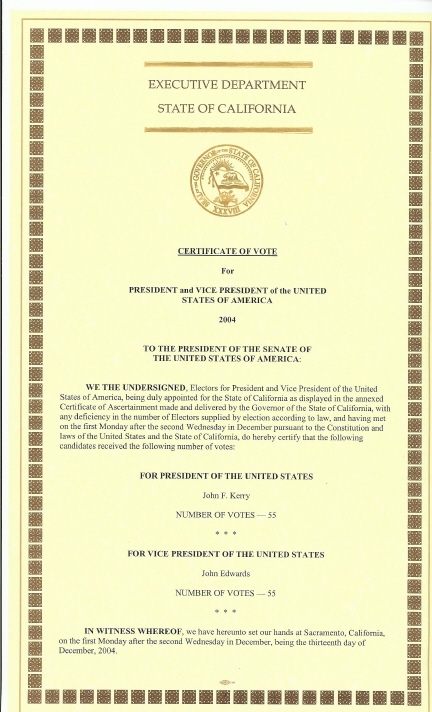
2008 Election Certificate of Vote, Electoral College Electors, California example, Secretary of State, US Constitution, Governor, Alan Keyes, Lawsuit, Obama not eligible, Citizen Wells, Democratic Disaster, December 16, 2008

“Ignorance is not bliss.”

“Knowledge is Power.”

The Citizen Wells blog and many other citizens have been busy for months
informing state officers, election officials, Electoral College Electors
and judges of eligibility issues surrounding Barack Obama and reminding
those people of their duty under the US Constitution, federal and state
laws. Despite these warnings and reminders, the states have plodded along
based on tradition, ignorance and party politics. Numerous lawsuits in
state and federal courts as well as the US Supreme court should have served
as a huge warning that something was wrong. We need someone like Harry
Truman to remind everyone that “The buck stops here.”

The Electoral College met yesterday and the next step in the process is for
state officials to prepare a certificate of vote and send it to the US Senate
and other locations described below. This is a very important document and in
highest sense of the word a legal document. The format of the document is
left up to the states. Remember, all of those people involved in the election
process are sworn to uphold the US Constitution. However, some of the states
have wording in their documents as a reminder of the obligation to uphold
the various laws.

We will focus on California for multiple reasons.

The following is taken from the 2004 certificate of vote:

“pursuant to the Constitution and the laws of the United States
and the state of california, do hereby certify”

From the dictionary:

pursuant to

in conformance to or agreement with; “pursuant to our agreement”; “pursuant to the dictates of one’s conscience”  

Now consider the following:

Electoral College Questions and Answers

Citizen Wells letter to Electoral College Electors

The Alan Keyes lawsuit is still alive questioning the eligibility
of Barack Obama.

The CA Secretary of State was contacted by the Citizen Wells blog,
the Democratic Disaster organization and numerous other entities.

It is clear to even a casual observer that Barack Obama is not
eligible to be president and that Electors in CA and throughout
the nation, despite compelling evidence that Obama is not eligible,
plodded along and engaged in the worst kind of party politics, and
violated the US Constitution.

2004 CA Certificate of Vote

cacertofvote2004

Electoral College Vote and subsequent procedures:

4.   Hold the Meeting of Electors
On the first Monday after the second Wednesday in December (December 15, 2008), the electors meet in their respective States. Federal law does not permit the States to choose an alternate date for the meeting of electors – it must be held on December 15, 2008. The State legislature may designate where in the State the meeting will take place, usually in the State capital. At this meeting, the electors cast their votes for President and Vice President.

If any electors are unable to carry out their duties on the day of the Electoral College meeting, the laws of each State would govern the method for filling vacancies. Any controversy or contest concerning the appointment of electors must be decided under State law at least six days prior to the meeting of the electors.

See Title 3, Section 6 of the U.S. Code
There is no Constitutional provision or Federal law requiring electors to vote in accordance with the popular vote in their States. Some States have such requirements.

5.   Prepare the Certificate of Vote
Federal law does not govern the general appearance of the Certificate of Vote. The format is determined under the law or custom of the submitting State. The electors must execute six Certificates of Vote. Federal law requires that the Certificates be prepared and authenticated in the following manner:
The Certificates of Vote must contain two distinct lists, one for President and one for Vice President.
The Certificates must list all persons who received electoral votes for President and the number of electors who voted for each person.
The Certificates must list all persons who received votes for Vice President and the number of electors who voted for each person.
The Certificates do not contain the names of persons who did not receive electoral votes.
Each of the six Certificates of Vote must be signed by all of the electors.

One of the six Certificates of Ascertainment provided to the electors by the Governor must be attached to each of the six Certificates of Vote.

Finally, each of the six pairs of Certificates must be sealed and certified by the electors as containing the list of electoral votes of that State for President and Vice President.
6.   Distribute the Paired Certificates of Vote and Certificates of Ascertainment
The six pairs of Certificates must be sent to the designated Federal and State officials as follows:
One is sent by registered mail to:
The Honorable Richard B. Cheney
President of the United States Senate
The Capitol
Washington, DC 20510

Two are sent by registered mail to:
Allen Weinstein
Archivist of the United States
National Archives and Records Administration
c/o Office of the Federal Register (NF)
8601 Adelphi Road
College Park, MD 20740-6001

Two are sent to:

The Secretary of State of each State.

One of these is held subject to the order of the President of the United States Senate or the Archivist of the United States in case the electoral votes fail to reach the Senate or the Archivist.
The other one is to be preserved by the Secretary of State for public inspection for one year.
One is sent to:

The Chief Judge of the Federal District Court located where the electors meet.

It is held subject to the order of the President of the United States Senate or the Archivist of the United States in case the electoral votes fail to reach the Senate or the Archivist.
The statutory deadline for the designated Federal and State officials to receive the electoral votes is December 24, 2008. Because of the very short time between the meetings of the electors in the States on December 15 and the December 24 statutory deadline, followed closely by the counting of electoral votes in Congress on January 6, 2009, it is imperative that the Certificates be mailed as soon as possible.

We strongly recommend that the sealed pairs of Certificates be taken to the Post Office on December 15, or no later than the morning of December 16, to minimize delays that could occur during the holiday mail season. Some States may find it useful to alert their local Postmaster to the extraordinarily important nature of the mailing. When the paired Certificates of Vote and Certificates of Ascertainment have been delivered to the designated Federal and State officials, the States’ Electoral College duties are complete.

Prior to the election this year, the Legal Staff of the Office of the Federal Register will telephone Secretaries of State and other election officials to establish contact with the States and assure the smooth operation of the Electoral College process.

Read more here:

http://www.archives.gov/federal-register/electoral-college/state_responsibilities.html#vote


Wrotnowski V Bysiewicz, US Supreme Court, December 15, 2008, Justices decide Cort Wrotnowski versus Connecticut Secretary of State Bysiewicz, Writ of Mandamus, Obama not eligible, Stay denied

The US Supreme Court today, Monday, December 15, 2008, the same day
that the Electoral College is meeting to vote for president and vice
president, has decided:


08A469


WROTNOWSKI, CORT V. BYSIEWICZ, CT SEC. OF STATE


The application for stay and/or injunction addressed


to Justice Scalia and referred to the Court is denied.


Most of the Electors believe, falsely, that they have an overriding
obligation to vote base on political party dictates and/or state laws
dictating they must vote based on the popular vote. The Electors owe
allegiance only to the US Constitution and the American public.

Electoral College Questions and Answers

Citizen Wells letter to Electoral College Electors

This is the opinion of Citizen Wells and I will stand by the following:

The US Supreme Court, on multiple occasions, in regard to several
lawsuits challenging Obama’s eligibility to be president, have not
addressed three distinct constitutional issues that need to either
be ruled on or clarified:

  • Obama’s eligibility to be president and the relevance of natural
    born citizen.
  • Clarification of state powers and duties to ensure that Electoral
    College Electors have a qualified candidate on the ballot to vote for.
  • Applicability of oaths taken to uphold and defend the Constitution
    to the election process. Marbury V Madison is clear on oaths. Why are
    the states ignoring this?

I respect the institution of the US Supreme Court. That respect does
not automatically flow to the individual Justices. Respect must be
earned. Every citizen of this country has a duty to uphold the US
Constitution. Supreme Court Justices have the highest duty to
uphold the US Constitution. They are not above the law. We will hold
them accountable.

Unless I read something soon that encourages me to believe that the
US Supreme Court is functioning as it should, I am compelled to
believe that some or all of the Supreme Court Justices are guilty of
dereliction of duty, if not “High Crimes and Misdemeanors.”

Here is the heart of the complaint

“HOLDING BY THE PLAINTIFF


Holding Regarding the Role of the State Supreme Court
 

The plaintiff asserts that Connecticut law is not explicit with respect to taking action against potential election fraud at the national level.  It neither authorizes nor prohibits.  In fact, it is silent on this important issue.  The only statutes providing direction are 9-323, and for Federal Election Disputes, sec. 10-13, 10-14, 10-15, and 10-17(a) (as found in  Connecticut Appellate Practice and Procedure, 3rd Edition, chapter titled:  Original Proceedings in the Supreme Court, pages 385-387.)

We do not have a federal ballot controlled by the federal government, we have Connecticut state election for electors who are pledged for a particular candidate which allows each state to determine how and in what manner they choose to project their power at the National Electoral College.

 
In the special case of individuals seeking the office of President of the United States, the US constitution prescribes a system of electors where citizens of the respective state have a state controlled election wherein electors representing the interest of the named individual on the state ballot are so elected as to represent the interests of the respective state at the Electoral College.
 

State law determines how the electors are determined and act. Since this is in actual fact a state election, our Secretary of State has prevue over certification of not just the counts of the ballots so cast for the named candidate for President, but also the veracity of the system which including publishing and promoting the ballot and for certifying or decertifying challenged candidates; in this case the electors who act as proxies for the candidate.
 

The plaintiff argues that the Connecticut constitution and statutes and enforcement should be consistent with the principles of the U.S. constitution.  When Connecticut law provides no guidance, then an electoral duty ascribed at the national level applies at the state level as well.  If there are national standards for preventing fraud in an election, then there need to be similar standards at the state level.  The state Supreme Court is responsible for ensuring that that Connecticut laws follows the U.S. Constitution.  In particular, Sec. 10-17(a) sets forth how the State Supreme Court can provide remedy.


Holding regarding Responsibility of the Secretary of State in National Elections
 

It is argued that the lack of language in the state law does not preclude the Secretary of State, as the Chief of Elections, from verifying national candidates for whom her constituents will vote especially so when allegations of blatant profound fraud is widely asserted.


She has threaded a path to inaction by her selective choice of words.  Hers is a “sin of omission” argument.  Estopple argument would say otherwise. Furthermore, without explicate legislative direction, there are still very clear “implied duties” that follow from Connecticut Statutes, Connecticut Constitution and  the U.S. Constitution that demand consideration and action from this independent branch of Government charged with action.


There are at least four statutes that set forth the duties of the Secretary of  State.  Plaintiff bolded passages in Sec. 9-3 for emphasis.


From:  Connecticut General Statutes


Sec. 3-77. General duties; salary. Office of Secretary full time.

…  provisions of section 11-4c. The Secretary may give certified copies of any entries in such records, files, books or other papers and of the files and records of said Superior Court and of the Supreme Court, remaining in the office, which copies shall be legal evidence. … The Secretary shall receive an annual salary of one hundred ten thousand dollars and shall devote full time to the duties of the office.


 Sec. 9-3. Secretary to be Commissioner of Elections. Presumption concerning rulings and opinions.

The Secretary of the State, by virtue of the office, shall be the Commissioner of Elections of the state, with such powers and duties relating to the conduct of elections as are prescribed by law and, unless otherwise provided by state statute, the secretary’s regulations, declaratory rulings, instructions and opinions, if in written form, shall be presumed as correctly interpreting and effectuating the administration of elections and primaries under this title, except for chapter 155, provided nothing in this section shall be construed to alter the right of appeal provided under the provisions of chapter 54.


The bolded language in Sec. 9-3  demonstrates that the legislature fully expected the Secretary of State to act independently and proactively to address situations germane to the task of executing elections consistent with all requirements of the constitutions and statutes.


The implied duty argument is vital for circumstances where questions about candidates remain, even up to Election Day.  She claims no such responsibility, yet the “national system” to which Secretary Bysiewicz refers to does not exist and/or has provided no remedy.  Despite popular misunderstanding, the FEC provides no verification whatsoever.  As the Chief of Elections, the Secretary of State is responsible for protecting Connecticut voters from fraud and unfair elections. Buck stops there.


Eligibility is a fundamental issue that strikes at the heart of fair elections.  Where the question of eligibility has become so obvious and clear, as in the case of Sen. Obama’s missing birth certificate, the Secretary of State must move to protect the voters, investigating the allegations of fraud or directing such agency as deemed proper such as the SEEC which would investigate and inform the Secretary of State of their findings.”

Wednesday, November 26, 2008

Citizen Wells comment

“There is apparently more chicanery going on at the US Supreme Court. First, Leo Donofrio had an unjust encounter
with clerk Danny Bickell. Now, Cort Wrotnowski has filed an emergency stay application with the US Supreme
Court and he is receiving the same unjust treatment from clerk Danny Bickell.”
Leo Donofrio


“US Supreme Court stay clerk Danny Bickell is guilty of obstruction of justice for the second time. Yesterday, Cort Wrotnowski filed an emergency stay application in the case WROTNOWSKI V. BYSIEWICZ, CONNECTICUT SECRETARY OF STATE, which is coming directly from a Connecticut Supreme Court order of Chief Justic Chase Rogers.

Mr. Wrotnowski was informed by Danny Bickell that Mr. Bickell denied Cort’s motion based on Rule 23.3, the same grounds Mr. Bickell had illegally improperly relied on to obstruct Donofrio v. Wells, the same case which is now going before the entire Supreme Court for Conference of Dec. 5th and to which Donofrio has pointed out Mr. Bickell was guilty of attemping to overturn Justice Powell’s holding in McCarthy v. Briscoe 429 U.S. 1317 n.1 (1976) and Justice O’Conner in Western Airlines, Inc. v. Teamsters, 480 U.S. 1301 (1987).”

“Donofrio (me) believes Mr. Wrotnowski’s case is at least as strong as his own, if not stronger. And Donofrio warned Wrotnowski that Bickell was going to try the same tactic again.”

“Courageously, Mr. Wrotnowski refused to back down and eventually Bickell said he would, reluctantly, docket the case.”

December 2, 2008

Leo Donofrio

“Cort Wrotnowski, (SCOTUS Docket No. 08A469), a day after facing the shock of his life when told by a SCOTUS clerk that his renewed application to Justice Scalia would be held back for 7 days due to anthrax screening, hand delivered 10 copies of his renewed application to the Security booth at SCOTUS this morning at 10:30 AM.  Cort was told by the Clerk’s office that the papers would “probably” be in the Clerk’s office by 2:00 PM.   Cort’s application, according to Supreme Court Rule 22.1, should be “transmitted promptly” to the Honorable Associate Justice Antonin Scalia.  Keep your eyes on that Docket to see if they will follow the Rules of Court.

Lt Col Donald Sullivan, TRO, NC Electors, Temporary Restraining Order, Stop NC Electoral College vote, Judge Baddour, Wake County Superior Court, Raleigh NC, December 10, 2008

Lt Col Donald Sullivan will appear in Wake County Superior Court, Raleigh NC, on Wednesday, December 10, 2008 with his TRO, Temporary Restraining Order, to attempt to stop the Electoral College vote in NC until Barack Obama’s eligibility can be confirmed. Lt Col Sullivan is scheduled to appear before Superior Court Judge Baddour at 2:15.

Donofrio vs Wells, US Supreme Court, Natural Born Citizen, Obama not eligible, Father Kenyan,British rule, Supreme Court Justices answer, US Constitution, New Jersey, Connecticut lawsuit, Secretary of State, Oath of office, Marbury Vs Madison, Monday, December 8, 2008

“Between these alternatives there is no middle ground. The constitution is either a superior, paramount law, unchangeable by ordinary means, or it is on a level with ordinary legislative acts, and like other acts, is alterable when the legislature shall please to alter it.”

“If then the courts are to regard the constitution; and the constitution is superior to any ordinary act of the legislature; the constitution, and not such ordinary act, must govern the case to which they both apply.”

Chief Justice Marshall opinion, Marbury Vs Madison

Donofrio versus Wells is before all nine Justices of the US Supreme Court
and it is expected that they will decide by Monday morning, December 8,
2008 whether or not they will accept the case for a possible opinion or ruling.
The Leo Donofrio case is based on the natural born citizen provision of the
US Constitution and the failure of New Jersey Secretary of State, Nina Wells to ensure
that Barack Obama is qualified under that provision. Having the US Supreme
Court give serious consideration to this case and uphold the US Constitution
is of utmost importance. However, this case demands attention to other
aspects of upholding the Constitution and clarifying duties that may in the
long term have more far reaching consequences. Here are three distinct
aspects of the Donofrio case that must be addressed and clarified by the
US Supreme Court Justices:

  • The Natural Born Citizen provision of the US Constitution as applicable to the 2008 election.
  • The powers given to state officials in the election process and inherent duties to uphold the
    US Constitution and Federal Election Laws.
  • The oath of office taken by federal and state officers, election officials and judges and the
    duty to uphold the US Constitution.

Not addressed specifically in the Donofrio lawsuit and therefore
not before the US Supreme Court, but a matter of much confusion,
is the statutes in some of the states and pledges by some
political parties to dictate how Electoral College Electors must
vote. This violates the letter and spirit of constitutional law
and the intent of the founding fathers to give carefully chosen
Electors the leeway to make wise choices.

Here is the basis in fact of Leo Donofrio’s lawsuit:

“On October 27, 2008, plaintiff-appellant, Leo Donofrio, a retired attorney acting Pro Se, sued Nina Mitchell Wells, Secretary of State of the State of New Jersey, in the Superior Court of New Jersey, Appellate Division, demanding the Secretary execute her statutory and Constitutional duties to police the security of ballots in New Jersey from fraudulent candidates ineligible to hold the office of President of the United States due to their not being “natural born citizens” as enumerated in Article 1, Section 2, of the US Constitution.”

“The cause of action first accrued on September 22, 2008, when Secretary Wells certified to county clerks, for ballot preparation, a written “statement”, prepared under her seal of office, that was required by statute to contain names of only those candidates who were “by law entitled” to be listed on ballots in New Jersey.  The statement is demanded by N.J.S.A. 19:13-22.

The law suit raises a novel contention that the statutory code undergoes legal fusion with the Secretary’s oath of office to uphold the US Constitution thereby creating a minimum standard of review based upon the “natural born citizen” requirement of Article 2, Section 1, and that the Supremacy clause of the Constitution would demand those requirements be resolved prior to the election.

The key fact, not challenged below, surrounds two conversations between the plaintiff-appellant and a key Secretary of State Election Division official wherein the official admitted, twice, that the defendant-Secretary just assumed the candidates were eligible taking no further action to actually verify that they were, in fact, eligible to the office of President.  These conversations took place on October 22nd and 23rd.”

“Now, post-election, plaintiff is seeking review by the United States Supreme Court to finally determine the “natural born citizen” issue. Plaintiff alleged the Secretary has a legal duty to make certain the candidates pass the “natural born citizen” test.  The pre-election suit requested that New Jersey ballots be stayed as they were defective requiring replacements to feature only the names of candidates who were truly eligible to the office of President.”

Here are the three distinct aspects of Donofrio’s lawsuit that should be reviewed and clarified
by the US Supreme Court Justices:

The Natural Born Citizen provision of the US Constitution as applicable to the 2008 election.

Leo Donofrio states:

“Don’t be distracted by the birth certificate and Indonesia issues. They are irrelevant to Senator Obama’s ineligibility to be President. Since Barack Obama’s father was a Citizen of Kenya and therefore subject to the jurisdiction of the United Kingdom at the time of Senator Obama’s birth, then Senator Obama was a British Citizen “at birth”, just like the Framers of the Constitution, and therefore, even if he were to produce an original birth certificate proving he were born on US soil, he still wouldn’t be eligible to be President.”

Read more from Leo Donofrio

The powers given to state officials in the election process and inherent duties to uphold the
US Constitution and Federal Election Laws.

There is much confusion and misunderstanding about the duties and powers of state officers and election
officials involved in presidential elections.

Read more here

The oath of office taken by federal and state officers, election officials and judges and the
duty to uphold the US Constitution.

From the opinion by Chief Justice Marshall on Marbury Vs Madison:


“The oath of office, too, imposed by the legislature, is completely demonstrative of the legislative opinion on the subject. It is in these words, “I do solemnly swear that I will administer justice without respect to persons, and do equal right to the poor and to the rich; and that I will faithfully and impartially discharge all the duties incumbent on me as according to the best of my abilities and understanding, agreeably to the constitution, and laws of the United States.”

Why does a judge swear to discharge his duties agreeably to the constitution of the United States, if that constitution forms no rule for his government? if it is closed upon him, and cannot be inspected by him?

If such be the real state of things, this is worse than solemn mockery. To prescribe, or to take this oath, becomes equally a crime.

Thus, the particular phraseology of the constitution of the United States confirms and strengthens the principle, supposed to be essential to all written constitutions, that a law repugnant to the constitution is void; and that courts, as well as other departments, are bound by that instrument.”

For the Justices of the US Supreme Court to disregard this important
lawsuit by Leo Donofrio, I am certain that all nine Justices would
violate their oath to uphold the US Constitution and duty to review,
consider and clarify the important principles outlined above. We are
accountable not only to uphold  the US Constitution and rule of law
in regard to the 2008 election, but the future integrity of the
Constitution, our system of checks and balances and stability of our
government. I strongly urge the Supreme Court Justices to help keep
our Constitution and government intact.

 
“It is emphatically the province and duty of the judicial department to say what the law is. Those who apply the rule to particular cases, must of necessity expound and interpret that rule. If two laws conflict with each other, the courts must decide on the operation of each.”

Chief Justice Marshall opinion, Marbury Vs Madison

Obama eligibility, State Electoral College Laws unconstitutional, State Election Laws, US Constitution and Federal Election Laws govern, State officers, State election officials, Election Boards, Electoral College Electors, Judges, Political parties, High Crimes and Misdemeanors, Uphold Constitution

I have begun an article that has evolved out of my efforts to understand all of the election laws as
they apply to the 2008 election and Barack Obama’s eligibility. It is clear to me and others that
many State officers, Election officials and judges are not performing their duties under the US
Constitution, Federal Election Law and state laws. It appears that many are guilty of High Crimes and
Misdemeanors
.

What is also self evident to me is that the states and political parrties that require Electoral College
Electors to vote for a certain candidate are violating the letter and spirit of the US Constitution and the
intent of the Founding Fathers.

I intend to finish this article soon. A personal obligation prevents me from finishing today. However,
I would like for those reading this to begin reading more about this topic. Begin thinking about initiating
two broad types of actions:

  • Lawsuits to declare unconstitutional state laws that mandate the way Electors must vote.
  • Petitions or other remedy catalysts to hold state officers, election officials and Electors
    accountable. This can be in the form of recall or impeachment petitions or whatever is most appropriate
    in your state.

Millions are outraged. We must channel our energies into productive efforts.

Interesting reading on powers and duties

AmericaMustKnow.com not updating lawsuits, TheRightSideOfLife.com lawsuit list, Citizen Wells will help

The AmericaMustKnow website will not be providing updates. Here is a statement from the site:

“Sorry, I’m bowing out
As of 8:00 AM 12/4/08, I can no longer update this website due to the time demands it has imposed on me and my family.  I believe this is a worthy cause, and I hope that some person will carry the torch.  I’m getting over 2,500 new visitors a day now.  Thank you so much to those that have helped me.  Press on, it won’t be very long!”

http://americamustknow.com/default.aspx
TheRightSideOfLife website will be maintaining the list of lawsuits formally maintained by AmericaMustKnow.

http://www.therightsideoflife.com/?page_id=1518

From AmericaMustKnow website, What can I do?

#1, Pray!
#2, Do Something!
Faith without works is DEAD!
 
 Sign Petitions

These are the two largest petitions so far:

Sign them both.  The Rally Congress web site will also send emails to members of the House of Representatives and the Senate.


Contact State and Federal Elected Representatives

Secretary of State and State Governors are usually involved in the validating of the votes of the electors.  They need to know people are concerned.

  1. 877-851-6437 (Congressional Switch Board)


Contact Electors

Contact your Electors that will cast their vote on December 15th.  Check this out.  Democratic-Disaster is heading up an organized means to contact them, but you should still strongly consider mailing a personal letter regarding your interests in the matter


Contact the Media

  1. Ask Fox Toledo to run a Follow up on the Berg case they covered on television on 10/13.
Contact Secretaries of State and Governors


URGENT!

Contact your United States Supreme Court Justices


Now is the time to act!

If you are seriously considering legal action in your state, I would contact Dr. Orly Taitz if I were you.  Several people have asked me and this is where I’ve pointed them.  She is in touch with several attorneys across the nation and there are several more cases in the works right now.  She’s very busy.  Don’t contact her unless you’re serious about doing something.  You can reach her on her blog at http://drorly.blogspot.com


2008 election, Obama not eligible, States have power to challenge, US Constitution, US Supreme Court, Federal Election Law, State laws, Secretary of State, Election Boards, Congress, Electoral College, Berg Donofrio Wrotnowski lawsuits, Hold accountable

The founding fathers set up guidelines for presidential elections and laid out the rules in the US
Constitution and subsequently Federal Election laws. There are two aspects that stand out about the
rules. First, the eligibility requirement for president is defined. But even more clear than
presidential eligibility, the powers given to the states are clearly defined. The states are given
control of the election process through the vote by the Electoral College Electors. The state
election laws vary widely and regardless of how explicit and detailed they are written, they all
fall under the guidelines and rules of the US Constitution. The ultimate objective is to elect a
qualified president. All laws and procedures must work to that end. The Electoral College Electors
are bound to uphold the US Constitution and therefore must only vote for a constitutionally
qualified candidate.

State laws have evolved out of tradition and indeed tradition drives many procedures and opinions
about allowing candidates on ballots and proceeding through the election process to being chosen
by Electoral College Electors. Allowing candidates to appear on ballots from instructions by major
political parties has evolved into many variations by state. The political parties are given no
special powers in the US Constitution. It is clear that each state has the full power and obligation
to ensure that a candidate running for president is qualified to hold office. To do otherwise
threatens to disenfranchise a myriad of voters. The citizens of each state expect state officers and
election officials to protect them and their votes.

It is clear that the states have been given the power to control the election process through the
Electors vote. Some states have recognized their power to challenge eligibility in state laws. It is also
clear in the Tenth Amendment to the US Constitution, part of the Bill of
Rights, that any powers not reserved for the federal government or the states, are reserved for the
people. Any state taking the position, incorrectly, that they have no power to challenge the
credentials of a presidential candidate have relinquished that power to their citizens.

One thing is clear from the research I have done. There is much confusion and misunderstanding about
the election process and responsibilities. As stated above, tradition is a huge driving force. I have
reviewed the US Constitution, Federal Election law and many state election statutes. I have also read
legal opinions and writings from constitutional experts. Below are federal and state laws and the major
players who have responsibilities in governing elections, state officers and election officials, judges
and congressmen.

Read about the US Constitution, Federal Law and Electors

Laws applicable in NC

Examples of state laws that address the issue of challenging eligibility

North Carolina

NC Statute § 163-114.  Filling vacancies among party nominees occurring after nomination and before election.

“If any person nominated as a candidate of a political party for one of the offices listed below (either in a primary or convention or by virtue of having no opposition in a primary) dies, resigns, or for any reason becomes ineligible or disqualified before the date of the ensuing general election, the vacancy shall be filled by appointment according to the following instructions:
Position

President 

Vacancy is to be filled by appointment of national executive
committee of political party in which vacancy occurs”

Georgia

§ 21-2-5.  Qualifications of candidates for federal and state office; determination of qualifications
“(a) Every candidate for federal and state office who is certified by the state executive committee of a political party or who files a notice of candidacy shall meet the constitutional and statutory qualifications for holding the office being sought.

(b) The Secretary of State upon his or her own motion may challenge the qualifications of any candidate at any time prior to the election of such candidate. Within two weeks after the deadline for qualifying, any elector who is eligible to vote for a candidate may challenge the qualifications of the candidate by filing a written complaint with the Secretary of State giving the reasons why the elector believes the candidate is not qualified to seek and hold the public office for which he or she is offering. Upon his or her own motion or upon a challenge being filed, the Secretary of State shall notify the candidate in writing that his or her qualifications are being challenged and the reasons therefor and shall advise the candidate that he or she is requesting a hearing on the matter before an administrative law judge of the Office of State Administrative Hearings pursuant to Article 2 of Chapter 13 of Title 50 and shall inform the candidate of the date, time, and place of the hearing when such information becomes available. The administrative law judge shall report his or her findings to the Secretary of State.”

Florida

102.168  Contest of election.–

“(1)  Except as provided in s. 102.171, the certification of election or nomination of any person to office, or of the result on any question submitted by referendum, may be contested in the circuit court by any unsuccessful candidate for such office or nomination thereto or by any elector qualified to vote in the election related to such candidacy, or by any taxpayer, respectively.”

Examples of ignorance, bias and tradition in positions of responsibility:

Connecticut Secretary of State
Susan Bysiewicz

“The court was satisfied that officials in Hawaii have stated that there is no doubt that the Democratic
presidential candidate was born there and that the state’s health department posseses Senator Obama’s
original birth certificate. This is now a matter of public record.”

What the Hawaii Health Officials said

Judge Surrick ruling on Philip J Berg case
Constitutional expert Ellis Washington responds:

“Constitutionally speaking, Judge Surrick’s reasoning is completely illogical and a total dereliction of his duty as a judge to substantively address this most vital constitutional controversy. Instead, in a gutless manner, Surrick dismissed Berg’s complaint 10 days before the elections on a technicality of standing, which to any rational person begs the question: If Philip J. Berg as an American citizen, a respected Democratic operative and former attorney general of Pennsylvania doesn’t have the “standing” to bring this type of lawsuit against Obama, then who in America does have standing? The good judge in all 34 pages of legal mumbo jumbo didn’t bother to answer this pivotal question.”

Read more

Senator Mel Martinez of Florida

The following is from a response from Senator Mel Martinez of Florida. Mr. Martinez clearly has no
understanding of the US Constitution  or election laws. The scary part is that Congress is part of the
last checks and balances during the election. Congress has the power to sertify the Electoral College
votes and challenge them.

“Thank you for contacting me regarding President-Elect Obama’s citizenship. I appreciate hearing from you and would like to respond to your concerns.

Like you, I believe that our federal government has the responsibility to make certain that the Constitution of the United States is not compromised. We must fight to uphold our Constitution through our courts and political processes.

Article II of the Constitution provides that “no Person except a natural born Citizen, or a Citizen of the United States, at the time of the Adoption of this Constitution, shall be eligible to the Office of President.” The Constitution, however, does not specify how that qualification for office is to be enforced. As you may know, a voter recently raised this issue before a federal court in Pennsylvania. On October 24, 2008, the United States District Court for the Eastern District of Pennsylvania released an order in the case of Berg v.Obama.In that case, the plaintiff, Phillip Berg, raised the same issue that your letter raises regarding proof of the President-Elect’s birthplace. Through his lawsuit, Mr. Berg sought to compel President-Elect Obama to produce a certified copy of his birth certificate.

The District Court dismissed Mr. Berg’s suit and held that the question of Obama’s citizenship is not a matter for a court to decide. The court further noted that voters, not courts, should decide whether a particular presidential candidate is qualified to hold office.

Presidential candidates are vetted by voters at least twice – first in the primary elections and again in the general election. President-Elect Obama won the Democratic Party’s nomination after one of the most fiercely contested presidential primaries in American history. And, he has now been duly elected by the majority of voters in the United States. Throughout both the primary and general election, concerns about Mr. Obama’s birthplace were raised. The voters have made clear their view that Mr. Obama meets the qualifications to hold the office of President.”

I contacted Senator Martinez’ office this morning and no one has responded. If Senator Martinez would like
to respond, we welcome that. If you are a citizen of the state of Florida you may want to contact Senator
Martinez and voice your concerns over his lack of knowledge. I am certain he is not the only member of
Congress to be informed.
What we have here is a failure to communicate and a real mess.

What can we do?

Continue to inform all of those involved in the election process of their legal duties and demand that
Barack Obama prove legally that he is eligible.

For those state officers, election officials, Electors, judges and congressmen that fail to do their
job and uphold the US Constitution, hold them accountable. State laws vary but their are usually remedies
available such as recall, impeachment and dismissal. Don’t forget, you have more power than is normally
recognized. The Tenth Amendment gives us plenty of power. Also, make sure you share information with
others and ask them to do the same.

God help us if the US Supreme Court fails us

Leo Donofrio lawsuit, Natural Born Citizen, Judah Benjamin article, Texas Darlin blog, December 1, 2008, Obama not natural born citizen, thenaturalborncitizen.blogspot.com, Donofrio new site on WordPress, naturalborncitizen.wordpress.com

Leo Donofrio has moved his website from Google’s blogger account to WordPress. Donofrio has a new
article that explains natural born citizen in response to the Judah Benjamin article on the Texas Darlin
blog.

“On November 28, 2008, Judah Benjamin published an article at the Texas Darlin blog which discussed my case and the natural born citizen issue.  While I enjoyed reading this article, and I agree with the conclusion – that Obama is not eligible – I disagree with the basis upon which that conclusion was made.

Specifically, I disagree that the common law is controlling on the issue of “natural born citizen”.  It is “national law” which is controlling.  I don’t know if Mr. Benjamin is a lawyer, but his reading, explanation and understanding of the natural born citizen issue is not exactly on point.

I do agree with Benjamin’s conclusion, that Obama is not a natural born citizen, but for the wrong reasons.

And I did enjoy Judah’s article above.  He has obviously done much research.  But there is a glaring mistake in his logic where he fails to point out the necessary concept in common law definition of “natural born subject.”

There are two mistakes in his article which need to be addressed.

FIRST MISTAKE: Failure to state cited law was repealed.

Judah mentions the 1790 naturalization act as follows:

“In the United States Naturalization Law of March 26, 1790 (1 Stat. 103) it says:

‘the children of citizens of the United States that may be born beyond Sea, or out of the limits of the United States, shall be considered as natural born Citizens’.”

Unfortunately, Benjamin fails to mention, as do many others, that this act was specifically repealed in 1795 and replaced with the same exact clause as written above EXCEPT the words “natural born” have been deleted leaving only the word “citizens”.

See Section 3 Naturalization Act of 1795

This leads to the second point of error.

SECOND MISTAKE:  Failure to properly analyze common law.”

Read more here:

http://naturalborncitizen.wordpress.com/

NC lawsuit, Obama is not eligible, Donald Sullivan, Lt Col, North Carolina Secretary of State, Elaine Marshall, Board of Elections, Class Action, Notice and Demand for Injunctive Relief, Case #08CV1153, Update November 27, 2008

We received an update from Lt Col Donald Sullivan last night regarding his class action lawsuit in North Carolina against Secretary of State Elaine Marshall and the NC State Board of Elections.

“On another subject, as you know I filed a Demand for Injunctive Relief, Case #08CV1076, on October 20th, against the NC Secretary of State to have Obama’s eligibility for the office of President validated.  The Attorney General’s office filed a motion to dismiss on the 27th.  It was a very good motion to dismiss, and on October 29th, my Demand was dismissed for cause, but not “with prejudice”.  What they didn’t know was that I had filed the case without any legal research just to get it on the record before the election.  The result was that the three assistant attorney generals did a great deal of legal research for me in their brief on their motion to dismiss; so I could easily file my follow-up case, with corrections, after the election.  On November 7th, I filed a “class action” Notice and Demand for Injunctive Relief with the Superior Court of North Carolina, Case #08CV1153, with the Board of Elections and the Secretary of State as Defendants.  I have not yet been notified of a hearing date.  I did receive the order from the first case on November 20th.  In it, the judge had added “with prejudice” to his ruling.  I have moved to amend that order and will be heard December 1st.
      I have received numerous phone calls and e-mails from people from all over the country who are either interested in my lawsuit, or who have information to share in its regard.  I was also contacted by the attorney for Presidential candidate and former ambassador to the UN, Allen Keyes, who has filed a similar lawsuit this past week against Obama’s candidacy.  Maybe we have something on this Obama fellow, since there are, at last count, at least 18 similar actions in several states and in the federal courts.  In any event, I am of the opinion that our next president, be he Obama or some other ne’er do well, shall be our last, for all practical purposes.  I am attaching my new Obama bumper sticker for your perusal.
      My next day in court, unless the Obama suit gets there quicker, is on December 1st.  It will be a hearing on my Notice and Demand to Amend Order in the permit case where the county and the court are threatening to destroy my house if I don’t get permits, and charge me almost $40,000.00 in fines, as of this month, for building it without permission.  The Obama motion is also calendared for that date.  Following that, I have a trial on December 15th in my appeal of a conviction in the second right to travel case.  It is, after all, a target-rich environment.”

Lt Col Donald Sullivan NC lawsuit