Category Archives: Labor Department

Bernanke unemployment high, Labor Day weekend August 31, 2012, Fed can do more, Economic recovery far from satisfactory, Jobless claims 374,000

Bernanke unemployment high, Labor Day weekend August 31, 2012, Fed can do more, Economic recovery far from satisfactory, Jobless claims 374,000

“We tried our plan—and it worked. That’s the difference. That’s the choice in this election. That’s why I’m running for a second term.”…Barack Obama
“after 29 months of allegedly stellar job growth under Obama, the jobless rate is still 8.3%. By this point in the Reagan and Bush jobs recoveries, the unemployment rate was 7.2% and 4.9%, respectively. If we were one of those fact-checking organizations, we’d give Stephanie Cutter the “Lying Liar from Liersburg” award.”…News Busters August 26, 2012

“And if all others accepted the lie which the Party imposed
–if all records told the same tale–then the lie passed into
history and became truth. “Who controls the past,” ran the
Party slogan, “controls the future: who controls the present
controls the past.”…George Orwell, “1984″

From Boston.com August 31, 2012.
“Bernanke: With unemployment high, Fed can do more”

“Chairman Ben Bernanke made clear Friday that the Federal Reserve will do more to boost the economy because of high U.S. unemployment and an economic recovery that remains ‘‘far from satisfactory.’’

He also argued that the Fed’s moves so far to keep interest rates at record lows and encourage borrowing and spending have helped bolster the economy.

Bernanke stopped short of committing the Fed to any specific move, such as another round of bond purchases to lower long-term rates. But in a speech at an annual Fed conference in Jackson Hole, Wyo., Bernanke said that even with rates at super-lows, the Fed can do more.

After Bernanke’s comments were released at 10 a.m. Eastern time, stocks initially gave up most of their earlier gains. But as investors digested the speech, stocks bounced back. By late morning, the Dow Jones industrial average was up more than 100 points. Broader stock indexes also surged.

Bernanke noted that further action carries risks but says the Fed can manage them. The Fed ‘‘should not rule out’’ new policies to improve the job market, he said.

The most dramatic step the Fed could take would be another round of bond buying. This is known as quantitative easing, or QE. In two rounds of QE, the Fed bought more than $2 trillion of Treasury bonds and mortgage-backed securities. Many investors have been hoping for a third round — QE3— to be unveiled as soon as the Fed’s next policy meeting in September.

In light of Bernanke’s comments Friday, some analysts said that might be a stronger possibility now.”

“In his speech, Bernanke cited studies showing that the Fed’s first two rounds of bond purchases created at least 2 million jobs.”

“Bernanke’s comments Friday made clear that the economy has a long way back to full health.

‘‘Unless the economy begins to grow more quickly than it has recently, the unemployment rate is likely to remain far above levels consistent with maximum employment for some time,’’ he said.”

Read more:

http://www.boston.com/business/markets/2012/08/31/bernanke-with-unemployment-high-fed-can-more/n9QmdIvIK9wPGKFNGsfSYK/story.html

From the US Labor Department August 30, 2012.

“In the week ending August 25, the advance figure for seasonally adjusted initial claims was 374,000, unchanged from the previous week’s revised figure of 374,000. The 4-week moving average was 370,250, an increase of 1,500 from the previous week’s revised average of 368,750.”

http://www.dol.gov/opa/media/press/eta/ui/current.htm

Obama lies from Stepanie Cutter, Obama campaign spokesperson lies about Obama job growth compared to Bush and Reagan, Bureau of Labor Statistics

Obama lies from Stepanie Cutter, Obama campaign spokesperson lies about Obama job growth compared to Bush and Reagan, Bureau of Labor Statistics

“the Times of the nineteenth of December had published the official forecasts of the output of various classes of consumption goods in the fourth quarter of 1983, which was also the sixth quarter of the Ninth Three-Year Plan. Today’s issue contained a statement of the actual output, from which it appeared that the forecasts were in every instance grossly wrong. Winston’s job was to rectify the original figures by making them agree with the later ones.”…George Orwell, “1984″

“And if all others accepted the lie which the Party imposed
–if all records told the same tale–then the lie passed into
history and became truth. “Who controls the past,” ran the
Party slogan, “controls the future: who controls the present
controls the past.”…George Orwell, “1984″

“Propaganda must not serve the truth, especially not insofar
as it might bring out something favorable for the opponent.”
… Adolf Hitler

From News Busters August 26, 2012.

“‘Fact Checkers’ AWOL After Obama Spokesperson Lies About Jobs Created Under Reagan and Obama”

“Obama campaign spokesperson Stepanie Cutter, appearing on MSNBC earlier this week, claimed that “over the past, you know, 27 months we’ve created 4.5 million private-sector jobs. That’s more jobs than in the Bush recovery (or) in the Reagan recovery.”

A Thursday Investor’s Business Daily editorial plaintively asked: “Where are those allegedly unbiased fact-checkers when you need them?” As will be seen shortly, the answer is “AWOL.”

First, to debunk Cutter’s lie (source: Bureau of Labor Statistics):”


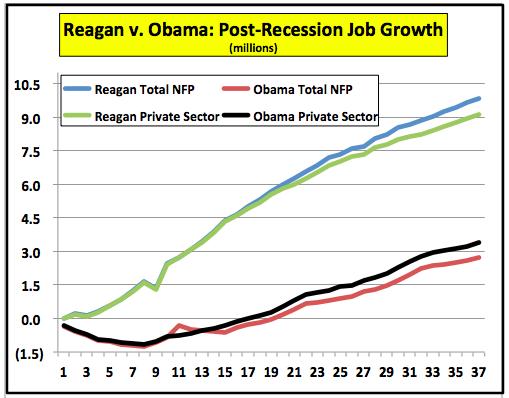
“Thanks to the graph, yours truly doesn’t need to bore readers with lots of numbers. Outside of very small blips, there is virtually no point on the above graph where the trajectory of job growth under Obama is as high as that seen under Reagan, even though the Reagan-era workforce was about one-third smaller. If done on percentage of workforce, the slope of the Reagan-era ascent would be even steeper.

For those who crave some numbers — In its first 37 post-recession months, the economy under Reagan added more than 9.8 million nonfarm payroll (NFP) jobs, over 7 million more than the 2.7 million added under Obama. To replicate the Reagan-era performance, the economy under Obama would have needed to add over 14 million jobs since the recession’s end; it has really added less than 20% of that. The Reagan-era private sector margin is over 5.7 million jobs.

And of course, there’s an obvious point to be made about the unemployment rate, as IBD noted:

What’s more, after 29 months of allegedly stellar job growth under Obama, the jobless rate is still 8.3%. By this point in the Reagan and Bush jobs recoveries, the unemployment rate was 7.2% and 4.9%, respectively.
If we were one of those fact-checking organizations, we’d give Stephanie Cutter the “Lying Liar from Liersburg” award.
A Google News search done this morning on “Stephanie Cutter Reagan” (past week, not in quotes, sorted by date with duplicates) returned six items (the final result listed pre-dates Cutter’s lie). The results are from American Thinker, Real Clear Politics (2), National Review, Washington Examiner, and United Liberty.

The same search at the Associated Press’s main site returned nothing.

AP’s “Presidential Campaign Fact Check” appears to be limited to what the presidential and vice-presidential candidates say. The wire service is currently carrying its interview with President Obama, naturally headlined “AP INTERVIEW: OBAMA CALLS ROMNEY’S IDEAS ‘EXTREME’,” on its “Top Story” page. Zheesh.

As to “fact-checkers” like PolitiFact and others, nothing demonstrates that they have turned themselves into just another tool of leftist bias than the “fact” that they haven’t called out Stephanie Cutter’s lie for four days and counting while trying and failing to nitpick the Romney campaign over its true statement about women’s job losses during the recession several months ago. PolitiFact falsely claimed it was “Mostly False.”

Oh, by the way, as James Pethoukouis noted in his second crucifixion of Cutter’s comment (his original post relating to Reagan is here), “both the Reagan and Bush recoveries were stronger than the current recovery under President Obama.””

http://newsbusters.org/blogs/tom-blumer/2012/08/26/fact-checkers-awol-after-obama-spokesperson-lies-about-jobs-created-unde

Obviously, congress is mostly at fault. The Democrats controlled both houses beginning in 2007 to create a “perfect storm” of failing liberal policies with the help of Obama.

Consider the following:

Reagan inherited an economic mess from Carter. Many of you remember the long gas lines and 18 percent mortgage rates from the Carter years.

In January 1983, 2 years after Reagan took office, the unemployment rate was 10.4 percent. In January 1989, when reagan left office, the rate was 5.4 percent.

When George Bush took office in January 2001, the unemployment rate was 4.2 percent. When the Democrats took control of congress in January 2007, the rate was 4.6 percent.

So, the impact of a Democrat congress with the addition of Barack Obama in January 2009 led to an unemployment rate of 9.1 percent in January 2011.

The Republicans took control of the house in January 2011. The stated unemployment rate is 8.3 percent but would be much higher if so many folks had not dropped out of the labor force.

Check for yourself:

http://data.bls.gov/timeseries/LNS14000000

From the Ulsterman,  February 24, 2012.

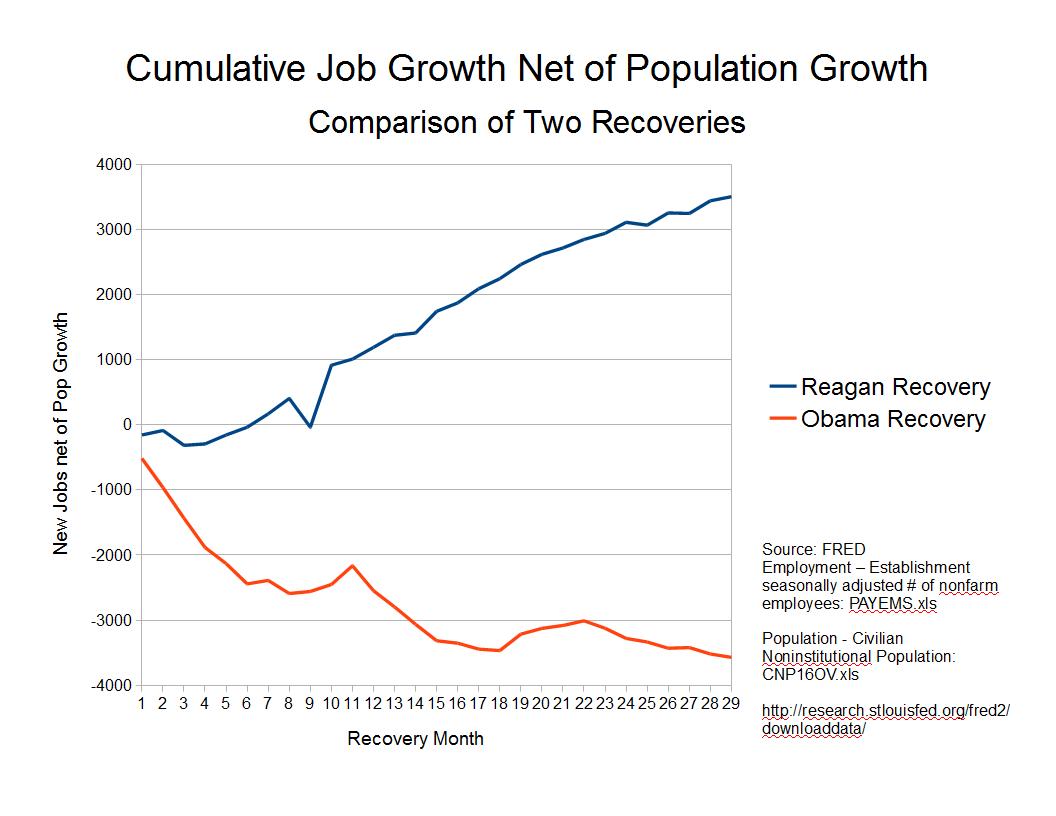
For a bit of contrast check out thiscomparative chart detailing the Reagan recovery vs the Obama recovery. One president charged ahead with plans to greatly reduce taxes, lessen regulations, and pushes to increase domestic energy production in the United States. The other president – Barack Obama, called for more taxes, more regulation, and has fought increasing domestic energy production at every opportunity – such as his shutting down of the much-needed Keystone pipeline:”


“The truth is clear – the Obama presidency has been a near-complete disaster for working Americans.  This might explain a term growing in popularity of late – “ABO”  –  Anybody But Obama in 2012…”

High jobless rates persist in NC, Greensboro News Record, August 25, 2012, Guilford county 5.3 percent when Democrats took congress 10.2 percent now

High jobless rates persist in NC, Greensboro News Record, August 25, 2012, Guilford county 5.3 percent when Democrats took congress 10.2 percent now

“Guilford (Large NC County) appears on it’s way to a third consecutive year with annual jobless rates in double digits. Economists say that likely hasn’t happened since the Great Depression.”…Greensboro News Record December 2, 2011

“North Carolina currently has the fourth-highest unemployment rate in the country and has stayed well above the national average through 2012.”…WRAL, August 17, 2012

“We tried our plan—and it worked. That’s the difference. That’s the choice in this election. That’s why I’m running for a second term.”…Barack Obama

Are there 2 versions of the Greensboro News & Record?

One in print with the facts for the older generations and one watered down for the younger folks on the internet. One designed to protect Obama?

The print edition, to my surprise and delight, has for months been presenting the truth about the economy and Jobs in NC.

From the front page top of the Print edition of the Greensboro News & Record August 25, 2012.

“High jobless rates persist in N.C.”

“Unemployment rates dropped or remained the same in most of North carolina in July, but joblessness remains high throughout the state.

In Guilford County, the unemployment rate fell by 1.3 percentage points to 10.2 percent in July, compared with 11.5 percent in July 2011.”

“But while more people now have jobs, analysts say local labor market conditions are still in distress. John Quinterno, a principal with South by North Strategies, an economic and social policy research firm, siad the labor market still isn’t generating enough jobs for all of the people who need them.”
“Is it an improvement to what it was when it was 11 percent? Yes…but it still doesn’t take away that there’s still a 10 percent unemployment rate, which is extraordinary,” Quinterno said.”

“Consider this: The unemployment rate in Guilford County was at 5.3 percent in July 2007. It hit it’s highest level—11.8 percent—in July 2009 during the height of the recesion.”

Guilford County had a  5.3 percent unemployment rate when the Democrats took control of congress in 2007.

From the internet version of the Greensboro News & Record August 24, 2012.

“Local unemployment decreases”

“Unemployment in Guilford County fell by 1.3 percentage points to 10.2 percent in July compared with 11.5 percent in July of 2011.

The Greensboro-High Point metro area, which covers employees in both cities, also fell to 10.2 percent in July from 11.5 percent in July 2011.

The state overall reported good news compared with this time last year, according to a news release from the N.C. Department of Commerce – Labor and Economic Analysis Division.

“Rates either dropped or remained the same in most of North Carolina in July,” said N.C. Department of Commerce Deputy Secretary Dale Carroll. “Compared to the same time last year, nearly all of the state’s counties have a lower unemployment rate.”

North Carolina had 34 counties that were at or below the state’s not seasonally adjusted unemployment rate of 9.8
percent. Unemployment rates decreased in eight of the state’s 14 Metropolitan Statistical Areas.

The rate increased in two and stayed the same in four.

The number of workers employed (not seasonally adjusted) increased in July by 12,968 to 4,249,084, while those unemployed fell 1,362 to 462,255.

Since July 2011, the number of workers unemployed decreased 50,996, while those employed increased 60,772.

Currituck County had the state’s lowest unemployment rate in July at 4.7 percent, and Scotland County had the highest unemployment rate at 17.6 percent.”

http://www.news-record.com/content/2012/08/24/article/local_unemployment_decreases

From Citizen Wells August 24, 2012.

“North Carolina’s statewide unemployment rate (not seasonally adjusted) was 9.8 percent in July. This was a 0.1 of a percentage-point decrease from June’s revised rate of 9.9 percent, and a 1.1 percentage-point decrease over the year.

Over the month, the unemployment rate decreased in 47 counties, increased in 26 and remained the same in 27. Thirty-four counties had unemployment rates below the state’s 9.8 percent rate.

Scotland County recorded July’s highest unemployment rate at 17.6 percent, remaining the same as the previous month. Graham County had the second-highest rate at 15.2 percent. Currituck County had the lowest unemployment rate at 4.7 percent, followed by Chatham, 7.0 percent; and Orange, 7.1 percent.”

“Mecklenburg County, the home of the 2012 Democrat convention in Charlotte, has an unemployment rate of 10 percent.”

https://citizenwells.wordpress.com/2012/08/24/us-unemployment-claims-rise-4000-nc-unemployment-rate-9-8-percent-unemployment-rate-increased-in-26-nc-counties-charlotte-mecklenburg-rate-10-percent/

US unemployment claims rise 4000, NC unemployment rate 9.8 percent, Unemployment rate increased in 26 NC counties, Charlotte Mecklenburg rate 10 percent

US unemployment claims rise 4000, NC unemployment rate 9.8 percent, Unemployment rate increased in 26 NC counties, Charlotte Mecklenburg rate 10 percent

“Guilford (Large NC County) appears on it’s way to a third consecutive year with annual jobless rates in double digits. Economists say that likely hasn’t happened since the Great Depression.”…Greensboro News Record December 2, 2011

“North Carolina currently has the fourth-highest unemployment rate in the country and has stayed well above the national average through 2012.”…WRAL, August 17, 2012

“We tried our plan—and it worked. That’s the difference. That’s the choice in this election. That’s why I’m running for a second term.”…Barack Obama

From the US Labor Department August  23, 2012.

“In the week ending August 18, the advance figure for seasonally adjusted initial claims was 372,000, an increase of 4,000 from the previous week’s revised figure of 368,000. The 4-week moving average was 368,000, an increase of 3,750 from the previous week’s revised average of 364,250.

The advance seasonally adjusted insured unemployment rate was 2.6 percent for the week ending August 11, unchanged from the prior week’s unrevised rate.

The advance number for seasonally adjusted insured unemployment during the week ending August 11, was 3,317,000, an increase of 4,000 from the preceding week’s revised level of 3,313,000. The 4-week moving average was 3,311,500, an increase of 6,500 from the preceding week’s revised average of 3,305,000.”

http://www.dol.gov/opa/media/press/eta/ui/current.htm

From the NC Department of Commerce August 24, 2012.

“North Carolina’s statewide unemployment rate (not seasonally adjusted) was 9.8 percent in July. This was a 0.1 of a percentage-point decrease from June’s revised rate of 9.9 percent, and a 1.1 percentage-point decrease over the year.

Over the month, the unemployment rate decreased in 47 counties, increased in 26 and remained the same in 27. Thirty-four counties had unemployment rates below the state’s 9.8 percent rate.

Scotland County recorded July’s highest unemployment rate at 17.6 percent, remaining the same as the previous month. Graham County had the second-highest rate at 15.2 percent. Currituck County had the lowest unemployment rate at 4.7 percent, followed by Chatham, 7.0 percent; and Orange, 7.1 percent.”

http://www.ncesc1.com/PMI/Rates/PressReleases/County/NR_July2012CountyRate_M.pdf

Mecklenburg County, the home of the 2012 Democrat convention in Charlotte, has an unemployment rate of 10 percent.

Obama job facts August 5, 2012, Obama lies about jobs created, Fewer jobs since Obama and Democrats took control, Higher unemployment, Lower labor force participation

Obama job facts August 5, 2012, Obama lies about jobs created, Fewer jobs since Obama and Democrats took control, Higher unemployment, Lower labor force participation

“The United States economy has lost more jobs than it has added since the recovery began over a year ago.”…NY Times Sept. 20, 2010.

“Guilford (Large NC County) appears on it’s way to a third consecutive year with annual jobless rates in double digits. Economists say that likely hasn’t happened since the Great Depression.”…Greensboro News Record December 2, 2011

“The Party told you to reject the evidence of your eyes and ears. It was their final, most essential command. His heart sank as he thought of the enormous power arrayed against him, the ease with which any Party intellectual would overthrow him in debate, the subtle arguments which he would not be able to understand, much less answer. And yet he was in the right! They were wrong and he was right. The obvious, the silly, and the true had got to be defended. Truisms are true, hold on to that! The solid world exists, its laws do not change. Stones are hard, water is wet, objects unsupported fall towards the earth’s centre. With the feeling that he was speaking to O’Brien, and also that he was setting forth an important axiom, he wrote:

Freedom is the freedom to say that two plus two make four. If that is granted, all else follows.”…George Orwell, “1984”

Obama is the biggest liar to ever occupy the Oval Office. One of his big lies is misleading the American Public on job creation. He only touts the jobs created, not the net impact of his policies. Not the jobs lost. Not the people dropping out of the labor force.

Here is a simplified example that explains what is happening.

Smallville USA, a fictional town, has five companies.

During the last month company A hires 2 people and company B hires 3. The mayor, interviewed by the local newspaper, brags about job growth in the town and states that 5 jobs were added.

What the mayor fails to mention is that company C dismisses 7, company D dismisses 5 and company E dismisses 3.

Smallville has a net loss of 10 jobs. The local economy is impacted. The mayor failed to mention that. So has Obama.

The misleading information, the lie, that Obama has been touting in his speeches can be found at BarackObama.com. Everything about the presentation of job creation leaves one with the impression that Obama has netted job gains.

For example:

4.5 million private sector jobs added in past 29 months.

The graph indicates many jobs lost prior to Obama taking office and the Recovery Act being signed.

The net jobs gained is not provided and no mention of the fact that the Democrats controlled congress beginning in January of 2007 until the Republicans took the House in 2011.

http://www.barackobama.com/jobsrecord?source=om2012_PR_G_gm-jobs-bg-search_core_&omtype=ofa&subsource=mkwid%7CXWIcSPIC%7Ckw%7C%5Bobama%20jobs%5D%7Cmatchtype%7Ce%7Cpcrid%7C15823272973%7Cpl%7C%7C&gclid=CN2Z5dLT0LECFW1j7Aod-SMAnw

Here is the acid test, the bottom line on Obama and the Democrats impact on jobs.

When the Democrats took control of congress in January 2007, the unemployment rate was 4.6 percent.

When Obama  took control of the White House in January 2009, the unemployment rate was 7.8 percent.

The stated current unemployment rate is 8.3 percent.

That is job creation???

http://data.bls.gov/timeseries/LNS14000000

And that is not all.

The Labor Force Participation Rate has dropped. If that rate had not dropped, the unemployment rate would have been significantly higher.

When the Democrats took control of congress in January 2007, the Labor Force Participation Rate 66.4 percent.

When Obama took control of the White House in January 2009, the Labor Force Participation Rate was 65.7 percent.

The Labor Force Participation Rate currently is 63.7 percent.

http://data.bls.gov/timeseries/LNS11300000/

My reason for quoting Orwell’s “1984” should be crystal clear.


NC unemployment claims increase second highest in nation, July 26, 2012, 11948 claims, Second only to CA, NC Labor force decreased and jobs lost

NC unemployment claims increase second highest in nation, July 26, 2012, 11948 claims, Second only to CA, NC Labor force decreased and jobs lost

“The United States economy has lost more jobs than it has added since the recovery began over a year ago.”…NY Times Sept. 20, 2010.

“Guilford (Large NC County) appears on it’s way to a third consecutive year with annual jobless rates in double digits. Economists say that likely hasn’t happened since the Great Depression.”…Greensboro News Record December 2, 2011

Freedom is the freedom to say that two plus two make four. If that is granted, all else follows.”…George Orwell, “1984″

Remember this article from the Greensboro News record reported here on July 20, 2012?

From Doug Clark of the Greensboro News Record July 20, 2012.

“North Carolina loses or gains jobs in June, depending on which state numbers you believe, if any”

“North Carolina lost nearly 8,000 jobs in June from the previous month, the state’s Commerce Department reports this morning.”

“The unemployment rate held at 9.4 percent, but that was because the labor force decreased.”

“Note: There are two sets of numbers in the report. You will see some media reports stating the state gained 16,690 jobs in June.”

“Please weigh in on the credibility of these numbers.”

https://citizenwells.wordpress.com/2012/07/20/north-carolina-loses-or-gains-jobs-in-june-depending-on-which-state-numbers-you-believe-if-any-july-20-2012-greensboro-news-record-doug-clark/

From the US labor Dept July 26, 2012.

“The largest increases in initial claims for the week ending July 14 were in California (+26,244), North Carolina (+11,948), Georgia (+8,372), Alabama (+4,148), and Oregon (+3,019)”

http://www.dol.gov/opa/media/press/eta/ui/current.htm

The unemployment rates for June by NC county will be released tomorrow.

Unemployment claims June 21, 2012, Initial claims 387000, Decrease 2000?, Moving average increases 3500, NC increases 3148, 13 states increase over 1000

Unemployment claims June 21, 2012, Initial claims 387000, Decrease 2000?, Moving average increases 3500, NC increases 3148, 13 states increase over 1000

“The United States economy has lost more jobs than it has added since the recovery began over a year ago.”…NY Times Sept. 20, 2010.

“Guilford (Large NC County) appears on it’s way to a third consecutive year with annual jobless rates in double digits. Economists say that likely hasn’t happened since the Great Depression.”…Greensboro News Record December 2, 2011

“the Times of the nineteenth of December had published the official forecasts of the output of various classes of consumption goods in the fourth quarter of 1983, which was also the sixth quarter of the Ninth Three-Year Plan. Today’s issue contained a statement of the actual output, from which it appeared that the forecasts were in every instance grossly wrong. Winston’s job was to rectify the original figures by making them agree with the later ones.”…George Orwell, “1984″

The Unemployment claims data for June 21, 2012 is just in. Initial claims are 387,000 with a decrease of 2,000 claims. The moving average  increased 3,500.   However, the big story is the number of states and the amount of increases in claims. NC is one of them.

From the US Labor Department June 21, 2012.

“In the week ending June 16, the advance figure for seasonally adjusted initial claims was 387,000, a decrease of 2,000 from the previous week’s revised figure of 389,000. The 4-week moving average was 386,250, an increase of 3,500 from the previous week’s revised average of 382,750.”

STATES WITH A DECREASE OF MORE THAN 1,000


State Change State Supplied Comment
None

STATES WITH AN INCREASE OF MORE THAN 1,000


State Change State Supplied Comment
CA +12,987 Layoffs in the service industry.
PA +7,036 Layoffs in the transportation, entertainment, lodging, food services, educational service, and healthcare and social service industries.
TX +4,028 No comment.
GA +3,686 Layoffs in the manufacturing, healthcare and social assistance, administrative service, trade, and construction industries.
NC +3,148 Layoffs in the nonclassifiable establishments, construction, furniture and fixture, textile, and business industries.
FL +1,933 Layoffs in the agriculture, construction, manufacturing, trade, retail, and service industries.
SC +1,845 Layoffs in the manufacturing industry.
MI +1,838 Modest increase in layoff across most industries.
IL +1,835 Layoffs in the construction, transportation and warehousing, and administrative service industries.
OH +1,596 No comment.
NY +1,561 Layoffs in the manufacturing, healthcare and social assistance, and retail industries.
WI +1,272 No comment.
MD +1,030 No comment.

http://www.dol.gov/opa/media/press/eta/ui/eta20121273.htm

US Labor Dept. May 2012 employment data, June 1, 2012, Long term unemployed rose .3 million, Involuntary part-time workers 8.1 million, March April increases revised down

US Labor Dept. May 2012 employment data, June 1, 2012, Long term unemployed rose .3 million, Involuntary part-time workers 8.1 million, March April increases revised down

“We’ve added back more than 4.2 million private sector jobs and seen 26 straight months of job growth—but there’s more work to do.”…Obama Truth Team

“the Times of the nineteenth of December had published the official forecasts of the output of various classes of consumption goods in the fourth quarter of 1983, which was also the sixth quarter of the Ninth Three-Year Plan. Today’s issue contained a statement of the actual output, from which it appeared that the forecasts were in every instance grossly wrong. Winston’s job was to rectify the original figures by making them agree with the later ones.”…George Orwell, “1984”

Forget the unemployment rate, which is not going down and is grossly understated. Read today’s, June 1, 2012, Employment Situation report from the US Labor Department and look at the data.

“THE EMPLOYMENT SITUATION — MAY 2012
Nonfarm payroll employment changed little in May (+69,000), and the unemployment rate was essentially unchanged at 8.2 percent, the U.S. Bureau of Labor Statistics reported today. Employment increased in health care, transportation and warehousing, and wholesale trade but declined in construction. Employment was little changed in most other major
industries.

Household Survey Data

Both the number of unemployed persons (12.7 million) and the unemployment rate (8.2 percent) changed little in May. (See table A-1.)

Among the major worker groups, the unemployment rates for adult men (7.8 percent) and Hispanics (11.0 percent) edged up in May, while the rates for adult women (7.4 percent), teenagers (24.6 percent), whites (7.4 percent), and blacks (13.6 percent) showed little or no change. The jobless rate for Asians was 5.2 percent in May (not seasonally adjusted), down from 7.0 percent a year earlier. (See tables A-1, A-2, and A-3.)

The number of long-term unemployed (those jobless for 27 weeks and over) rose from 5.1 to 5.4 million in May. These individuals accounted for 42.8 percent of the unemployed. (See table A-12.)

The civilian labor force participation rate increased in May by 0.2 percentage point to 63.8 percent, offsetting a decline of the same amount in April. The employment-population ratio edged up to 58.6 percent in May. (See table A-1.)

The number of persons employed part time for economic reasons (sometimes referred to as involuntary part-time workers) edged up to 8.1 million over the month. These individuals were working part time because their hours had been cut back or because they were unable to find a full-time job. (See table A-8.)

In May, 2.4 million persons were marginally attached to the labor force, up from 2.2 million a year earlier. (The data are not seasonally adjusted.) These individuals were not in the labor force, wanted and were available for work, and had looked for a job sometime in the prior 12 months. They were not counted as unemployed because they had not searched for work in the 4 weeks preceding the survey. (See table A-16.)

Among the marginally attached, there were 830,000 discouraged workers in May, about the same as a year earlier. (The data are not seasonally adjusted.) Discouraged workers are persons not currently looking for work because they believe no jobs are available for them. The remaining 1.6 million persons marginally attached to the labor force in May had not searched for work in the 4 weeks preceding the survey for reasons such as school attendance or family responsibilities. (See table A-16.)

Establishment Survey Data

Total nonfarm payroll employment changed little in May (+69,000), following a similar change in April (+77,000). In comparison, the average monthly gain was 226,000 in the first quarter of the year. In May, employment rose in health care, transportation and warehousing, and wholesale trade, while construction lost jobs. (See table B-1.)

Health care employment continued to increase in May (+33,000). Within the industry, employment in ambulatory health care services, which includes offices of physicians and outpatient care centers, rose by 23,000 over the month. Over the year, health care employment has risen by 340,000.

Transportation and warehousing added 36,000 jobs over the month. Employment gains in transit and ground passenger transportation (+20,000) and in couriers and messengers (+5,000) followed job losses in those industries in April. Employment in both industries has shown little net change over the year. In May, truck transportation added 7,000 jobs.

Employment in wholesale trade rose by 16,000 over the month. Since reaching an employment low in May 2010, this industry has added 184,000 jobs.

Manufacturing employment continued to trend up in May (+12,000) following a similar change in April (+9,000). Job gains averaged 41,000 per month in the first quarter of this year. In May, employment rose in fabricated metal products (+6,000) and in primary metals (+4,000). Since its most recent low in January 2010, manufacturing employment has increased by 495,000.

Construction employment declined by 28,000 in May, with job losses occurring in specialty trade contractors (-18,000) and in heavy and civil engineering construction (-11,000).
Since reaching a low in January 2011, employment in construction has shown little change on net.

Employment in professional and business services was essentially unchanged in May. Since the most recent low point in September 2009, employment in this industry has grown by 1.4 million. In May, job losses in accounting and bookkeeping services (-14,000) and in services to buildings and dwellings (-14,000) were offset by small gains elsewhere in the industry.

Employment in other major industries, including mining and logging, retail trade, information, financial activities, leisure and hospitality, and government, changed little in May.

The average workweek for all employees on private nonfarm payrolls edged down by 0.1 hour to 34.4 hours in May. The manufacturing workweek declined by 0.3 hour to 40.5 hours, and factory overtime declined by 0.1 hour to 3.2 hours. The average workweek for production and nonsupervisory employees on private nonfarm payrolls was unchanged at 33.7 hours.
(See tables B-2 and B-7.)

In May, average hourly earnings for all employees on private nonfarm payrolls edged up by 2 cents to $23.41. Over the past 12 months, average hourly earnings have increased by 1.7 percent. In May, average hourly earnings of private-sector production and nonsupervisory employees edged down by 1 cent to $19.70. (See tables B-3 and B-8.)

The change in total nonfarm payroll employment for March was revised from +154,000 to +143,000, and the change for April was revised from +115,000 to +77,000.”

http://www.bls.gov/news.release/empsit.nr0.htm

Notice

Inserted at the end:

“The change in total nonfarm payroll employment for March was revised from +154,000 to +143,000, and the change for April was revised from +115,000 to +77,000.”

Also important:

“The number of long-term unemployed (those jobless for 27 weeks and over) rose from 5.1 to 5.4 million in May.”

“The number of persons employed part time for economic reasons (sometimes referred to as involuntary part-time workers) edged up to 8.1 million over the month. These individuals were working part time because their hours had been cut back or because they were unable to find a full-time job.”

“In May, 2.4 million persons were marginally attached to the labor force, up from 2.2 million a year earlier. (The data are not seasonally adjusted.) These individuals were not in the labor force, wanted and were available for work, and had looked for a job sometime in the prior 12 months. They were not counted as unemployed because they had not searched for work in the 4 weeks preceding the survey.”

Obama and Democrats created high unemployment and blame Bush and others, Obama inherited 2 years of a Democrat controlled Congress, Unemployment and gas prices began climb in Jan 2007

Obama and Democrats created high unemployment and blame Bush and others, Obama inherited 2 years of a Democrat controlled Congress, Unemployment and gas prices began climb in Jan 2007

“What do you think a stimulus is? It’s spending – that’s the whole point! Seriously.”…Barack Obama

“The fact that we are here today to debate raising America’s debt limit is a sign of leadership failure. America has a debt problem and a failure of leadership. Americans deserve better. I, therefore, intend to oppose the effort to increase America’s debt.”…Barack Obama

“And if all others accepted the lie which the Party imposed
–if all records told the same tale–then the lie passed into
history and became truth. “Who controls the past,” ran the
Party slogan, “controls the future: who controls the present
controls the past.”…George Orwell, “1984″

The catalyst for this article came several days ago after a brief conversation with a young college student. It is my understanding that this young man is not a Obama supporter. However he believed that unemployment had gone down since Obama took office. I enlightened him.

Citizen Wells began quoting George Orwell early in 2008 for a reason. Obama, in concert with the mainstream media, has been telling non stop lies. One of the constant themes of lies has to do with the Obama stimulus bill and job creation and unemployment.

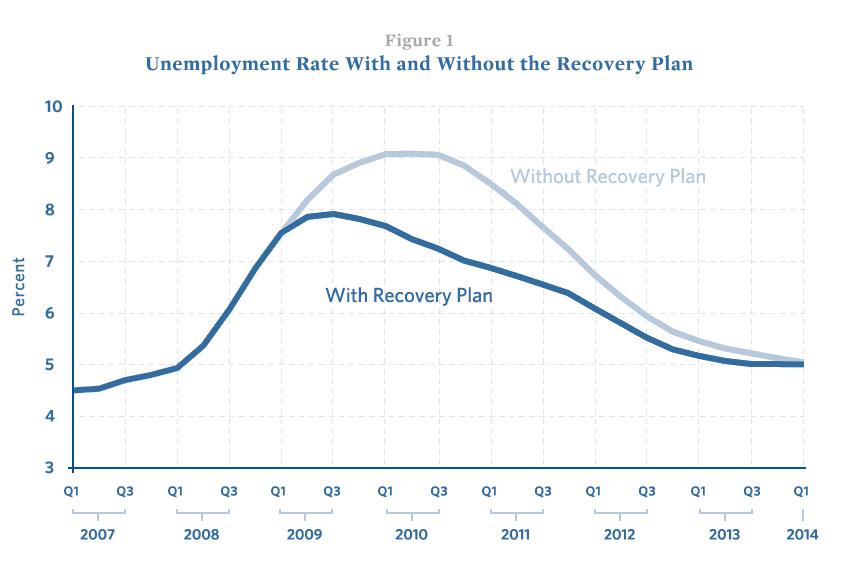
There has been much debate about whether or not Obama promised that the stimulus bill would keep unemployment at a maximum of 8 percent or not. It does not matter. Obama stated that the stimulus would save and create jobs and the following graph from a report prepared by Christina Romer and Jared Bernstein shows unemployment staying below 8 percent with the implementation of Obama’s stimulus bill.

The Washington Post has more on this.

http://www.washingtonpost.com/wp-srv/special/business/unemployment-predictions/

From Investors Business Daily February 17, 2012.

“Obama Stimulus Turns Three: What Has It Achieved?”

“Without any fanfare whatsoever from the White House, February 17 marks the three-year anniversary of the day President Obama signed the much ballyhooed stimulus into law.

At the time, Obama claimed that it would “create or save” up to 3.5 million jobs, and that “a new wave of innovation, activity and construction will be unleashed across America.” The stimulus, would, he promised””ignite spending by businesses and consumers” and bring “real and lasting change for generations to come.”

So three years later, how do the stimulus results stack up? Here’s where various indicators stood in or around February 2009, and where they stand today.

Unemployment rate: The jobless rate is unchanged from February 2009 to January 2012, the latest month for which we have data. Both stood at 8.3%, according to the Bureau of Labor Statistics. Obama’s economists had initially predicted that with the stimulus, unemployment would stay below 8%.

Number of long-term unemployed: The number of workers who have been unable to find a job in 27 months or more has shot up 83%, with their ranks now at 5.5 million.

Civilian labor force: It has shrunk by 126,000. In past recoveries, the labor force climbed an average of more than 3 million over comparable time periods.

Labor force participation: The share of adults in the labor force — either looking or working — has dropped 3% — also highly unusual in a recovery. At 63.7%, labor force participation is at a low not seen since the middle of the very deep 1981-82 recession, when fewer women were in the work force. A lower participation rate makes the unemployment rate look better.

Household income: Median annual household income is about 7% below where it was in February 2009, according to the Sentier Research Household Income Index.

National debt: Up $4.5 trillion, or 41%, according to the Treasury Department’s monthly reports. The latest Treasury figures put the national debt at $15.4 trillion, larger than the entire U.S. economy.

Deficits: The deficit for fiscal year 2009 totaled $1.4 trillion. The Obama administration’s proposed deficit for 2012 is $1.3 trillion, which would mark the fourth year of deficits topping $1 trillion.

Gross Domestic Product: Real GDP has climbed just 6% between Q1 2009 and Q4 2011, according to the Bureau of Economic Analysis.

Spending by consumers and businesses: Personal consumption has managed to climb 10% in the past three years, according to the BEA, but companies continue to hoard cash, with cash on hand up 27% since Q1 2009, according to the Federal Reserve Bank.

Stimulus price tag: The original estimate for the cost of the stimulus was $787 billion. Now the Congressional Budget Office says that, when all is said and done, it will have cost$825 billion .

Perhaps the best measure of the success or failure of the stimulus, however, is the fact that President Obama in his latest budget plan has called for still another round of stimulus spending, this time totaling $350 billion over the next four years, for what is labeled “short-term measures for jobs growth.””

http://news.investors.com/article/601526/201202171525/obama-economic-stimulus-turns-three.htm

The Democrats took control of Congress in January 2007. Obviously Obama inherited the damage they inflicted on the economy and made it worse.

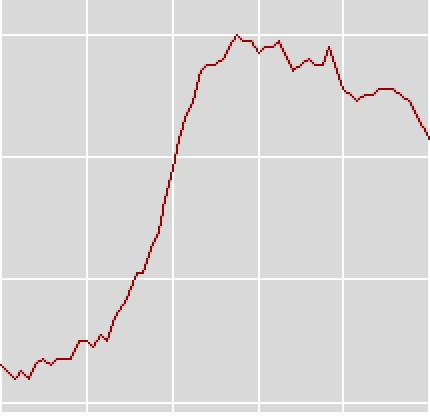
US unemployment data, from the federal government, Jan. 2007 to Jan. 2012.

More details here.

http://data.bls.gov/timeseries/LNS14000000

Truth Team real unemployment rate, NC jobs data, Stephanie Cutter, Truth about employment in US and North Carolina, Obama lies

Truth Team real unemployment rate, NC jobs data, Stephanie Cutter, Truth about employment in US and North Carolina, Obama lies

“Guilford (Large NC County) appears on it’s way to a third consecutive year with annual jobless rates in double digits. Economists say that likely hasn’t happened since the Great Depression.”…Greensboro News Record December 2, 2011

“”You’re a traitor!” yelled the boy. “You’re a thought criminal!””…George Orwell, “1984″

“And if all others accepted the lie which the Party imposed
–if all records told the same tale–then the lie passed into
history and became truth. “Who controls the past,” ran the
Party slogan, “controls the future: who controls the present
controls the past.”…George Orwell, “1984″

To:

Stephanie Cutter, Truth Team, et al.

First of all, I would like to thank you for your concerns about the truth about Obama statements and performance. I share those concerns and am happy to share facts with you. The truth.

Since the Democrat Party will be holding the 2012 convention in Charlotte, NC, I am certain that the Truth Team will want the correct figures for North Carolina employment.

Recently Citizen Wells has reported on unemployment in NC.

From Citizen Wells December 4, 2012.

“Jobless figures worst in 80 years”

“data released Thursday by the Employment Security Commission of North Carolina show that Guilford appears on it’s way to a third consecutive year with annual jobless rates in double digits.

Economists say that likely hasn’t happened since the Great Depression.

“I suspect we would have to go back to the 1930′s (to find that),” said Don Jud, professor emeritus at UNCG’s Bryan School of Business and Economics.””

https://citizenwells.wordpress.com/2011/12/04/nc-unemployment-worst-since-great-depression-uncg-and-government-spending-spree-other-peoples-money-obama-supporters-predictable/

From Citizen Wells February 11, 2012.

“While the job market showed signs of growth last year, both Guilford and the state ended 2011 with more people unemployed than was the case the previous
December.

In Guilford , nearly 24,500 didn’t have jobs; statewide, the number surpassed 446,000.

And both the county and the state ended the year with jobless rates of 9.9 percent. That’s equal to or higher than the rates a year earlier.”

“At the current rate of growth–adding 8,300 annually–it will take 3.5 years–or until 2016–to regain the positions lost during and after the Great recession.

“Looking ahead, Quinterno said he expects more of the same this year.

“Absent robust job growth, joblessness and associated hardships will remain widespread,” he wrote. “2012 could well be the fifth consecutive year of negative or minimal job growth in North Carolina.”

https://citizenwells.wordpress.com/2012/02/11/nc-job-growth-dismal-greensboro-news-record-february-11-2012-guilford-county-and-north-carolina-9-9-percent-unemployent-446000-jobless-statewide/

From South by North Strategies, LTD February 10, 2012.

“No Rebound For NC Job Market In 2011”
“North Carolina’s labor market experienced minimal payroll employment growth during 2011. Between December 2010 and December 2011, the state gained 19,600 more payroll jobs than it lost (+0.5 percent). Though the private sector netted 29,400 positions, a net drop of 9,800 government jobs erased one-third of the private-sector gain. With such weak growth, little progress was made against unemployment. Both the number of unemployed individuals and the share of the labor force that was unemployed rose in 2011. And, 2011 marked the fourth consecutive year of negative (2008 and 2009) or minimal (2010 and 2011) job growth in North Carolina.”

“Large Job Gap Remains

The weak job growth recorded during 2011 did little to replace the jobs lost earlier in the business cycle. Since the onset of the “Great Recession,” North Carolina has lost, on net, 295,300 positions, or 7.1 percent of its payroll employment base. The maximum job loss recorded during the business cycle occurred in February 2010, when the state had 323,000 fewer jobs (-7.7 percent) than it did 26 months before. Since that time, North Carolina has netted 27,700 positions (+0.7 percent), for an average monthly gain of nearly 1,300 jobs. While the state’s economy added more jobs in 2011 than in 2010 (+19,600 versus +5,400), the growth was too weak to materially alter the employment situation. Even if the annual level of job growth were to triple, it still would take roughly five years to close the current jobs gap, holding all else equal.

As fig. 3 shows, the job losses recorded during the Great Recession have proven more severe than the ones experienced during the 2001 and 1990-1991 recessions. At the height of the 2001 recession, the state shed 4.5 percent of its jobs base, while the comparable drop during the 1990-1991 recession was 1.9 percent. In both of those recessions, the job gap began to steadily close after the peak job losses were realized. That has not happened during the current cycle. In fact, since December 2009, payroll employment in the state has grown by just 25,000 positions, which has succeeded in lowering the job gap by only 0.6 percentage points.”

“Remember, too, that the job shortfall currently facing North Carolina is actually larger than the one caused by the destruction of jobs during the recession. Since December 2007, the number of working-age Tar Heels has increased by 362,100 (+5.2 percent) persons. This means that payroll employment in the state should have been growing at an average monthly rate of 0.11 percent per month just to keep pace with workforce growth. If one considers the jobs that should have been created over the last four years but were not, the gap facing the state is 518,000 positions (fig. 4). To close that gap by December 2015, holding all else equal, North Carolina would need to net 14,389 jobs per month for each of the next 36 months. At no point since 1990 has North Carolina sustained such a level of growth over so long a period.”

“Joblessness Remains Widespread

Weak job growth in 2011 did little to reduce the problems of unemployment and joblessness in North Carolina. The monthly number of unemployed Tar Heels (seasonally adjusted) averaged 449,679. Furthermore, the average number of unemployed persons rose over the year. On a quarterly basis, there was an average of 16,216 more unemployed persons (+3.7 percent) during 2011.Q4 than one year earlier.

In December 2011, the statewide unemployment rate equaled 9.9 percent, compared to 9.8 percent in December 2010. Throughout 2011, the monthly unemployment rate fluctuated between 9.7 and 10.5 percent. For the year, the average monthly rate was 10 percent, which represented an improvement over the 2010 average rate of 10.5 percent.”

“More Problems Than Simple Unemployment”

“While part of that decline may be attributable to changes in the structure of the workforce (e.g., more people of retirement age), part is likely tied to the decision of frustrated job seekers to abandon their searches. This suggests that joblessness is more widespread than reflected in the official unemployment rate.

Estimates of the underemployment rate, a broader measure of labor under-utilization prepared by the US Bureau of Labor Statistics, indicate that 17.9 percent of North Carolina’s adjusted labor force was underemployed, on average, in 2011. That measure includes not only individuals who meet the formal definition of unemployment, but also those working part-time despite preferring full-time work and those marginally attached to the workforce. Over the year, the statewide underemployment rate rose by 0.5 percentage points, rising to 17.9 percent from a level of 17.4 percent in 2010.

Regardless of the exact measure used, a sizable amount of labor in North Carolina is currently sitting idle. Nearly 10 of every 100 members of the state’s labor force are unemployed (seasonally adjusted), while almost 18 of every 100 are underemployed. Moreover, the share of adult North Carolinians with a job has fallen sharply since late 2007. In December 2011, only 55.6 percent of working-age North Carolinians (seasonally adjusted) had jobs, a level no different from the one posted one year prior. This rate actually fell to a low of 55.3 percent near the end of 2011.Q3. At no other time since 1976 has the employment-to-population been as low as it has been in recent months (fig. 7). The current ratio also is well below the historical average rate of 63.6 recorded between January 1976 and December 2007.”

“Perhaps the most troubling indicator of the economic hardships facing North Carolina’s households is the surge in the size of the state’s Food Stamp caseload. Between December 2010 and October 2011, the most recent month with data, the number of Tar Heels participating in the program grew by 7 percent, or 108,073 persons.”

“If recent trends hold, North Carolina’s labor market will not grow robustly in 2012. Even if job growth in the private sector accelerates, it is unlikely to pick up enough to put much of a dent in the problems of unemployment and underemployment. Economic hardships therefore should remain pronounced across much of the state. For the long-term unemployed in particular, their odds of returning will continue to fall, yet the tattered state of the nation’s safety net means that little help will be available for such individuals and their families.

Absent significant changes in economic conditions and public policies, weak job growth, high levels of joblessness, and pervasive economic hardships appear to be in store for North Carolina, with 2012 apt to mark the fifth consecutive year of negative or minimal job growth.”

http://www.sbnstrategies.com/archives/9798

Stephanie Cutter, Truth Team, et al, I have a strong background in Math, Computer Science and business, and as Donald Trump said, I went to some really good schools. So, if you have any difficulty with any of the facts presented here, or as we refer to it in NC, Truth, just let me know. I am at your service.