Category Archives: Unemployment

Jobless claims, March 4 2010, Jobless claims fall, Total beneficiaries rise, Number of people out of work more than six months surged

Jobless claims, March 4 2010

From The Wall Street Journal Market Watch, March 4, 2010.

“Jobless claims fall 29,000 to 469,000”

“The number of people filing for initial unemployment benefits declined by 29,000 in the week ending Feb. 27 to a seasonally adjusted 469,000, the Labor Department reported Thursday.”

“Initial claims in the most recent week were about 8% higher than at the beginning of the year. Economists who follow the data aren’t sure if the increase reflects a weaker job market or is due primarily to non-economic factors, such as weather or backlogs.

The four-week average of initial claims — a better gauge of the trend than the volatile weekly number – fell by 3,500 to 470,750. Read the full report on the Labor Department website.

Meanwhile, the number of people receiving regular state jobless benefits declined by 134,000 in the week of Feb. 20 to a seasonally adjusted 4.5 million, the lowest in a year. More than half of the people who get state jobless benefits ultimately lose their eligibility, usually after 26 weeks, before finding a job.

The number of people who’ve been out of work for more than six months has surged during this recession to a record 6.3 million in January, accounting for 41% of the 14.8 million people officially classified as unemployed, according to monthly data previously released.”

Read more:

http://www.marketwatch.com/story/jobless-claims-fall-29000-to-469000-2010-03-04

Jobless claims jump to 496,000, February 25, 2010, new claims for unemployment benefits, four week average rose, 8.4 million jobs lost, 4.6 million continuing claims, North Carolina had biggest increase

Jobless claims jump to 496,000, February 25, 2010

From Fox News,  February 25, 2010.

“New Jobless Claims Jumped to 496,000 as Heavy Snow Caused Rise in Layoffs”

“The number of new claims for unemployment benefits jumped unexpectedly last week as heavy snows caused layoffs to rise.”

“The department said Thursday that first-time claims for unemployment insurance rose by 22,000 to a seasonally adjusted 496,000. Wall Street analysts polled by Thomson Reuters expected a drop to 455,000.”

“The four-week average has risen by about 30,000 in the past month, raising concerns that job cuts are continuing. Initial claims had fallen sharply over the summer and fall but the improvement has stalled since the year began.

The economy has grown for six months but is not yet spurring new hiring. Many economists point out that the current recovery is weak compared to the aftermath of previous deep recessions.

The Labor Department said earlier this month that while the unemployment rate fell to 9.7 percent from 10 percent, employers still cut 20,000 jobs. The economy has lost 8.4 million jobs since the recession began.”

“Among the states, North Carolina had biggest increase in claims, with 5,897, which it attributed to layoffs in the construction, furniture and mining industries. Pennsylvania and Kentucky also reported large increases. The state data lags initial claims by one week.”

Read more:

http://www.foxnews.com/politics/2010/02/25/new-jobless-claims-rise-unexpectedly/

Shadow Inventory Of Troubled Mortgages, Standard and Poors, US housing prices, Mortgage crisis may be far from over, More delinquencies and lower home prices are to come

Shadow Inventory Of Troubled Mortgages

From Standard and Poors, February 16, 2010.

“The Shadow Inventory Of Troubled Mortgages Could Undo U.S. Housing Price Gains”

“In summer 2009, the seasonally adjusted S&P/Case-Shiller Home Price Index rose for the first time in virtually two years. Since May 2009, the index has risen by over 3%, suggesting that the necessary correction to U.S. residential home prices is nearing an end. However, in Standard & Poor’s Ratings Services’ view, the mortgage crisis may be far from over. The overhang of homes heading toward liquidation suggests more delinquencies and lower home prices are to come.
The current “shadow inventory” (including all delinquent loans, not only those that are real estate owned [REO]) of troubled mortgages will likely take about 33 months?or nearly three years?to clear at the current rate of liquidations. Moreover, we believe this estimate is conservative, as we do not assume any loans that have yet to show any serious signs of distress to date will default in the future and further increase the overhang of homes. Nonetheless, we believe that in reality additional loans will default in the near future due to the weak economic environment, distressed residential home values, and the resulting contraction in the supply of mortgage finance.
We believe that the recent reversal in housing prices is the result of a temporary constriction in the supply of foreclosed homes on the market. This temporary constriction ensued because servicers have completed fewer foreclosures due to court delays, servicing backlogs, and political pressure to keep borrowers in their homes. However, there is a rapidly growing shadow inventory of properties where borrowers are delinquent but foreclosure has not been completed. Overall, it is our opinion that recent positive housing reports should not be construed as a sign that the distress in the residential housing market is abating, but rather should be attributed to the temporarily limited supply of homes on the market.”

“A Swelling Number Of Distressed Loans Creates The Shadow Inventory
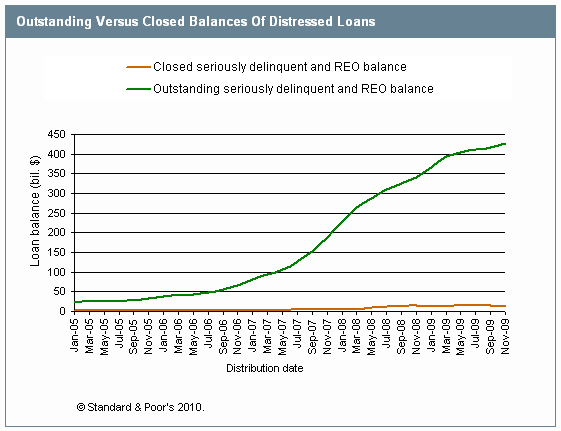
The monthly balance of distressed loans currently outstanding relative to the monthly balance of those that pay off, or close, suggests that there is a growing shadow inventory of loans that need to undergo the closure process. In January 2005, the balance of distressed loans outstanding was about 18x that of distressed loans that closed. Today, the balance of outstanding to closed distressed loans has increased to about 31x (see chart 2).”

Chart 2

Read more:

http://www.standardandpoors.com/ratings/articles/en/us/?assetID=1245206147429

Real unemployment rate, February 6 2010, Jobless claims, More jobs lost, Government surveys, Americans not looking for jobs

“And if all others accepted the lie which the Party imposed
–if all records told the same tale–then the lie passed into
history and became truth. “Who controls the past,” ran the
Party slogan, “controls the future: who controls the present
controls the past.”…George Orwell, “1984″


Yesterday, February 5, 2010, we reported that the supposed latest unemployment rate is 9.7 %, while at the same time unemployment claims rose again for the last week.

“The unemployment rate dropped from 10 percent because a survey of households found the number of employed Americans rose by 541,000, the Labor Department said Friday. The job losses are calculated from a separate survey of employers.

The department also revised its past employment estimates to show that job losses from the Great Recession have been much worse than previously stated. The economy has shed 8.4 million jobs since the downturn began in December 2007, up from a previous figure of 7.2 million.

That’s the most jobs lost in any recession, as a percent of total employment, since World War II.”

“The Labor Department says unemployment claims rose 8,000 to a seasonally adjusted 480,000 last week. Economists had predicted claims would drop to 460,000.”

“Stock futures weakened Thursday as a rise in weekly jobless claims damped hopes about a key employment report Friday.”
Real unemployment rate?

From Fox News, February 05, 2010

“The Real Story Behind Our Unemployment Numbers”

“A slight improvement in the jobless rate but what is the government hiding about the picture for most of 2009?”

“Most people seem to believe that the number of Americans with jobs is a clearly identifiable number. All you do is count up the number of people with jobs. Unfortunately, that isn’t the way it works. The number reported each month is based on surveys, and surveys have can often have problems. As it turns out, the surveys estimating the number of people with jobs reported over the last couple of years suffered from some really big problems. The economy actually lost about 824,000 more jobs during the recession than we previously thought.
But those adjustments have so far only been made through March 2009, and there are strong reasons to believe that the survey data since then also needs to be adjusted downward.
There are two ways economists measure the number of jobs, the establishment survey that asks about 370,000 employers how many people they are employing and the household survey that asks about 110,000 people each month whether they are working. The establishment survey is often given more weight because about 40 million Americans work for the companies surveyed, a lot more than the 110,000 people interviewed in the other survey. But 110,000 people still make up a huge sample (remember that a big survey for a presidential election might involve 2,000 people), and it is hard to ignore its results. The household survey is also what is used to calculate the unemployment rate.”

“These recent errors are quite large. The error in estimating the number of jobs from April 2008 to March 2009 was 10 times greater than the average error over the preceding eight years. What does this mean in terms of jobs? Normally the government would underestimate the number of new jobs by 80,000 and this time it was overestimating them by about 800,000.”

Read more:

http://www.foxnews.com/opinion/2010/02/05/john-lott-unemployment-jobs-bureau-labor-statistics-grim/

Do the government numbers “smell right” to you?