Category Archives: US economy

Obama energy policy pay to play, Reward supporters, Punish taxpayers, Commerce Department imposes new import fees on solar panels made in China

Obama energy policy pay to play, Reward supporters, Punish taxpayers, Commerce Department imposes new import fees on solar panels made in China

“If some politicians have their way, there won’t be any more public investments in solar energy,” …Barack Obama

“Obama’s energy policy is pay to play”…Citizen Wells

“The Party told you to reject the evidence of your eyes and ears. It was their final, most essential command. His heart sank as he thought of the enormous power arrayed against him, the ease with which any Party intellectual would overthrow him in debate, the subtle arguments which he would not be able to understand, much less answer. And yet he was in the right! They were wrong and he was right. The obvious, the silly, and the true had got to be defended. Truisms are true, hold on to that! The solid world exists, its laws do not change. Stones are hard, water is wet, objects unsupported fall towards the earth’s centre. With the feeling that he was speaking to O’Brien, and also that he was setting forth an important axiom, he wrote:

Freedom is the freedom to say that two plus two make four. If that is granted, all else follows.”…George Orwell, “1984”

Wasn’t the argument that we needed to become more energy independent, not reward Obama’s supporters?

Let’s face it. At this point in time, the Chinese are going to make solar cells and panels at a lower cost than we are, with or without tariffs.

A good friend of mine approached me several months ago and asked if I was concerned about the Chinese subsidizing their solar cell production. I looked and him and exclaimed. Absolutely not! Let the Chinese bring the cost down, which they have. That will lower the cost here and put more people to work installing them, fuel ancillary industries and reduce our dependence on foreign oil.

Instead, Obama and his administration have rewarded his supporters such as Solyndra at the cost of taxpayer dollars. Then the American manufacturers fail and they along with Obama blame the Chinese.

It’s the Chinese stupid. This should have been factored in to manufacturing decisons and energy policies. The Chinese are a known factor. They didn’t just show up yesterday.

A smart, taxpayer friendly solution would be to work with the Chinese. If they can make the solar cells (and they can) cheaper, let them. Let them lower the price at their expense and learn from their technology like the Japanese did with us. At some point in time it may make sense for the US to manufacture solar cells. Regardless, in a reality based decision platform, “let’s make lemonade out of lemons.”

From The LA Times March 20, 2012.

“U.S. sets new tariffs on China solar panels”

“The U.S. Commerce Department has imposed new import fees on solar panels made in China, finding that the Chinese government is improperly giving subsidies to manufacturers of the panels there.

The Commerce Department said Tuesday it has found on a preliminary basis that Chinese solar panel makers have received government subsidies of 2.9 percent to 4.73 percent. Therefore the department said tariffs in the same proportions will be charged on Chinese panels imported into the U.S., depending on which company makes them.

The tariff amounts are considered small, but the decision could ratchet up trade tensions between the U.S. and China. Several U.S. solar panel makers had asked the government to impose steep tariffs on Chinese imports. They are struggling against stiff competition from China as well as weakening demand in Europe and other key markets, just as President Barack Obama is working to promote renewable energy.

“Today’s announcement affirms what U.S. manufacturers have long known: Chinese manufacturers have received unfair … subsidies,” Steve Ostrenga, CEO of Helios Solar Works in Milwaukee, Wis., said in a statement. The company is a member of a group called the Coalition for American Solar Manufacturing.

On the other side, some U.S. companies argue that low-priced Chinese imports have helped consumers and promote rapid growth of the industry.”

“The U.S. and China are two of the world’s biggest markets for solar, wind and other renewable energy technology. Both governments are promoting their own suppliers in hopes of generating higher-paid technology jobs.

The U.S. manufacturers’ complaints have been amplified by the controversy surrounding Solyndra Inc. — a California-based solar panel maker that filed for bankruptcy protection after winning a $500 million federal loan from the Obama administration.

Solyndra’s failure embarrassed the administration and prompted a lengthy review by congressional Republicans who are critical of Obama’s green energy policies. Solyndra has cited Chinese competition as a key reason for its failure.

U.S. energy officials say China spent more than $30 billion last year to subsidize its solar industry. Obama said in November that China has “questionable competitive practices” in clean energy and that his administration has fought “these kinds of dumping activities.” The administration will act to enforce trade laws where appropriate, Obama said.”

Read more:

http://www.latimes.com/business/la-fi-china-solar-20120320,0,2891514.story?track=rss&utm_source=feedburner&utm_medium=feed&utm_campaign=Feed%3A+latimes%2Fbusiness+(L.A.+Times+-+Business)


Obama change in gas and food prices, Higher gas prices threaten economy, Jobs added?, Millions of jobs and job seekers lost, WON Whip Obama Now

Obama change in gas and food prices, Higher gas prices threaten economy, Jobs added?, Millions of jobs and job seekers lost, WON Whip Obama Now

“If you’re complaining about the price of gas and you’re only getting 8 miles a gallon, you know…you might want to think about a trade-in.”…Barack Obama
“This announcement is not a judgment on the merits of the pipeline, but the arbitrary nature of a deadline that prevented the State Department from gathering the information necessary to approve the project and protect the American people,”…Barack Obama

“And if all others accepted the lie which the Party imposed
–if all records told the same tale–then the lie passed into
history and became truth. “Who controls the past,” ran the
Party slogan, “controls the future: who controls the present
controls the past.”…George Orwell, “1984″

Obama Change

Gasoline and food price facts for Truth Team and interested Americans.

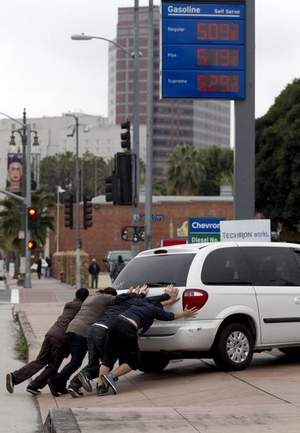
Pedestrians help push a motorist who ran out of gas Friday into a station in downtown Los Angeles, where prices topped $5 per gallon. / Damian Dovarganes / Associated Press

I have located several versions of an AP article on gas prices and the economy.

From the AP March 16, 2012.

“Higher gas prices threaten economy if they persist”

“Inflation remains tame throughout the U.S. economy, with one big exception: gas prices.

Those higher prices haven’t derailed a steadily improving economy. But if they surpass $4 or $5 a gallon, experts fear Americans could pull back on spending, and job growth could stall, posing a potentially serious threat to the recovery.

And the longer prices remain high, the more they could imperil President Barack Obama’s re-election hopes.

A few weeks ago, economists generally agreed that the economy was in little danger from higher gas prices as long as job growth remained strong. But fears are now mounting that gas prices could begin to weaken consumer confidence.

The average pump price nationwide is $3.83 a gallon. Energy analysts say it’s bound to climb higher in the weeks ahead.

“It’s a thorn in the side of the consumer and businesses,” said Chris Christopher, an economist at IHS Global Insight. The economy this year “would have been better and stronger if we didn’t have to deal with this.”

So far, higher prices aren’t undermining the economic recovery, which is getting a lift from strong job creation. It would take a big jump — to around $5 a gallon — before most economists would worry that growth would halt and the economy would slide into another recession.

That’s because an improving economy is somewhat insulated from any threat posed by higher prices at the pump.

The risk is that gas prices could eventually slow growth by causing some people to cut spending on other goods, from appliances and furniture to electronics and vacations. Gasoline purchases provide less benefit for the U.S. economy because about half of the revenue flows to oil-exporting nations, though U.S. oil companies and gasoline retailers also benefit.

Many American businesses suffer, too. They must pay more for fuel and shipping and for materials affected by high oil prices, such as petroleum-based plastics. Profit margins get squeezed.

Even if prices ease after the summer driving season, don’t expect gasoline to fall below $3 a gallon. The government estimates that this year’s average will be $3.79, followed by $3.72 in 2013.

Most economists accept a rough guideline that a 25-cent rise in gas prices knocks about 0.2 percentage point off economic growth.

Gas prices also have an outsize impact on consumer confidence, Christopher noted. It’s a high-frequency purchase. Consumers notice the price whether they’re filling up or driving past a gas station.

Along with the unemployment rate and stock market levels, gasoline prices heavily determine how Americans see their financial health.

That effect was evident Friday when a decline was reported in the Thomson Reuters/University of Michigan index of consumer sentiment. The result surprised some economists who had assumed that higher stock prices and lower unemployment would lift consumer sentiment.

The Michigan report showed that “gasoline worries … are outweighing stock market gains and job growth” when it comes to influencing consumer attitudes, said Michael Hanson, an economist at Bank of America Merrill Lynch.

The price of gasoline has climbed 17 percent since the year began — to a national average of $3.83 a gallon. That’s the highest ever for this time of year. A month ago, it was $3.52.”
http://www.google.com/hostednews/ap/article/ALeqM5jCwE51Rb2hl34tObtft80XI1pKhA?docId=8d2a58e51da64b07b23f1f6bad04b2b6

From above:

“So far, higher prices aren’t undermining the economic recovery, which is getting a lift from strong job creation. It would take a big jump — to around $5 a gallon — before most economists would worry that growth would halt and the economy would slide into another recession.”

Which country are they referring to? As evidenced recently in NC and reported here, the NC unemployment rate was adjusted upward to above 10 percent.

Also as reported here several times.

Inflation has been downplayed as well. Anyone visiting a grocery store for the past several years has watched food prices skyrocket, mostly due to rising gasoline prices.

From America’s North Shore Journal March 17, 2012.

The Bureau of Labor Statistics (BLS) keeps track of the average retail price for a number of common items as a U.S. city average. Let’s take a look at a few. We used the price for the month President Obmam was inaugurated, January 2009, and the last month of data available, December 2011. The items are sorted in descending order by the percentage increase of the price during the Obama administration.

    Obama Obama
Item Unit Jan 2009 Dec 2011 I/D Perc
Gasoline, unl reg gal $1.787 $3.278 $1.491 83.44%
Fuel oil, #2 gal $2.509 $3.777 $1.268 50.54%
Ground beef lb $2.357 $2.921 $0.564 23.93%
Sugar, white lb $0.569 $0.703 $0.134 23.55%
Bacon. Sliced lb $3.730 $4.550 $0.820 21.98%
Cookies, Choc chip lb $3.114 $3.682 $0.568 18.24%
Spaghetti & macaroni lb $1.131 $1.306 $0.175 15.47%
Eggs, A lrg doz $1.850 $1.874 $0.024 1.30%
Electricity kwh $0.126 $0.127 $0.001 0.79%
Lettuce, iceberg lb $0.944 $0.947 $0.003 0.32%
Milk, whole gal $3.575 $3.565 -$0.010 -0.28%
Potatoes, white lb $0.676 $0.666 -$0.010 -1.48%

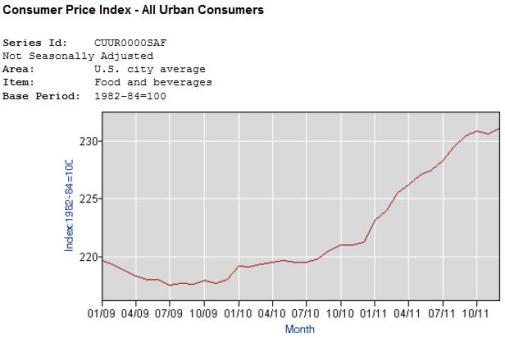
CPI Food 2009-2011

http://northshorejournal.org/whip-inflation-now

WON (whip inflation now)

Whip Obama Now

CBO real Truth Team, Unemployment rate 15 percent, Obama deficits, 1.2 trillion 2012, Obamacare costs rise and causes millions to lose employer insurance

CBO real Truth Team, Unemployment rate 15 percent, Obama deficits, 1.2 trillion 2012, Obamacare costs rise and causes millions to lose employer insurance

“And so our goal on health care is, if we can get, instead of health care costs going up 6 percent a year, it’s going up at the level of inflation, maybe just slightly above inflation, we’ve made huge progress. And by the way, that is the single most important thing we could do in terms of reducing our deficit. That’s why we did it.”…Barack Obama

“The fact that we are here today to debate raising America’s debt limit is a sign of leadership failure. America has a debt problem and a failure of leadership. Americans deserve better. I, therefore, intend to oppose the effort to increase America’s debt.”…Barack Obama

“the Times of the nineteenth of December had published the official forecasts of the output of various classes of consumption goods in the fourth quarter of
1983, which was also the sixth quarter of the Ninth Three-Year Plan. Today’s issue contained a statement of the actual output, from which it appeared that
the forecasts were in every instance grossly wrong. Winston’s job was to rectify the original figures by making them agree with the later ones.”…George
Orwell, “1984”

Real unemployment rate 15 percent.

From the CBO February 2012.

“The rate of unemployment in the United States has
exceeded 8 percent since February 2009, making the past
three years the longest stretch of high unemployment in
this country since the Great Depression. Moreover, the
Congressional Budget Office (CBO) projects that the
unemployment rate will remain above 8 percent until
2014. The official unemployment rate excludes those
individuals who would like to work but have not searched
for a job in the past four weeks as well as those who are
working part-time but would prefer full-time work; if
those people were counted among the unemployed, the
unemployment rate in January 2012 would have been
about 15 percent. Compounding the problem of high
unemployment, the share of unemployed people looking
for work for more than six months—referred to as the
long-term unemployed—topped 40 percent in December
2009 for the first time since 1948, when such data began
to be collected; it has remained above that level ever
since.”

http://www.cbo.gov/sites/default/files/cbofiles/attachments/02-16-Unemployment.pdf
Obama budget deficits

From the CBO March 2012.

“This report by the Congressional Budget Office (CBO) presents an analysis of the proposals contained in the President’s budget request for fiscal year 2013. The analysis is based on CBO’s economic projections and estimating techniques (rather than the Administration’s) and incorporates estimates by the staff of the Joint Committee on Taxation for the President’s tax proposals.1

In conjunction with analyzing the President’s budget, CBO has updated its baseline budget projections, which were previously issued in January 2012. Unlike its estimates of the President’s budget, CBO’s baseline projections largely reflect the assumption that current tax and spending laws will remain unchanged, so as to provide a benchmark against which potential legislation can be measured. Under that assumption, CBO estimates that the deficit would total $1.2 trillion in 2012 and that cumulative deficits over the 2013–2022 period would amount to $2.9 trillion.”

http://www.cbo.gov/publication/43083

Obamacare cost

From the Amrican Enterprise Institute March 15, 2012.

“CBO: Obamacare could cost $2.1 trillion through 2022”

“According to a new government report, it turns out that more people than first expected will end up getting healthcare through the subsidized insurance exchanges and Medicaid rather than through their employers:

In the original analysis of the impact of the legislation, CBO and JCT estimated that, on balance, the number of people obtaining coverage through their employer would be about 3 million lower in 2019 under the legislation than under prior law. As reflected in CBO’s latest baseline projections, the two agencies now anticipate that, because of the ACA, about 3 million to 5 million fewer people, on net, will obtain coverage through their employer each year from 2019 through 2022 than would have been the case under prior law.

The results acknowledge that if a business chooses not to offer insurance coverage under the ACA, some workers might enroll in Medicaid or CHIP or be eligible to receive subsidies through the insurance exchanges. And as a result, the cost of those programs would increase.

Right now, the updated baseline CBO forecast sees the gross cost of Obamacare through 2022 as $1.8 trillion, a number which includes this new estimate of employee coverage. When you include new taxes, the net cost is $1.3 trillion. (Back in 2010, the ten-year, gross cost was a mere $940 billion, as the bill was structured to back end spending. But now instead of six years of spending estimates, we have nine.)

But under one CBO-JCT scenario, the gross costs through 2022 could be $2.1 trillion if even more businesses than expected decide not to offer health insurance and more people need government subsidized coverage.

But no worry, say the government bean counters, $386 billion in addition taxes (for a total of $895 billion) will cover the difference. First, there would be higher penalty payments by employers and individuals. Second, since health benefits are generally not taxed but wages and salaries are, a shift in the mix of compensation would raise federal revenues.”

http://blog.american.com/2012/03/cbo-obamcare-could-cost-2-1-trillion-through-2022/

Obamacare causes millions to lose employer coverage.

From human Events March 16, 2012.

“The latest revelation, reported at The Hill, is that ObamaCare could cause up to 20 million Americans to lose their health care coverage. There is a “tremendous amount of uncertainty” in the forecast, which is just what our fragile Obamanized economy needs right now, but 20 million is the CBO’s worst-case estimate. Maybe it will only be 3 to 5 million people.

The CBO is actually being very, very conservative in its damage estimates, as industry groups think ObamaCare will nuke closer to 50 million employer-provided policies over the next decade. Amusingly, the CBO points to RomneyCare in Massachusetts as “one piece of evidence that may be relevant” to its projections, as “employment-based health insurance appears to have increased since that state’s reforms.” It will be super awesome to hear Romney debate this with Obama.

ObamaCare kills health insurance by dumping so many mandates on employers that it becomes attractive for them to escape by dropping insurance coverage altogether. Even the CBO’s worst-case projections are underestimating the effect this will have on health insurance, in years to come. What do you think will happen to insurance companies that swiftly lose millions of customers to the “public exchanges?” What will happen to the prices they charge to their diminished customer base… and how will that, in turn, influence other businesses trying to decide whether dropping coverage makes sense?

It is nevertheless significant that the Congressional Budget Office, with its typical static-analysis caution, is predicting that ObamaCare might create a number of uninsured that dwarfs the uninsured population it was ostensibly created to help. If Obama’s true agenda is to destroy private health insurance and clear the way for a socialized medicine takeover, everything is proceeding according to plan.”

http://www.humanevents.com/article.php?id=50264


NC unemployment worse than reported, Over 10 percent, North carolina fourth highest, Economy worse than first thought, Truth Team notification

NC unemployment worse than reported, Over 10 percent, North carolina fourth highest, Economy worse than first thought, Truth Team notification

“Guilford (Large NC County) appears on it’s way to a third consecutive year with annual jobless rates in double digits. Economists say that likely hasn’t happened since the Great Depression.”…Greensboro News Record December 2, 2011

“And if all others accepted the lie which the Party imposed–if all records told the same tale–then the lie passed into history and became truth. “Who controls the past,” ran the Party slogan, “controls the future: who controls the present controls the past.”…George Orwell, “1984″

“And you shall know the truth, and the truth shall set you free.”…Jesus, John 8:32

We told you so.

Citizen Wells, Rush Limbaugh and others criticized the stated unemployment rate from the past several months. I knew from my math background and cursory examination of the data that the reported rates were wrong and the economy much worse.

However, I am confident that the Truth Team is on top of this. As part of my efforts to work with the Truth Team to make certain that the candidates quote the correct numbers, I gave them a heads up several weeks ago.

From Citizen Wells February 16, 2012.

“NC Truth Team, Citizen Wells provides facts for Obama Truth Team and Republicans, North Carolina jobs unemployment hardships, No more lies”

““While the job market showed signs of growth last year, both Guilford and the state ended 2011 with more people unemployed than was the case the previous
December.

In Guilford , nearly 24,500 didn’t have jobs; statewide, the number surpassed 446,000.

And both the county and the state ended the year with jobless rates of 9.9 percent. That’s equal to or higher than the rates a year earlier.”

“At the current rate of growth–adding 8,300 annually–it will take 3.5 years–or until 2016–to regain the positions lost during and after the Great recession.

“Looking ahead, Quinterno said he expects more of the same this year.

“Absent robust job growth, joblessness and associated hardships will remain widespread,” he wrote. “2012 could well be the fifth consecutive year of negative or minimal job growth in North Carolina.””

“The employment picture is much bleaker.”

““The weak job growth recorded during 2011 did little to replace the jobs lost earlier in the business cycle. Since the onset of the “Great Recession,” North Carolina has lost, on net, 295,300 positions, or 7.1 percent of its payroll employment base. The maximum job loss recorded during the business cycle occurred in February 2010, when the state had 323,000 fewer jobs (-7.7 percent) than it did 26 months before. Since that time, North Carolina has netted 27,700 positions (+0.7 percent), for an average monthly gain of nearly 1,300 jobs. While the state’s economy added more jobs in 2011 than in 2010 (+19,600 versus +5,400), the growth was too weak to materially alter the employment situation. Even if the annual level of job growth were to triple, it still would take roughly five years to close the current jobs gap, holding all else equal.”

“Estimates of the underemployment rate, a broader measure of labor under-utilization prepared by the US Bureau of Labor Statistics, indicate that 17.9 percent of North Carolina’s adjusted labor force was underemployed, on average, in 2011. That measure includes not only individuals who meet the formal definition of unemployment, but also those working part-time despite preferring full-time work and those marginally attached to the workforce. Over the year, the statewide underemployment rate rose by 0.5 percentage points, rising to 17.9 percent from a level of 17.4 percent in 2010.

Regardless of the exact measure used, a sizable amount of labor in North Carolina is currently sitting idle. Nearly 10 of every 100 members of the state’s labor force are unemployed (seasonally adjusted), while almost 18 of every 100 are underemployed. Moreover, the share of adult North Carolinians with a job has fallen sharply since late 2007. In December 2011, only 55.6 percent of working-age North Carolinians (seasonally adjusted) had jobs, a level no different from the one posted one year prior. This rate actually fell to a low of 55.3 percent near the end of 2011.Q3. At no other time since 1976 has the employment-to-population been as low as it has been in recent months (fig. 7). The current ratio also is well below the historical average rate of 63.6 recorded between January 1976 and December 2007.””

https://citizenwells.wordpress.com/2012/02/16/nc-truth-team-citizen-wells-provides-facts-for-obama-truth-team-and-republicans-north-carolina-jobs-unemployment-hardships-no-more-lies/

I would like to thank the Greensboro News Record for reporting this today, March 14, 2012.

“Update: N.C. jobless rate still above 10 percent”

“New, more-accurate estimates show North Carolina’s unemployment rate stayed above 10 percent throughout 2011, falling to 10.2 percent in January in a key election battleground state, the state Commerce Department reported today.

North Carolina’s jobless rate was the fourth-highest in the country in January, trailing California, Rhode Island and Nevada, which leads the nation with a 12.7 percent unemployment rate.

The report also pointed to some bright spots amid signs of slow improvement in the national economy. An additional 14,213 people were drawing paychecks in January. An extra 6,245 entered the workforce as previously discouraged or young workers started looking for jobs.

On the downside, nearly 8,000 more people were on unemployment rolls in January than in the previous month.

“These new data say the economy is improving, but it’s also saying the economy is worse than we first thought,” said James Kleckley, director of the Bureau of Business Research at East Carolina University.

The estimates were revised in an annual re-examination of available data coupled with U.S. Census information of people reporting themselves as working or unemployed.

The result was that earlier estimates of North Carolina’s unemployment rate dropping below 10 percent in December were revised upward. The new estimates are that the state’s unemployment rate was 10.4 percent in November and December before falling to 10.2 percent in January. The national average was 8.3 percent in January.

“What everything’s been saying is that North Carolina has been improving but not by leaps and bounds by any means,” Kleckley said. “This will make me have to rethink some of the other data. I didn’t expect it. I expected the unemployment rate to be a little lower.”

North Carolina lost more than 330,000 jobs by the time the national recession bottomed out in February 2010, state data showed Tuesday. Since then, the state has gained back about 80,000 jobs, or about a quarter of the jobs lost, John Connaughton, an economic forecaster at UNC-Charlotte.

In January, North Carolina employers added 17,000 more payroll jobs than they cut.

“We had a big January jump,” said Connaughton, who predicts the state’s businesses to add about 50,000 jobs this year.

“The issue here is I think the economy has turned a corner. 2012 is going to start to feel like a recovery for most people,” he said. “People are going to say, ‘Yep, things are getting better. I’ve got job opportunities. I’ve got options.’ ”

Tuesday’s report comes during an election year in which the economy and job prospects are expected to be a huge issue. President Barack Obama is targeting North Carolina as key to his re-election prospects. He narrowly won the state in 2008, reversing a generation of voters picking Republican presidential candidates.

With rising stock markets, increased manufacturing and other indicators pointing to a slowly improving U.S. economy, North Carolina residents have reported increasing optimism. An Elon University poll released last week found about two-thirds of state residents think the economy either will stay the same or get better in the months ahead. More than half of the poll’s respondents said the economy was the most important issue facing the state.

Small-business owners across the country reported increasing optimism for the sixth straight month in February, the National Federation of Independent Business said Tuesday. The hopeful forecast is spreading among North Carolina’s main-street business community, but it’s far too early to celebrate, NFIB state director Gregg Thompson said.

“It looks like things are finally turning around, but unless the pace of recovery picks up, it’ll be years before we’re back where we started,” he said.”

http://www.news-record.com/content/2012/03/13/article/nc_jobless_rate_still_above_10_percent


Truth Team unemployment facts, CNN Money Orwellian reporting, 8.3 percent unemployment, 227000 jobs added, How many jobs lost?, 476000 added to workforce?

Truth Team unemployment facts, CNN Money Orwellian reporting, 8.3 percent unemployment, 227000 jobs added, How many jobs lost?, 476000 added to workforce?

“The past is whatever the records and the memories agree upon.
And since the party is in full control of all records, and in
equally full control of the minds of it’s members, it follows
that the past is whatever the party chooses to make it. Six
means eighteen, two plus two equals five, war is peace,
freedom is slavery, ignorance is strength.”…George Orwell, “1984”

“the Times of the nineteenth of December had published the official forecasts of the output of various classes of consumption goods in the fourth quarter of 1983, which was also the sixth quarter of the Ninth Three-Year Plan. Today’s issue contained a statement of the actual output, from which it appeared that the forecasts were in every instance grossly wrong. Winston’s job was to rectify the original figures by making them agree with the later ones.”…George Orwell, “1984”

“And if all others accepted the lie which the Party imposed
–if all records told the same tale–then the lie passed into
history and became truth. “Who controls the past,” ran the
Party slogan, “controls the future: who controls the present
controls the past.”…George Orwell, “1984″

As I promised recently, I am here to assist the Truth Team in keeping the candidates honest by reporting the facts

The Labor Department, Obama Administration, Mainstream media and Truth Team would have us believe that the alleged influx of 476,000 extra people in the labor force was the reason for the unemplyment rate not dropping. Retirement timing is affected by birth date and other more random events such as the economy and length of service and should be somewhat evenly dispersed during the year. The biggest labor entry events are graduation from high school, college or other schools. So where did the big influx of employees come from? Illegal aliens?

CNN Money gives one of it’s best theatric, Orwellian efforts to make the 8.3 percent (already manipulated by Orwell math) unemployment rate look normal and explained by population growth.

From CNN Money March 9, 2012.

“The economy added 227,000 jobs in February, but the unemployment rate didn’t change at all.
Woe is the White House — which would love to have the lowest rate possible heading into the general election.

Before Obama even took office, America had lost 4.4 million jobs. Track his progress since then.

But why didn’t the unemployment rate change if the economy added jobs?

The unemployment rate measures the percent of the labor force that is unemployed.

The unemployed are individuals who have actively looked for work over the previous four weeks. Looking for work can mean having a job interview, sending out resumes, or even something as simple as calling friends or relatives in hopes of finding a job.

The number of unemployed is then divided by the total labor force. And in February, the size of the labor force increased — possibly as discouraged workers started looking for work again.

As the labor force swelled, so did the number of new jobs necessary to drop the unemployment rate.

Behind the jobs recovery

Just take a look at the last two months for an example of how this works.

In February, 227,000 jobs were added and the unemployment rate didn’t change. Compare that to January, when the economy added 243,000 jobs and the unemployment rate dropped from 8.5% to 8.3%.

The difference?

In January, the labor force participation rate decreased by 0.3%. In February, it increased by 0.2%.

And that 0.2% increase in February translated to 476,000 extra people in the labor force, preventing a decline in the unemployment rate.

So it’s possible that an improving economy can actually cause the unemployment rate to remain static, or even rise, as more discouraged workers start mailing resumes.

Much has been made of how low — or high — the unemployment rate might be on Election Day, and whether a particular number will be enough to ensure a victory for President Obama, or sink his candidacy.

Of course, the unemployment rate is not the best measure of economic strength, but the number plays a large role in campaign trail rhetoric.”

“Assuming the labor force participation rate holds steady, and the population grows at the same rate it has over the previous year, the economy needs to add 149,288 jobs per month to get the unemployment rate to 8%.”

http://money.cnn.com/2012/03/09/news/economy/unemployment-election/

“and the population grows at the same rate it has over the previous year”

The only population event aside from aging (and that was explained above) that affects the labor force is immigration. Legal immigration is monitored and controlled. Are they implying that illegal aliens affected the workforce numbers?

Reread the CNN report and other reports you have heard lately after reading the following from the US Labor Department March 9, 2012.

“Nonfarm payroll employment rose by 227,000 in February, and the unemployment rate was unchanged at 8.3 percent, the U.S. Bureau of Labor Statistics reported today.
Employment rose in professional and businesses services, health care and social
assistance, leisure and hospitality, manufacturing, and mining.

Household Survey Data

The number of unemployed persons, at 12.8 million, was essentially unchanged in February. The unemployment rate held at 8.3 percent, 0.8 percentage point below the August 2011 rate.”
“Both the labor force and employment rose in February. The civilian labor force
participation rate, at 63.9 percent, and the employment-population ratio, at 58.6 percent, edged up over the month. (See table A-1.)

The number of persons employed part time for economic reasons (sometimes referred to as involuntary part-time workers) was essentially unchanged at 8.1 million in February. These individuals were working part time because their hours had been cut back or because they were unable to find a full-time job. (See table A-8.)

In February, 2.6 million persons were marginally attached to the labor force,
essentially unchanged from a year earlier. (The data are not seasonally adjusted.)
These individuals were not in the labor force, wanted and were available for work, and had looked for a job sometime in the prior 12 months. They were not counted as unemployed because they had not searched for work in the 4 weeks preceding the survey. (See table A-16.)

Among the marginally attached, there were 1.0 million discouraged workers in
February, about the same as a year earlier. (The data are not seasonally adjusted.)
Discouraged workers are persons not currently looking for work because they believe no jobs are available for them. The remaining 1.6 million persons marginally attached to the labor force in February had not searched for work in the 4 weeks preceding the survey for reasons such as school attendance or family responsibilities. (See table A-16.)”

http://www.bls.gov/news.release/empsit.nr0.htm

There is nothing in the above report that accounts for a 0.2% increase in  the labor force participation.

On February Citizen Wells presented an article on unemployment facts and used the graph from BarackObama.com

https://citizenwells.wordpress.com/2012/02/28/obama-jobs-lies-truth-team-facts-real-unemployment-picture-obama-vs-reagan-jobs-created-not-lost-touted/

I received an email recently from the Truth Team. I was pleased to see that they presented the same graph revealing the worsening employment situation since December 2007.

“Today we received some good news: Last month, American businesses added another 233,000 jobs. That means that after inheriting an economy that was shedding more than 750,000 jobs a month when the President took office, we’ve now had two straight years of job growth. While it’s certainly encouraging, we all know there’s much more that needs to be done.

If you haven’t seen it, check out this jobs chart, spread the good news, and encourage friends to stand with the President as he continues to fight for jobs:”

I am certain that the Truth Team will want the following important omission rectified:

The Democrats took control of congress in 2007. That is when the job situation began worsening.

Truth Team, no thanks necessary.

I just want to make certain that the candidates quote the correct information.

Also, I believe that CNN deserves at least 4 Orwells for their Orwellian presentation of Obama’s performance.

Obama jobs lies, Truth team facts, Real unemployment picture, Obama vs Reagan, Jobs created not lost touted

Obama jobs lies, Truth team facts, Real unemployment picture, Obama vs Reagan, Jobs created not lost touted

“the Times of the nineteenth of December had published the official forecasts of the output of various classes of consumption goods in the fourth quarter of 1983, which was also the sixth quarter of the Ninth Three-Year Plan. Today’s issue contained a statement of the actual output, from which it appeared that the forecasts were in every instance grossly wrong. Winston’s job was to rectify the original figures by making them agree with the later ones.”…George Orwell, “1984”

“And if all others accepted the lie which the Party imposed
–if all records told the same tale–then the lie passed into
history and became truth. “Who controls the past,” ran the
Party slogan, “controls the future: who controls the present
controls the past.”…George Orwell, “1984″

“Propaganda must not serve the truth, especially not insofar
as it might bring out something favorable for the opponent.”
Adolf Hitler

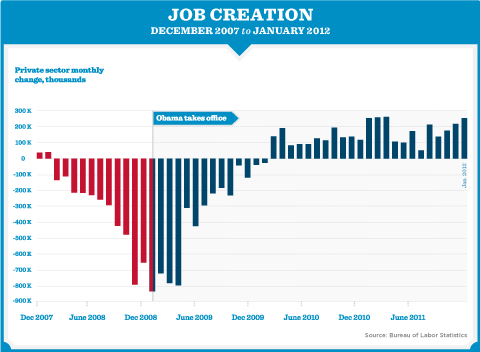
A habitual liar will let something slip. They often can’t keep straight the truth from the lies. Such it is with Barack Obama and the Obama Camp. Here is an example from BarackObama.com  February 3, 2012.
“23 Months of Job Growth”


“According to new jobs numbers released this morning, the economy added 257,000 private-sector jobs last month, making January the 23rd consecutive month of private-sector job growth.”

http://www.barackobama.com/news/entry/23-months-of-job-growth

They must believe that their followers will accept anything they promote as gospel truth. Anyone paying attention at all knows that the employment picture painted by this graph is not realistic. Here are the facts regarding this graph. Truth Team, pay close attention.

1. The Democrats took control of congress in 2007. That is when the job situation began worsening.

2. The job creation numbers Obama has used have always been suspect.

3. The jobs lost and discouraged workers dropping out of the workforce are not reflected.

Based on the lies and Orwellian attempts to mislead the public I am compelled to give this article 5 Orwells.

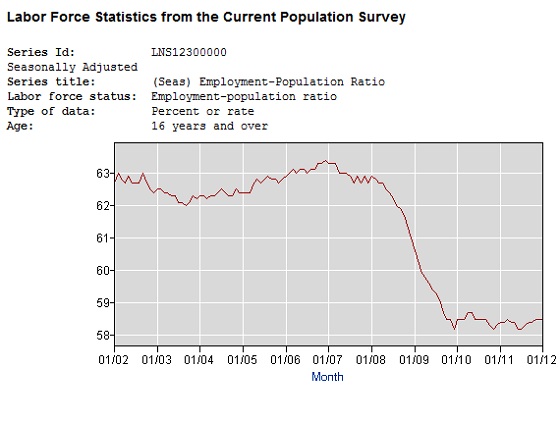
Ulsterman presented some interesting graphs on February 24, 2012.

“While the Obama administration and the mainstream media attempt to paint Americaas enjoying a current economic recovery – the facts tell a very different story.  After some 5 TRILLION dollars in deficit spending, job growth remains as stagnant as ever under the yoke of the Obama presidency:”

“There are a couple of interesting observations to be made from the above graphic from the Bureau of Labor Statistics. One, the steep decline in American jobs correlates to when the Democrats took over control of Congress. Coincidence? Perhaps. But then recall that Barack Obama begins his presidency in 2009 and the decline very much continues well into 2010 where it at least flatlines. 2010 was when Republicans then took control of the House of Representatives and gained a number of seats in the Senate – which the Democrats still control.
$5 TRILLION in lost taxpayer deficit dollars is quite a sum for what that chart reflects – stagnant job growth. Millions who remain unemployed. Millions more who have dropped out of even trying to find work and are therefor not even being counted in the unemployment figures.

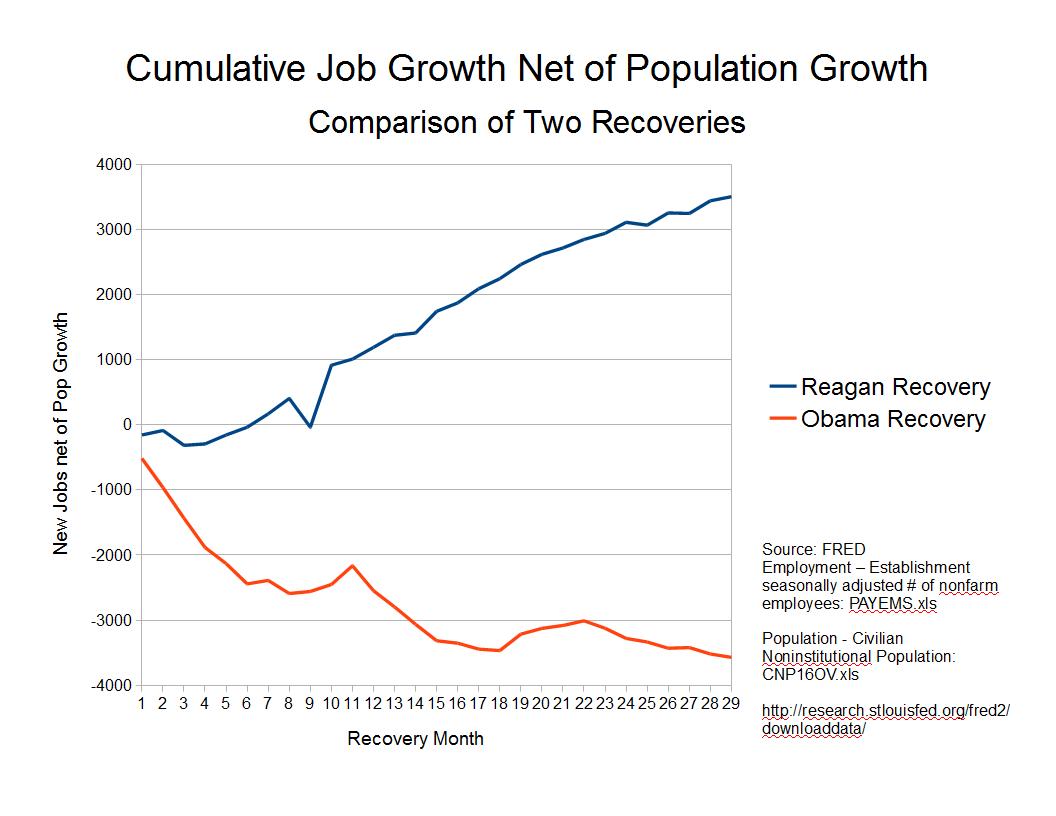
For a bit of contrast check out thiscomparative chart detailing the Reagan recovery vs the Obama recovery. One president charged ahead with plans to greatly reduce taxes, lessen regulations, and pushes to increase domestic energy production in the United States. The other president – Barack Obama, called for more taxes, more regulation, and has fought increasing domestic energy production at every opportunity – such as his shutting down of the much-needed Keystone pipeline:”


“The truth is clear – the Obama presidency has been a near-complete disaster for working Americans.  This might explain a term growing in popularity of late – “ABO”  –  Anybody But Obama in 2012…”

 
Excellent Ulsterman!
 
For more graphs and data:
 

Obama economy equals higher gas prices fewer jobs and more debt, Obama lies continue, Obama blocked Canada Keystone XL pipeline, Offshore leases

Obama economy equals higher gas prices fewer jobs and more debt, Obama lies continue, Obama blocked Canada Keystone XL pipeline, Offshore leases

“Obama energy policy: Pander to the left, lie to the poor and working class and enrich his friends.”…Citizen Wells

From the Washington Times February 24, 2012.

“Sessions: Obama ‘defeatist’ on rising gas prices”

“President Obama’s indignant defense this week of his administration’s energy policies has done nothing to deter GOP critics, as gas prices continue to rise amid worries that their continued climb could throw the economic recovery off course.

Alabama Sen. Jeff Sessions, the ranking Republican on the Senate Budget Committee, said in a letter to Mr. Obama Friday that the president was taking a “defeatist view” when it comes to trying to reduce gas prices.

“I reject the defeatist view that says the nation that won two world wars, pioneered space travel, and overcame the Soviet empire is now helpless in the face of high prices at the pump,” Mr. Sessions wrote. “We are not at the mercy of dictators, cartels and events beyond our control.”

In a speech in Miami Thursday, the president blamed the current spike prices on Wall Street speculators reacting to instability in the Middle East, most notably in Iran — not the amount of oil drilled in the U.S.

“There are no quick fixes to this problem,” Mr. Obama said. “You know we can’t just drill our way to lower gas prices.”

In his letter, Mr. Sessions echoed the views of other Republican critics in arguing that lifting Obama administration barriers to drilling would go a long way in helping drive down the price at the pump.

“Powerful action to harness America’s untapped oil and gas resources would place downward pressure on prices and speculation in the short run, and, by surging global supply, would serve to keep prices low in the future,” Mr. Sessions continued. “Crucially, it would also provide millions of Americans with good-paying, private-sector jobs; produce substantial royalties for local, state and federal governments; reduce our enormous trade imbalance; and put an end to our huge wealth transfer from American to competitors overseas.”

Mr. Sessions offered a list of proposals, including restoring the bipartisan 2010-2015 offshore lease plan to ensure that the 31 pending lease sales are completed expeditiously, abandoning Mr. Obama’s proposal to increase taxes and fees for oil and gas companies, and approving the massive Canada-to-Texas Keystone XL pipeline and expediting its completion.

“Your administration only directed one lease sale in 2011 and has announced just one lease sale for 2012, far short of the number of sales that would have occurred over this period under the original 2010-2015 plan that your administration discarded,” he wrote.

Mr. Sessions also urged Mr. Obama to “take all necessary steps” to accelerate the leasing and permitting process for domestic shale oil production and maximize oil production from federal lands, which are now producing just 714 million barrels a year — a 16 percent decline from what was projected five years ago.

In addition, the Alabama Republican called on the president to direct the Environmental Protection Agency, the Department of Energy and other federal bodies to grant all necessary waivers and approvals to oil and gas refineries to facilitate maximum production at minimum cost.

“Refinery expenses comprise 11 percent of the price for gasoline that Americans pay at the pump, but your administration has imposed numerous regulations that have driven refining costs up, not down,” he contended.

A White House spokesman said the president is particularly sensitive to the impact rising gas prices are having on family budgets across the country, but said there’s no silver bullet to solve the problem.

“If your answer to this challenge of rising gas prices is just drilling for oil, you’re not going to find a very good answer because an ‘all-of-the-above’ approach is required,” White House spokesman Josh Earnest told reporters Friday. “So that also is why the president is pursuing a range of other things: investments in biofuels, in renewable energy, wind and solar.”

The Obama administration is also backing the construction of the first nuclear power plant in the U.S. in 30 years, Mr. Earnest added.”

Read more:

http://www.washingtontimes.com/news/2012/feb/24/sessions-obama-defeatist-rising-gas-prices/

Obama lies continue, Energy policy Political Platitudes, Gas prices, Truth team moment, No concern from Obama for poor and working families

Obama lies continue, Energy policy Political Platitudes, Gas prices, Truth team moment, No concern from Obama for poor and working families

“the Times of the nineteenth of December had published the official forecasts of the output of various classes of consumption goods in the fourth quarter of 1983, which was also the sixth quarter of the Ninth Three-Year Plan. Today’s issue contained a statement of the actual output, from which it appeared that the forecasts were in every instance grossly wrong. Winston’s job was to rectify the original figures by making them agree with the later ones.”…George Orwell, “1984”

“And if all others accepted the lie which the Party imposed
–if all records told the same tale–then the lie passed into
history and became truth. “Who controls the past,” ran the
Party slogan, “controls the future: who controls the present
controls the past.”…George Orwell, “1984″

“Propaganda must not serve the truth, especially not insofar
as it might bring out something favorable for the opponent.”
Adolf Hitler

PP effluent from Obama and left.

Political Platitudes.

These are designed to appeal to Obama’s core support, the left, the elitists, the experts at spending other people’s money, like colleges and universities.

Obama PP in recent speeches.

In regard to the Republicans plan:

“three-point plan for $2 gas”

“Step one is to drill, step two is to drill, and step three is to keep on drilling.”

“not a strategy to solve our energy challenge.”

“It’s the easiest thing in the world to make phony election-year promises about lower gas prices,”

“What’s harder is to make a serious, sustained commitment to tackle a problem that may not be solved in one year or one term or even one decade.”

And straight from “1984” by George Orwell.

“In 2011, the United States relied less on foreign oil than in any of the last 16 years. Because of the investments we’ve made, the use of clean, renewable energy in this country has nearly doubled, and thousands of Americans have jobs because of it.”

Obama is speaking to his elitist, know it all support, such as the UNC University System, which recently raised tuition in a down economy.

This is a Truth Team moment.

While I agree that we need a comprehensive, common sense based energy program, we also need cheaper oil products in the short term. If Obama and his cronies really cared about poor and working class families, they would be concerned about rising gas prices which in turn raise the price of almost everything else, especially food prices. Obama appeases lower income folks with his lying rhetoric and the left with PP, Political Platitudes.

Obama states “not a strategy to solve our energy challenge.” in response to Republicans wanting lower gas prices. Obama’s startegy to help the economy and jobs has failed.

Obama, what is your stategy to help the poor and working families afford food.

More food stamps!

“phony election-year promises”

Obama is the king of phony election year promises.

Obama plan:

Tax

Spend

Promise

Blame

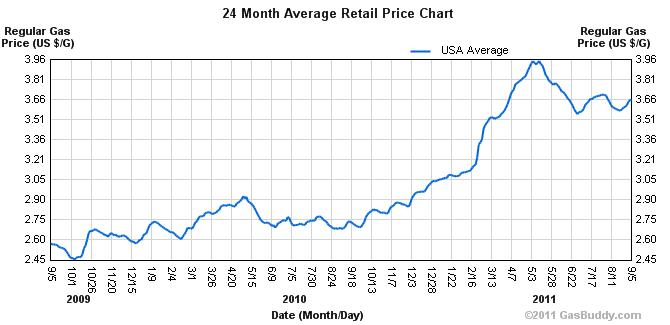
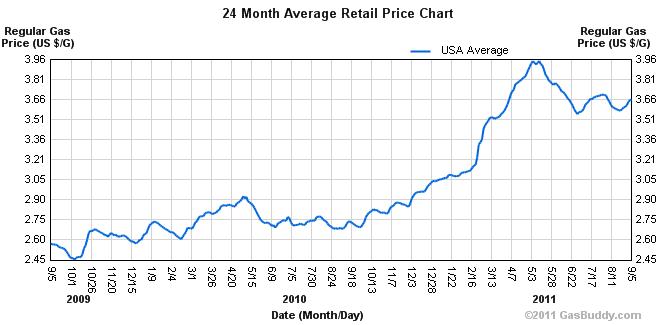
And in case you haven’t noticed, here is a chart presented here last year of the gas prices since Obama took office. I am certain you are aware of food price increases.

Penny Pritzker Obama 2008 national finance chairwoman, Economic Recovery Advisory Board, Skills for America’s Future, Obama Council for Jobs and Competitiveness, Superior Bank origin of sub prime crisis

Penny Pritzker Obama 2008 national finance chairwoman, Economic Recovery Advisory Board, Skills for America’s Future, Obama Council for Jobs and Competitiveness, Superior Bank origin of sub prime crisis

“We intend to close loopholes that allowed big financial firms to trade risky financial products like credit defaults swaps and other derivatives without
oversight; to identify system-wide risks that could cause a meltdown; to strengthen capital and liquidity requirements to make the system more stable; and to ensure that the failure of any large firm does not take the entire economy down with it. Never again will the American taxpayer be held hostage by a bank
that is “too big to fail.”…Barack Obama

“Democratic presidential contender Barack Obama says he’ll crack down on fraudulent sub-prime lenders. If he really means it he can start by firing his campaign finance chair, Penny Pritzker. Before taking over Obama’s campaign finances, she headed up the borderline shady and failed Superior Bank. It collapsed in 2002. The bank’s sordid story and its abominable role in fueling the sub-prime crisis are well known and documented. It engaged in deceptive and faulty lending, questionable accounting practices, and charged hidden fees. It did it with the sleepy-eyed see-no-evil oversight of federal. It made thousands of dubious loans to mostly poor, strapped homeowners. A disproportionate number of them were minority.

Obama’s home state, Illinois, ranked near the top of thee states in the percentage of sub-prime mortgages. Nearly 15 percent of home loans were sub-prime according to the Mortgage Bankers Association. But that only tells part of the tale. According to the Woodstock Institute, a Chicago non-profit that studies housing issues, the sub-prime fall-out was far higher in the predominantly black and Latino neighborhoods of South and Southwest Chicago.

The predictable happened when many of those lost their homes. When the bank collapsed Pritzker and bank officials skipped away with their profits and reputations intact. Aside from the financial and personal misery sub prime lenders caused the thousands of distressed homeowners, sub-prime lending has been a major cause of the housing crisis in many areas, and has dealt a sledgehammer blow to the economy. Obama has said nothing about Pritzker, Superior Bank, or their dubious practices.”…Huffington Post, February 29, 2008

“One could make the argument that Pritzker was the most important person in Barack Obama’s presidential bid – except, perhaps, for Obama himself. A longtime Obama friend, Pritzker was national finance chairwoman for the Obama campaign throughout his 2008 presidential effort. She helped him raise a record $750 million from a dizzying array of donors.
Obama’s huge fundraising advantage not only gave him clout during the primaries against Sen. Hillary Rodham Clinton (D-N.Y.), but also provided the means to bypass federal funding for the general election and dramatically outspend Sen. John McCain (R-Ariz.)…Washington Post 

“Why did Obama employ Robert Bauer of Perkins Coie, to request an advisory opinion on FEC matching funds that he was not eligible for?”…Citizen Wells

More on Obama’s 2008  National Finance Chairwoman and economic advisor Penny Pritzker.

From Consortium News February 28, 2008.

“Though Superior Bank collapsed years before the current sub-prime turmoil that is rocking the world’s financial markets – and pushing those millions of homeowners toward foreclosure – some banking experts say the Pritzkers and Superior hold a special place in the history of the sub-prime fiasco.

“The [sub-prime] financial engineering that created the Wall Street meltdown was developed by the Pritzkers and Ernst and Young, working with Merrill Lynch to sell bonds securitized by sub-prime mortgages,” Timothy J. Anderson, a whistleblower on financial and bank fraud, told me in an interview.

“The sub-prime mortgages,” Anderson said, “were provided to Merrill Lynch, by a nation-wide Pritzker origination system, using Superior as the cash cow, with many millions in FDIC insured deposits. Superior’s owners were to sub-prime lending, what Michael Milken was to junk bonds.”

In other words, if you traced today’s sub-prime crisis back to its origins, you would come upon the role of the Pritzkers and Superior Bank of Chicago.”

http://www.consortiumnews.com/2008/022708a.html

From Chicago Magazine December 2002.

“”They were always more interested in building an empire than in getting their name in the newspaper,” says Patrick Foley, formerly president of Hyatt Hotels Corporation. “They just didn’t enjoy that kind of notoriety.”

Last year, however, the Pritzkers found themselves most uncomfortably in the public eye after the stunning collapse of Superior Bank, the Oakbrook Terrace–based savings and loan they jointly owned with the New York real estate developer Alvin Dworman. The institution’s failure is “a tale of gross mismanagement,” says George Kaufman, a finance professor at Loyola University Chicago. “[Superior] was engaged in relatively unethical practices, fancy-footwork accounting, playing it very close to the edge.” Kaufman says many share in the blame for the mess-the bank’s managers, directors, and auditors, as well as banking regulators-but he also wonders how the Pritzkers, as co-owners, could have allowed it to happen. “One of the great mysteries to me is what the Pritzkers were up to, why they took these chances,” he says. “It makes no sense given their wealth and visibility.””

“The family’s most agonizing setback, however, was the stunning collapse last year of the once high-flying Superior Bank. The thrift had come into the Pritzker fold in 1988, when Jay Pritzker and Alvin Dworman-old social friends and partners in several past business ventures-put up $42.5 million for the insolvent Lyons Savings Bank, as it was then called, in return for an estimated $645 million in federal tax credits and loan guarantees. (By one estimate, it would have cost the government $200 million less simply to shut Lyons down.) Although Dworman had agreed to run the renamed Superior Bank out of his New York office, Jay deputized his niece Penny-a Harvard educated go-getter who had just earned her law degree and M.B.A. from Stanford-to help keep tabs on the investment. She served as chairman of Superior from 1989 to 1994, long enough for the bank to regain its financial health and embark on an aggressive new strategy, making high-interest home and auto loans to people with bad credit. For a time, that strategy appeared to work like a charm, yielding big profits-and large dividends for the Pritzkers and Dworman.

In reality, Superior was spiraling into ruin. Although the details are complicated, the bank’s fall stemmed from a risky business strategy and from poor oversight by the bank’s directors, according to investigations by banking regulators. Superior became heavily concentrated in high-risk assets connected with its subprime lending business, and then used “unrealistic and overly optimistic assumptions” to record the value of those assets, according to a report by the inspector general of the Federal Deposit Insurance Corporation. In language redolent of the corporate accounting scandals that have rocked Wall Street recently, the report adds that by using “liberal interpretations of accounting principles” Superior was able to “report impressive net income figures that masked the net operating losses the institution was actually experiencing.” Those phony “profits,” by the way, allowed Coast-to-Coast Financial Corporation, the holding company owned jointly by the Pritzkers and Dworman, to collect more than $200 million in dividends from 1993 to 1999-money the bank desperately could have used as it tottered toward insolvency.

After the Pritzkers and Dworman failed in July of last year to follow through on a plan to inject $270 million into the bank, Superior was seized by the Office of Thrift Supervision and eventually placed in receivership under the FDIC. Last December, to avoid being punished for Superior’s failure, the Pritzkers agreed to pay the FDIC $460 million while admitting no wrongdoing. Because $360 million of that payment was to be spread out interest free over 15 years, the settlement was worth an estimated $335 million in today’s dollars. But that won’t cover all the damage. Even with the settlement, Superior’s failure is expected to cost the federal thrift insurance fund an estimated $440 million.

Meanwhile, the Pritzkers still have not put their Superior troubles entirely behind them. Tom and Penny Pritzker are defendants (along with Dworman, several officers and directors, and the bank’s auditor, Ernst & Young) in a federal civil racketeering suit brought on behalf of Superior’s uninsured depositors (those with deposits in excess of the federally insured $100,000). Although the 1,400 uninsured depositors so far have recovered about 55 percent of the more than $65 million they lost in the collapse, they are still out almost $30 million, according to Clint Krislov, the lawyer for the plaintiffs. By contrast, the Pritzkers may not have fared so badly. Counting the tax credits and deductions they originally received and the dividends they collected over the years, “they appear not to have lost money on the deal,” Krislov says. (A source close to the family says the Pritzkers did lose money in Superior, and asserts that the lawsuit is without merit.)

* * *
The Superior scandal stained virtually everyone connected with it-the bank’s managers and directors, the accountants who signed off on its financial statements, the banking regulators who failed to act aggressively as early as the mid-nineties, when Superior’s problems were fast becoming apparent, and, of course, the owners. As the fallout spread, the Pritzkers worked feverishly to control the damage. They claimed that they had been “passive investors” while Dworman’s people ran the show (Dworman said the Pritzkers shared in the blame). They also made the case that Superior’s auditor had continued to give favorable opinions on the bank’s accounting over the years. On that score, the Pritzkers appeared to gain some vindication in early November of this year when the FDIC sued Ernst & Young for fraud in its audit of Superior, and sought at least $2.19 billion in punitive and compensatory damages. (Ernst & Young denied responsibility for Superior’s collapse and said it would vigorously fight the charges.)

To some, however, the Pritzkers were hardly the innocents they made themselves out to be. The family, after all, controlled half the board seats of the bank’s holding company, which benefited from all that dividend income, and the Pritzker Organization’s chief financial officer, Glen Miller, chaired the bank’s audit committee. Although Penny had stepped down as the bank’s chairman in 1994, she remained a director of its holding company.

“No one should have had any illusions about what was going on,” says Bert Ely, a banking consultant in Alexandria, Virginia, who tracked the Superior story. “[Superior] was reporting gains that were unrealistically high, which allowed [it] to pay big dividends [to the Pritzkers and Dworman]. It was a lot like Enron and WorldCom-reporting profitability that wasn’t there. Their financial people should have been able to figure that out. If they truly didn’t understand the bank’s fundamentally unworkable business model, then the Pritzkers have bigger problems than Superior.”

The Pritzkers said in a statement that the settlement was simply “the right thing to do,” reflecting the family’s “historical commitment to stand behind their investments.” That may have been true. But it also entitles them to 25 percent of any sum the government collects in its $2.19-billion suit against Ernst & Young. Beyond that, the settlement made an ugly story go away. “I am convinced that the Pritzkers wanted to get their name off the front page,” says Ely. “They had stepped into a pile of horse manure, and they were highly embarrassed.””

http://www.chicagomag.com/Chicago-Magazine/December-2002/Tremors-in-the-Empire/


Penny Pritzker Obama Economic advisor fundraiser, Media Matters aka Times of 1984, Destroy banks and economy, Blame others

Penny Pritzker Obama Economic advisor fundraiser, Media Matters aka Times of 1984, Destroy banks and economy, Blame others

“During its 15 years in New York City, ACORN has helped squatters claim derelict city-owned property, forced bankers to invest in low-income communities, and organized a war against the city’s workfare program.

It’s also developed a reputation for no-holds-barred tactics—getting results through adversarial campaigns against bankers, politicians and bureaucrats using confrontation and concession rather than consensus.”…ACORN document, February 1999

“We intend to close loopholes that allowed big financial firms to trade risky financial products like credit defaults swaps and other derivatives without
oversight; to identify system-wide risks that could cause a meltdown; to strengthen capital and liquidity requirements to make the system more stable; and to ensure that the failure of any large firm does not take the entire economy down with it. Never again will the American taxpayer be held hostage by a bank
that is “too big to fail.”…Barack Obama

“Democratic presidential contender Barack Obama says he’ll crack down on fraudulent sub-prime lenders. If he really means it he can start by firing his campaign finance chair, Penny Pritzker. Before taking over Obama’s campaign finances, she headed up the borderline shady and failed Superior Bank. It collapsed in 2002. The bank’s sordid story and its abominable role in fueling the sub-prime crisis are well known and documented. It engaged in deceptive and faulty lending, questionable accounting practices, and charged hidden fees. It did it with the sleepy-eyed see-no-evil oversight of federal. It made thousands of dubious loans to mostly poor, strapped homeowners. A disproportionate number of them were minority.

Obama’s home state, Illinois, ranked near the top of thee states in the percentage of sub-prime mortgages. Nearly 15 percent of home loans were sub-prime according to the Mortgage Bankers Association. But that only tells part of the tale. According to the Woodstock Institute, a Chicago non-profit that studies housing issues, the sub-prime fall-out was far higher in the predominantly black and Latino neighborhoods of South and Southwest Chicago.

The predictable happened when many of those lost their homes. When the bank collapsed Pritzker and bank officials skipped away with their profits and reputations intact. Aside from the financial and personal misery sub prime lenders caused the thousands of distressed homeowners, sub-prime lending has been a major cause of the housing crisis in many areas, and has dealt a sledgehammer blow to the economy. Obama has said nothing about Pritzker, Superior Bank, or their dubious practices.”…Huffington Post, February 29, 2008

“As a businesswoman and education advocate, I have spent much of my life working to improve America’s economic competitiveness — and put the American Dream within reach for more people.”…Penny Pritzker

Birds of a feather flock together. The old saying seems to be true. Take Barack Obama and Penny Pritzker. They both have done their part to destroy banks and blame others for the devastation. They both use Media Matters which looks a lot like the Times of George Orwell’s “1984” to divert attention away from them.

Before I present more details on Penny Pritzker and her collaboration with Obama, here is an interesting article by David Moburg from November 8, 2002.

“Breaking the Bank”

“After federal regulators closed the $2.3 billion Superior Bank in July 2001, investigations revealed that the suburban Chicago thrift was tainted with the hallmarks of a mini-Enron scandal. New legal developments are adding additional twists, including racketeering charges. And yet the bank’s owners, members if one of America’s wealthiest families, ultimately could end up profiting from the bank’s collapse, while many of Superior’s borrowers and depositors suffer financial losses.

The Superior story has a familiar ring. Using a variety of shell companies and complex financial gimmicks, Superior’s managers and owners exaggerated the profits and financial soundness of the bank. While the company actually lost money throughout most of the ’90s, publicly it appeared to be growing remarkably fast and making unusually large profits. Under that cover, the floundering enterprise paid its owners huge dividends and provided them favorable loans and other financial deals deemed illegal by federal investigators.

Superior’s outside auditor, which doubled as a financial consultant, engaged in dubious accounting practices that kept feckless regulators at bay. Many individuals—disproportionately low-income and minority borrowers with spotty credit records—had apparently been exploited through predatory-lending techniques, including exorbitant fees, inadequate disclosure and high interest rates. In the end, more than 1,000 uninsured depositors lost millions of dollars in savings in one of the biggest bank failures of the past decade.

Yet unlike Enron, the people behind Superior’s collapse were not nouveau-riche corporate hustlers, but members of Chicago’s Pritzker family. The Pritzkers, whose two current patriarchs—Robert and his nephew Thomas—tie for 22nd place on Forbes’ list of the richest Americans, own an empire valued at more than $15 billion, including the Hyatt hotel chain, casinos, manufacturers and real estate, and they are major contributors to both political parties. They were equal partners in the private ownership of Superior with New York real estate developer Alvin Dworman, a longtime associate of Thomas’ father, Jay Pritzker, who died in 1999.

And Superior’s accounting and consulting was not provided by the disgraced Arthur Andersen, but by Ernst & Young. When regulators shuttered the bank, the publicity-shy Pritzkers, who take pride in their philanthropy (such as the prestigious international architecture award in the family name) quickly negotiated what appeared to be a generous settlement to stay out of the newspapers and the courtrooms.

But now both the Pritzkers and Ernst & Young may face the legal and public relations uproar they were trying to avoid. On November 1, the Federal Deposit Insurance Corporation (FDIC) sued Ernst & Young for more than $2 billion. The FDIC alleges that the firm concealed its improper accounting practices at Superior to facilitate the sale of its consulting unit for $11 billion, leading to Superior’s insolvency and ultimately costing the FDIC $750 million. Ernst & Young denies responsibility, blaming the bank’s managers and board, failed regulation and changing economic conditions. Investigators from the FDIC, Treasury Department and the General Accounting Office (GAO) had cited all those causes for Superior’s failure, but also had criticized Ernst & Young’s flawed work and conflicts of interest.

Meanwhile, in a case that has received no public notice, uninsured depositors are bringing a charge of financial racketeering against one-time board chairwoman Penny Pritzker, her cousin Thomas Pritzker, Dworman, other bank principals and Ernst & Young. In this federal class-action suit filed under the RICO (Racketeering Influenced and Corrupt Organizations) statute, plaintiffs’ attorney Clint Krislov claims that those who controlled Superior induced depositors to put money in the bank, “corruptly” funneling money out of the bank to “fraudulently” profit the owners. Pritzker attorney Stephen Novack says that the defendants will ask to dismiss the case as having no merit. Such a RICO suit has rarely, if ever, been used to recover money lost in a bank failure, partly because the owners in such cases, in the words of bank consultant Bert Ely, “usually don’t have a pot to piss in.” But the Pritzkers have a gold-plated pot.

This may not be the last of legal battles stemming from the Superior failure. Published reports indicate that a federal grand jury has been investigating potential criminal wrongdoing and that the Internal Revenue Service could press claims against the owners for tax evasion.

————–

The problems at Superior Bank date back to at least 1988, when the Federal Home Loan Bank Board, in an effort to conceal the depths of the developing savings-and-loan crisis, hastily made generous arrangements for the takeover of several failed thrifts. The Pritzkers and Dworman bought the failed Lyons Federal for the relatively modest price of $42.5 million, with each using a shell corporation to control half of Coast-to-Coast Financial Corporation (CCFC), a holding company created to own Superior.

Superior opened for business with substantial federal assistance and guarantees, but the Pritzkers also reportedly received $645 million in tax credits as an inducement to buy Lyons. This was not the first Pritzker-Dworman joint venture into banking. In 1985, the partners had acquired New York-based River Bank America. But in 1991, federal and state regulators closed River Bank, which was engaged in large-scale real estate speculation, when they discovered that the bank had inadequate capital and was badly managed. Nelson Stephenson, the chief financial officer of River Bank, later became chairman of Superior.

In 1992, the Pritzkers and Dworman transferred ownership of Alliance Funding Company, a nationwide mortgage banking company the partners had founded in 1985, to Superior Bank, which began specializing in selling securities backed by subprime mortgages. Prospective homeowners with less-than-stellar credit ratings often must turn to such subprime lenders, which typically charge higher interest rates to compensate for the higher risk of default.

But a great many subprime lenders also unfairly exploit borrowers, seeking them out through aggressive television, direct mail and telemarketing techniques, then charging excessively high interest rates and exorbitant fees. Since many borrowers are in difficult situations and financially unsophisticated, they often are duped into agreeing to harsh conditions, such as stiff penalties for pre-paying their mortgages if their credit improves or interest rates drop, or improper costs, such as having the entire dividend for a 30-year-mortgage insurance policy included up-front in their mortgage.

Superior Bank accumulated mortgages that originated from its own branches or Alliance offices, as well as those bought from other brokers. They would then issue securities with high credit ratings but lower interest rates than what they charged borrowers. As collateral, these securities were backed by the stream of income from the mortgages. Superior Bank would retain “residual interests”—part of the collateral mortgages plus some of the excess mortgage interest—but they also retained responsibility for all of the potential losses, or what’s known in the business as “toxic waste.”

Because of the greater risks of subprime lending, it was difficult to project the future value of Superior’s residual interests. But aided by Fintek, another subsidiary of CCFC, and abetted by Ernst & Young, Superior made extremely rosy projections and—like Enron—booked those projected profits as immediate, or “imputed,” earnings. The extremely optimistic value of some residual interests was also counted as part of Superior’s capital, which banks must maintain at regulated levels—depending on their condition and type of business—to make sure that depositors can be repaid.

————–

Examiners from the Office of Thrift Supervision (OTS) expressed concern about aggressive subprime policy, the value of residuals, the level of capital and other bank practices early in the ’90s. But Superior’s managers and board filed erroneous reports and repeatedly failed to take any of the action that regulators recommended. Nevertheless, according to investigators, the OTS did not take any corrective action. They were persuaded that management was experienced (even though two top managers had been involved in large losses or failures at other thrifts); that Ernst & Young had given its approval in annual audits without any reservations (even though the firm had a long history of penalties and censure for its involvement in high-profile thrift failures); and that “because of their financial status, the OTS placed a great deal of reliance on the ability of the owners to inject capital if the institution encountered any financial difficulties,” as the FDIC inspector general’s report stated.

Meanwhile, Superior was growing rapidly: Loan volume rose from $200 million generated in 1993 to $2.2 billion in 1999, with the value of securities issued reaching $9.4 billion. The bank reported a return on assets that was 12 times the industry average. But its reliance on the risky residual interests from its mortgage securitization soared to levels far out of line with the rest of the industry, and by 2000 the bank’s residual interests were valued at more than four times its less fictional capital (such as stockholder equity). Superior expanded its business to subprime auto loans, then had to pull out because it was clearly failing.

All this should have looked like a sea of red flags to regulators, but they issued modest warnings and failed to follow up when management ignored their recommendations. Superior’s management actually revised its accounting methods in 1997 to further exaggerate its projected earnings, and it more than doubled the volume of the lowest quality loans in the following years. It was all a house of cards, but a very lucrative one for the owners. During the ’90s, the bank paid CCFC—and thus the Pritzkers and Dworman—more than $200 million in dividends.

————–

There was a small problem, however. From 1995 on, investigators concluded, Superior was actually losing money, except for the fictional “imputed” earnings. So the dividends effectively were being paid out of the growing deposits, a practice that Ely describes as having “Ponzi-like characteristics.” Furthermore, in 2000 Superior sold loans to CCFC, which the holding company immediately resold for a $20.2 million profit. Such a sale of assets at less than fair market value to insiders is a violation of federal law. There were other loans made to CCFC and its affiliates totalling $36.7 million—all in violation of the Federal Reserve Act—that were never repaid, the inspector general reported.

Superior also supposedly loaned the Dworman family’s shell company $70 million in 1996, but even though Dworman promised to pay it all back by the end of 1999, the inspector general found no evidence of any payments being made. (Dworman reportedly claimed that the money was a dividend payment concealed as a loan, which would raise questions about tax evasion.) All these transactions enriched the Pritzkers and Dworman at the expense of the bank—and ultimately the FDIC insurance fund and uninsured depositors.

In the spring of 1999, both the OTS and FDIC downgraded Superior’s rating. Over the course of nearly two years, Superior and Ernst & Young resisted the analysis and recommendations of the regulatory agencies, but by January 2001 Ernst & Young finally agreed that the accounting of the residual assets had been wrong. The bank was deeply troubled even in good times, but the vulnerabilities would only increase. As interest rates declined, borrowers would try to pay off high-interest loans and refinance; as unemployment rose, increasing numbers of subprime borrowers would default.

After downgrading the bank further, regulators concluded that it was “significantly undercapitalized” and needed an infusion of $270 million, which the Pritzkers—with some participation by Dworman—agreed in March to provide. Then in July regulators reported that, as a result of overly optimistic assumptions, the bank would need to write off an additional $150 million of of its residual interests. The Pritzkers pulled out of the agreed capital plan, and the feds closed the bank.

————–

Wanting to avoid a lawsuit, the secretive Pritzkers quickly agreed to what the FDIC hailed in December as the biggest settlement they had ever negotiated. The Pritzkers would pay $100 million immediately, then $360 million over 15 years. But there were lots of little provisions in the agreement that benefit the Pritzkers. First, as former bank consultant and longtime thrift watchdog Tim Anderson notes, the $100 million doesn’t even quite pay back all of the unpaid loans made to the owners. The Pritzkers also pay no interest on the $360 million, and since it is paid over many years, the real cost to the Pritzkers may be only around $250 million. As of September 2002, according to FDIC figures, the insurance fund was still out $440 million after this settlement.

But it gets even sweeter for the Pritzkers. The FDIC also agreed to pay the Pritzkers 25 percent of any claim won in a lawsuit against Ernst & Young. Since the FDIC is now suing for $548 million, the Pritzker share could be $137 million. On top of that, the agreement stated that the Pritzkers get half of any civil penalties from such a lawsuit (after certain agency expenses). The FDIC is asking for triple damages, or $1.64 billion; the Pritzker share could be over $800 million.

Even taking into account the “record” settlement they made with the FDIC, the Pritzkers could make more than $700 million in additional profit for running a financial institution into the ground. They had already profited handsomely, sharing in the more than $200 million in dividends to the owners in the ’90s. They accomplished all this with an investment of about $21 million for each partner—though the Pritzkers had also already benefited from $645 million in tax credits.

Meanwhile, roughly 1,000 depositors who had deposits above $100,000 in a Superior account—money above the FDIC-insured limit—lost about $65 million. Most of them were middle-class individuals, attracted by Superior’s high interest rates. In the three months just before the bank was closed, there was a surge of $9.6 million in uninsured deposits. Since about 54 percent of the uninsured money has since been repaid as Superior was sold off, the depositors have still collectively lost about $30 million. (That just happens to be the amount that the Pritzkers gave to the University of Chicago’s Pritzker School of Medicine earlier this year.)

————–

Some of that money could have paid back Fran Sweet for the roughly $138,000 that she has still not recovered from her deposits at Superior. After retiring as a manager at a telecommunications company, Sweet was seeking a secure place to put her entire retirement savings of about $500,000. “I knew the Pritzkers were owners of the bank,” she says, “and they were a reputable name in Chicago. I had no idea that the bank was in trouble.”

She even asked a bank manager if there was anything wrong with the bank. “She said, ‘No, nothing is wrong, We’re owned by the Pritzkers,’ ” Sweet recalls. “I want it all back. I worked 23 years for a company and got this money from them as a buyout, and the Pritzker family and Dworman stole it from me.”

People at the other end of the deal—who borrowed from Superior—are also still hurting as a result of the scam. The National Community Reinvestment Coalition, which monitors bank lending, last year accused Superior of participating in a variety of predatory practices, including overly aggressive telemarketing, targeting low-income minority borrowers, and disproportionately incorporating problematic “balloon payments” in the loans. One borrower in Philadelphia, represented by attorney Brian Mildenberg, ended up in bankruptcy partly because Superior didn’t properly credit him for payments he had made. In another case, Cleveland construction worker Dan Sutton claims that a broker for Superior falsified papers to inflate his mortgage and charged exorbitant fees.

The Pritzkers are likely to make out like bandits, which is exactly what customers like Sweet and Sutton think they are. All of the government studies of Superior’s failure agree that there’s plenty of blame to spread around. As the FDIC inspector general’s report concluded, the bank managers pursued an ultra-risky strategy based on unrealistic assumptions and unjustifiably pumped dividends and illegal, unpaid loans out of the bank and into the owners’ coffers.

Ernst & Young provided inaccurate audits, resisted regulators, and did not test or properly disclose crucial financial assumptions. The OTS didn’t investigate or follow up on problems adequately, ignored warning signs for years, and unduly relied on the expertise of managers, the auditor’s report, and the promise of the wealthy owners to put their money behind the bank’s strategy, which they ultimately refused to do. While the FDIC lawsuit against Ernst & Young correctly highlights the accounting firm’s sorry record of accounting malpractice, it ignores the dubious history of the Pritzkers and Dworman in cases ranging from tax evasion to bank mismanagement, instead praising the Pritzkers for their charity.

What looked like a good deal for the FDIC in resolving Superior’s failure is now looking like yet another opportunity for the wealthy Pritzkers to further profit from their misdeeds. Certainly, the record suggests that Ernst & Young bears responsibility, but so do the Pritzkers and Dworman. The question is not just who will extract money from whose pocket in the aftermath of the bank failure, but also whether the rich are simply above the law. The RICO lawsuit against bank managers, owners and auditors raises the issue of criminal conspiracy and at least attempts to recover damages for the uninsured depositors. But beyond that, argues thrift watchdog Anderson, “I think there ought to be a criminal investigation.””

http://www.inthesetimes.com/article/671/