Category Archives: Citizen News

Seth Rich murder lawsuits filed by parents and Rod Wheeler dismissed, Claimed Fox News caused them emotional distress and engaged in “extreme and outrageous conduct”

Seth Rich murder lawsuits filed by parents and Rod Wheeler dismissed, Claimed Fox News caused them emotional distress and engaged in “extreme and outrageous conduct”

“Let me tell you something. They were all over that woman,”
“And it was the type of stuff we ran into with the outfit (the Chicago mob). Intimidation just by watching her, making their presence known. … Just to let her know ‘We can do what we want.’ ”…Attorney David Schippers, Clinton investigator

“I know that Seth Rich was involved in the DNC leak.”…Kim Dotcom

“Burkman said in an interview that he considered Selig like a brother and was badly shaken by his friend’s death.”
“The tragically ironic part is Glenn’s last words to me were, ‘Be careful,’” Burkman said. “It’s just a tragedy — terrible.””…Politico Jan. 24, 2018


From the NY Times.

“A federal judge in Manhattan dismissed a lawsuit Thursday that was brought against Fox News by the parents of Seth Rich, the young Democratic aide whose unsolved murder was turned into fodder for a lingering right-wing conspiracy theory.

In his dismissal of the lawsuit, Judge George B. Daniels said he sympathized with Mr. Rich’s parents, but added that they had not been personally defamed by the story — despite the fact that it included “false statements or misrepresentations.”

Mr. Rich’s parents, Joel and Mary, filed the suit in Federal District Court in Manhattan in March, arguing that Fox News had caused them emotional distress and engaged in “extreme and outrageous conduct” by publishing a fabricated article claiming that their son had leaked thousands of internal emails from the Democratic National Committee to WikiLeaks. Those emails were then released to the public in an act that proved damaging to Hillary Clinton’s 2016 presidential campaign.

The story, published on the Fox News website on May 16, 2017, implied that Mr. Rich’s death on the streets on Washington in July 2016 had occurred in retaliation for the leaks, even though no evidence supported that conclusion. Mr. Rich’s parents held that Mr. Rich — then 27 — had been killed during an attempted robbery.

Within a week, Fox News retracted the story, saying that it had not met its standards, but the conspiracy theory has persisted, fueled by prominent conservatives like Newt Gingrich, the Fox News pundit Sean Hannity and the right-wing broadcasters Rush Limbaugh and Alex Jones of Infowars. The rumors about Mr. Rich’s death were embraced by some supporters of President Trump, who used them to undercut the notion that Russian operatives had been responsible for the leak.

“It is understandable that plaintiffs might feel that their grief and personal loss were taken advantage of, and that the tragic death of their son was exploited for political purposes,” Judge Daniels wrote. But he added that he had no choice but to dismiss the suit, because Fox’s conduct did not amount to the intentional infliction of emotional distress.

The judge also noted that Mr. Rich could not have been defamed by the story under New York law, because he was dead.”

“In a related decision, Judge Daniels also dismissed a separate lawsuitbrought against Fox News, Ms. Zimmerman and Mr. Butowsky by a private detective who had played a central role in the retracted story.

The detective, Rod Wheeler, was hired by the Rich family on Mr. Butowsky’s recommendation to help them investigate their son’s death. Mr. Wheeler — who was himself a Fox News contributor — was quoted in the story as saying there was “information” linking Mr. Rich to WikiLeaks. But he later accused Fox News and Ms. Zimmerman of misrepresenting what he had said, calling that action part of a coordinated effort with the White House to smear Mr. Rich and “shift the blame from Russia.””

Read more:

https://www.nytimes.com/2018/08/02/nyregion/seth-rich-fox-news-lawsuits.html


More here:

https://citizenwells.com/

http://citizenwells.net/

Decline of middle class? Increase of stupidity and bad habits, Plenty of jobs in “education” restaurants breweries tattoo parlors, Common sense and time tested frugality out the window

Decline of middle class? Increase of stupidity and bad habits, Plenty of jobs in “education” restaurants breweries tattoo parlors, Common sense and time tested frugality out the window

“Mercury is a highly toxic element; there is no known safe level of exposure. Ideally, neither children nor adults should have any mercury in their bodies because it provides no physiological benefit.”…National Institute of Health

“U.S. Sen. Chuck Grassley, R-Iowa, investigating the issue”
“What he learned was astonishing. In 2013 and 2014 alone, ICE set loose more than 66,000 illegal immigrant criminals who had over 166,000 convictions (30,000 for drunk or drug driving, 414 kidnapping, over 11,000 rapes or other sexual assaults and 395 homicides). Already thousands of those have already been convicted of new crimes in the U.S., including felonies, since their release.”…WND October 25, 2015

“There is an epidemic of stupid in this country.”…Citizen Wells


From Zero Hedge.

“The Number Of Americans Living In Their Vehicles “Explodes” As The Middle Class Collapses

As the gap between the rich and the poor continues to increase, the middle class is steadily eroding.  In fact, I recently gave my readers 15 signs that the middle class in America is being systematically destroyed.  More Americans are falling out of the middle class and into poverty with each passing day, and this is one of the big reasons why the number of homeless is surging.  For example, the number of people living on the street in L.A. has shot up 75 percent over the last 6 years.  But of course L.A. is far from alone.  Other major cities on the west coast are facing similar problems, and that includes Seattle.  It turns out that the Emerald City has seen a 46 percent rise in the number of people sleeping in their vehicles in just the past year

The number of people who live in their vehicles because they can’t find affordable housing is on the rise, even though the practice is illegal in many U.S. cities.

The number of people residing in campers and other vehicles surged 46 percent over the past year, a recent homeless census in Seattle’s King County, Washington found. The problem is “exploding” in cities with expensive housing markets, including Los Angeles, Portland and San Francisco, according to Governing magazine.

Amazon, Microsoft and other big tech companies are in the Seattle area.  It is a region that is supposedly “prospering”, and yet this is going on.

Sadly, it isn’t just major urban areas that are seeing more people sleeping in their vehicles.  Over in Sioux Falls, South Dakota, many of the homeless sleep in their vehicles even in the middle of winter…”

Read more:

https://www.zerohedge.com/news/2018-08-01/number-americans-living-their-vehicles-explodes-middle-class-collapses

People in the US during the Great Depression had to resort to desperate measures.

Though times now can be challenging, the situation now is far better than then.

So why are so many homeless? Living in cars.

Part of the answer is the epidemic of stupid which I believe began in the sixties.

Growing up, I not only had a good education in school, I had one at home.

My parents were depression era survivors and also survivors of the hard times of settling this country. What used to be status quo.

They shared their stories of growing up in rural NC and what they and their families did to survive. This has stayed with me.

Part of my life and training was my duties (luxurious compared to theirs):

  • I was the oldest of 4. I babysat my siblings.
  • I was given a tiny allowance. If I wanted more, I had to work for it in addition to my chores.
  • I had a paper route, cut grass, babysat for others, picked blackberries, collected returnable bottles, etc.
  • I knew how to use a hammer & tools and liked it. We collected used nails & lumber scraps for our treehouses. Recycling.

By example we learned reality 101.

Starting with we ate out infrequently. Drank our own coffee. Used hand me down clothing. Had a garden. Paid with cash. My mom made some of our clothing and repaired much. And of course, my mom’s sayings for every occasion such as “You’re not too old for your wants to hurt you.”

I am frugal to this day.

I made really good money most of my life, lived beneath my means and this served me well when my disability hit.

I am a strong believer in education, real education, not just receiving a piece of paper and piling up debt.

There are many fine institutions of higher learning training medical professionals, engineers, accountants, etc.

However, we have created a myth, perpetuated by an unholy alliance between institutions and politicians that a diploma will cure practically everything.

We are not educating our young folks. And older folks.

I am around a lot of young people near the university and I have advised many of them to buy a house in an area that is conducive to high rent demand and perhaps with a layout that facilitates having renters who will help pay the mortgage. I knew an attorney couple years ago who did just that.

Many of them are sharing houses and that is another good way to save money.

We are not sacrificing enough, as our Greatest Generation did, to get started or managing our spending habits.

Just examine what is thriving in the economy. Restaurants, breweries, coffee shops, tattoo parlors, etc. None of which are essential for survival or condusive to saving and prospering.

We are not prepared for marriage and having kids and we are not being educated about the costs or responsibilities.

Too many people are having kids too soon without having the necessary funds or skills.

What more important skill to be educated about?

Our understanding of survival skills, cost versus benefit and common sense must increase, not attendance at college, restaurants, breweries, coffee shops, tattoo parlors, etc.

Wells


More here:

https://citizenwells.com/

http://citizenwells.net/


Insurance company intimidation tactics, Fraud allegations bullying, Manipulate situation by choosing what information is relevant, NC Statutes on unfair claim settlement practices

Insurance company intimidation tactics, Fraud allegations bullying, Manipulate situation by choosing what information is relevant, NC Statutes on unfair claim settlement practices

“For members who have found themselves in disputes with Thrivent, the retroactive change rankles. “You’re wondering how Lutheran organizations can treat their own customers that way,” says Mr. Tiedemann, an 83-year-old retiree who navigated the dispute-resolution process for more than two years before giving up.”...WSJ May 30, 2006

“The insurance companies understand that if they deny and deny claims, then many of the claimants will never pursue their claim,”…ABC News Good Morning America April 25, 2008

“pre-dispute mandatory arbitration provisions are inappropriate in insurance policies and incompatible with the legal duties insurers owe policyholders when handling their claims.”…NAIC, National Association of Insurance Commissioners, August 15, 2016


How Do Insurance Companies Use Intimidation Tactics?

“One of the ways an insurance company may try to manipulate the situation is by choosing what information is relevant. If they discover some key information that wasn’t previously communicated to them, they might choose to punish you for not telling them, instead of simply assuming you had made a mistake and asking you to supply the missing information.”

“Unsubstantiated Fraud Allegations: Many insurance providers will allege that their policyholder is engaged in fraud by inflating the value of items in their claim, fabricating events resulting in loss or claiming loss of items that do not exist or were not lost or damaged. Sometimes these allegations will be loosely based on mistakes on a proof of loss form or be completely without any factual support. The objective is to intimidate a policyholder into accepting a lowball offer because of fears that the insured will face potential civil or criminal liability as well as having his or her claim completely denied.”

http://eachstorytold.com/2018/06/30/fraud-accusation-insurance-company-intimidation-tactic-common-intimidation-techniques-tactics-by-insurance-companies-are-unethical-illegal-obligation-of-good-faith-and-fair-dealing-toward-policyh/

From AcomHealth.

“It is a very common device for claims adjusters to allege “fraud” as a means to drive a minimal financial settlement with a provider. The claim by some insurance company employee that “overutilization” has taken place and that somehow, based on self-serving and unreal “guidelines” they are exploring legal action against the provider is, indeed, sobering and probably as intimidating as it is intended to be. As absurd and unethical as this behavior is, it is frequent and it is effective in driving low-dollar settlements by providers even for the most legitimate of claims.”

“While the exact language in the law regarding fraud may vary from state to state, the common elements necessary to prove fraud might be summarized as follows:

Fraud must be proved by showing that the defendant’s actions involved five separate elements:

  1. A false statement of a material fact,
  2. Knowledge on the part of the defendant that the statement is untrue,
  3. Intent on the part of the defendant to deceive the alleged victim,
  4. Justifiable reliance by the alleged victim on the statement, and
  5. Injury to the alleged victim as a result. Source:  Farlex Internet Free Dictionary”

Read more:

https://acomhealth.com/steps-prevent-defend-claims-insurance-fraud/

NC Statutes.

“§ 58-24-165. Unfair methods of competition and unfair and deceptive acts and practices. Every society authorized to do business in this State shall be subject to the provisions of Article 63 of this Chapter relating to unfair methods of competition and unfair or deceptive acts or practices”

https://www.ncleg.net/EnactedLegislation/Statutes/PDF/BySection/Chapter_58/GS_58-24-165.pdf

“(11) Unfair Claim Settlement Practices. – Committing or performing with such frequency as to indicate a general business practice of any of the following: Provided, however, that no violation of this subsection shall of itself create any cause of action in favor of any person other than the Commissioner:
a. Misrepresenting pertinent facts or insurance policy provisions relating to coverages at issue;
 b. Failing to acknowledge and act reasonably promptly upon communications with respect to claims arising under insurance policies;
c. Failing to adopt and implement reasonable standards for the prompt investigation of claims arising under insurance policies;
d. Refusing to pay claims without conducting a reasonable investigation based upon all available information;
e. Failing to affirm or deny coverage of claims within a reasonable time after proof-of-loss statements have been completed;
 f. Not attempting in good faith to effectuate prompt, fair and equitable settlements of claims in which liability has become reasonably clear;
g. Compelling [the] insured to institute litigation to recover amounts due under an insurance policy by offering substantially less than the amounts ultimately recovered in actions brought by such insured;
h. Attempting to settle a claim for less than the amount to which a reasonable man would have believed he was entitled;
 i. Attempting to settle claims on the basis of an application which was altered without notice to, or knowledge or consent of, the insured;
 j. Making claims payments to insureds or beneficiaries not accompanied by [a] statement setting forth the coverage under which the payments are being made;
k. Making known to insureds or claimants a policy of appealing from arbitration awards in favor of insureds or claimants for the purpose of compelling them to accept settlements or compromises less than the amount awarded in arbitration;
 l. Delaying the investigation or payment of claims by requiring an insured claimant, or the physician, of [or] either, to submit a preliminary claim report and then requiring the subsequent submission of formal proof-of-loss forms, both of which submissions contain substantially the same information;
 m. Failing to promptly settle claims where liability has become reasonably clear, under one portion of the insurance policy coverage in order to influence settlements under other portions of the insurance policy coverage; and

n. Failing to promptly provide a reasonable explanation of the basis in the insurance policy in relation to the facts or applicable law for denial of a claim or for the offer of a compromise settlement.”

More here:

https://citizenwells.com/

http://citizenwells.net/


To Brad Hewitt Chief Executive Officer of Thrivent Financial for Lutherans, My claims experience my background and thoughts, Request that you read and investigate facts, Opportunity to act out Christian beliefs

To Brad Hewitt Chief Executive Officer of Thrivent Financial for Lutherans, My claims experience my background and thoughts, Request that you read and investigate facts, Opportunity to act out Christian beliefs

“pre-dispute mandatory arbitration provisions are inappropriate in insurance policies and incompatible with the legal duties insurers owe policyholders when handling their claims.”…NAIC, National Association of Insurance Commissioners, August 15, 2016

“Thrivent contends that its commitment to individual arbitration is ‘”important to the membership because it reflects Thrivent’s Christian Common Bond, helps preserve members’ fraternal relationships, and avoids protracted and adversarial litigation that could undermine Thrivent’s core mission.’”…Thrivent v. Acosta Nov. 3, 2017

“Martin Luther may or may not have stated ‘Here I Stand’ but his actions certainly did.”…Citizen Wells


I have it on authority that Thrivent does not like what I have written about them.

I recently told the outside attorney who relayed this message that I endeavor to be accurate and do not lie.

I stated that if Thrivent finds any errors or wishes to respond with a rebuttal, I will accomodate them.

I also have not written about my later claims experience yet.

From my recent letter to

Mr. Mike Causey

NC Insurance Commissioner

” Most of my adult life was spent in IT. My first job was with a top 20 accounting firm in Greensboro. I taught college Computer Science for 5 years. The rest of my IT career was spent in higher level IT/management positions or in my own consulting firm. I represented 3 NC companies in Manhattan for their IT matters. I had the highest level of real estate licensing in NC, Broker in Charge until 2009. I have had 3 successful motions in NC court and zero failures.

I was baptized as an infant in the Lutheran Church, went through catechism class, was an acolyte, joined the church at age 12 and sang in a choir for years. The first time I was self employed in 1985, I took out a disability policy with AAL, Aid Association for Lutherans, a fraternal benefit society licensed to sell insurance in NC. They later became Thrivent. I believed I could trust them then.”

I have addressed to or copied Mr. Brad Hewitt, Chief Executive Officer of Thrivent Financial for Lutherans, multiple times over the years.

Someone(s) at Thrivent have read some of what I have written about them and my first claims experience

Mr. Hewitt, I hope this article reaches you.

  • From the “Thrivent’s Christian Calling” pdf: “Fraternal benefit societies have a common bond among members. Thrivent’s common bond is Christianity. We embrace the core Christian beliefs as articulated in the Apostles’ Creed”
  • From Thrivent vs Perez Sept. 29, 2016: “The MDRP is the sole means for presenting and resolving grievances, complaints, or disputes between Members, insureds, certificate owners or beneficiaries and Thrivent or Thrivent’s directors, officers, agents and employees. The MDRP reflects Thrivent’s Christian belief system and strives to preserve Members’ fraternal relationship.”
  • I can assure you that the “core Christian beliefs” touted in the above did not manifest in my claims experiences with Thrivent. The whole of my experience has been the recipient of adversarial and argumentative postures.
  • No one from the Thrivent headquarters/claims office ever expressed any concern over my well being or in truly helping me through difficult times. Not the least hint of living out Christian values.
  • I believe that your staff, especially your corporate and outside legal resources, believes they are right and I am wrong. I have dealt with numerous attorneys and their specialty is adversarial positions. They don’t however like being lied to. Your upper level staff has been misled.
  • My first claims experience, though simpler in scope, covers a lot of territory. It reveals much of a pattern I have experienced with Thrivent that may explain partly my last claims experience.
  • My first claims experience was presented here along with a summary. It contains indisputable facts that explain my level of frustration and dissatisfaction with Thrivent. I strongly suggest you read it and investigate and then reach out to me.
  • The bottom line is that Thrivent used the wrong language on the claims form, the language that the doctor had to follow for date of disability. I was ignored and ultimately slandered and libeled by Thrivent personnel (I have the transcript). Thrivent later corrected the claims form. They did not apologize to me or make restitution to me for my ill treatment.
  • In a recent email I sent to your outside attorney I stated:
    “We appear to be at an impasse.
    I am an expert on business & business systems. Over 30 years experience,
    with customers with $ 5 million to over a billion in sales.
    I represented 3 companies in Manhattan.
    My proposal:
    Take this out of the legal/adversarial mode.
    Hire me as a consultant to explain what happened and to prevent it from happening again.
    They tout the MDRP program as benefiting the members and representing their core Christian values.
    What better way to exemplify it than to create a win win situation, heal our wounds & to fix any problems in the system.
    I am certain a bible verse applies.”
  • This was difficult for me to write after what has transpired with the financial, physical and emotional toll on me. However, it is closer to what I believe is a Christian posture.

Here I stand.

First claims experience.

https://citizenwells.com/2018/07/25/thrivent-incompetence-misrepresentation-fraud-my-first-claims-experience-not-unique-thrivent-touts-core-christian-values-and-beneficial-dispute-resolution-wolf-in-sheeps-clothing-directed-by-devi/


More here:

https://citizenwells.com/

http://citizenwells.net/

First Thrivent claims experience very frustrating, Claims person offended when I quoted Bible, Obviously did not understand contract, All business problems are management problems

First Thrivent claims experience very frustrating, Claims person offended when I quoted Bible, Obviously did not understand contract, All business problems are management problems

“pre-dispute mandatory arbitration provisions are inappropriate in insurance policies and incompatible with the legal duties insurers owe policyholders when handling their claims.”…NAIC, National Association of Insurance Commissioners, August 15, 2016

“Thrivent contends that its commitment to individual arbitration is ‘”important to the membership because it reflects Thrivent’s Christian Common Bond, helps preserve members’ fraternal relationships, and avoids protracted and adversarial litigation that could undermine Thrivent’s core mission.’”…Thrivent v. Acosta Nov. 3, 2017

“Martin Luther may or may not have stated ‘Here I Stand’ but his actions certainly did.”…Citizen Wells


From the recent letter I sent to the NC Insurance Commissioner attached:

“Larry Wells brief Bio”

 “I was baptized as an infant in the Lutheran Church, went through catechism class, was an acolyte, joined the church at age 12 and sang in a choir for years. The first time I was self employed in 1985, I took out a disability policy with AAL, Aid Association for Lutherans, a fraternal benefit society licensed to sell insurance in NC. They later became Thrivent. I believed I could trust them then”.

All business problems are management problems.

It is sometimes difficult to have empathy for someone who has caused you pain or problems.

It is easier however, with the passage of time, and proper reflection and sympathy to do so.

So it is with the Thrivent claims person I spoke to in 2002.

Thrivent, misrepresenting the contract, used “unable to work” on claims forms and in their conversations instead of the contract dictated unable to perform regular occupation.

I had numerous communications regarding this massive error and they were extremely frustrating, especially in the context of much pain and trying to take care of my essential responsibilities.

It was not only frustrating but surreal like being in Alice in Wonderland.

I referred to the forms as sleazy (trying not to use words like incompetent or evil) and according to the transcripts I obtained, used 3 different bible verses.

She was offended by my quoting the bible.

I quote the bible regularly.

Here are 2 of my favorites:

“And you shall know the truth, and the truth shall set you free.”…Jesus, John 8:32

“And Jesus went into the temple of God, and cast out all them that sold and bought in the temple, and overthrew the tables of the moneychangers, and the seats of them that sold doves,

And said unto them, It is written, My house shall be called the house of prayer; but ye have made it a den of thieves.”…Matthew 21:12-13

I was obviously influenced by Martin Luther.

“In fact, Luther says this is the most important reason to read and study the Catechism, because it grants the Holy Spirit, who brings us to faith in Christ and drives away the devil. Indeed, “for this reason alone you ought gladly to read, speak, think, and use these things, even if you had no other profit and fruit from them than driving away the devil and evil thoughts by doing so. For he cannot hear or endure God’s Word… Yes indeed, it is the power of God that gives the devil burning pain and strengthens, comforts, and helps us beyond measure.”[10] Read, repeat, meditate. Learn it by rote, so as to learn it by heart. Then you can take it with you to your deathbed and beyond.”

https://lutheranreformation.org/history/large-small-catechisms-dr-luther/

The poor lady was becoming almost as frustrated as I was. I truly believe she did not understand the contract nor how the claim forms were affecting me.

ALL PROBLEMS ARE MANAGEMENT PROBLEMS.


More here:

https://citizenwells.com/

http://citizenwells.net/


Thrivent incompetence misrepresentation fraud, My first claims experience not unique, Thrivent touts core Christian values and beneficial dispute resolution, Wolf in sheep’s clothing directed by Devil’s Advocates

Thrivent incompetence misrepresentation fraud, My first claims experience not unique, Thrivent touts core Christian values and beneficial dispute resolution, Wolf in sheep’s clothing directed by Devil’s Advocates

“The MDRP is the sole means for presenting and resolving grievances, complaints, or disputes between Members, insureds, certificate owners or beneficiaries and Thrivent or Thrivent’s directors, officers, agents and employees. The MDRP reflects Thrivent’s Christian belief system and strives to preserve Members’ fraternal relationship.”…Thrivent vs Perez Sept. 29, 2016

“pre-dispute mandatory arbitration provisions are inappropriate in insurance policies and incompatible with the legal duties insurers owe policyholders when handling their claims.”…NAIC, National Association of Insurance Commissioners, August 15, 2016

“Beware of false prophets, which come to you in sheep’s clothing, but inwardly they are ravening wolves.”…Matthew 7:15


From my recent letter to Mike Causey, NC Insurance Commissioner:

“My first claims experience with AAL/Thrivent was 2001-2003. It was an eye opening experience. This was never intended to be a large claim or “war.” I did experience a series of incompetence, misrepresentation, adversarial responses and a great deal of frustration. I even learned later, after requesting conversation transcripts, that I had been slandered and libeled. This earlier experience, put aside because it was not a war, not life devastating, is resurrected in the context of being a pattern and not appropriately handled by the Insurance Commission in 2003.”

From Thrivent v. Acosta Nov. 3, 2017.

“Thrivent contends that its commitment to individual arbitration is ‘”important to the membership because it reflects Thrivent’s Christian Common Bond, helps preserve members’ fraternal relationships, and avoids protracted and adversarial litigation that could undermine Thrivent’s core mission.’”

They have avoided adversarial litigation and replaced it with adversarial claims processes and dispute resolution controlled by their Devil’s Advocates. This has benefited Thrivent.

Here is a summary of what transpired from 2001-2003.

  • My knee went out early in 2001 (old football injury). My profession, computer consulting required much walking through warehouses and offices.
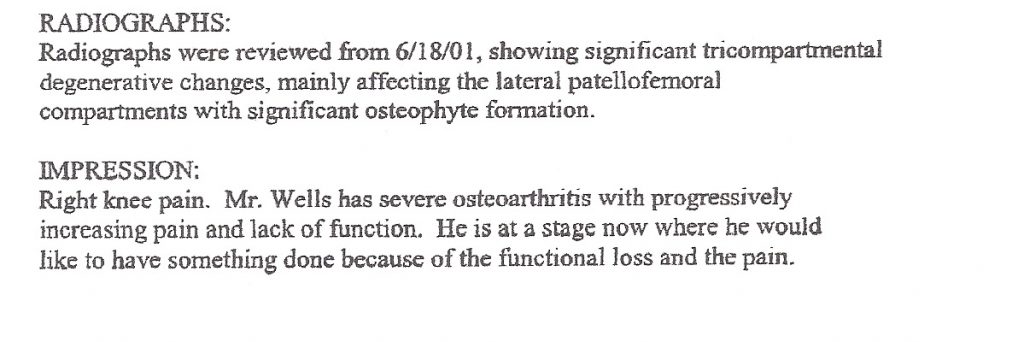
  • I was diagnosed on 6/18/01 with “severe osteoarthritis with progressively increasing pain and lack of function.”
  • Knee replacement surgery was scheduled for 12/17/01.
  • The local Thrivent rep urged me to file a claim. I did so. It was the right decision and the impact on my life was more significant than I expected.
  • My policy states that total disability is a disability that prevents one from performing their regular occupation. Clearly the date should fall between 6/18/01 and 12/17/01. I was unable to perform my regular occupation prior to surgery.
  • The doctor filled out a claims form and indicated 12/17/01 as the date of disability. The date of surgery. Why? Because Thrivent used the terminology “Unable to work” instead of the contract language.
  • I had a phone conversation with Thrivent claims, the beginning of a series of insane dialogues with people who were not listening about the disability.
  • It is important to note that I was in much pain before, during and after surgery, unable to work and dealing with other life stresses. This is an elephant in the room of insurance claims.
  • I received a letter from Ann Weyenberg of Thrivent dated 12/7/01 which states the correct contract language and reminds me to review the contract. Apparently I was the only one doing so.
  • I was in the hospital 5 days. My surgeon said my knee was the worst he had seen.
  • On 12/26/01, from a transcript I later obtained, Dave Burnette, the local rep, speaking to claims rep Jen Schroeder, uses the phrase “unable to work” instead of the proper contract language. Incompetence/misrepresentation is widespread.
  • On 2/4/02 I had a conversation with claims rep Sandy Kruse. I referred to the claims form as a disgrace and the process sleazy. She obviously was trained to respond in a certain manner and had no clue about the contract. I later learned that she and Dave Burnette slandered and libeled me.
  • I went round and round going back and forth between the claims people and the doctor getting nowhere but frustrated. There was a 3 month waiting period in the contract before benefits would kick in. I later learned there is more to that story and that is why they put so much effort into controlling the disability date.
  • In 2003, on the recommendation of an attorney, I filed a complaint with the NC Insurance Commission. From my recent letter to the commissioner: “The first complaint I filed with the NC Insurance Commission was a travesty. Apparently no investigation was performed, no one requested more info from me and the word of Thrivent was taken as Gospel. I believe this has empowered them to believe they are untouchable.”
  • This matter was put aside until I had a more serious claim with Thrivent.
  • I had a more serious claim in 2009. The first encounter is fully documented and presented again to the NC Insurance Commission. One of the discoveries: Thrivent corrected the claim form to reflect the wording of the contract.

Below is some of the documentation.

“Thrivent letter December 7, 2001, Ann Weyenberg.

A disability prevents performing regular occupation.

And  I am reminded to review the contract.


Claim form filled out by Dr. Aluisio (smoking gun).

  1. Notice, there is no date of disability per the contract language, the date unable to perform regular occupation.
  2. Date patient became medically unable to work does not match the contract and is a Social Security definition.
  3. Notice below that “Is patient medically able to return to the above noted occupation?”. Now they use contract language.
  4. Notice part-time checked.
  5. “Do you feel the patient is medically able to perform another occupation?” No checked.
  6. Under Current limitations / restrictions: Standing and walking checked. The doctor and Thrivent had been notified that walking was an integral part of my profession.

Furthermore, the diagnosis from June 18, 2001 revealed a funtional loss and pain.

Clearly the date of disability should have at least been somewhere between 6/19/01 and prior to surgery on 12/17/01.

I had several conversations with Thrivent personnel about the wording, each time I was ignored. Apparently the worker bees had no concept of the contract and probably believed that “unable to work” was perfectly acceptable. Management and legal staff should know better.

On February 4, 2002 I had a lengthy conversation with Sandy Kruse. She appeared confused when I requested clarification of the term “earned income.” She had no concept of what I was talking about. I was still in pain and frustrated with Thrivent’s attitude. I called form DL259, that the doctor filled out a disgrace and the process as sleazy. Incompetent and/or evil are probably more appropriate.

After going round and round with Thrivent and getting nowhere, an attorney suggested I file a complaint with the NC Insurance Commission. I did so.

NC Insurance Commission complaint.

“An attorney advised me to file a complaint with the NC Insurance Commission. I did so on September 24, 2003.”

“After the so called investigation, the Commission responded.

As you can see, they take Thrivent’s word and do no real investigation. They did not contact me with questions or for more input.

However, it was not a total waste of time.

  • This proves that Thrivent believed they were bound by NC insurance laws.
  • This proves that Thrivent continued their incompetent/fraudulent position of using “unable to work” instead of the contract language and had the gaul to maintain their position with the NC Insurance Commission. Misrepresentation.
  • Finally, Thrivent’s Ann Weyenberg, who wrote the December 7, 2001 letter quoting the contract correctly then, sent the following to the Insurance commission in a letter dated .October 14, 2003.

Ann Weyenberg begins:

“I’d like to explain some provisions of his disability contract:”

Really?

Notice that after “An occupation means the covered person’s regular occupation,” “but work part-time during the first 24 months of total disability.” does not match the contract language or the letter from Ann Weyenberg (see above) dated December 7, 2001.

Thrivent misrepresented the policy to the NC Insurance Commission!

Incompetence or Fraud?”

Read more:

http://eachstorytold.com/2018/07/10/thrivent-disability-claim-denial-complaint-to-nc-insurance-commission-no-investigation-just-echo-of-thrivents-statements-did-prove-thrivent-bound-by-law-and-their-misrepresentation/


In a letter dated August 14, 2004, Dr. Aluisio states why he used the date of surgery as the disability date.

It is obviously not the definition used in the policy. It is, as shown above, what Thrivent used on the claim form.

I do not know when Thrivent corrected the claim form, but if you retrieve one online now, this is what you see.

Date patient became medically unable to perform activities listed above (mm/dd/yyy)“, which is correct replaces “unable to work”.

http://eachstorytold.com/2018/07/22/thrivent-disability-claim-denial-my-first-experience-part-4-thrivent-claim-form-doctor-forced-to-use-definition-provided-by-thrivent-unable-to-work-instead-of-contract-unable-to-perform-regul/


Alleged Seth Rich murder witness Luke Anon Jack Burkman interview on Hagman Report, Orwellian subjugation of Seth Rich murder investigations on search engines, DNC controlled media attacks thought criminals

Alleged Seth Rich murder witness Luke Anon Jack Burkman interview on Hagman Report, Orwellian subjugation of Seth Rich murder investigations on search engines, DNC controlled media attacks thought criminals

“Let me tell you something. They were all over that woman,”
“And it was the type of stuff we ran into with the outfit (the Chicago mob). Intimidation just by watching her, making their presence known. … Just to let her know ‘We can do what we want.’ ”…Attorney David Schippers, Clinton investigator

“I know that Seth Rich was involved in the DNC leak.”…Kim Dotcom

“Burkman said in an interview that he considered Selig like a brother and was badly shaken by his friend’s death.”
“The tragically ironic part is Glenn’s last words to me were, ‘Be careful,’” Burkman said. “It’s just a tragedy — terrible.””…Politico Jan. 24, 2018


Jack Burkman was interviewed recently on the Hagman Report regarding the alleged Seth Rich murder witness referred to as Luke Anon.

I have been on the internet a lot for years.

I have continued to follow the Seth Rich murder almost daily since it happened.

I have noticed a trend.

  1. The subjugation of probing investigations with honest questions and sincere motives.
  2. The intensity with which the left, DNC controlled media has attacked those asking questions, “Thought Criminals.”
  3. The difficulty in finding the latest news on the Seth Rich murder.

I have therefore tried to keep the story alive.

I listened to part of the interview of the alleged witness presented at the press conference.

I still need to review it and will. Any feedback from those who have listened to it would be appreciated.

The press conference July 11, 2018.


More here:

https://citizenwells.com/

http://citizenwells.net/


Case against Thrivent, NAIC  why arbitration clauses should be banned, If arbitration benefits members why mandate?, Erickson vs Thrivent

Case against Thrivent, NAIC  why arbitration clauses should be banned, If arbitration benefits members why mandate?, Erickson vs Thrivent

“Thrivent contends that its commitment to individual arbitration is ‘”important to the membership because it reflects Thrivent’s Christian Common Bond, helps preserve members’ fraternal relationships, and avoids protracted and adversarial litigation that could undermine Thrivent’s core mission.’”…Thrivent v. Acosta Nov. 3, 2017

“pre-dispute mandatory arbitration provisions are inappropriate in insurance policies and incompatible with the legal duties insurers owe policyholders when handling their claims.”…NAIC, National Association of Insurance Commissioners, August 15, 2016

“Beware of false prophets, which come to you in sheep’s clothing, but inwardly they are ravening wolves.”…Matthew 7:15


From Erickson vs Thrivent.

“This case involves an insurance contract between Plaintiff Raymond Erickson and a fraternal benefit society. Insurance contracts issued by a fraternal benefit society generally include the society’s bylaws, as well as any subsequent amendments to the bylaws, provided that the amendments do not reduce the benefits promised in the original contract. This Court must decide whether Erickson is bound by an arbitration clause that was not in his original insurance
contract but was later added to the fraternal benefit society’s bylaws. Because the arbitration clause does not reduce Erickson’s benefits under the contract, this Court finds that the clause applies to him and requires him to arbitrate his claims.”

“Erickson made a claim for benefits under the contract. in December 2014 after he moved into a long-term care facility. Doc. 1 at 13. Thrivent paid Erickson benefits for some time, but terminated them in November 2015. Doc. 1 at 16, 18. Erickson then sued Thrivent in this Court, asserting claims for breach of contract, bad faith, breach of fiduciary duty, punitive damages, and attorney’s fees. Doc. 1. The parties mediated before Magistrate Judge Veronica Duffy, but were unable to resolve their dispute. Doc. 11. Thereafter, Thrivent filed a Motion to Compel Arbitration and argued that the Federal Arbitration Act (FAA), 9 U.S.C. §§ 1-14, and the Dispute Resolution Bylaw require this Court to stay the case and compel arbitration. Docs. 14, 15, 21. Erickson opposed the motion, contending that the Dispute Resolution Bylaw is unenforceable for several reasons.”

“State contract law governs whether a valid arbitration agreement exists between Erickson and Thrivent. First Options of Chi .. Inc. v. Kaplan, 514 U.S. 938, 944 (1995). This Court is sitting in diversity jurisdiction, so it applies South Dakota’s choice-of-law rules to determine which state’s laws govern whether a valid arbitration agreement exists. Dakota Foundry, 891 F. Supp. 2d at 1095. The parties disagree on which state’s law should apply, with Thrivent arguing
for Wisconsin law and Erickson arguing for South Dakota law.”

“The issue of which state’s law applies does not raise a material question of fact because the Dispute Resolution Bylaw constitutes a valid arbitration agreement under Minnesota, South Dakota, and Wisconsin law. Minnesota, South Dakota, and Wisconsin have all enacted statutes regulating fraternal benefit societies. Minn. Stat.§§ 64B.Ol–64B.48; SDCL §§ 58-37A-1 to 58-37A-39; Wis. Stat. §§ 614.01–614.96, 632.93. Under these laws, a fraternal benefit society
insurance contract consists of the insurance certificate, the member’s application, and the laws of the society. Minn. Stat. § 64B.19; SDCL § 58-37A-19; Wis. Stat. § 632.93. Critically, Minnesota, South Dakota, and Wisconsin statutes recognize that contracts between a fraternal benefit society and its members include later amendments to the society’s laws, provided that the
amendments do not destroy or diminish the benefits promised in the original contract. . Minn. Stat.§ 64B.19(2) (“Any changes, additions, or amendments to the laws of the society duly made or enacted subsequent to the issuance of the certificate, shall bind the owner and the beneficiaries, and shall govern and control the benefit contract in all respects the same as though the changes, additions, or amendments had been made prior to and were in force at the time of the application for insurance, except that no change, addition or amendment shall destroy or diminish benefits that the society contracted to give the owner as of the date of issuance.”); SDCL § 58-37-A-19 (“Any changes, additions or amendments to the laws of the society made or enacted after the issuance of the certificate, bind the owner and the beneficiaries, and govern and control the benefit contract in all respects the same as though the changes, additions, or
amendments had been made before and were in force at the time of the application for insurance. However, no change, addition, or amendment may destroy or diminish benefits which the society . contracted to give the owner.as of the date of issuance.”); Wis. Stat. § 632.93(2) (“[A]ny changes in the laws of a fraternal made subsequent to the issuance of a policy or certificate bind the
owner and any beneficiary under the policy or certificate as if they had been in force at the time of the application, so long as they do not destroy or diminish benefits promised in the policy or certificate.”). As required by Minnesota, South Dakota and Wisconsin law, Minn. Stat. § 64B.19; SDCL § 58-37-A-19; Wis. Stat.§ 632.93, Erickson’s contract states that the Articles of Incorporation and Bylaws, including any later amendments, are part of the agreement: ”

Read more:

http://eachstorytold.com/2018/07/15/thrivent-and-fraternal-insurance-why-you-should-not-buy-their-insurance-erickson-vs-thrivent-reveals-all-retroactive-contract-changes-mandated-dispute-resolution-and-arbitration-companies-control/

United Insurance vs Office of Insurance Regulation, State of Florida.

“Section 624.155 is a statute regulating the business of insurance. The statute relates, directly or indirectly, to the relationship between the insurance company and the policyholder. The proposed arbitration agreement would impair, invalidate or supersede section 624.155. The statute provides for a civil action — with the relevant procedural protections. The statute also provides for court costs and fees. Mandatory binding arbitration lacks the procedural and constitutional protections (such as jury and appeal to an Article V court) of a civil action.”

Read more:

http://eachstorytold.com/2018/07/15/florida-insurance-statutes-mandatory-binding-arbitration-lacks-the-procedural-and-constitutional-protections-such-as-jury-and-appeal-united-insurance-company-vs-florida-office-of-insurance/

NAIC: Why arbitration clauses should be banned.

“This judicial recognition that mandatory arbitration provisions can interfere with core state and federal Constitutional rights, and that consumers have not “consented” in any meaningful sense to these clauses, apply equally to insurance consumers. This is demonstrated previously in the memorandum presented at the April 5, 2016 Consumer Liaison Meeting in New Orleans, and further detailed by the consumer group Texas Watch.2 Along with our colleagues, we can provide detailed information on these issues if D Committee wishes.
Today we focus on the claims process. The nature of the insurance promise is different from most other consumer services or products, and pre-dispute mandatory arbitration provisions are inappropriate in insurance policies and incompatible with the legal duties insurers owe policyholders when handling their claims.

  • Companies that include pre-dispute mandatory arbitration clauses in their consumer contracts presumably do so because it will be to their advantage should a dispute later occur.
  •  However, handling claims is an essential element of the insurance contract and insurers are required to consider the best interests of their policyholders. Courts frequently describe this broad duty as requiring “the insurer to consider the interests of its policyholder in a manner at least equal to its own.”3
  • Inserting a pre-dispute mandatory arbitration clause in an insurance policy allows the insurer to select the venue most favorable to it should a dispute later occur and therefore makes it less likely that policyholders will assert their rights to dispute their insurers’ claim evaluations, and less likely they will succeed when they do.
  • Insurers convinced that arbitration will benefit policyholders and insurers equally (or policyholders more), should therefore be willing to provide – and not mandate – arbitration as an option when an actual dispute occurs. If arbitration provides a truly neutral forum, then there is no need for an insurer to insist on its use.”

“Insurers that would insist on mandatory arbitration of policyholder disputes have selected the forum that they believe will be more favorable to them than to their policyholders, if not on each individual claim then in the aggregate. However, manipulating the dispute resolution process in this manner conflicts with the duties insurers owe their policyholders and is not holding their policyholders’ interests “at least equal to their own.”

If arbitration was truly a neutral forum rather than one favoring insurers, then there would be no need for an insurer to insist on its use before a dispute has even arisen. Insurers should utilize arbitration only when the policyholder has consented to do so after an actual dispute occurs (which is what the suggested amendment to the Model Unfair Trade Practices Act should accomplish), rather than requiring it in boilerplate language that the policyholder is very unlikely to read, could not bargain over the provision even if she did, and could not make an
informed decision at the point of sale on the merits. True freedom of contract, combined with the fundamental right to a trial, requires a knowing relinquishment of that right, which can only occur voluntarily once a specific dispute has materialized.”

“Taken together, these decisions deliver two clear messages: (1) States can enforce bans on arbitration provisions in insurance contracts, and (2) the likelihood of surviving a FAA preemption argument is often related to the specificity of the prohibition. Our sample language (below) attempts to maximize the power of McCarran-Ferguson by adding it as an amendment to the Model UTPA, which itself states in Section 1 that “The purpose of this Act is to regulate trade practices in the business of insurance in accordance with the intent of
Congress … [citing McCarran-Ferguson],” and by making the ban directly related to insurance contracts.”

Read more:

http://eachstorytold.com/2018/07/16/naic-banning-arbitration-clauses-in-insurance-policies-why-arbitration-clauses-should-be-banned-companies-that-include-pre-dispute-mandatory-arbitration-clauses-do-so-because-it/


More here:

https://citizenwells.com/

http://citizenwells.net/

 

Thrivent Financial for Lutherans v. Colin Brock appeal, Thrivent nonpayment of disability benefits, Order denying Thrivent’s motion to confirm arbitration award, Brock alleges fraud corruption or other undue means

Thrivent Financial for Lutherans v. Colin Brock appeal, Thrivent nonpayment of disability benefits, Order denying Thrivent’s motion to confirm arbitration award, Brock alleges fraud corruption or other undue means

“Thrivent contends that its commitment to individual arbitration is ‘”important to the membership because it reflects Thrivent’s Christian Common Bond, helps preserve members’ fraternal relationships, and avoids protracted and adversarial litigation that could undermine Thrivent’s core mission.’”…Thrivent v. Acosta Nov. 3, 2017

“Beware of false prophets, which come to you in sheep’s clothing, but inwardly they are ravening wolves.”…Matthew 7:15

“Martin Luther may or may not have stated ‘Here I Stand’ but his actions certainly did.”…Citizen Wells


From Thrivent Financial for Lutherans v. Colin Brock.

“This interlocutory appeal and original proceeding arise from a dispute between Colin Brock and his insurer, Thrivent Financial for Lutherans (“Thrivent”) over nonpayment of disability benefits, which Brock claims Thrivent owes him under a Thrivent insurance policy.   As required by the policy, the trial court compelled the parties to arbitrate.   Following an evidentiary hearing, the arbitrator denied Brock’s claims.   Thrivent moved the trial court to confirm the arbitration award.   In turn, Brock requested the trial court to vacate the arbitration award on the ground that the award was obtained “by fraud, corruption, or other undue means.”   The trial court signed an order denying Thrivent’s motion to confirm the award, vacating the arbitration award, and directing a rehearing before a new arbitrator.   Thrivent appeals the order and also seeks review by way of a petition for writ of mandamus.   Brock contends that we have no appellate jurisdiction over the interlocutory order and requests that the petition for mandamus be denied.

We dismiss Thrivent’s interlocutory appeal for lack of jurisdiction and deny its petition for writ of mandamus.”

https://caselaw.findlaw.com/tx-court-of-appeals/1108836.html

AAL, Aid Association for Lutherans, implemented a change to their contracts, retroactively in 1999, to impose mandatory dispute resolution consisting of Appeal, Mediation and Arbitration in lieu of litigation. Their member dispute resolution program is referred to as MDRP. They claim, and many courts have upheld that they could implement and enforce the change retroactively due to their fraternal status. This has not been challenged in all states and since the states differ on how insurance entities are treated, this is still an open question.

The embracing of mandatory arbitration has become widespread in consumer and employment contracts. This has led to a huge impact on our day in court and given companies much power to control outcomes and continue unsavory practices, harmful to consumers.

This is not just a Thrivent problem or insurance problem, it is a problem affecting the daily lives of all Americans. Thrivent’s practice of using their special status is particularly unjust and alarming and runs contrary to their platitudes touted in company policies.

Thrivent v. Brock revelations and questions.
  • Brock alleges: “the award was obtained ‘by fraud, corruption, or other undue means.’”  We have no way of knowing because the MDRP, culminating in arbitration, was held behind closed doors, out of the light of day of a courtroom.
  • Brock had taken the arbitration decision to trial court and next the appeals court. How much were the legal fees?
  • Thrivent has a large legal staff and engages outside legal firms who specialize in disability cases.
  • How much time elapsed from the first disability claim to the appeals court decision and probable redo of arbitration?
  • What happened next? Arbitration? What was the outcome.
  • What is Colin Brock’s disability? Is it life threatening or painful? Is Mr. Brock getting adequate treatment?
  • Was Mr. Brock able to pay his bills? Feed a family?
  • How has the MDRP process helped Mr. Brock? Did he experience the blessings of the Christian beliefs touted by Thrivent?
  • How many Thrivent members drop out of this MDRP process for various reasons such as too engulfed in pain and stress or discouraged by improper Thrivent procedures and attitudes? Mr. George Tiedemann went through the process for 2 years and dropped out. He was 83.
  • How many Thrivent members were shocked to find out that the policy they took out years earlier, had been modified without their consent or signature?
  • How many Thrivent members sought legal representation to no avail because many attorneys will not touch a case with mandated arbitration?


“Thrivent’s Christian Calling

Thrivent’s Lutheran heritage of answering God’s call has led to a strong membership-owned organization that now welcomes Christians seeking to live out their faith.

Fraternal benefit societies have a common bond among members. Thrivent’s common bond is Christianity. We embrace the core Christian beliefs as articulated in the Apostles’ Creed as follows:

I believe in God, the Father almighty, maker of heaven and earth.
I believe in Jesus Christ, his only Son, our Lord, who was conceived by the Holy Spirit, born of the virgin Mary, suffered under Pontius Pilate, was crucified, died, and was buried. He descended into hell. The third day he rose again from the dead. He ascended into heaven and is seated at the right hand of God the Father almighty. From there he will come to judge the living and the dead.
I believe in the Holy Spirit, the holy Christian Church, the communion of saints, the forgiveness of sins, the resurrection of the body, and the life everlasting.

If you share these beliefs, we invite you to join other Thrivent members called to pursue a life of generosity and wisdom with money.”

https://www.thrivent.com/about-us/files/28023.pdf

Here I stand.


More here:

https://citizenwells.com/

http://citizenwells.net/

Thrivent insurance claims reviews, Dispute resolution program benefits members?,Christian common bond?, “Don’t use this company they hide behind the cross”

Thrivent insurance claims reviews, Dispute resolution program benefits members?, Christian common bond?, “Don’t use this company they hide behind the cross”

“Thrivent contends that its commitment to individual arbitration is “important to the membership because it reflects Thrivent’s Christian Common Bond, helps preserve members’ fraternal relationships, and avoids protracted and adversarial litigation that could undermine Thrivent’s core mission.”…Thrivent v. Acosta Nov. 3, 2017

“The MDRP is the sole means for presenting and resolving grievances, complaints, or disputes between Members, insureds, certificate owners or beneficiaries and Thrivent or Thrivent’s directors, officers, agents and employees. The MDRP reflects Thrivent’s Christian belief system and strives to preserve Members’ fraternal relationship.”…Thrivent vs Perez Sept. 29, 2016

“Beware of false prophets, which come to you in sheep’s clothing, but inwardly they are ravening wolves.”…Matthew 7:15


Below are some reviews of Thrivent insurance claims experiences that are similar to my experiences with Thrivent.

January 17, 2017.

“First of all I’m not a insurance company or employee. I have investments, life insurance, and disability insurance with Thrivent. I have been with Thrivent for many years and trusted them. when I became disabled a year ago and could not work I filed my private disability insurance along with my SSDI. After 7 months of waiting my SSDI was approved the 1st time, Still waiting and expecting my private disability insurance to be approved by Thrivent I received a letter from them with a denial stating I could still work according to all the medical records supplied. I supplied letters from my primary doctor and the specialists treating me stating I was disabled and could not work, I sent an e-mail to Thrivent letting them know of my approval for my SSDI and I got a letter back from them stating that there standards for approval are much higher then the Federal Gov. I followed all there requirements supplied all records never had to be evaluated by Thrivent’s doctor. They just flat denied my claim with a stupid excuse. I have been working with a attorney on this claim to try and settle it. Thrivent has been stalling them every step of the way. THIS DISABILITY POLICY IS A SCAMM. They never had any attention on paying out benefits. They communicated during the process with useless letters telling me nothing about my case. and short to the point e-mails telling me nothing. I have had to put out thousands of dollars in attorney fee’s and thousands of dollars in medical treatment fee’s for out of network doctors. If I don’t qualify for there disability benefits I don’t think anyone can. I DIDNT KNOW IT WAS ME AGIANST THRIVENT INSURANCE, THAT IS HOW THEY MAKE YOU FEEL. Don’t use this company they hide behind the cross.”

Read more:

https://insurance.freeadvice.com/reviews/377/comments/Thrivent+Financial/

Nancy Bowman February 6, 2018.

“We had a very difficult time during my husband’s illness, Parkinson’s among others, getting any help from Thrivent. Their customer service people were rude and of no assistance. Of his $170.000 fund, we spent $6,000 due to their outrageous, convoluted rules written for the benefit of the company. The salesman did not explain any of these caveats when we purchased the policy and refused to take my calls. Now I need some help, in-home, due to a broken foot but am told I have to pay for 90days of help before they will begin to pay, then need a doctor’s certification that I am disabled. There is a clause stating that if a licensed Health Care Practitioner has, with a 12 month period preceding that day, (what day?) certifies that the person has a physical impairment to last at least 90 days, but it doesn’t say anything else.I am about to go to my attorney, call my Congressmen and anything else to bring this company around. They keep a client’s fund separately but then, if not used, they abscond with it. It’s our money but they act like it’s theirs. They could keep the interest, but refund the premiums not used. It’s white-collar theft and they get away with it because they are a brotherhood. I would never have done business with this company.”

Cathy February 13, 2018.

“I am working on a long-term care insurance benefit dispute for 9 months now. Thrivent refuses to pay the claim even though my mother is coming to the end of her life and is totally disabled. I received a letter today stating that Thrivent does not have to justify their reasons for not paying the claim.
I attempted to resolve the claim through the Pennsylvania Dept of Insurance who did nothing but recommend we get an attorney. I also Issued a claim with the Better Business Bureau… another complete waste of time. Thrivent pays the BBB to post an A+ rating.
Today I sent my dispute to the Attorney General’s office.
Please… let’s not let this unethical organization take our parent’s money and then hide behind red tape and ambiguity when it is time for a payout. Has anyone contacted the Lutheran Synod to find out who is promoting these crooks? Does the Lutheran Synod know that Thrivent is not paying their claims?”

Kris Boike November 3, 2016.

“After a year of paying out on my mothers Long-Term Nursing Claim, Thrivent has stopped. They continuously change their minds of what they require within the Plan of Care from the Nursing Home. This has been going on for 4-5 months now, with at least 6 different versions of the Nursing Plan of Care being submitted. Not only is this experience frustrating, expensive to now start paying Nursing Home expenses directly, they expect my mother and father to re-start paying the LT Care Premiums while we go through the appeals/Membership Resolution Process. The Claims Examiners lie/change their minds constantly to avoid paying out! Lawyer-Up people! 17 Years of paying premiums and now they want more years of premium payments to avoid paying out! Snakes!”

Read more:

https://www.expertinsurancereviews.com/insurance-company-reviews/thrivent-financial/

I have attempted to contact a Doctor who is seeking others with bad Thrivent experiences. Hopefully he will respond.


More here:

https://citizenwells.com/

http://citizenwells.net/