
Category Archives: Economy

Greensboro Guilford County NC jobless rates drop, April 10, 2014, Fewer people working and jobs lost, Greensboro News Record accurate report, Labor force has plummeted in NC

Greensboro Guilford County NC jobless rates drop, April 10, 2014, Fewer people working and jobs lost, Greensboro News Record accurate report, Labor force has plummeted in NC

“11.4%: What the U.S. unemployment rate would be if labor force participation were back to January 2008 levels.” …James Pethokoukis, American Enterprise Institute, June 2013

“Nearly half of U.S. companies are reluctant to hire full-time employees because of the ACA. One in five firms indicates they are likely to hire fewer employees, and another one in 10 may lay off current employees in response to the law.

Other firms will shift toward part-time workers. More than 40 percent of CFOs say their companies will consider switching some jobs to less than 30 hours per week or targeting part-time workers for future employment.”…Duke University Fuqua School of Business December 11, 2013

“Freedom is the freedom to say that two plus two make four. If that is granted, all else follows.”…George Orwell, “1984″


I applaud the Greensboro News Record for this accurate jobs report April 10, 2014.
“Jobless rate falls again in Guilford, but what does it mean?”

“Greensboro’s unemployment rate keeps dropping, but that may not mean that more people are working.

Since February 2013, this region’s unemployment rate has dropped from 9.9 percent to 6.9 percent this February, according to statistics released Wednesday by the N.C. Department of Commerce. The numbers are not adjusted for seasonal variations in hiring patterns.

But the employment pie is shrinking, so the number doesn’t necessarily mean more people have landed jobs.

And because the state surveys employment in a variety of ways, one measurement is up, and one is down, sending mixed messages.

A simple count shows that 1,970 more people say they’re working, compared with February a year ago, but the Greensboro-High Point labor force, defined as people who are employed or unemployed and actively seeking work, has dropped from 370,500 in February 2013 to 360,500 this past February.

That suggests that many people simply have stopped looking for work, local economists have said in recent months.

Perhaps the best measure of jobs, UNCG economist Andrew Brod said, is the survey of establishments that asks how many workers they employ.

Wednesday’s establishment survey shows that the Greensboro-High Point metro area lost 800 jobs between February 2013 and February 2014.”

Read more:

http://m.news-record.com/business/article_3f1582e4-bff4-11e3-8341-0017a43b2370.html?mode=jqm

From Citizen Wells March 29, 2014.

“We have the Obama administration touting job creation.

Governor Pat McCrory of NC is pleased with the improvement in the jobs situation.

The truth has stayed mostly hidden or under reported.

To fix a problem it is important to:
A) Acknowledgement the problem.
B) Understand the problem.

It appears that neither A or B is the case.

The Labor Force Participation Rate in NC has dropped 4 percent since Obama took office in January 2009 and 1.7 percent since Pat McCrory took office in January 2013.

The real unemployent rate in the US and NC?

Well over 10 percent.”

https://citizenwells.wordpress.com/2014/03/29/nc-unemployment-rate-drops-while-labor-force-plummets-participation-rate-drops-4-since-obama-took-office-1-7-since-mccrory-took-office-nc-losing-jobs-and-workers/

God only knows the impact of part time jobs on NC employment and the economy.


Labor Secretary Perez on March employment numbers, Fact vs fiction, Solid and steady economic recovery?, Obamacare helping working families enjoy greater economic security?

Labor Secretary Perez on March employment numbers, Fact vs fiction, Solid and steady economic recovery?, Obamacare helping working families enjoy greater economic security?

“Over the last six months, of the net job creation, 97 percent of that is part-time work,”…Keith Hall, former BLS chief

“Nearly half of U.S. companies are reluctant to hire full-time employees because of the ACA. One in five firms indicates they are likely to hire fewer employees, and another one in 10 may lay off current employees in response to the law.

Other firms will shift toward part-time workers. More than 40 percent of CFOs say their companies will consider switching some jobs to less than 30 hours per week or targeting part-time workers for future employment.”…Duke University Fuqua School of Business December 11, 2013

“Freedom is the freedom to say that two plus two make four. If that is granted, all else follows.”…George Orwell, “1984″


The US Labor Dept. reported the March employment data on Friday April 4, 2014.

US Secretary of Labor Thomas E. Perez issued the following statement:

“Today’s report tells the story of a solid and steady economic recovery delivering more opportunity for more people. We saw 192,000 new jobs in the month of March, and the private sector has now created 8.9 million jobs over the last 49 consecutive months of employment growth. The unemployment rate held steady at 6.7 percent and is down from 7.5 percent a year ago.
“There is encouraging news across sectors. Health-care employment increased by 19,000 jobs. The average work week in manufacturing rebounded to 42.0 hours, tied for the highest mark since July 1945. Motor vehicle sales had their strongest month in seven years. At the height of the recession, there were six job seekers for every job available. Today, it’s two-and-a-half people competing for every open job.
“Without question, there is more still to do. On issues from infrastructure to immigration reform, from manufacturing to the minimum wage, there are steps Congress can take that will help more people punch their ticket to the middle class.
“For the 57th straight month (since the middle of 2009), at least one-third of jobless Americans have been unemployed for more than 27 weeks. So, priority number one must be for the House and Senate to extend emergency unemployment benefits that they irresponsibly allowed to expire more than three months ago, creating profound hardship for 2.3 million people. These benefits are a critical lifeline for job seekers struggling to get back on their feet; but they also act as a broader economic stimulus, putting money in people’s pockets and spurring consumer demand.
“The success of the Affordable Care Act is helping working families enjoy greater economic security, the peace of mind of knowing they won’t be wiped out by an injury or illness. The open enrollment period ended with 7.1 million people signing up for health coverage they didn’t have before. The ACA will help provide a shot in the arm to the economy, as people are free to start their own businesses and pursue entrepreneurial ventures now that their health insurance is no longer tied to their job.”

http://www.dol.gov/opa/media/press/opa/opa20140572.htm

The “1984” analogy is obvious.

As most of you know, Obamacare is costing millions of Americans far more in healthcare premiums.

Despite the best linguistic efforts of Secretary Perez to put a positive spin on the impact of Obamacare, it is also impacting jobs.

From the Duke University Fuqua School of Business, December 11, 2013.

“——————————————-
DUKE UNIVERSITY NEWS
Duke University Office of News & Communications

http://www.dukenews.duke.edu

——————————————-

FOR IMMEDIATE RELEASE: Wednesday, Dec. 11, 2013
CONTACTS: Kevin Anselmo (Duke’s Fuqua School of Business)
(919) 660-7722
kevin.anselmo@duke.edu
or
David W. Owens (CFO Magazine)
(617) 790-3000
davidowens@cfo.com

CFO SURVEY: AFFORDABLE CARE ACT COULD CURTAIL HIRING

Note to editors: For additional comment, see contact information at the end of this release.
Watch professor John Graham discuss the results (or use this link
http://youtu.be/F4oj8d5F9Jo). You may also post this video on your website. Names of CFOs who took part in the survey and agreed to speak with media are available by request.

DURHAM, N.C. — A significant percentage of U.S. chief financial officers indicate that because of the Affordable Care Act (ACA), they may reduce employment growth at their firms and shift toward part-time workers.

A majority of finance chiefs also believe the full Social Security retirement age should be raised to help close the budget shortfall.

Despite these issues, underlying economic conditions are expected to improve in 2014 and, except in Europe, corporate charitable giving remains strong

These are some of the findings from the latest Duke University/CFO Magazine Global Business Outlook Survey, which concluded Dec. 5. The survey has been conducted for 71 consecutive quarters and spans the globe, making it the world’s longest running and most comprehensive research on senior finance executives. Presented results are for U.S. firms unless otherwise noted.

EMPLOYMENT EFFECTS OF THE AFFORDABLE CARE ACT

Nearly half of U.S. companies are reluctant to hire full-time employees because of the ACA.
One in five firms indicates they are likely to hire fewer employees, and another one in 10 may lay off current employees in response to the law.

Other firms will shift toward part-time workers. More than 40 percent of CFOs say their companies will consider switching some jobs to less than 30 hours per week or targeting part-time workers for future employment.”

Read more:

http://www.cfosurvey.org/14q1/PressRelease.pdf

From data provided by the US Labor Dept. we learn:

The Labor Force Participation Rate has dropped 2.5 percent since Obama took office in January 2009 and actually has dropped .1 percent the past year.

The number of people who could only find part time work has risen 1,055,000 since Obama took office and has risen 146,000 in the past year.

The only statement from Secretary Perez that reflects reality is:

“For the 57th straight month (since the middle of 2009), at least one-third of jobless Americans have been unemployed for more than 27 weeks.”


NC unemployment rate drops while labor force plummets, Participation rate drops 4 % since Obama took office, 1.7 % since McCrory took office, NC losing jobs and workers

NC unemployment rate drops while labor force plummets, Participation rate drops 4 % since Obama took office, 1.7 % since McCrory took office, NC losing jobs and workers

“11.4%: What the U.S. unemployment rate would be if labor force participation were back to January 2008 levels.” …James Pethokoukis, American Enterprise Institute, June 2013

“Nearly half of U.S. companies are reluctant to hire full-time employees because of the ACA. One in five firms indicates they are likely to hire fewer employees, and another one in 10 may lay off current employees in response to the law.

Other firms will shift toward part-time workers. More than 40 percent of CFOs say their companies will consider switching some jobs to less than 30 hours per week or targeting part-time workers for future employment.”…Duke University Fuqua School of Business December 11, 2013

“Freedom is the freedom to say that two plus two make four. If that is granted, all else follows.”…George Orwell, “1984″


We have the Obama administration touting job creation.

Governor Pat McCrory of NC is pleased with the improvement in the jobs situation.

The truth has stayed mostly hidden or under reported.

To fix a problem it is important to:
A) Acknowledgement the problem.
B) Understand the problem.

It appears that neither A or B is the case.

The Labor Force Participation Rate in NC has dropped 4 percent since Obama took office in January 2009 and 1.7 percent since Pat McCrory took office in January 2013.

The real unemployent rate in the US and NC?

Well over 10 percent.

The following article at least attempts to present the truth.

From WRAL March 28, 2014.

“NC employers shed thousands of jobs in February; unemployment rate dips”
“North Carolina’s unemployment rate fell again in February, but employers in the state continued to shed jobs, according to data released Friday by the state Department of Commerce.

A survey calculating nonfarm payrolls recorded 11,300 fewer jobs in the month after a decline of more than 7,000 jobs in January.

Despite the drop in jobs, the state’s unemployment rate dipped to 6.4 percent, marking the eighth straight month of steady decline. North Carolina’s unemployment rate is down 2.2 percentage points from February 2013 and is now better than the national unemployment rate, which was 6.7 percent last month.

The state’s labor force in February was 4,659,236, down 7,349 since January. The labor force is down more than 60,000 since February 2013, evidence of many people, some of them the long-term unemployed, are dropping out of the job market and are no longer counted in the unemployment rate calculation.

“If North Carolina is going to see a healthy long-term recovery in employment growth, we need to see all jobless workers moving into jobs, rather than out of the labor force. And we’re not seeing that because job creation remains anemic,” said Allan Freyer, an analyst with the NC Justice Center.

The number of people unemployed – those who are looking for jobs – fell sharply, from 310,974 in January to 296,226 in February.

Employers continue to shed jobs

Employers in North Carolina shed more than 11,000 jobs in February, and only three nonfarm sectors saw growth during the month.
NC Department of Commerce.”

“Gov. Pat McCrory said Friday that he’s pleased to see more people getting back to work.”

Read more:

http://www.wral.com/nc-employers-shed-thousands-of-jobs-in-february-unemployment-rate-dips/13520294/

By the way, the labor force in NC was 4,728,203  when McCrory took office. It was 4,659,236 in February 2014.

http://esesc23.esc.state.nc.us/d4/LausSelection.aspx

US & NC jobs data reality, Labor force plummets, Part time jobs created, WSJ The Hidden Rot in the Jobs Numbers, CitizenWells reveals unreported data, Media continues to protect Obama

US & NC jobs data reality, Labor force plummets, Part time jobs created, WSJ The Hidden Rot in the Jobs Numbers, CitizenWells reveals unreported data, Media continues to protect Obama

“11.4%: What the U.S. unemployment rate would be if labor force participation were back to January 2008 levels.” …James Pethokoukis, American Enterprise Institute, June 2013

“Nearly half of U.S. companies are reluctant to hire full-time employees because of the ACA. One in five firms indicates they are likely to hire fewer employees, and another one in 10 may lay off current employees in response to the law.

Other firms will shift toward part-time workers. More than 40 percent of CFOs say their companies will consider switching some jobs to less than 30 hours per week or targeting part-time workers for future employment.”…Duke University Fuqua School of Business December 11, 2013

“Freedom is the freedom to say that two plus two make four. If that is granted, all else follows.”…George Orwell, “1984″


2014 is an election year and the media continues to protect Obama.

Everyone could be unemployed and the mainstream media would portray the jobs situation as rosy.

The following article from the Wall Street Journal is a notable exception.

From the WSJ March 16, 2014.

“The Hidden Rot in the Jobs Numbers”

“Most commentators viewed the February jobs report released on March 7 as good news, indicating that the labor market is on a favorable growth path. A more careful reading shows that employment actually fell—as it has in four out of the past six months and in more than one-third of the months during the past two years.

Although it is often overlooked, a key statistic for understanding the labor market is the length of the average workweek. Small changes in the average workweek imply large changes in total hours worked. The average workweek in the U.S. has fallen to 34.2 hours in February from 34.5 hours in September 2013, according to the Bureau of Labor Statistics. That decline, coupled with mediocre job creation, implies that the total hours of employment have decreased over the period.

Job creation rose from an initial 113,000 in January (later revised to 129,000) to 175,000 in February. The January number frightened many, while the February number was cheered—even though it was below the prior 12-month average of 189,000.

The labor market’s strength and economic activity are better measured by the number of total hours worked than by the number of people employed. An employer who replaces 100 40-hour-per-week workers with 120 20-hour-per-week workers is contracting, not expanding operations. The same is true at the national level.

The total hours worked per week is obtained by multiplying the reported average workweek hours by the number of workers employed. The decline in the average workweek for all employees on private nonfarm payrolls by 3/10ths of an hour—offset partially by the increase in the number of people working—means that real labor usage on net, taking into account hours worked, fell by the equivalent of 100,000 jobs since September.

Here’s a fuller explanation. The job-equivalence number is computed simply by taking the total decline in hours and dividing by the average workweek. For example, if the average worker was employed for 34.4 hours and total hours worked declined by 344 hours, the 344 hours would be the equivalent of losing 10 workers’ worth of labor. Thus, although the U.S. economy added about 900,000 jobs since September, the shortened workweek is equivalent to losing about one million jobs during this same period. The difference between the loss of the equivalent of one million jobs and the gain of 900,000 new jobs yields a net effect of the equivalent of 100,000 lost jobs.”

“Another possibility for the declining average workweek is the Affordable Care Act. That law induces businesses with fewer than 50 full-time employees—full-time defined as 30 hours per week—to keep the number of hours low to avoid having to provide health insurance. The jury is still out on this explanation, but research by Luis Garicano, Claire LeLarge and John Van Reenen (National Bureau of Economic Research, February 2013) has shown that laws that can be evaded by keeping firms small or hours low can have significant effects on employment.”

Read more:

http://online.wsj.com/news/articles/SB10001424052702304250204579433442474053878

I would like to add the following bit of data from the BLS.

The number of people who could only find part time work rose 121,000 from January to February 2014.

Did you see or hear that reported anywhere?

And now for NC.

From the Raleigh News Observer March 17, 2014.

“North Carolina’s unemployment rate continued improving in January to near the national average, falling to 6.7 percent, the state Commerce Department reported Monday.”

“”We’ve been in this kind of transitional period for years now. There are times when I say I wish I could have some news that was all good or all bad. If it was all good or all bad, it would be easy to interpret,” said Andrew Brod, a senior researcher at the business school at the University of North Carolina at Greensboro. “You take the numbers as a whole. They’re not all good or all bad.””

“About 60,000 dropped out of the pool of people either holding jobs or looking for work in the year ending in January, while nearly 106,000 left the unemployed list, the state report said. That indicated around 60 percent of the decline in the unemployment rate was due to people ending their job searches, for whatever reason, rather than landing jobs, Brod said.

“In terms of the flight from the labor force, it’s looking as though last year wasn’t as bad as we previously thought,” Brod said.”

Read more:
Here are a few interesting numbers from the NC state website.

Labor force participation rate

Jan 2009  64.9%

Jan 2013  62.6%

Jan 2014  61.1%

As you can see, the labor force participation rate plummeted 3.8% since Obama took office in January 2009 and 1.5% in the last year alone.

The number of people employed in NC in January 2013 was 4,310,807.

The number of people employed in NC in January 2014 was 4,356,090.

That is a one year increase of 45, 283 people employed.

Does that match up with the drop in unemployment rate and gain in jobs that you have read about?

No!

Check for yourself.

http://esesc23.esc.state.nc.us/d4/LausSelection.aspx

Thanks to commenter and patriot Zach.


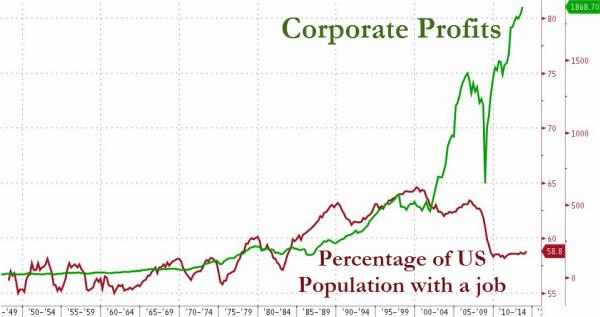
Corporate profits and financial markets soar with diminished labor force, The market is not the economy but food stamp recipients part time workers and labor force dropouts are minimal consumers

Corporate profits and financial markets soar with diminished labor force, The market is not the economy but food stamp recipients part time workers and labor force dropouts are minimal consumers

“The Congressional Budget Office recently warned that Obamacare would “keep hours worked and potential output during the next 10 years lower than they would be otherwise.” That nonpartisan verdict should be bad news for workers.”…Washington Times February 14, 2014

“Nearly half of U.S. companies are reluctant to hire full-time employees because of the ACA. One in five firms indicates they are likely to hire fewer employees, and another one in 10 may lay off current employees in response to the law.

Other firms will shift toward part-time workers. More than 40 percent of CFOs say their companies will consider switching some jobs to less than 30 hours per week or targeting part-time workers for future employment.”…Duke University Fuqua School of Business December 11, 2013

Freedom is the freedom to say that two plus two make four. If that is granted, all else follows.”…George Orwell, “1984″


There is not a one to one correlation between the labor force and economy and financial markets.

However, food stamp recipients, part time workers and labor force dropouts are minimal consumers.

There will come a day of reckoning and recent Walmart quarterly results may be a harbinger of that.

From Zero Hedge March 3, 2014.
“‘The Market Is Not The Economy’ And The Winner-Takes-All Society”

“You hear that old saw that “the market is not the economy,” a lot these days, and for good reason. As ConvergEx’s Nick Colas notes, the S&P 500 breaks to record highs – but U.S. labor markets remain sluggish; investor portfolios do well – but over 47 million Americans (more than 15% of the population) are still in U.S. food stamp program – the same as August 2012. The important question now is: “Is the market TOO different from the economy?””

CorporateProfitsEconomy


“Record corporate profits – the reason for all-time highs in U.S. equities – come with little hiring or wage gains. The hottest growth stories are business models with lots of customers but very few employees. The recently purchased WhatsApp – for $19 billion – has 55 employees. Investment payoffs – and increasingly social outcomes as well – are technology-enabled, asymmetric and sporadic. How soon before we reach a tipping point?

Via ConvergEx’s Nick Colas,

Last week the local government of San Francisco announced that Google has promised to give $6.8 million over the next two year to pay for over 31,000 low-income young people to use the city’s mass transit system for free. Mayor Edwin Lee applauded the company for helping ease San Francisco’s “Affordability crisis for lower and middle-income families”. Without Google’s help, the successful pilot program would have run out of money in July of this year.

Google’s initiative seems to be a direct response to numerous local protests over its practice of providing free shuttle busses throughout the city for the sole benefit of its employees. Local and often long-time residents, fed up with cost of living inflation from their new stock-option enriched neighbors, see the busses as a symbol of an out-of-touch elite and the companies they serve. Some of the protests have turned violent. Even Wired magazine, a widely read voice of the merits of technology, sees the problem. In the most recent issue: an editorial entitled “Breaking Point: Silicon Valley Can’t Avoid the Haters”, and a back page questionnaire – “Am I a Silicon Valley Douchbag?”

There’s an old Wall Street aphorism that goes “The market is not the economy”, something akin to “A Google bus is not the San Francisco economy.” In both cases, you’d think there were would some correlation. A hugely profitable Silicon Valley should mean a broadly wealthy and generally content “City by the Bay”. And a rocking stock market should indicate a U.S. economy solidly on the mend after the Financial Crisis and accelerating in 2014. Neither seems to be true.”

Read more:

http://www.zerohedge.com/news/2014-03-03/market-not-economy-and-winner-takes-all-society


March 2014 Sheriff Arpaio Mike Zullo announcement, AL Supreme Court Obama eligibility ruling, Blagojevich appeal and wiretaps, Perfect storm brewing, Ukraine Syria economy diversion?

March 2014 Sheriff Arpaio Mike Zullo announcement, AL Supreme Court Obama eligibility ruling, Blagojevich appeal and wiretaps, Perfect storm brewing, Ukraine Syria economy diversion?

“Why has Obama, since taking the White House, used Justice Department Attorneys, at taxpayer expense,  to avoid presenting a legitimate birth certificate and college records?”…Citizen Wells

“Moore said he’s seen no convincing evidence that Obama is a “natural born citizen” and a lot of evidence that suggests he is not.”…Judge Roy Moore interview by WND

Freedom is the freedom to say that two plus two make four. If that is granted, all else follows.”…George Orwell, “1984″


Storms are brewing.

Storms rage in Syria, the Ukraine and a huge thunderhead is developing in the economy.

Potential diversions?

A perfect storm may be developing.

The Sheriff Arpaio Mike Zullo investigation is already tied to the AL Supreme Court Obama eligibility case.

Mike Zullo affifavit:

Click to access zullo-affidavit.pdf

Will the Alabama Supreme Court ruling coincide with the purported Mike Zullo announcement in March?

An update from Birther Report February 16, 2014.

“Mike Zullo Traces Obots to White House and They All Disappear Overnight”
“On Sunday afternoon, founder of WheresObamasBirthCertificate.com and radio show host Mike Volin told The Post & Email exclusively that Geir Smith has joined WOBC as a writer on the Cold Case Posse’s investigation of Obama’s long-form birth certificate.

Smith is a writer at the popular website beforeitsnews.com and also uses the alias King of Shambhala.

Smith will be a guest on Volin’s next WOBC radio show, which will take place on either Monday, February 24 or Tuesday, February 25. The Post & Email will announce a firm date as soon as it is scheduled and has agreed to appear as a guest on the show at Smith’s request.

“He’s under attack by the Obots,” Volin told us of Smith. Now he’s written an article about the Obots and the fact that it’s been so quiet. It’s a short article, but it gets right to the point.” “Obots” are ideological Obama supporters who have trolled the internet for at least five years to silence criticism of and investigation into the background of Barack Hussein Obama, often spreading disinformation.”
“Obama’s Obots have disappeared overnight. Where are they?

On Carl Gallup’s Freedom Friday radio show, Mike Zullo said they’ve traced the IP address of “RC” to DOD’s DARPA disinformation department.

The Obots have gone eerily silent ever since. Why?”
“Joe Arpaio is releasing all his investigation’s results in less than a month, during the month of March. The heavy hand of the law is clamping down on them and they just have a few days left till the curtain comes down for them.

The rats are scuttling for the exits. Or are they regrouping for a last stand?

The problem is that Mike Zullo’s got “proof, proof, proof” as he said on the radio show. Joe Arpaio’s got “stuff” on DOD and Obama.”

Read more:

http://www.birtherreport.com/2014/02/report-team-arpaio-trace-obots-to-white.html


Even if the IL appeals court reviews the previously hidden Blagojevich wiretaps, it is doubtful that we will ever see them.

They touch Obama too much.

The Blagojevich “prosecution” and appeal is proceeding as predicted here.

Slowly and selectively to protect Obama.

Labor force participation rate at 35 year low, State by state, 55 and over record high, WV lowest P2P rate Washington DC highest, CA NV highest underemployment rates

Labor force participation rate at 35 year low, State by state, 55 and over record high, WV lowest P2P rate Washington DC highest, CA NV highest underemployment rates

“11.4%: What the U.S. unemployment rate would be if labor force participation were back to January 2008 levels.” …James Pethokoukis, American Enterprise Institute, June 2013

“Nearly half of U.S. companies are reluctant to hire full-time employees because of the ACA. One in five firms indicates they are likely to hire fewer employees, and another one in 10 may lay off current employees in response to the law.

Other firms will shift toward part-time workers. More than 40 percent of CFOs say their companies will consider switching some jobs to less than 30 hours per week or targeting part-time workers for future employment.”…Duke University Fuqua School of Business December 11, 2013

“Freedom is the freedom to say that two plus two make four. If that is granted, all else follows.”…George Orwell, “1984″


Another excellent report from Zero Hedge on the US employment situation February 14, 2014.

“The US Participation Rate Is At A 35 Year Low: This Is How It Looks Broken Down State By State”

After years of being roundly ignored by the mainstream media, and certainly be self-important economists, the issue of labor force participation is suddenly up front and center, especially now that the Fed itself finds itself scrambling to explain the humiliation of hitting its 6.5% unemployment “forward guidance” threshold without proceeding to tighten as it said it would initially when it launched QEternity in December 2012.

Incidentally, we predicted precisely this when we said in December 2012 that “using a simple forecast, based on LTM trends across all key employment metrics reveals something very troubling, for the Fed and stocks that is: the 6.5% unemployment rate will be breached in July 2013! Now granted that is simply idiotic, and there is no way that the US economy could possibly recover that fast, but that is precisely what is implied based on the ongoing collapse in the Labor Force Participation, and the concurrent plunge in the Labor Force Participation rate,which has been the biggest marginal driver for the unemployment rate, far more than the number of people who have jobs, or are unemployed (readers can recreate our calculation on their own in 10 minutes with excel).”

Granted, we were off by six months, but we were spot on about the reason why the unemployment threshold number was hit so quickly, instead of as the Fed has originally predicted, some time in 2015/2016.

So now that absolutely everyone is laser-focused more on the participation print, recently at 35 year lows, than the actual unemployment number which even the Fed has implied is meaningless in the current context, one thing to note is that while the overall number is a blended average across the US, it certainly differs on a state by state basis.

In order to get a sense of which states are the winners and losers in the payroll to participation ratio,we go to Gallup, which conveniently has broken down this number on a far more granular basis.

Gallup finds that Washington, D.C., had the highest Payroll to Population (P2P) rate in the country in 2013, at 55.7%. A cluster of states in the Northern Great Plains and Rocky Mountain regions — North Dakota, Nebraska, Minnesota, Wyoming, Iowa, Colorado, and South Dakota — all made the top 10. West Virginia (36.1%) had the lowest P2P rate of all the states.

“Of course, this now defunct demographic explanation does not account for the fact that within the US labor force, the number of people employed aged 55 and over has just hit a record high, as it defeats the demographic explanation. So while one should ignore the rationalization, one should certainly be aware of which states skew the participation distribution on the high and low side.”

“And guess which states were by far the worst offenders when it comes underemployment:

California and Nevada have the highest percentages of their workforces not working at desired capacity. Their rates are about twice those of states at the other end of the spectrum, such as North Dakota (10.1%). Other states hard hit by the recession and declining housing market, including Florida and Arizona, rank among the states with the highest underemployment rates.”

Read more:

http://www.zerohedge.com/news/2014-02-14/us-participation-rate-35-year-low-how-it-looks-state-state


John B. Taylor house testimony February 11, 2014, Poor economic performance and job growth, Unemployment drop due to labor force dropouts, Failed Fed policies, Committee on Financial Services

John B. Taylor house testimony February 11, 2014, Poor economic performance and job growth, Unemployment drop due to labor force dropouts, Failed Fed policies, Committee on Financial Services

“11.4%: What the U.S. unemployment rate would be if labor force participation were back to January 2008 levels.” …James Pethokoukis, American Enterprise Institute, June 2013

“Nearly half of U.S. companies are reluctant to hire full-time employees because of the ACA. One in five firms indicates they are likely to hire fewer employees, and another one in 10 may lay off current employees in response to the law.

Other firms will shift toward part-time workers. More than 40 percent of CFOs say their companies will consider switching some jobs to less than 30 hours per week or targeting part-time workers for future employment.”…Duke University Fuqua School of Business December 11, 2013

“Freedom is the freedom to say that two plus two make four. If that is granted, all else follows.”…George Orwell, “1984″


From The Testimony Before The Committee on Financial Services United States House of Representatives February 11, 2014, John B. Taylor

“Monetary Policy and the State of the Economy”


“The Current Economic Situation

Recently released data indicate that the U.S. economy continues to underperform, with the recovery from the deep 2007-09 recession looking as disappointing as ever. Real GDP growth has been too slow to close the gap between real GDP and its pre-recession trend, even incorporating the temporary pickup near the end of last year.1 Job growth has been too slow to
raise employment relative the population, leaving the employment-to-population ratio below the recession low.2 While the unemployment rate has declined recently, much of the decline is due to an unusually large number of people dropping out of the labor force because of the weak recovery.3 It is good news that the inflation rate has averaged very close to the Fed’s 2 percent
goal during the past decade, but by any measure the performance of the real economy has deteriorated compared to the previous two decades.

I have argued that the main cause of the poor performance is a significant shift in economic policy away from what worked reasonably well in the decades before. Broadly speaking, monetary policy, regulatory policy, and fiscal policy each became more discretionary, more interventionist, and less predictable starting in the years leading up to the financial crisis and have largely remained in that mode.4

There is an obvious empirical correlation between this shift in economic policy and the poor economic performance. But it is more than a correlation: A significant body of economic research predicts that such a shift would result in poorer performance, a prediction that is confirmed by historical experiences from the 1970s to the 1980s and 1990s and by empirical studies of specific policy actions. Moreover, this “policy is the problem” explanation fits the
facts better than alternative views that there has been a secular stagnation due to a persistent decline in the normal real interest rate or that weak recoveries normally follow deep recessions.”
“Though the intention of the majority of those at the Fed in favor of the policies was to stimulate the economy, there is little evidence that the policy has helped economic growth or job growth. Growth has been less with the unconventional policies than the Fed originally forecast. In the year since QE3 gained full steam at the end of 2012, interest rates on long-term Treasuries and mortgage backed securities have risen rather than fallen as was the intent of the policy.
Before quantitative easing, from 2003 to 2008, the average spread between one year and ten year Treasury securities was 1.3%. During the three quantitative easing programs, from 2009 through 2013 the average spread was 2.4%. So it is very hard to establish that QE reduced spreads.”

Read more:

Click to access HHRG-113-BA00-WState-JTaylor-20140211.pdf


Obama media BLS jobs spin exceeds big brother of “1984”, 2.870 million real actual jobs lost in January, Global warming or harsh winter?, George Orwell understated coming lies

Obama media BLS jobs spin exceeds big brother of “1984”, 2.870 million real actual jobs lost in January, Global warming or harsh winter?, George Orwell understated coming lies

“11.4%: What the U.S. unemployment rate would be if labor force participation were back to January 2008 levels.” …James Pethokoukis, American Enterprise Institute, June 2013

“Nearly half of U.S. companies are reluctant to hire full-time employees because of the ACA. One in five firms indicates they are likely to hire fewer employees, and another one in 10 may lay off current employees in response to the law.

Other firms will shift toward part-time workers. More than 40 percent of CFOs say their companies will consider switching some jobs to less than 30 hours per week or targeting part-time workers for future employment.”…Duke University Fuqua School of Business December 11, 2013

“Freedom is the freedom to say that two plus two make four. If that is granted, all else follows.”…George Orwell, “1984″

George Orwell painted a picture of what he had seen from totalitarian regimes and what he envisioned could come. He understated what we experience today.

From “1984.”

“Winston dialled ‘back numbers’ on the telescreen and called for the appropriate issues of The Times, which slid out of the pneumatic tube after only a few minutes’ delay. The messages he had received referred to articles or news items which for one reason or another it was thought necessary to alter, or, as the official phrase had it, to rectify. For example, it appeared from The Times of the seventeenth of March that Big Brother, in his speech of the previous day, had predicted that the South Indian front would remain quiet but that a Eurasian offensive would shortly be launched in North Africa. As it happened, the Eurasian Higher Command had launched its offensive in South India and left North Africa alone. It was therefore necessary to rewrite a paragraph of Big Brother’s speech, in such a way as to make him predict the thing that had actually happened. Or again, The Times of the nineteenth of December had published the official forecasts of the output of various classes of consumption goods in the fourth quarter of 1983, which was also the sixth quarter of the Ninth Three-Year Plan. Today’s issue contained a statement of the actual output, from which it appeared that the forecasts were in every instance grossly wrong. Winston’s job was to rectify the original figures by making them agree with the later ones. As for the third message, it referred to a very simple error which could be set right in a couple of minutes. As short a time ago as February, the Ministry of Plenty had issued a promise (a ‘categorical pledge’ were the official words) that there would be no reduction of the chocolate ration during 1984. Actually, as Winston was aware, the chocolate ration was to be reduced from thirty grammes to twenty at the end of the present week. All that was needed was to substitute for the original promise a warning that it would probably be necessary to reduce the ration at some time in April.

As soon as Winston had dealt with each of the messages, he clipped his speakwritten corrections to the appropriate copy of The Times and pushed them into the pneumatic tube. Then, with a movement which was as nearly as possible unconscious, he crumpled up the original message and any notes that he himself had made, and dropped them into the memory hole to be devoured by the flames.

What happened in the unseen labyrinth to which the pneumatic tubes led, he did not know in detail, but he did know in general terms. As soon as all the corrections which happened to be necessary in any particular number of The Times had been assembled and collated, that number would be reprinted, the original copy destroyed, and the corrected copy placed on the files in its stead. This process of continuous alteration was applied not only to newspapers, but to books, periodicals, pamphlets, posters, leaflets, films, sound-tracks, cartoons, photographs — to every kind of literature or documentation which might conceivably hold any political or ideological significance. Day by day and almost minute by minute the past was brought up to date. In this way every prediction made by the Party could be shown by documentary evidence to have been correct, nor was any item of news, or any expression of opinion, which conflicted with the needs of the moment, ever allowed to remain on record. All history was a palimpsest, scraped clean and reinscribed exactly as often as was necessary. In no case would it have been possible, once the deed was done, to prove that any falsification had taken place. The largest section of the Records Department, far larger than the one on which Winston worked, consisted simply of persons whose duty it was to track down and collect all copies of books, newspapers, and other documents which had been superseded and were due for destruction. A number of The Times which might, because of changes in political alignment, or mistaken prophecies uttered by Big Brother, have been rewritten a dozen times still stood on the files bearing its original date, and no other copy existed to contradict it. Books, also, were recalled and rewritten again and again, and were invariably reissued without any admission that any alteration had been made. Even the written instructions which Winston received, and which he invariably got rid of as soon as he had dealt with them, never stated or implied that an act of forgery was to be committed: always the reference was to slips, errors, misprints, or misquotations which it was necessary to put right in the interests of accuracy.

But actually, he thought as he re-adjusted the Ministry of Plenty’s figures, it was not even forgery. It was merely the substitution of one piece of nonsense for another. Most of the material that you were dealing with had no connexion with anything in the real world, not even the kind of connexion that is contained in a direct lie. Statistics were just as much a fantasy in their original version as in their rectified version. A great deal of the time you were expected to make them up out of your head. For example, the Ministry of Plenty’s forecast had estimated the output of boots for the quarter at one-hundred-and-forty-five million pairs. The actual output was given as sixty-two millions. Winston, however, in rewriting the forecast, marked the figure down to fifty-seven millions, so as to allow for the usual claim that the quota had been overfulfilled. In any case, sixty-two millions was no nearer the truth than fifty-seven millions, or than one-hundred-and-forty-five millions. Very likely no boots had been produced at all. Likelier still, nobody knew how many had been produced, much less cared. All one knew was that every quarter astronomical numbers of boots were produced on paper, while perhaps half the population of Oceania went barefoot. And so it was with every class of recorded fact, great or small. Everything faded away into a shadow-world in which, finally, even the date of the year had become uncertain.”

From Zero Hedge February 9, 2014.

“Much has been said about the January Non-farm payrolls number, which rose by 113K on expectations of a 180K increase, most of which has been focused on the US atmospheric conditions during the winter. There is a problem with those numbers: they don’t really exist (as for the non-impact of “the weather” on jobs we showed previously that the number of people “not at work due to weather” as calculated by the BLS itself. this winter was lower than 2008, 2009, 2010, 2011 and 2012 – so much for historic winter weather).

So what really happened in January?

For the real answer we have to go to the BLS’ non-seasonally adjusted data series. It is here that we find that in January, some 2.870 million real, actual jobs were lostnot gained. Putting this further in perspective, the number of NSA jobs losses in January 2014 was greater than in January of 2013, 2012, 2011 and tied that of 2010. In fact only during the peak of the depression in January 2009 was there a greater NSA drop in the first month of the year when 3.691 million jobs were lost.”

Read more:

http://www.zerohedge.com/news/2014-02-09/about-those-29-million-jobs-lost-january

Let’s cut through the crap.

From the US Labor dept. BLS.

In January of 2009 when Obama took office there were 80,529,000 not in the labor force.

In January of 2014 there were 91,455,000  not in the labor force.

Look it up for yourself.

http://www.bls.gov/webapps/legacy/cpsatab1.htm

The government and media use the weather as an excuse when it is convenient.

Harsh winter or global warming.

More crap.

Jobless claims of 331k shows labor market improvement?, Market Watch claims, Challenger Gray & Christmas January job cuts surge, ADP Jan job creation plunges, Labor force plummets

Jobless claims of 331k shows labor market improvement?, Market Watch claims, Challenger Gray & Christmas January job cuts surge, ADP Jan job creation plunges, Labor force plummets

“11.4%: What the U.S. unemployment rate would be if labor force participation were back to January 2008 levels.” …James Pethokoukis, American Enterprise Institute, June 2013

“Nearly half of U.S. companies are reluctant to hire full-time employees because of the ACA. One in five firms indicates they are likely to hire fewer employees, and another one in 10 may lay off current employees in response to the law.

Other firms will shift toward part-time workers. More than 40 percent of CFOs say their companies will consider switching some jobs to less than 30 hours per week or targeting part-time workers for future employment.”…Duke University Fuqua School of Business December 11, 2013

“Freedom is the freedom to say that two plus two make four. If that is granted, all else follows.”…George Orwell, “1984″


Is the primary function of Market Watch to keep people throwing money into the financial markets, prop up Obama or both?

From Market Watch February 6, 2014.

“Jobless claims show labor-market improvement”

“The number of people who applied to receive unemployment benefits in the last week of January fell by 20,000, reversing the increase from the week before and signaling that the U.S. labor market continues to gradually improve.

Initial jobless claims fell to a seasonally adjusted 331,000 in the seven-days ended Feb. 1 from a revised 351,000 in the prior week, the Labor Department said Thursday. Claims from two weeks ago were 3,000 higher than previously reported.

Economists polled by MarketWatch had expected claims to total 337,000.”

Read more:

http://www.marketwatch.com/story/jobless-claims-drop-20000-to-331000-2014-02-06?link=MW_home_latest_news

From the US Labor Dept. February 6, 2014.

“In the week ending February 1, the advance figure for seasonally adjusted initial claims was 331,000, a decrease of 20,000 from the previous week’s revised figure of 351,000. The 4-week moving average was 334,000, an increase of 250 from the previous week’s revised average of 333,750.

The advance seasonally adjusted insured unemployment rate was 2.3 percent for the week ending January 25, unchanged from the prior week’s unrevised rate. The advance number for seasonally adjusted insured unemployment during the week ending January 25 was 2,964,000, an increase of 15,000 from the preceding week’s revised level of 2,949,000. The 4-week moving average was 2,985,500, an increase of 25,750 from the preceding week’s revised average of 2,959,750.”

Read more:

http://www.dol.gov/opa/media/press/eta/ui/current.htm

From Challenger, Gray & Christmas, Inc. February 6, 2014.

“FOR RELEASE AT 7:30 A.M. ET, FEBRUARY 6, 2014

Job Cuts Surge 47% to Kick Off 2014

EMPLOYERS PLAN 45,107 JOB CUTS; RETAILERS LEAD PACK AS HOLIDAY SALES DISAPPOINT

CHICAGO, February 6, 2014 – After falling to a 13-year low in December, monthly job cuts surged nearly 50 percent to kick off 2014, as U.S.-based employers announced plans to reduce their payrolls by 45,107 in January, according to the latest report on monthly job cuts released Thursday by global outplacement consultancy Challenger, Gray & Christmas, Inc.

The 45,107 job cuts last month were 47 percent higher than a December total of 30,623, which was the lowest one-month total since 17,241 planned layoffs were announced in June 2000. January job cuts were up 12 percent from the same month a year ago, when 40,430 job cuts were recorded.

The heaviest downsizing activity occurred in retail, where poor earnings led to a wave of job cut announcements from several national chains, including Macy’s, Sam’s Club, JC Penney, Sears, Best Buy and Target. Overall, retailers announced 11,394 job cuts in January; a 71 percent increase from the 6,676 retail cuts tracked in January 2013. Last month’s retail cuts were the heaviest for the sector since last March, when 16,445 planned layoffs were announced.
“Holiday sales gains were relatively weak and many retailers achieved the gains by slashing prices on their products, which adversely impacted their year-end earnings. The post-holiday job-letting in the sector was inevitable,” said John A. Challenger, chief executive officer of Challenger, Gray & Christmas.
“Retail employment will, in fact, fall further than the announced job cuts indicate. Starting in January, retailers started shedding the tens of thousands of temporary seasonal workers hired to help handle the holiday rush. The announced job cuts, on the other hand, will impact full-time, permanent workers in the stores and at the corporate offices of these struggling chains,” he added.”

Read more:

http://www.challengergray.com/press/press-releases

From Zero Hedge February 5 2014.

“ADP Plunges In January To 175K; Biggest Miss Since August; December Revised Lower: “Cold, Storms” Blamed”

“Earlier today, we predicted with absolute accuracy what today’s joke of an ADP print would be:

And sure enough, the January ADP print missed as we expected, printing at 175K vs the expected 185K, while the December 238K was revised lower to 227K, confirming that ADP is nothing but an NDP trend follower and an absolutely worthless and meaningless data point that does nothing to add relevant data to the economic picture.

For those who care, this was the biggest miss since August and the largest monthly drop since August 2012, and the weakest print since August as well.”

Read more:

http://www.zerohedge.com/news/2014-02-05/adp-plunges-january-175k-biggest-miss-august-december-revised-lower

The labor force participation has plummeted since Obama took office.