Category Archives: Illinois

Cellini found guilty of conspiracy bribery, November 1, 2011

Cellini found guilty of conspiracy bribery, November 1, 2011

From the Chicago Tribune November 1, 2011.

“Cellini found guilty of conspiracy, bribery”
“A federal jury convicted Springfield power broker William Cellini on two of four counts in connection with a plot to extort a Hollywood producer.

The multimillionaire Republican businessman who wielded influence behind the scenes in Illinois politics and government for four decades was convicted of conspiracy to commit extortion and aiding and abetting the solicitation of a bribe.

He was acquitted of conspiracy to commit mail fraud and attempted extortion.

A straight-faced Cellini tapped his folded hands at the edge of the defense table as the verdict was read, otherwise showing little emotion. His daughter Claudia dropped her head on word of the first of the two guilty verdicts.

Cellini’s lawyer Dan Webb put the best face possible on the verdict, saying he was pleased the jury had “thrown out the most serious charges” and  that Cellini’s involvement “didn’t even rise to the level of an attempted extortion.”

“We obviously are going to appeal … and we are confident we have a substantial chance of getting the case reversed,” Webb said.

Cellini did not speak as he left the courthouse.

Patrick Fitzgerald, on crutches, said the prosecution was gratified by the guilty verdicts on the two counts, calling Cellini’s prosecution an “extremely important case.”

“In the quiet corridors in Chicago and Cook County and Springfield, a lot of backroom deals take place, and the fact that Bill Cellini was convicted today sends a very, very loud message,” Fitzgerald said.

The guilty verdict brings to 15 the number of individuals convicted in the eight-year federal Operation Board Games probe of the scandal-plagued Blagojevich administration.

Blagojevich himself is awaiting sentencing after being convicted in June on 17 of 20 counts, including allegations he tried to sell the U.S. Senate seat left open by Barack Obama’s election to president in 2008. The former governor was also convicted at his first trial in the summer of 2010 on a single count of lying to the FBI.

Word of a verdict in the Cellini trial came at about 10:15 a.m. Tuesday. It was announced at about 12:15 p.m.

The 10-woman, two-man jury had just returned to the courthouse from a three-day weekend. Deliberations began last Wednesday but had to be restarted on Thursday after a juror was excused for an unexplained conflict of interest. An alternate was added to the panel.

The charges against Cellini centered on his longtime influence at the Illinois Teachers’ Retirement System, the state pension fund for public school teachers outside Chicago. To keep from losing his clout after Blagojevich became the first Democratic governor of Illinois in more than a quarter century, prosecutors alleged that the prominent Republican fundraiser agreed to pick firms to manage TRS’s hundreds of millions of dollars in investments on one key condition – if they had contributed to Blagojevich’s campaign.”

http://www.chicagotribune.com/news/local/breaking/chi-jury-has-reached-verdict-in-cellini-extortion-trial-20111101,0,3309176.story

FDIC Mutual Bank lawsuit reveals Rezko Obama corruption, Kenneth J. Conner lawsuit, Amrish Mahajan, Richard Barth, Where did Rezkos get the money?

FDIC Mutual Bank lawsuit reveals Rezko Obama corruption, Kenneth J. Conner lawsuit, Amrish Mahajan, Richard Barth, Where did Rezkos get the money?

“Why did Mutual Bank fire whistleblower Kenneth J Connor after he
challenged the appraisal on the land purchased by Rita Rezko, just
prior to the land sale to Obama?”…Citizen Wells

“Where did Rita Rezko get the money to buy the lot she sold to Barack and Michelle Obama?”…Citizen Wells

Here is what we know about the purchase of a lot by Barack and Michelle Obama from Rita Rezko in 2006:

1. “In June, 2005, Mutual Bank President and CEO Amrish Mahajan and
other Mutual Bank officers approved a loan to Rita Malki Rezko (Rita
Rezko) which was guaranteed by Antonin Rezko so that Rita Rezko could
purchase a 9,090 square foot vacant parcel of real estate at 5050 S.
Greenwood Avenue, Chicago.” (Conner lawsuit)

2. “On or about January 4, 2006, Rita Rezko entered into an
agreement with Senator Barack and Michelle Obama (Obamas) to sell a
ten-foot strip of the 5050 S. Greenwood property to the Obamas.”
(Conner lawsuit)

3. “In late 2005 or early 2006, Conner performed an appraisal review
of the Adams Appraisal (Exhibit C) per the directive of Richard Barth
and James Murphy. Conner prepared a written Appraisal Review report
(ARR) opining that the Adams Appraisal overvalued the Greenwood lot by
a minimum of $ 125,000.00 and that a reasonable and fair valuation for
Mutual Banks’s underwriting purposes should be no greater than $
500,000.00 for the entire 5050 S. Greenwood parcel as originally
purchased by Rita Rezko.” (Conner lawsuit)

4. “On or about October 19, 2006, Mutual Bank received a Grand Jury
Subpoena (GJS) requiring Mutual Bank to produce the Rezko 5050
Greenwood loan file, as well as a Rita Rezko Riverside District
Development LLC checking account and loan file.” (Conner lawsuit)

5. “In October, 2007, Conner had various communications with Mutual
Bank’s Human Resources Department representative, Lana Schlabach. In
an email communication of October 15, 2007, Conner directly referenced
“Resentment over my mentioned discovery of the removal/replacement of
an appraisal review that I conducted. That appraisal review contained
substantial observations and suggestions. The transaction and parties
involved were high profile in the media.I am under the impression that
the FBI has since looked at the file.”” On October 23, 2007, eight days after Conner’s October 15, 2007 email to Schlabach attached as Exhibit J, Mutual Bank terminated Conner’s employment for pretextual reasons.” (Conner lawsuit)

6. “On October 23, 2007, eight days after Conner’s October 15, 2007
email to Schlabach attached as Exhibit J, Mutual Bank terminated
Conner’s employment for pretextual reasons.” (Conner lawsuit)

7. The FDIC has filed a lawsuit against Mutual Bank, Amrish Mahajan, Richard Barth, et al.
From Citizen Wells October 31, 2011.

“The FDIC is suing eight former directors, two officers and the bank’s lawyer.

The failure of the $1.7 billion-asset bank, which had 10 branches in
the Chicago area, is expected to cost the FDIC $775 million. From 2005
to 2009, the lender had nearly doubled in size, fueled by what would
turn out to be bad real estate loans, many of which were made to about
15 borrowers. Record-keeping was shoddy, and loan terms were changed
at closing with no board approval, the suit said. Mutual had become a
“lender of last resort for failed real estate projects,” particularly
in the hotel industry, the suit said.

One of the defendants, former bank president and board member Amrish
Mahajan, couldn’t be reached for comment.”
“5. Collectively, the Director Defendants and Officer Defendants
(“Director and Officer Defendants”) (a) recklessly implemented a
strategy of rapid asset growth through approving a high concentration
of risky CRE, ADC and out-of-area loans to a small concentration of
high-volume borrowers; (b) failed to implement appropriate
underwriting and credit administration practices; (c) ignored the
Bank’s loan policies; (d) ignored federal lending regulations; and (e)
disregarded warnings from the Bank’s regulators regarding the Bank’s
lending activities.”
https://citizenwells.wordpress.com/2011/10/31/mutual-bank-amrish-mahajan-richard-barth-fdic-lawsuit-kenneth-j-conner-whistleblower-vindication-obama-rezko-land-deal/
8. The Rezko’s were deeply in debt. Where did they get the money to purchase the lot?

From the Real Barack Obama April 1, 2008 by Brenda J. Elliott.

“Weeks earlier, on February 10, 2008, RezkoWatch posted a lengthy
article in which was discussed the fact that Rita Rezko purchased the
lot for the full asking price of $625,000.00, with a downpayment of
$125,000.00 and the $500,000.00 balance financed with the Mutual Bank
of Harvey, Illinois, which is owned by Amrish Mahajan, who had loaned
millions of dollars in financing for Tony Rezko’s real estate
ventures.

It is also important to note that Sreenan, who handled the transaction
for Rita Rezko, “said that the lot was attractive to developers and
that the Rezkos had to outbid others to buy it.”

Complicating the matter is the fact that the January 26, 2008, Motion
for Issuance of an Arrest Warrant in United States of America v.
Antoin Rezko showed that in November 2006 Tony Rezko had submitted
documentation “detailing his assets and liabilities” to the Court. On
November 2, 2006, Rezko’s counsel sent a letter to the Court which
stated “that it was ‘abundantly clear’ that [Rezko] ‘has no income,
negative cash flow, no liquid assets, no unemcumbered assets, is
significantly in arrears on many of his obligations … and has been
forced to rely on family friends for financial assistance.’” Rita
Rezko only “had a salary of $37,000, but no other significant assets.”

In fact, on October 20, 2006, when Tony Rezko made his second court
appearance following his indictment, it was reported that Rezko had
“fallen tens of thousands of dollars behind in mortgage and property
tax payments. The lender filed suit to take back the big place.” Not
only were the Rezkos broke, but Tony Rezko was about $50 million in
debt.

As RezkoWatch wrote on February 10, 2008, this leads to the question
of where Rita Rezko obtained the $125,000.00 downpayment to purchase
the lot, as the source is not stated. Additionally, as this debt—the
$125,000.00—is not listed among Rita Rezko’s liabilities in October
2006, it suggests that the loan had been paid off.”

http://therealbarackobama.wordpress.com/2008/04/01/follow-the-money-who-really-bought-the-rezko-lot-updated/

Mutual Bank, Amrish Mahajan, Richard Barth, FDIC lawsuit, Kenneth J Conner whistleblower vindication, Obama Rezko land deal

Mutual Bank, Amrish Mahajan, Richard Barth, FDIC lawsuit, Kenneth J Conner whistleblower vindication, Obama Rezko land deal

“Why did Mutual Bank fire whistleblower Kenneth J Connor after he
challenged the appraisal on the land purchased by Rita Rezko, just
prior to the land sale to Obama?”…Citizen Wells

It looks like whistleblower Kenneth J. Conner is being vindicated. Conner was fired after revealing that the appraisal for the lot in the Obama Rezko lot deal was too high.

From the Chicago Tribune October 31, 2011.

“Officers and directors of Mutual Bank issued $10.5 million in
“imprudent” dividends, spent $250,000 of the bank’s money on a
wedding, and paid $495,000 in defense costs for a spouse’s Medicaid
fraud case before the Harvey-based lender failed in July 2009, a
federal regulator alleged last week.

Mutual was the bank that financed the purchase by the wife of
political fundraiser Tony Rezko of a side lot in a deal that enabled
Barack Obama to buy his dream house.
In a lawsuit filed in a U.S. District Court in the Northern District
of Illinois last week, the Federal Deposit Insurance Corp. also
accused the bank of spending $300,000 to hold a board meeting in Monte
Carlo, Monaco.

The FDIC is suing eight former directors, two officers and the bank’s lawyer.

The failure of the $1.7 billion-asset bank, which had 10 branches in
the Chicago area, is expected to cost the FDIC $775 million. From 2005
to 2009, the lender had nearly doubled in size, fueled by what would
turn out to be bad real estate loans, many of which were made to about
15 borrowers. Record-keeping was shoddy, and loan terms were changed
at closing with no board approval, the suit said. Mutual had become a
“lender of last resort for failed real estate projects,” particularly
in the hotel industry, the suit said.

One of the defendants, former bank president and board member Amrish
Mahajan, couldn’t be reached for comment.”

http://www.chicagotribune.com/business/ct-biz-1031-bank-suit-20111031,0,3469830.story

From the lawsuit:

“5. Collectively, the Director Defendants and Officer Defendants (“Director and Officer Defendants”) (a) recklessly implemented a strategy of rapid asset growth through approving a high concentration of risky CRE, ADC and out-of-area loans to a small concentration of high-volume borrowers; (b) failed to implement appropriate underwriting and credit administration practices; (c) ignored the Bank’s loan policies; (d) ignored federal lending regulations; and (e) disregarded warnings from the Bank’s regulators regarding the Bank’s lending activities.”

http://www.courthousenews.com/2011/10/26/FDIC.pdf

The name Mahajan may ring a bell.  Richard Barth may not. This should help.

From Citizen WElls August 22, 2011.

“A former state contractor with close ties to ex-Gov. Rod Blagojevich
plans to enter a guilty plea Monday, more than four years after she
was charged with bilking the state out of $2 million for drug tests
that were never performed, said a source with knowledge of the case.

Anita Mahajan, the wife of a major Blagojevich fundraiser, was charged
in May 2007 with theft and fraud, based on allegations that her
company, K.K. Bio-Science, submitted bogus bills for drug screenings
for clients of the Illinois Department of Children and Family
Services.

Elections Prosecutors also accused Mahajan of laundering money taken
from the alleged fraud and using it to buy properties in Chicago and
New York.”

“Mahajan is the wife of Amrish Mahajan, a former head of the defunct
Mutual Bank of Harvey who was called “Uncle Amrish” by Blagojevich’s
children. He held events for Blagojevich and raised at least $500,000
for the former governor’s campaigns. The Mahajans also hired Patricia
Blagojevich for several real estate deals that netted the former first
lady more than $113,000 in commissions.”

Kenneth J Conner whistleblower lawsuit

“9.  In June, 2005, Mutual Bank President and CEO Amrish Mahajan and
other Mutual Bank officers approved a loan to Rita Malki Rezko (Rita
Rezko) which was guaranteed by Antonin Rezko so that Rita Rezko could
purchase a 9,090 square foot vacant parcel of real estate at 5050 S.
Greenwood Avenue, Chicago. As part of the Mutual Bank loan
underwriting process, Mutual Bank obtained a real estate appraisal
from Adams Valuation Corporation (Adams Appraisal) which purported to
provide an opinion of value of the subject 5050 S. Greenwood real
estate (the collateral for the Rezko loan) at $ 68.76 per square foot.
A copy of the Adams Appraisal is attached as Exhibit C. In June, 2005,
Rita Rezko closed on the purchase of the 5050 S. Greenwood property at
a purchase price of $ 625,000.00 along with the loan from Mutual Bank
in the amount of $ 500,000.00 with Mutual bank obtaining a first
mortgage lien position on the Greenwood vacant parcel.”

“10.  On or about January 4, 2006, Rita Rezko entered into an
agreement with Senator Barack and Michelle Obama (Obamas) to sell a
ten-foot strip of the 5050 S. Greenwood property to the Obamas. A copy
of the Obama/Rita Rezko contract is attached as Exhibit D. As a result
of that transaction, the Rezkos requested that Mutual Bank release
it’s first collateral position to the ten-foot strip parcel
transferred to the Obamas. In that same general time frame, Richard
Barth, Mutual Bank Senior VP of construction lending and James Murphy,
Mutual Bank Senior VP Internal Auditor/Risk Manager, requested that
Conner perform an appraisal review of the Adams Appraisal attached
hereto as Exhibit C.”

“11.  In late 2005 or early 2006, Conner performed an appraisal review
of the Adams Appraisal (Exhibit C) per the directive of Richard Barth
and James Murphy. Conner prepared a written Appraisal Review report
(ARR) opining that the Adams Appraisal overvalued the Greenwood lot by
a minimum of $ 125,000.00 and that a reasonable and fair valuation for
Mutual Banks’s underwriting purposes should be no greater than $
500,000.00 for the entire 5050 S. Greenwood parcel as originally
purchased by Rita Rezko. In that same general time frame an appraisal
was performed for the 5050 S. Greenwood property by Howard B. Richter,
MAI which valued the 5050 S. Greenwood property at $ 54.00 per square
foot but then discounted the ten-foot strip being transferred by Rita
Rezko to the Obamas by fifty percent, as the ten-foot strip was
unbuildable standing alone…The valuation by the Richter Appraisal for
the 5050 S. Greenwood lot was substantially to Conner’s ARR
valuation.”

“12.  Conner notified Richard Barth and James Murphy orally of his ARR
findings and Conner’s ARR was filed in the “Rezko 5050 Greenwood” loan
file at Mutual Bank.”

“13.  In addition to Conner’s ARR stating that the Adams Appraisal
overvalued the 5050 S. Greenwood property, Conner had reported on
other occasions that Adams Valuation Corporation had overvalued real
estate subject to Mutual Bank loan underwriting valuation.”

“14.  On or about October 19, 2006, Mutual Bank received a Grand Jury
Subpoena (GJS) requiring Mutual Bank to produce the Rezko 5050
Greenwood loan file, as well as a Rita Rezko Riverside District
Development LLC checking account and loan file. Electronic mail
(email) communications about the subpoena were circulated to Mutual
Bank officers and attorneys, including Amrish Mahajan, James Murphy
and Conner. A copy of an October 19, 2006 email string pertaining to
the Rezko GJS is attached as Exhibit F. On information and belief,
Conner’s ARR was removed from the Rezko 5050 Greenwood loan file prior
to the submission of that file pursuant to the GJS, and in it’s place
Mutual bank submitted an appraisal checklist which was purportedly
dated “06/15/05″ from Senior VP James P. Murphy (Murphy Checklist). A
copy of the Murphy Checklist is attached as Exhibit G.”

“16.  In 2007, Conner observed that his ARR of the 5050 S. Greenwood
property was not in the Rezko 5050 Greenwood loan file and in it’s
place was the Murphy Checklist purportedly dated “06/15/2005.”…On June
18, 2007, Conner sent an email to James Murphy which provides, in
part, “I spent time trying to track down work of mine that should be
in a particular high profile loan file, though it is not–having been
replaced by a checklist.””

“17.  In October, 2007, Conner had various communications with Mutual
Bank’s Human Resources Department representative, Lana Schlabach. In
an email communication of October 15, 2007, Conner directly referenced
“Resentment over my mentioned discovery of the removal/replacement of
an appraisal review that I conducted. That appraisal review contained
substantial observations and suggestions. The transaction and parties
involved were high profile in the media.I am under the impression that
the FBI has since looked at the file.””

“18.  On October 23, 2007, eight days after Conner’s October 15, 2007
email to Schlabach attached as Exhibit J, Mutual Bank terminated
Conner’s employment for pretextual reasons.”

https://citizenwells.wordpress.com/2011/08/22/anita-mahajan-pleads-guilty-blagojevich-and-obama-ties-mutual-bank-president-amrish-mahajan-wife-rezko-obama-land-purchase/

From the Washington Times November 4, 2008.

“A former Illinois real estate specialist says FBI agents have questioned him about a Chicago property that had been bought by convicted felon Tony Rezko’s wife and later sold to the couple’s next-door neighbor, Sen. Barack Obama.

The real estate specialist, Kenneth J. Conner, said bank officials replaced an appraisal review he prepared on the property and FBI agents were investigating in late 2007 whether the Rezko-Obama deal was proper.

“Agents and I talked about payoff, bribe, kickback for a long time, though it took them only a short number of minutes of talking with me while looking at the appraisal to acknowledge what they already seemed to know: The Rezko lot was grossly overvalued,” Mr. Conner told The Washington Times Monday.

“Rezko paid the asking price on the same day Obama paid $300,000 less than the asking price to the same seller for his adjacent mansion,” he said. “This begs the question of payoff, bribe, kickback.””

http://www.washingtontimes.com/news/2008/nov/04/fbi-asked-questions-on-rezko-land-deal/

There is one more event which must take place to vindicate Kenneth J. Conner. That is the indictment and arrest of Barack Obama.

Illinois high school graduation rates slump, Obama legacy, Obama Ayers Chicago corruption cronies, Obama doing to US what he did to Illinois

Illinois high school graduation rates slump, Obama legacy, Obama Ayers Chicago corruption cronies, Obama doing to US what he did to Illinois

“Why was Obama promoting Capri Capital and other investment firms at the same time that Rezko, Levine and Cellini were shaking them down?”…Citizen Wells

From the Chicago Tribune October 31, 2011.

“Illinois high school graduation rates slump”

“Despite its academic struggles, North Chicago Community High School could count on at least one piece of good news: Students were getting their diplomas. The school reported a 90.3 percent graduation rate in 2010.

But in 2011, the figure plummeted to 50.2 percent, a dismal picture created by a new formula that more accurately tracks how many ninth-graders graduate within four years. The new method, required by the federal government, was used for the first time this year in Illinois, with sobering results: Across the state, about 75 percent of high schools saw small dips to big drops in graduation rates, causing educators to adjust to a new reality.

“I think the school probably felt like they were doing things right because we were at 90 percent,” said Eric Gallagher, new principal at the struggling North Chicago high school. “It just took someone else to look at it from the outside.”

The new graduation rates are among the dozens of figures released Monday in the annual School Report Card data that provide information about everything from test scores to teachers’ experience to how much taxpayers spend on their schools.

Parents won’t see the changes in graduation rates in their school report cards because the state reports only this year’s figure with no comparisons to the prior year. The Tribune’s online database (schools.chicagotribune.com), however, shows 10 years of rates in addition to the regular report card data.

Educators who have seen comparative numbers often reacted with a mixture of criticism, concern and confusion over the new graduation rate formula.”

“In Lake Zurich, district officials corrected their figure twice after initially reporting a 100 percent graduation rate for Lake Zurich High School. The problem stemmed from misunderstandings about applying the formula, according to district spokeswoman Jean Malek. She said the accurate graduation rate is 92.8, up from 92.5 the year before.

Still, Lake Zurich is in the minority of high schools showing an increase in its graduation rate this year. It’s also a high performer — among about 30 percent of the more than 600 Illinois high schools that posted a graduation rate of 90 percent or higher this year.

Only 18 high schools, including Chicago’s Northside College Preparatory High School, attained a 100 percent graduation rate this year, compared with almost 100 high schools that did so last year. The statewide graduation rate slid from 87.8 to 83.8 percent.

The numbers are significant because graduation rates are one of the most important barometers in education, research shows.

“Because high school graduation is a strong indicator of social and economic well-being, this provides important information on the most basic measure of education success in the population,” stated a 2009 study by the Consortium on Chicago School Research at the University of Chicago. The report also cautioned that calculating graduation rates is fraught with technical issues and that no method is ideal.

The search for a better way to gauge how many students were getting their diplomas on time bubbled up from state governments.

“There was no consistency previously, and state governors were very interested in knowing how their particular schools and states were doing on getting students through high school within four years,” said Ryan Reyna, an education program director for the National Governors Association Center for Best Practices.

In 2005, the governors association for the first time came up with a common way to calculate graduation rates across states, leading the federal government to draw from that work and draft rules in 2008 on a new graduation formula.”

http://www.chicagotribune.com/news/education/ct-met-grad-rates-1031-20111031,0,1934891.story

Just some of Obama’s contributions to education in Illinois.

October 23, 2011

“In 2000, after losing a Congressional race, Barack Obama was looking to revive his political fortunes. And he soon found a springboard — a group of black entrepreneurs also trying to break out.”

“In that push, Mr. Obama met with three state pension boards and introduced a bill on the executives’ behalf. He also worked closely with the state’s top legislative leaders to encourage the pension funds to increase the share of their investment portfolios managed by minority-owned firms. That share has risen to 12 to 20 percent now from 1 to 3 percent in 2000.”

“During this period, campaign finance records show, executives from Ariel, Loop and two other leading Chicago investment firms, Holland Capital Management and Capri Capital, sharply increased their donations to Mr. Obama’s State Senate campaign fund. And once he began his campaign for the United States Senate, they quickly became a fund-raising core that has carried over into the presidential race.”

https://citizenwells.wordpress.com/2011/10/23/obama-role-in-corrupting-il-teacher-retirement-system-pensions-cellini-trial-2007-ny-times-article-where-is-tony-rezko-where-is-house-judiciary-committee/

October 19, 2011

“Following Obama’s efforts, the Illinois Teachers’ Retirement System gave Ariel Capital $112.5 million to manage, and added hundreds of millions more over the next few years.”

“Three other minority-run firms — Holland Capital, Loop Capital and Capri Capital Partners — also saw hundreds of millions of assets turned over to them to manage after meeting with Obama and the state pension boards.”
“Cellini’s alleged crimes – essentially conspiring with others to force Capri Capital, also a real estate investment firm, and Thomas Rosenberg, a principal and part owner of Capri, to raise or donate substantial political contributions for Public Official A….”

https://citizenwells.wordpress.com/2011/10/19/william-cellini-trial-capri-capital-obama-connection-obama-arrest-prevented-by-corrupt-us-justice-department-where-is-the-house-judiciary-committee/

September 25, 2008

The Annenberg challenge was supposed to improve Chicago schools but instead funded controversial groups like Acorn. Stanley Kurtz filed a FOIA request and after evaluating the Annenberg Challenge records has written his findings. Here are some of the highlights:

■Obama had most of his executive experience while working at the Annenberg Challenge. Obama does not refer to this fact.
■Chicago schools were not improved by the Annenberg Challenge. The money was instead spent on radical groups.
■Apparently Ken Rolling gave Bill Ayers a heads up in a possible cover up scheme.
■Obama and Ayers were on a committee together that created rules and bylaws.

https://citizenwells.wordpress.com/2008/09/25/obama-william-ayers-annenberg-challenge-stanley-kurtz-cover-up-ken-rolling-tips-ayers-obama-and-ayers-on-committee-kurtz-foia-request-obama-executive-experience-obama-hides-truth/

2 links in the article above yield the following:

“During Obama’s time as Annenberg board chairman, Ayers’s own education projects received substantial funding. Indeed, during its first year, the Chicago Annenberg Challenge struggled with significant concerns about possible conflicts of interest. With a writ to aid Chicago’s public schools, the Annenberg challenge played a deeply political role in Chicago’s education wars, and as Annenberg board chairman, Obama clearly aligned himself with Ayers’s radical views on education issues.”

http://www.nationalreview.com/articles/225348/chicago-annenberg-challenge-shutdown/stanley-kurtz

Another Obama damaging article removed?

“I can’t seem to find the page you wanted.

I’m sorry we had to meet under these circumstances, but allow me to introduce myself.
I’m Colonel Tribune, the Web ambassador for chicagotribune.com.

Perhaps I can help you find what you wanted when you hit this error page? Try our search  or our topics pages. If you are looking for an article that is more than a month old, you may find it in our archives.

If that doesn’t work, please feel free to leave us a question here.

Meantime, I hope I run into you surfing the Web. You can find me on Twitter and Facebook.

Have a good day!”

http://www.chicagotribune.com/news/local/chicago/chi-obama-ayers-universitysep09-archive,0,1053585.story

Obama is doing to the nation what he did to Illinois education for many years.

William Cellini trial jury, How Stuart Levine a thief and con man became star witness, Where is Tony Rezko?

William Cellini trial jury, How Stuart Levine a thief and con man became star witness, Where is Tony Rezko?

“Why was Obama promoting Capri Capital and other investment firms at the same time that Rezko, Levine and Cellini were shaking them down?”…Citizen Wells

“Why was Tony Rezko’s sentencing delayed?”…Citizen Wells

“There is enough corruption in Illinois so that all it takes is someone who is serious about finding it to uncover it. If a U.S. attorney is not finding corruption in Illinois, they’re not seriously looking for it.”…Northwestern Law Professor James Lindgren

Here is another example of why “WE” is capitalized in Citizen WElls. From Commenter and astute observer of Chicago corruption, Bessie, at 10:40 AM.

“In today’s SunTimes there is a propaganda article spoon fed by the
prosecution their justification for choosing Stuart Levine…No mention
of how Tony Rezko would make a better witness, having never been a
drug addict, nor did he ever rip off close friends estate, or have
affairs on his wife with multiple male companions, or suffer long term
brain damage from over 30 years of drug use. They planted this piece
in the weekend paper hoping the jury would read it…and we are suppose
to trust the U.S. Attorney’s office?

Tony Rezko and his partner Daniel T. Frawley will be sentenced
November 22 and 23rd, the day before Thanks Giving, hoping no one will
cover or notice…They think they can sweep these two under the rug and
no one will notice….We should let them know we are WATCHING we are
paying attention and they could sentence them on Christmas day and we
will be there.”

From the Chicago SunTimes October 30, 2011.

“How Stuart Levine — a thief and con man — became star witness”

“To most people, Stuart Levine probably appears unassuming enough.

At 65, he works at a kiosk in a suburban shopping mall selling
electronic cigarettes.

But if the man helping bring down some of the most powerful people in
the state hoped to disappear into suburban obscurity, that hasn’t
quite happened.

Some days while behind that kiosk, the former Highland Park resident
once worth $70 million gets hecklers.

Those are the people who recognize the now minimum-wage-earning
Levine, having had a glimpse of his lurid history, painstakingly laid
bare in public twice after Levine has spent parts of 21 days
testifying in two high-profile criminal trials in Chicago.

He most recently sat as the star witness in the federal trial of
Springfield power broker William Cellini.

If Cellini is convicted, the much-reviled Levine will have been
central to sending some of the most prominent and back-room politicos
to prison. That includes Tony Rezko, a onetime political fund-raiser
to Barack Obama. Levine was the star witness in Rezko’s 2008 trial,
which led to his conviction.

Levine wore a wire against Ed Vrdolyak, a onetime alderman and
behind-the-scenes political force for decades. Vrdolyak ended up
pleading guilty to taking part in a $1.5 million bribery scheme.

Then there’s former Gov. Rod Blagojevich, whose corruption
investigation stemmed from a probe into corruption involving state
boards that blossomed with Levine. Once he flipped, Levine spent years
getting debriefed by various teams of federal agents and prosecutors.

“This was a massive undertaking,” said Levine’s lawyer, Jeffrey
Steinback, of his client’s role in cooperating since 2004. “You’re
talking about analyzing activities of the entire state government and
having to understand who and what and how it worked and figuring out
from the government’s standpoint who was culpable and who wasn’t.””

“Defense lawyers have repeatedly lambasted the government for pitting
Levine, someone who has admitted to conning people out of millions of
dollars, against defendants who aren’t accused of pocketing any money.

Webb noted Levine spent the better part of his adult life committing
reprehensible crimes, then pointed to an on-screen timeline: the
evidence tied to the criminal allegations against Cellini spanned just
a few days in May of 2004.

“Levine is a whack-job. Okay?” Webb told them.

In his 2008 closing argument, Rezko’s attorney, Joseph Duffy, said
Levine had spent decades living a double-life and fooling the world.
It didn’t end when he faced natural life in prison with no possibility
of parole after admitting to all of his crimes, Duffy argued.

“They are trained to suspect deception, and he conned them,” Duffy
said of the government. “He got the better of them, and he got his
deal.”

Levine’s deal calls for a prison term of five years, seven months.”

“But there’s another side of the story, prosecutors say: there are few
“choir boys” that can expose Illinois’ odorous underworld.

“Flippers like Levine, you don’t see them too often. He’s an anomaly,”
said former federal prosecutor Jeff Cramer. “The government would have
preferred to have put an honest man on the stand. The problem is that
defendants who are on tape trying to extort money never conspire with
honest men.””
“Testimony at trial showed Levine routinely schemed for kickbacks while
serving on state boards, including the Teachers’ Retirement System. In
2004, when he left the board, he didn’t give the real reason: the FBI
had come knocking on his door and played tapes of him secretly
scheming to make kickbacks off board business.”

http://www.suntimes.com/8479435-417/how-stuart-levine-a-thief-and-con-man-became-star-witness.html

Why call Tony Rezko as a witness?

He was only mentioned 75 times in the Cellini indictment and has no drug issues.

He knows everything about corruption in Chicago or as someone stated “He knows where all the bodies are.”

Oops, that may be a problem for you know who.

Donald Trump Fox Greta interview, Trump not convinced of Obama’s birth certificate, Governor Rick Perry, Greta Van Susteren believes Obama

Donald Trump Fox Greta interview, Trump not convinced of Obama’s birth certificate, Governor Rick Perry, Greta Van Susteren believes Obama

“Why has Obama, since taking the White House, used Justice Department Attorneys, at taxpayer expense,  to avoid presenting a legitimate birth certificate and college records?”…Citizen Wells and millions of concerned Americans

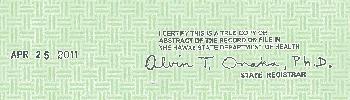
“The term abstract is subject to different meanings, but in a legal sense, it refers to an abbreviated history of an official record.”…USlegal.com
On October 25, 2011, Greta Van Susteren interviewed Donald Trump on his current stance on Obama’s birth certificate after Governor Rick Perry quoted Trump as still being a skeptic.

Van Susteren stated “Well, I actually — I’m convinced it’s the real deal,”
Here is some of the more compelling evidence:

1. Obama has used private attorneys and USDOJ attorneys at taxpayer expense for over 3 years to prevent presenting a legitimate birth certificate and college records.

2. When an image was placed on WhiteHouse.gov in April of 2011, no “chain of record” was authenticated.

3. Here is one a first year law student would question:

It states true copy or abstract.

4. Tim Adams, a election official in Honolulu in 2008 has signed an affidavit, a legal document, stating that there was no birth certificate for Obama in Hawaii in 2008.


5. Retired Major General Paul Vallely, a former Fox contributor, has had the image evaluated by document experts and ex CIA employees. He states emphatically the the image is a forgery.

What law school did Greta attend?

Interview transcript:

“VAN SUSTEREN: Donald, nice to talk to you.

DONALD TRUMP, TRUMP ORGANIZATION (Via Telephone): Hello, Greta.

VAN SUSTEREN: I’ve got a lot — a long list today of questions for
you, a lot of topics. Let me start with…

TRUMP: You always do, Greta. You always do.

VAN SUSTEREN: Well, this time, I wrote them all down.

TRUMP: Well, that’s good.

VAN SUSTEREN: Anyway, Governor Rick Perry said that he had dinner with
you recently and that you do not believe the president’s birth
certificate is real or not. Is the governor correct that you don’t
believe it? I thought that you were satisfied.

TRUMP: No, I’m not a major believer. I mean, I don’t know how it just
miraculously appeared, and we’ll see what happens. But I’m never —
I’ve never been a major believer. All of a sudden, after years and
years, it was produced out of nowhere. Some people have serious,
serious doubts as to its validity.

And I frankly really want to get on to much more important subjects,
although that’s a very important one because if, in fact, it’s not 100
percent, he’s not supposed to be the president of this country, which
is a pretty important fact.

But nevertheless, I want to talk about jobs. I want to talk about the
economy. I want to talk about how China and OPEC and others are
ripping us off. But I’m not a fan.

VAN SUSTEREN: I thought last April that it was finally put to rest with you?

TRUMP: No, no, never to rest. I’m at a point where I say, Look, the
country is going to hell in a handbasket, and something has to be done
about it. And we shouldn’t be talking about the birth certificate. But
people love to talk about it.

For instance, it’s your first question. I guess at a luncheon or in an
interview, Governor Perry had mentioned that I said that I’m not a big
believer, and I’m not. I mean, you know, people look at the hospital.
There are no records that his mother was ever there. There are many
other things that are really suspect.

So you know, out of — after years of Hillary wanting it and McCain
wanting it and everybody wanting it, and I put the big pressure on,
all of a sudden, it appears. And people have real questions about the
validity.

Now, I don’t want to talk about that. I want to talk about jobs. I
want to talk about how to get this country great again. But I’m not a
big fan.

VAN SUSTEREN: All right. Well, I actually — I’m convinced it’s the
real deal, so you know, that…

TRUMP: Well, that’s good. I’m glad you are. That’s OK. And some people
are and some people aren’t. And you know, I’m just not as easily
convinced.”

http://www.foxnews.com/on-air/on-the-record/2011/10/26/obama-birther-debate-not-dead-donald-trump

William Cellini trial closing statements, October 25, 2011, Prosecution closing arguments first, Where is Tony Rezko?

William Cellini trial closing statements, October 25, 2011, Prosecution closing arguments first, Where is Tony Rezko?

“Why was Obama promoting Capri Capital and other investment firms at the same time that Rezko, Levine and Cellini were shaking them down?”…Citizen Wells

“Why did Patrick Fitzgerald and the US Justice Department wait until December 2008 to arrest Rod Blagojevich?”…Citizen Wells

 “Why was Tony Rezko’s sentencing delayed?”…Citizen Wells

From the Chicago Tribune October 25, 2011.

“Courtroom adversaries this morning are poised to deliver closing arguments at the last trial related to the years of federal scrutiny of ousted Gov. Rod Blagojevich.

The prosecution will be first in addressing jurors at the shakedown trial of Springfield power broker and businessman William Cellini.”

“After the defense finishes its closing, prosecutors get the last word to the jury in a rebuttal.

Before jurors withdraw to deliberate, the judge will instruct them on how to assess the three weeks of evidence.

Each side gets three hours for its closing.”

Read more:

http://www.chicagotribune.com/news/local/breaking/chi-closing-arguments-set-in-cellini-trial-20111025,0,4709075.story

Tony Rezko, who was convicted in June 2008 and not yet sentenced, was not called as a witness in the Cellini or Blagojevich trials. Rezko was at the center of Operation Board Games corruption and was a long time associate of Barack Obama.

Where is Tony Rezko?

Obama Rezko problem remains despite Fitzgerald, Holder, USDOJ and media, Blagojevich trial wiretaps, Court documents, Early articles

Obama Rezko problem remains despite Fitzgerald, Holder, USDOJ and media, Blagojevich trial wiretaps, Court documents, Early articles

“Why was Obama promoting Capri Capital and other investment firms at the same time that Rezko, Levine and Cellini were shaking them down?”…Citizen Wells

“I believe I’m more pristine on Rezko than him.”…Rod Blagojevich

“There is enough corruption in Illinois so that all it takes is someone who is serious about finding it to uncover it. If a U.S. attorney is not finding corruption in Illinois, they’re not seriously looking for it.”…Northwestern Law Professor James Lindgren

We are nearing the end of the William Cellini trial. Tony Rezko, Mr. Corruption in Chicago and Illinois, with connections to every player in Operation Board Games who has been indicted or prosecuted and with long time close ties to Barack Obama, has not been sentenced or called as a witness since he was convicted in June 2008. It is clear that Patrick Fitzgerald, Eric Holder and the US Justice Department, along with the mainstream media, have protected Obama.  Still Obama has a Rezko problem. We know this because of early articles written about Obama et al before he became the chosen one. We also learn much from the legal documents, wiretaps and trials of Rezko, Blagojevich and Cellini.

Patrick Fitzgerald, Eric Holder and Obama must be investigated and prosecuted. Regardless of how this plays out,

Obama has a Rezko problem.

Obama role in corrupting IL Teacher Retirement System pensions, Cellini trial, 2007 NY Times article, Where is Tony Rezko?, Where is House Judiciary Committee?

Obama role in corrupting IL Teacher Retirement System pensions, Cellini trial, 2007 NY Times article, Where is Tony Rezko?, Where is House Judiciary Committee?

“Why was Obama promoting Capri Capital and other investment firms at the same time that Rezko, Levine and Cellini were shaking them down?”…Citizen Wells

“There is enough corruption in Illinois so that all it takes is someone who is serious about finding it to uncover it. If a U.S. attorney is not finding corruption in Illinois, they’re not seriously looking for it.”…Northwestern Law Professor James Lindgren

Before I delve deeper into Obama’s connections to the corrupting of the Illinois Teacher Retirement System pensions, I present an article from the NY Times dated October 1, 2007. This article came out before the Tony Rezko trial and at the beginning of Obama’s campaign for the presidency. Apparently the NY Times staff had not done their homework and connected the dots. If they had read the Joseph Cari, Steven Loren indictment press release from August 3, 2005 they probably would not have allowed Obama’s ties to the IL Teacher Restirement System pension, investment companies and people like John Rogers to come to light.

Perhaps this is the reason that the William Cellini indictment was separated from the Blagojevich indictment and the trial delayed until late 2011.

From the NY Times, October 1, 2007, presented in entirety.

“In 2000, after losing a Congressional race, Barack Obama was looking to revive his political fortunes. And he soon found a springboard — a group of black entrepreneurs also trying to break out.

Month after month, Mr. Obama, then an Illinois state senator, showed up at the Chicago group’s meetings, listening to members’ concerns about the difficulties they faced in getting government and corporate business, and asking them what he could do to help.

And help them he did. Members of the group, the Alliance of Business Leaders and Entrepreneurs, say Mr. Obama checked into their problems and helped start a drive that enabled minority investment executives to win millions of dollars in business from the state’s giant pension funds.

If Mr. Obama was able to deliver by helping the executives overcome some of the historical barriers facing minority-owned companies, he also would subsequently benefit from his ties to the group. Several of the businessmen or their wives would help clear the debts from his Congressional race, and six of the group’s members are now among the top fund-raisers for his presidential campaign, according to campaign finance records.

All told, employees at more than 30 of the 42 companies listed on the group’s Web site and their relatives donated more than $300,000 to help Mr. Obama win his seat in the United States Senate in 2004 and set fund-raising records early in the 2008 presidential race.

In his presidential campaign, Mr. Obama has been running on a platform of reducing the influence of money in politics. But with Mr. Obama, as with every politician, money has been the blood flow of his campaigns. And at a critical point in his career, he greatly expanded an early pillar of his fund-raising network while trying to help the black entrepreneurs secure work with the state.

The senator’s courtship of the Chicago group and its members is a little-known chapter in his political development that shows the inextricable link between money and politics and the different interpretations people attach to it.

Jay Stewart, executive director of an Illinois watchdog group known as the Better Government Association, said that in helping these and other executives as a state senator, Mr. Obama also benefited from the kind of special-interest-driven politics he now decries.

“Raising large chunks from special interests was common in Illinois,” Mr. Stewart said. “Obama did that too. Now he’s talking about chasing away special interests; that’s great. But that doesn’t change the past.”

Mr. Obama says his involvement with the alliance reflects his longtime passion for ensuring that minority businesses are treated fairly, and there is no indication that he helped the businessmen simply to secure their donations.

“The suggestion that these pioneering leaders would need my help or anyone’s help in order to succeed is troubling, to say the least,” Mr. Obama said in a statement. “I’m proud that I’ve spent my career fighting to ensure that minority-owned businesses would have a chance to compete, and I will continue to do so as president.”

Mr. Obama also recently pointed to his work on the Illinois pension issue as a model for what he would do as president to promote minority-owned companies.

In that push, Mr. Obama met with three state pension boards and introduced a bill on the executives’ behalf. He also worked closely with the state’s top legislative leaders to encourage the pension funds to increase the share of their investment portfolios managed by minority-owned firms. That share has risen to 12 to 20 percent now from 1 to 3 percent in 2000.

Other alliance members said Mr. Obama also looked into whether they could get state business in other areas, including legal work on bond issues and the printing of official notices. As Stephen H. Pugh, a lawyer who belongs to the group, said, “He wanted to understand what our needs were and how government could help.”

Mr. Obama, Mr. Pugh said, “would be our representative — our advocate — to bring our views back to state government.”

The alliance was founded in 1992 to help Chicago’s top black executives and entrepreneurs share business tips and push for greater opportunities. According to the group’s Web site, the companies — which also include architecture, engineering, transportation and communications firms — average 65 full-time employees and annual revenues of $19 million.

The goal was always “to open up doors,” said John W. Rogers Jr., the chief executive of Ariel Capital Management, one of the investment firms that received state business. “It was, as the Rev. Jesse Jackson has eloquently put it, to force other industries to have their ‘Jackie Robinson’ moment.”

During its early years, the group’s main political patron was State Senator Emil Jones Jr., who later became the State Senate president and one of Mr. Obama’s chief mentors. In 1993, Mr. Jones took the first crack at opening up the pension business, persuading the Legislature to pass a bill encouraging the multibillion-dollar funds to use minority-owned firms “to the greatest extent feasible.”

But by the time Mr. Obama, then a junior state senator, began meeting regularly with the group in 2000, little progress had been made. As a result, said Hermene Hartman, the alliance president, the pension issues got “a lot of attention” in the discussions with Mr. Obama.

The investment firms were also among the largest and most prominent companies in the group, and some of their executives were among Mr. Obama’s closest friends.

Mr. Rogers, who also sits on the boards of the McDonald’s Corporation and other major companies, played basketball at Princeton University with Mr. Obama’s brother-in-law. James Reynolds Jr., the chief executive of Loop Capital, a brokerage firm, had been a top fund-raiser for Mr. Obama’s Congressional race.

Mr. Rogers said the investment managers also solicited support from Michael J. Madigan, the powerful Democratic speaker of the Illinois House. In 2001 and 2002, Mr. Madigan and Mr. Obama — at times joined by the investment executives — made formal pitches before three of the state pension boards.

And after Mr. Jones became the State Senate president in 2003, he assigned Mr. Obama to a committee looking into the pension questions to help raise his political profile.

During this period, campaign finance records show, executives from Ariel, Loop and two other leading Chicago investment firms, Holland Capital Management and Capri Capital, sharply increased their donations to Mr. Obama’s State Senate campaign fund. And once he began his campaign for the United States Senate, they quickly became a fund-raising core that has carried over into the presidential race.

Mr. Rogers, who is one of three people at his company who have each bundled at least $50,000 in donations for Mr. Obama’s presidential campaign, said that his financial support for the senator had “no connection” to his company’s efforts to win state contracts, but that it reflected the broader excitement over what Mr. Obama’s success meant for blacks in America.

Pointing to his parents’ struggles to break into the legal business in Chicago, Mr. Rogers said that pushing for greater opportunities was “in your blood, and when you have a peer come along like Barack, who is your own age and lives in your neighborhood, you can’t wait to help him.”

Mr. Reynolds of Loop Capital, who is also one of the bundlers in Mr. Obama’s presidential campaign, did not return calls for comment.

In the end, Mr. Obama dropped off the State Senate committee in late 2003 as his United States Senate race heated up, and just as the panel began a series of hearings that produced the most substantial changes.

Still, William Atwood, the director of the Illinois State Board of Investment, said Mr. Obama regularly asked about minority participation in the pension funds when their paths crossed. “He would ask: ‘How are we doing? Are we making progress?’” Mr. Atwood recalled.

The changes have generated several million dollars in fees for some of the investment firms, although the complete totals could not be obtained. Loop Capital, for instance, saw its brokerage fees related to one of the pension funds shoot up to $2.4 million last year from just $5,700 in 2001. All told, Loop Capital received $5 million in fees from managers for that fund over those six years.

Still, things have not worked out as well for some of the investment managers. Both Ariel and Holland were given several hundred million dollars to invest.

But one of the funds dropped Ariel and two dropped Holland last year after their investment returns lagged behind those of other firms.

Mr. Rogers, the Ariel chief executive, said his firm’s value-oriented stocks tended to lag in fast-rising markets, and other state funds say they are sticking with Ariel for now because it has produced impressive long-term returns. Officials at Holland declined to comment.

But Mr. Rogers also complained that the Illinois funds, which are free to hire minority managers from anywhere in the country, have given much of their business to out-of-state firms owned by women and Asian-Americans.

And while Mr. Obama recently told the Urban League that if he was elected president he would use the same model in helping black-owned businesses nationwide as he did on the pension issue, Mr. Rogers said, “Actually, it is a model of how hard it is to get sustained traction.””

http://www.nytimes.com/2007/10/01/us/politics/01obama.html?pagewanted=print

The article appears to be lauding Obama’s role in helping minority firms. However, indictments in Operation  Board Games and court testimony paint a different picture. One that strongly impacted Illinois teachers and taxpayers.

From the LA Times April 7, 2008.

In 2002, the year after Obama made the pitch, the Illinois Teacher Retirement System reported an 18% increase in assets managed by minority-owned firms. Ariel’s share grew to $442 million by 2005.

In 2006, after the federal investigation became public, the teacher pension board severed its relationship with Ariel, concluding that Ariel’s investment returns were insufficient.

http://latimesblogs.latimes.com/washington/2008/04/obamarezko.html

From Natasha Korecki of the Chicago SunTimes tweets from the William Cellini trial courtroom, October 21, 2011.

“Defense now has first witness on the stand, a TRS attorney who is talking real estate investments, like Cellini’s firm.”

“Cellini’s Commonwealth, used by TRS, had a 20 percent rate of return in 2003 vs Capri Capital (Rosenberg) at 7.35 %”

http://twitter.com/#!/natashakorecki

 Obama is doing to the nation what he did to Illinois teachers for many years.

Where is Tony Rezko?

Where is the House Judiciary Committee?

Howard Coble, et al, are you paying attention?

William Cellini may testify, Cellini attorney Dan Webb informed Judge James Zagel, Stuart Levine not reliable, Where is Tony Rezko?

William Cellini may testify, Cellini attorney Dan Webb informed Judge James Zagel, Stuart Levine not reliable, Where is Tony Rezko?

“Rezko has also stated in interviews with the government that he believed he transmitted a quid pro quo offer from a lobbyist to the public official, whereby the lobbyist would hold a fundraiser for the official in exchange for favorable official action”

“The defense has a good faith belief that this public official is Barack Obama.”…Blagojevich defense subpoena of Barack Obama

“There is enough corruption in Illinois so that all it takes is someone who is serious about finding it to uncover it. If a U.S. attorney is not finding corruption in Illinois, they’re not seriously looking for it.”…Northwestern Law Professor James Lindgren

From the Chicago Tribune October 21, 2011.

“Cellini weighing whether to testify in own defense”

“Lawyers for William Cellini told the judge presiding over his federal trial today that the Springfield power broker wants to testify on his own behalf, but no decision has been made about whether he will indeed take the witness stand.
Cellini’s attorney, Dan Webb, told U.S. District Judge James Zagel outside the presence of the jury that the defense team is waiting until the end of Friday to decide whether Cellini will take the stand.

“It’s a major issue for my client to decide,” Webb said. “Right now my client wants to see how this goes.”

In the meantime, Webb is planning to call witnesses to testify about Cellini’s business dealings with the state teacher pension board.

While testimony today has yet to start, Webb, a former U.S. attorney and veteran criminal-defense lawyer, is arguing to Zagel that some counts against Cellini should be thrown out, calling the government’s star witness the least reliable he’s ever seen.

“He is the single-most non credible witness I have seen in a courtroom,” Webb said outside the presence of the jury.

Webb’s remarks were targeted at Stuart Levine, who prosecutors say conspired with Cellini on the extortion.

Levine has a long history of financial scams and kickbacks schemes as well as three decades of heavy drug abuse.

Cellini’s relationship with that board forms the background of the charges against him.

Prosecutors have charged that Cellini agreed in 2004 to help extort a campaign contribution for then-Gov. Rod Blagojevich from a Hollywood producer whose investment firm had major business with the state teacher pension board.

Cellini, 76, agreed to the plot, the government asserts, to protect his influence and access to the teacher pension board.

Cellini is accused of conspiring with Leveine, another longtime political insider, as well as two top advisers to then Gov. Rod Blagojevich, Antoin “Tony” Rezko and Christopher Kelly, to hold up an investment deal by Hollywood producer and money manager Thomas Rosenberg with the Teachers Retirement System until Rosenberg came up with a $1.5 million contribution to Blagojevich.

On Thursday, Rosenberg concluded his testimony, describing how he turned to old friend Cellini when Rosenberg’s deal suddenly stalled in Springfield seven years ago. Cellini, whom Rosenberg had known for years and who also did a lot of business at the pension board, could figure out what was happening, Rosenberg figured.

But Cellini’s answer left Rosenberg furious, he testified at Cellini’s federal trial.

Rezko and Kelly had put a brick on the pension deal, and the only way to get it moving again was to make a contribution to Blagojevich, he said he learned from Cellini.

“I screamed and cursed,” Rosenberg responded in a low, even voice when asked how he reacted to the news. “I wanted him to pass on the full level of my fury.”

Cellini is alleged to have agreed to assist in the plot to protect his influence at the Teachers Retirement System, or TRS, where his own investment company had also made millions of dollars.

Rosenberg, 64, who was born in Chicago but relocated to California to produce movies, was relaxed and confident on the witness stand Thursday. At times, he drew smiles or laughs from jurors and spectators during a cross-examination by Cellini’s attorney, Terence Gillespie.

Under questioning by prosecutors, Rosenberg said that Cellini made it clear to him in May 2004 that he needed to contribute to Blagojevich or that the TRS deal with his company, Capri Capital, would not be approved.

Cellini told Rosenberg that Rezko and Kelly were aware of how much money Capri had already managed for TRS and that they were angry that “we had done virtually nothing for Blagojevich,” Rosenberg testified.

Capri’s $220-million deal had already been stalled, Rosenberg explained to jurors.

“I didn’t look at it as a threat,” Rosenberg said of Cellini’s remarks to him. “I looked at it as a fait accompli.”

Rosenberg didn’t blink, instead telling Cellini to relay to Rezko and Kelly that he would sooner go to Blagojevich about their strong-arm tactics than make a campaign contribution, he testified.

He also warned Cellini that Rezko and Kelly were going to get them in trouble with law enforcement.

“If there is not a grand jury already investigating these two, there will be,” Rosenberg said he told Cellini. “These two were so outrageous, so crazy, so wild, so brazen it was just a matter of time.”

Assistant U.S. Attorney Christopher Niewoehner then asked Rosenberg how Cellini reacted to his ire.

“He was nervous,” Rosenberg quickly responded over the objection of Cellini’s attorney but then was allowed to continue. “I interpreted his voice as nervous.”

Cellini then told him that he “had to deal with these guys” because he was a lobbyist, Rosenberg said.”

Read more:

http://www.chicagotribune.com/news/local/breaking/chi-cellini-to-start-to-put-on-his-defense-20111021,0,4500919.story

Where is Tony Rezko?