Category Archives: Employment

State employment rates lower in 2014 than 2007, Pew Charitable Trust Aug 19, 2014, Employment rates for 25 to 54 year olds lower, 3.7 percent drop, Safety net programs strained

State employment rates lower in 2014 than 2007, Pew Charitable Trust Aug 19, 2014, Employment rates for 25 to 54 year olds lower, 3.7 percent drop, Safety net programs strained

“11.4%: What the U.S. unemployment rate would be if labor force participation were back to January 2008 levels.” …James Pethokoukis, American Enterprise Institute, June 2013

“For now, the absence of young adults from the housing market continues to put a dent in the homeownership rate, which dropped to 64.8% in the first quarter, compared with 65.2% in the fourth quarter of 2013, according to U.S. Census statistics. The rate was as high as 69.2% in the fourth quarter of 2004. For those younger than 35, the rate has fallen noticeably faster. It slipped to 36.2% in the first quarter, from 36.8% in the fourth. The homeownership rate for this group was as high as 43.6% in the second quarter of 2004.”…Market Watch May 12, 2014

“Freedom is the freedom to say that two plus two make four. If that is granted, all else follows.”…George Orwell, “1984″


From the  Pew Charitable Trust August 19, 2014.

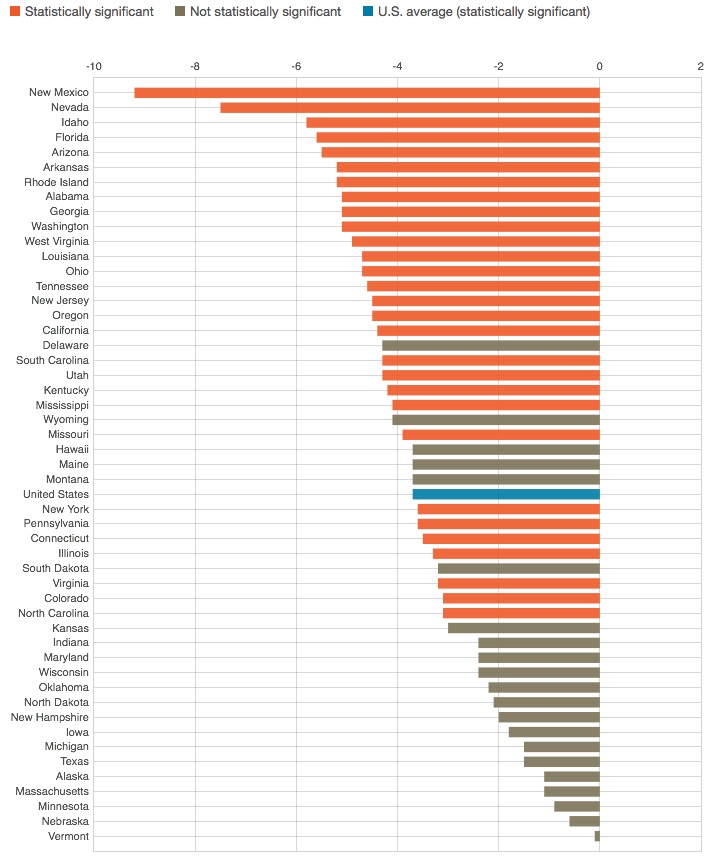
“Percentage-point Change in Employment Rate, CY 2007 to FY 2014”

StateEmployment

“In 2007, leading up to the Great Recession, 79.9 percent of people ages 25 to 54 in the United States had a job. In the 12 months ending June 2014, five years after the recession ended, only 76.2 percent of people in that age group were working.

The latest rates show a slight improvement from fiscal 2013, when 75.9 percent of people in their prime working years had a job nationally. At that time, employment rates were below prerecession levels in 35 states.

Still, at 3.7 percentage points lower than before the recession, the employment to population ratio for prime-age workers shows that the U.S. labor market remains weak. This finding has significant budgetary consequences for states:

Without paychecks, people pay less income tax and tend to buy less, reducing sales and business income tax revenue.
Unemployed people frequently need more services, such as Medicaid and other safety-net programs, increasing costs at a time when state governments may have less tax revenue.
A state-by-state comparison of calendar year 2007 with fiscal 2014 shows:

No state reported employment rate gains for 25- to 54-year-olds.
29 states had statistically significant decreases.
The largest decline in the employment rate was in New Mexico, where 69.9 percent of prime-age workers had jobs in fiscal 2014 — 9.2 percentage points lower than in 2007.
Among the least affected were Vermont and Nebraska, which recorded the smallest observed changes in their current employment rates of 83.3 and 85.2 percent, respectively.
Although unemployment figures receive more media attention, the employment rate is a preferred index for many economists because it provides a sharper picture of changes in the labor market. The unemployment rate, for example, fails to count workers who stopped looking for a job. By focusing on 25- to 54-year-olds, trends are less distorted by demographic effects such as older and younger workers’ choices regarding retirement or full-time education.”

Read more:

http://www.pewtrusts.org/en/multimedia/data-visualizations/2014/fiscal-50#ind3


Thanks to commenter bob strauss.


NC unemployment rate up to 6.5 percent and labor force drops .3, Labor force participation rate plummets 4.1 percent since Jan 2009, How are dropouts paying bills?

NC unemployment rate up to 6.5 percent and labor force drops .3, Labor force participation rate plummets 4.1 percent since Jan 2009, How are dropouts paying bills?

“11.4%: What the U.S. unemployment rate would be if labor force participation were back to January 2008 levels.” …James Pethokoukis, American Enterprise Institute, June 2013


“Nearly half of U.S. companies are reluctant to hire full-time employees because of the ACA. One in five firms indicates they are likely to hire fewer employees, and another one in 10 may lay off current employees in response to the law.

Other firms will shift toward part-time workers. More than 40 percent of CFOs say their companies will consider switching some jobs to less than 30 hours per week or targeting part-time workers for future employment.”…Duke University Fuqua School of Business December 11, 2013


“Freedom is the freedom to say that two plus two make four. If that is granted, all else follows.”…George Orwell, “1984″


I rarely watch News 2 News out of Greensboro, NC. Yesterday, at a family member’s house I heard Julie Luck of News 2 describe the recent news about the NC unemployment rate for July. I was reminded of the Valley Girl speak of years ago.

The News Record did a little better.

“North Carolina’s unemployment rate inched higher for July as the state’s labor force declined by nearly 15,000 over the course of a month, state officials said Monday.

The jobless rate increased by 0.1 percentage points to 6.5 percent in July after being flat for two months, according to a report by the Commerce Department. North Carolina’s unemployment rate was higher than the national rate of 6.2 percent.”
“”The number of employed decreased almost 20,000, when it’s seasonally adjusted, which is quite a bit,” said Kurt, an associate professor of economics at Elon University.

Still, Kurt noted the numbers look better than they did a year ago when the unemployment rate was 1.6 percentage points higher. Total private sector jobs have grown by about 94,000 since July 2013.

“When you compare it year to year, it’s not a bad report,” he said. “Overall, the last year has been good for North Carolina.””

Read more:

http://www.news-record.com/news/n-c-jobless-rate-inches-up-to-percent-for-july/article_16f57002-26fc-11e4-a89d-001a4bcf6878.html

From above:

“Overall, the last year has been good for North Carolina.”

Really?

The labor force participation dropped 1 percent in the past year.

It dropped .3 percent the past month.

The labor force participation rate in NC plummeted 4.1 percent since January 2009.

Home ownership hits lowest level since 1965, Morgan Stanley analysts ownership rate lower than Census Bureau statistics, Nation of renters, Obama core supporters millenials hit hardest with unemployment student loans and housing options

Home ownership hits lowest level since 1965, Morgan Stanley analysts ownership rate lower than Census Bureau statistics, Nation of renters, Obama core supporters millenials hit hardest with unemployment student loans and housing options

“For now, the absence of young adults from the housing market continues to put a dent in the homeownership rate, which dropped to 64.8% in the first quarter, compared with 65.2% in the fourth quarter of 2013, according to U.S. Census statistics. The rate was as high as 69.2% in the fourth quarter of 2004. For those younger than 35, the rate has fallen noticeably faster. It slipped to 36.2% in the first quarter, from 36.8% in the fourth. The homeownership rate for this group was as high as 43.6% in the second quarter of 2004.”…Market Watch May 12, 2014

“Nearly half of U.S. companies are reluctant to hire full-time employees because of the ACA. One in five firms indicates they are likely to hire fewer employees, and another one in 10 may lay off current employees in response to the law.

Other firms will shift toward part-time workers. More than 40 percent of CFOs say their companies will consider switching some jobs to less than 30 hours per week or targeting part-time workers for future employment.”…Duke University Fuqua School of Business December 11, 2013

“Freedom is the freedom to say that two plus two make four. If that is granted, all else follows.”…George Orwell, “1984″


Well, we told you so.

Once again one of Obama’s core support groups is getting clobbered by EconObama.

From CNN Money August 5, 2014.
“Home ownership hits lowest level since 1965”

“As the foreclosure crisis continues to wreak havoc on the housing market, a source of national pride has taken a sour turn. Home ownership is on the decline and, according to a recent Morgan Stanley report, the United States is fast becoming a nation of renters.

Last Friday, the Census Bureau reported that the percentage of people who owned a home had dropped to 65.9% during the second quarter — its lowest level since the first quarter of 1998 and a far cry from the high of 69.2% reached in late 2004.

Yet, in a research paper issued a week earlier, Morgan Stanley (MS, Fortune 500) analysts Oliver Chang, Vishwanath Tirupattur and James Egan argued that the home ownership rate is even lower than the Census Bureau statistics say.

In fact, once they factored in delinquent mortgage borrowers (the ones who are likely to lose their homes at some point), Morgan Stanley calculated that the home ownership rate is more like 59.2%.

That’s the lowest level since the Census Bureau started keeping quarterly records back in 1965 (before that, it recorded home ownership rates once a decade). The Census Bureau’s statistics, however, do not factor in mortgage delinquencies.”

“The dip in home ownership has done more than just line the pockets of landlords. It has also created a base of Americans with no home to rely on in times of financial need. Millions of owners can tap into their home’s equity in times of financial stress or to pay for cars, college tuition or other major expenses.

Are you on track for retirement?

Paying for a home is also a type of “forced savings,” said David Crowe, chief economist for the National Association of Home Builders. He explained that, after interest, mortgage payments go toward paying down the loan balance — and for homeowners who end up in the right type of loan the ending balance can be significant.
There are also less tangible benefits to home ownership. An increase in home ownership overall tends to improve community stability, according to “The Social Benefits of Homeownership and Stable Housing,” a report released last year by the National Association of Realtors (NAR).

In the paper, NAR cited several academic studies that found that children of homeowners have greater academic achievement than children of renters, that homeowners vote more and volunteer their participation in more community events than renters and that communities are better maintained and safer in neighborhoods with high ownership rates.”

Read more:

http://money.cnn.com/2011/08/05/real_estate/home_ownership/

From Citizen Wells May 13, 2014.

Citizen Wells recently presented the impact on blacks of the Obama economy.

Another demographic that supported Obama, young people, has also been devastated by the Obama economy and the subsequent impact on the housing market has affected everyone.

From Market Watch May 13, 2014.

“There was an 8% drop in existing home sales in Greensboro-High Point, N.C., after a 2% rise in the fourth quarter, RealtyTrac found. “There’s still a lot of uncertainty about the economy,” says Tommy Camp, president and CEO of Berkshire Hathaway HomeServices Yost & Little Realty. “Some buyers say, ‘We’ve got a job, but we don’t know how secure that is.’” A slowdown in household formation has also had a negative impact on the housing market, he says; 18- to 34-year-olds account for more than half of missing households — that is, Americans who would be owning or renting a home now if prerecession economic trends had continued.”

Read more:

http://www.marketwatch.com/story/7-places-where-property-prices-are-falling-2014-05-13?dist=beforebell

From Market Watch May 12, 2014.

“For now, the absence of young adults from the housing market continues to put a dent in the homeownership rate, which dropped to 64.8% in the first quarter, compared with 65.2% in the fourth quarter of 2013, according to U.S. Census statistics. The rate was as high as 69.2% in the fourth quarter of 2004. For those younger than 35, the rate has fallen noticeably faster. It slipped to 36.2% in the first quarter, from 36.8% in the fourth. The homeownership rate for this group was as high as 43.6% in the second quarter of 2004.

“The [25 to 35] age cohort…probably has had the hardest time recovering from the Great Recession,” said Rick Sharga, executive vice president of Auction.com, an online real estate marketplace. “For the time being, we’re likely to see a higher percentage of households formed being rental households,” and overall homeownership rates are likely to continue to drop somewhat—perhaps even down to 62%—before bottoming out and climbing back up, he added.

While some industry watchers have suggested a shift in attitudes away from Homeownership, Sharga and others say it’s too soon to know whether people truly have a waning interest in owning homes. But one thing’s for sure: Young people have plenty of hurdles to becoming homeowners.”
“The unemployment rate for 18-to-29-year-olds was 9.1% in April, which rises to 15.5% if you include those who have given up looking for work, according to Generation Opportunity, a national, nonpartisan youth advocacy organization. The unemployment rate was 6.3% in April for all ages.

Forget that without a job it’s just about impossible to get a mortgage. (It’s also hard to rent: Twenty-nine percent of adults younger than 35 live with their parents, according to Gallup poll results released earlier this year.) A slow start to earnings also means a slow start to saving.

“The majority of younger renters report having insufficient assets to cover a 5% down payment plus closing costs on a typical starter home,” Shahdad wrote.”

“In 2012, 1.3 million students who graduated from four-year colleges (or 71%) had student loan debt, up from 1.1 million in 2008 and 900,000 in 2004, according to the Institute for College Access & Success, a nonprofit independent research and policy organization. Graduating seniors with student loans had average debt levels of $29,400 in 2012, up 25% from $23,450 in 2008.

And new mortgage regulations, set into motion by the Dodd-Frank Act, require that borrowers have no more than a 43% debt-to-income ratio (with debt encompassing monthly housing costs and debt payments, including those on student loans). That ceiling may also restrict first-time buyers, some say.”

https://citizenwells.wordpress.com/2014/05/13/obama-economy-devastates-young-and-housing-markets-under-35-home-ownership-plummets-from-43-6-percent-to-36-2-unemployment-rate-9-1-to-15-5-percent-for-18-to-29-year-olds-student-loan-debt/


NC lost thousands of jobs in June, Labor force participation rate plummeted 3.8 percent since Obama took White House in January 2009, Reduced unemployment benefits and labor force dropouts lower unemployment rate

NC lost thousands of jobs in June, Labor force participation rate plummeted 3.8 percent since Obama took White House in January 2009, Reduced unemployment benefits and labor force dropouts lower unemployment rate

“Nearly half of U.S. companies are reluctant to hire full-time employees because of the ACA. One in five firms indicates they are likely to hire fewer employees, and another one in 10 may lay off current employees in response to the law.

Other firms will shift toward part-time workers. More than 40 percent of CFOs say their companies will consider switching some jobs to less than 30 hours per week or targeting part-time workers for future employment.”…Duke University Fuqua School of Business December 11, 2013

“Over the last six months, of the net job creation, 97 percent of that is part-time work,”…Keith Hall, former BLS chief

“11.4%: What the U.S. unemployment rate would be if labor force participation were back to January 2008 levels.” …James Pethokoukis, American Enterprise Institute, June 2013


NC lost thousands of jobs in June.

The big story is that the NC labor force participation rate plummeted 3.8 percent since Obama took the White House in January 2009.

From Triangle Business Journal July 18, 2014.

“N.C. economy sheds thousands of jobs in June”

“North Carolina lost more than 8,500 jobs in June, wiping out job gains experienced since March. The net job loss was attributable largely to job losses in the government sector.

The unemployment rate of 6.4 percent was unchanged from May to June, though that has to do with how the rate is artificially measured. A more accurate depiction of the jobs picture is to look at total jobs.”
“The state measures unemployment in two ways, one through a survey of households, which is where the official unemployment rate comes from, and one from a survey of employers, typically referred to as “nonfarm employment.” This nonfarm measure excludes workers in general government, teachers, private households, nonprofit organizations and individual or corporate farms, a measure that makes up roughly 77 percent of the total gross domestic product, according to the Bureau of Labor Statistics.

By that measure, the state lost an estimated 5,800 jobs from May to June, though it still had 74,800 more jobs than in June of last year.
Going by the household survey reflects a job loss of 8,577, but an unchanged unemployment rate of 6.4 percent. Since last year, the rate had been steadily declining, but looking at only the rate gives a false overall jobs picture. One of the major policies implemented by the state government was to reduce the length of time that individuals receive unemployment benefits after being laid off. This policy has had the effect of artificially reducing the unemployment rate.
By reducing benefits, the household unemployment survey technically tallies fewer people in the labor force, even if those people haven’t actually found jobs or stopped looking for work. Reducing the officially counted labor force number, even if that number is reduced artificially because of reduced unemployment benefits, will drive the unemployment rate down – artificially in North Carolina.”

Read more:

http://www.bizjournals.com/triangle/news/2014/07/18/nc-economy-sheds-thousands-of-jobs-in-june.html?page=all


Gallup poll reveals high inflation and struggling economy, July 13, 2014, Almost 60 percent paying more for groceries gasoline, 42 percent paying more for healthcare

Gallup poll reveals high inflation and struggling economy, July 13, 2014, Almost 60 percent paying more for groceries gasoline, 42 percent paying more for healthcare

“If you’ve got health insurance we’re going to work with you to lower your premiums by $2,500 per family per year.”…Barack Obama

“We can’t drive our SUVs and eat as much as we want and keep our homes on 72 degrees at all times… and then just expect that other countries are going to say OK”…Barack Obama


“Freedom is the freedom to say that two plus two make four. If that is granted, all else follows.”George Orwell, “1984″


I am certain you have been reading the horse poop about the improving economy, lower unemployment rate and low inflation.

I am also certain that informed readers and certainly frequenters of Citizen Wells have dismissed the Orwellian brainwashiong attempts.

Here is more evidence of what you already know and have experienced.

From Gallup July 11, 2014.

“Consumers Spending More, Just Not on Things They Want
Groceries, gasoline top list; leisure, travel, dining out at bottom”

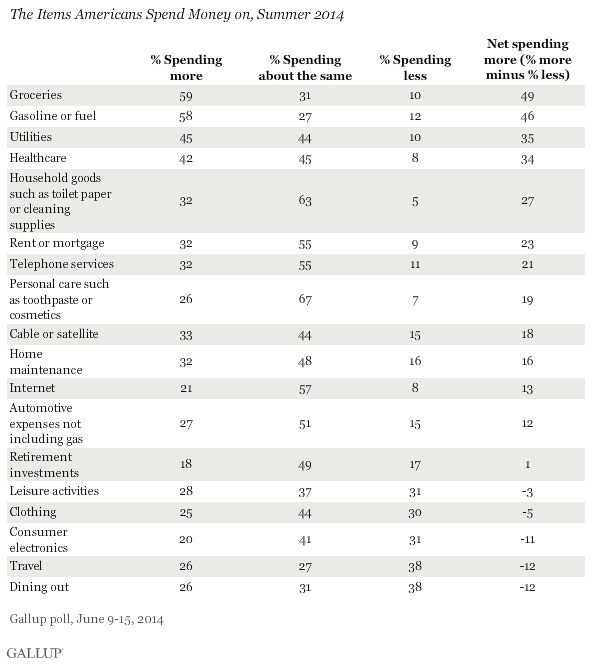
“Slightly less than half of all Americans (45%) report spending more than they did a year ago, while 18% report spending less. A closer look at these numbers reveals Americans’ increased spending is on household essentials, such as groceries, gasoline, utilities, and healthcare, rather than on discretionary purchases.

The Items Americans Spend Money on, Summer 2014

At the other end of the spectrum, roughly one-third of Americans report spending less on discretionary items such as travel (38%), dining out (38%), leisure activities (31%), consumer electronics (31%), and clothing (30%). More than half of Americans say they are spending about the same for rent or mortgage, household goods, telephone, automobile expenses other than fuel, personal care products, and the Internet.

All of this suggests that the increasing cost of essential items is further constraining family budgets already hit hard by the Great Recession and still reeling from a stagnant economy. This is the first time Gallup has measured household spending in this way, so it is unclear whether the current patterns are typical, or if the results on discretionary spending are better now than during the recession. Gallup’s daily measure of consumer spending has been significantly higher the last two years than in 2009 through 2011 — although this could be partly the result of higher spending on essentials.”

“These results paint a picture of consumers straining against rising prices on daily essentials to afford summer travel, dining out, and discretionary household purchases — the kinds of purchases that ordinarily keep an economy humming. And while the two-thirds of Americans who plan to travel this summer is the highest level Gallup has measured since 2006, nearly one-third plan to spend just one night or less away from home, meaning it is not much of a vacation.

Those who do intend to travel this summer expect to spend more in all travel categories — transportation, food, lodging, and entertainment — than last year, further pressuring their already-strained budgets. Most will take their own cars despite relatively high gas prices. If there was any doubt that the U.S. economy is still struggling to get back on its feet, the results of this poll reinforce that reality. Because consumer spending is the lifeblood of a healthy economy, these findings suggest that discretionary spending still has a ways to go before it will fuel the kind of economic growth Americans have been hoping for.”

GallupSpending2014

Read more:

http://www.gallup.com/poll/172532/consumers-spending-not-things.aspx


Walmart CEO questions US employment, People dropping out of the work force and lower disposable income, Bellwether Walmart sales and traffic sluggish, Part time jobs and labor force participation rate

Walmart CEO questions US employment, People dropping out of the work force and lower disposable income, Bellwether Walmart sales and traffic sluggish, Part time jobs and labor force participation rate

“11.4%: What the U.S. unemployment rate would be if labor force participation were back to January 2008 levels.” …James Pethokoukis, American Enterprise Institute, June 2013

“Approximately 1 million more people could only find part time employment since Obama took office in January 2009.”…Citizen Wells August 2013

“Freedom is the freedom to say that two plus two make four. If that is granted, all else follows.”…George Orwell, “1984″


Citizen Wells has warned for years of the plummeting labor force participation rate and part time jobs replacing full time jobs.

Evidence of the impact of reduced full time employment comes from Walmart.

From Zero Hedge July 8, 2014.

“When the CEO of the world’s biggest company doubts the veracity of US economic data, you know you have a problem. After quarters of disappointing growth in the face of miraculous equity market performance; Wal-Mart CEO Bill Simon warns that shoppers aren’t returning at the pace one might expect years after the recession peaked, despite mainstream media interpretation of the data showing unequivocal growth. Simply put, he exclaims, “the unemployment numbers particularly have been difficult to read with the number of people dropping out of the work force,” adding that if we see a further drop in the participation rate it would fit with the fact that “middle-class and lower-class are still economically challenged, only spending during holidays and for family occasions,” adding that traction has only come at the top-end.”
“CNBC “Is that the problem with sales, your consumers don’t have as much disposable income to spend?”

Wal-Mart CEO: “Yes – Retail in general has not been robust in the last six years, in the last year particularly.””

“This is not a tin-foil-hat-wearing blogger or ranting Chicagoan (or former GE chairman) – this is the current CEO of the world’s largest revenue-producing firm casting doubt on the reality of the jobs picture the government is painting and furthermore confirming things are anything but back to normal…”

Read more:

http://www.zerohedge.com/news/2014-07-08/what-rosy-job-numbers-wal-mart-ceo-slams-recovery-mirage


Part time job crisis, Employment rate and economy distorted, Election year protection of Obama and Democrats, Record part time jobs count as full time in stats, Financial markets and economy worlds apart

Part time job crisis, Employment rate and economy distorted, Election year protection of Obama and Democrats, Record part time jobs count as full time in stats, Financial markets and economy worlds apart


“11.4%: What the U.S. unemployment rate would be if labor force participation were back to January 2008 levels.” …James Pethokoukis, American Enterprise Institute, June 2013

“Approximately 1 million more people could only find part time employment since Obama took office in January 2009.”…Citizen Wells August 2013

“Freedom is the freedom to say that two plus two make four. If that is granted, all else follows.”…George Orwell, “1984″


Thursday, July 3, 2014 was another day of Orwellian employment data reporting, straight out of “1984.”

The US Labor Dept. reported 288,000 new jobs in June.

The media and financial markets went wild.

From “1984” by George Orwell.

“But actually, he thought as he re-adjusted the Ministry of Plenty’s figures, it was not even forgery. It was merely the substitution of one piece of nonsense for another. Most of the material that you were dealing with had no connexion with anything in the real world, not even the kind of connexion that is contained in a direct lie. Statistics were just as much a fantasy in their original version as in their rectified version. A great deal of the time you were expected to make them up out of your head. For example, the Ministry of Plenty’s forecast had estimated the output of boots for the quarter at one-hundred-and-forty-five million pairs. The actual output was given as sixty-two millions. Winston, however, in rewriting the forecast, marked the figure down to fifty-seven millions, so as to allow for the usual claim that the quota had been overfulfilled. In any case, sixty-two millions was no nearer the truth than fifty-seven millions, or than one-hundred-and-forty-five millions. Very likely no boots had been produced at all. Likelier still, nobody knew how many had been produced, much less cared. All one knew was that every quarter astronomical numbers of boots were produced on paper, while perhaps half the population of Oceania went barefoot. And so it was with every class of recorded fact, great or small. Everything faded away into a shadow-world in which, finally, even the date of the year had become uncertain.”

We know that for years now many of the jobs that were added were part time jobs. They count as full time jobs in the Labor Dept. stats.

From the Atlanta Journal Constitution August 5, 2013.

“Welcome to the Obamcare economy. From McClatchy:

“The July government employment report released Friday showed the job market treading water.”And a closer look at one of the two measures the Labor Department uses to gauge employment suggests that part-time work accounted for almost all the job growth that’s been reported over the past six months. …” ‘Over the last six months, of the net job creation, 97 percent of that is part-time work,’ said Keith Hall, a senior researcher at George Mason University’s Mercatus Center. ‘That is really remarkable.’”Hall is no ordinary academic. He ran the Bureau of Labor Statistics, the agency that puts out the monthly jobs report, from 2008 to 2012. Over the past six months, he said, the Household Survey shows 963,000 more people reporting that they were employed, and 936,000 of them reported they’re in part-time jobs.” ‘That is a really high number for a six-month period,’ Hall said. ‘I’m not sure that has ever happened over six months before.’ “”
From the Duke University Fuqua School of Business December 11, 2013.

“Nearly half of U.S. companies are reluctant to hire full-time employees because of the ACA. One in five firms indicates they are likely to hire fewer employees, and another one in 10 may lay off current employees in response to the law.

Other firms will shift toward part-time workers. More than 40 percent of CFOs say their companies will consider switching some jobs to less than 30 hours per week or targeting part-time workers for future employment.”
An example from the media.

From Rex Nutting at Mark Watch July 3, 2014.

“The payrolls report is right, and GDP isn’t”

“No, the economy really did not tank in the first half of the year.

You could be excused for thinking it did. After all, gross domestic product plunged at a 2.9% annualized rate in the first three months of the year, according to the government’s Bureau of Economic Analysis.

Which means that, even if GDP rebounds at a 3.2% rate in the second quarter, as expected, the level of real GDP at the end of June would be scarcely higher than it was in December.

Two quarters of essentially no growth sounds a lot like a recession. Should we be worried?

Not at all. Almost certainly we are not in a recession, nor are we heading into one soon. How do we know? Because all of the other economic data we have — and we have a lot of data from a lot of different sources — disagrees with the GDP report.”

“Payrolls are rising at a 1.9% pace so far this year”

Read more:

http://www.marketwatch.com/story/the-economy-surprise-didnt-tank-in-first-half-2014-07-03?pagenumber=1

Hey Rex, how about looking at the GDP and the real payroll numbers.

For example, 111,000 more people in June could only find part time work.

Remember, many people are working multiple part time jobs to make ends meet. Each one of those part time jobs could be counted as a job added.
The same day Market Watch provided the following information with less fanfare.

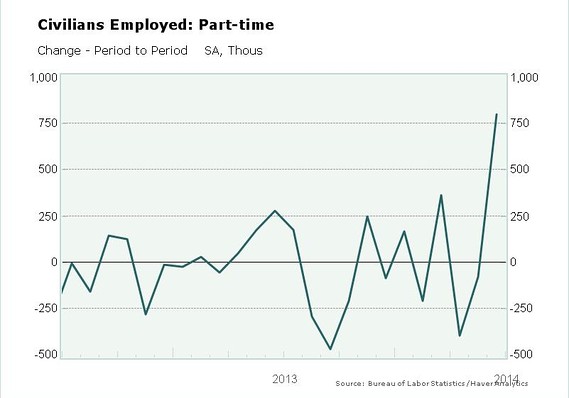
“Part-time work jumps in June by nearly 800,000”

PartTimeJune2014

“One interesting nugget in the June jobs report was the rise in the number of people who worked part-time.

While it’s a number that flops around from month to month — the standard deviation is 287,000 —  it jumped by 799,000, which was the largest one-month gain since January 1994. At the same time, there was a 523,000-person drop in full-time workers, the first decline since October.”

Read more:

http://blogs.marketwatch.com/capitolreport/2014/07/03/part-time-work-jumps-in-june-by-nearly-800000/?link=instory

A voice of reason from Zero Hedge July 4, 2014.
“There is a growing gap between the financial markets and the real economy.

Six years ago, many investors were way out over their skis. Giant financial institutions were brought to their knees…

The survivors pledged to themselves that they would forever be more careful, less greedy, less short-term oriented.

But here we are again, mired in a euphoric environment in which some securities have risen in price beyond all reason, where leverage is returning to rainy markets and asset classes, and where caution seems radical and risk-taking the prudent course. Not surprisingly, lessons learned in 2008 were only learned temporarily. These are the inevitable cycles of greed and fear, of peaks and troughs.

Can we say when it will end? No. Can we say that it will end? Yes. And when it ends and the trend reverses, here is what we can say for sure. Few will be ready. Few will be prepared.”

Read more:

http://www.zerohedge.com/news/2014-07-04/making-investment-decisions-based-fundamentals-no-longer-viable-philosophy

Clearly the financial markets are salivating with enthusiasm when they should be trembling.

We have a part time job crisis.

And don’t forget:

The labor force participation rate is 2.9 percent lower than when Obama took office.

There are 11,591,000 more people not in the labor force now than when Obama took office.

Feeling euphoric?

 

June employment data reveals 111000 more could only find part time work, 288000 jobs added misleading, Employed part time for economic reasons up 275k, Labor force participation rate remains at 62.8 %

June employment data reveals 111000 more could only find part time work, 288000 jobs added misleading, Employed part time for economic reasons up 275k, Labor force participation rate remains at 62.8 %

“11.4%: What the U.S. unemployment rate would be if labor force participation were back to January 2008 levels.” …James Pethokoukis, American Enterprise Institute, June 2013


“Nearly half of U.S. companies are reluctant to hire full-time employees because of the ACA. One in five firms indicates they are likely to hire fewer employees, and another one in 10 may lay off current employees in response to the law.

Other firms will shift toward part-time workers. More than 40 percent of CFOs say their companies will consider switching some jobs to less than 30 hours per week or targeting part-time workers for future employment.”…Duke University Fuqua School of Business December 11, 2013

“Freedom is the freedom to say that two plus two make four. If that is granted, all else follows.”…George Orwell, “1984″


From the US Labor Dept. July 3, 2014.

“Total nonfarm payroll employment increased by 288,000 in June, and the unemployment  rate declined to 6.1 percent, the U.S. Bureau of Labor Statistics reported today.
Job gains were widespread, led by employment growth in professional and business services, retail trade, food services and drinking places, and health care.

Household Survey Data

In June, the unemployment rate declined by 0.2 percentage point to 6.1 percent. The  number of unemployed persons decreased by 325,000 to 9.5 million. Over the year, the unemployment rate and the number of unemployed persons have declined by 1.4 percentage points and 2.3 million, respectively. (See table A-1.)

Among the major worker groups, the unemployment rates for adult women (5.3 percent) and blacks (10.7 percent) declined in June, and the rate increased for teenagers (21.0 percent). The rates for adult men (5.7 percent), whites (5.3 percent), and Hispanics (7.8 percent) showed little change. The jobless rate for Asians was 5.1 percent (not seasonally adjusted), little changed from a year earlier. (See tables A-1, A-2, and A-3.)

The number of long-term unemployed (those jobless for 27 weeks or more) declined by 293,000 in June to 3.1 million; these individuals accounted for 32.8 percent of the unemployed. Over the past 12 months, the number of long-term unemployed has decreased by 1.2 million. (See table A-12.)

In June, the civilian labor force participation rate was 62.8 percent for the third
consecutive month. The employment-population ratio, at 59.0 percent, showed little change over the month but is up by 0.3 percentage point over the year. (See table A-1.)

The number of persons employed part time for economic reasons (sometimes referred to as involuntary part-time workers) increased by 275,000 in June to 7.5 million.
The number of involuntary part-time workers is down over the year but has shown no clear trend in recent months. These individuals were working part time because their hours had been cut back or because they were unable to find a full-time job. (See table A-8.).”

http://www.bls.gov/news.release/empsit.nr0.htm

Look a little deeper and you find that 111,000 more people could only find part time work.

That 288,000 jobs added number is not so great after all.


NAR May 2014 existing home sales report, All but million dollar plus homes sales down, Wealthy propping up US housing market, Housing recovery only for the richest

NAR May 2014 existing home sales report, All but million dollar plus homes sales down, Wealthy propping up US housing market, Housing recovery only for the richest

“For now, the absence of young adults from the housing market continues to put a dent in the homeownership rate, which dropped to 64.8% in the first quarter, compared with 65.2% in the fourth quarter of 2013, according to U.S. Census statistics. The rate was as high as 69.2% in the fourth quarter of 2004. For those younger than 35, the rate has fallen noticeably faster. It slipped to 36.2% in the first quarter, from 36.8% in the fourth. The homeownership rate for this group was as high as 43.6% in the second quarter of 2004.”…Market Watch May 12, 2014

“Nearly half of U.S. companies are reluctant to hire full-time employees because of the ACA. One in five firms indicates they are likely to hire fewer employees, and another one in 10 may lay off current employees in response to the law.

Other firms will shift toward part-time workers. More than 40 percent of CFOs say their companies will consider switching some jobs to less than 30 hours per week or targeting part-time workers for future employment.”…Duke University Fuqua School of Business December 11, 2013

“Freedom is the freedom to say that two plus two make four. If that is granted, all else follows.”…George Orwell, “1984″


From the NAR Summary of May 2014 Existing Homes Sales Statistics.

NAR05-2014-summary-2014-06-23 NARmay2014

Click to access ehs-05-2014-summary-2014-06-23.pdf

From Zero Hedge June 23, 2014.

“Guess Who Is Propping Up The US Housing Market”
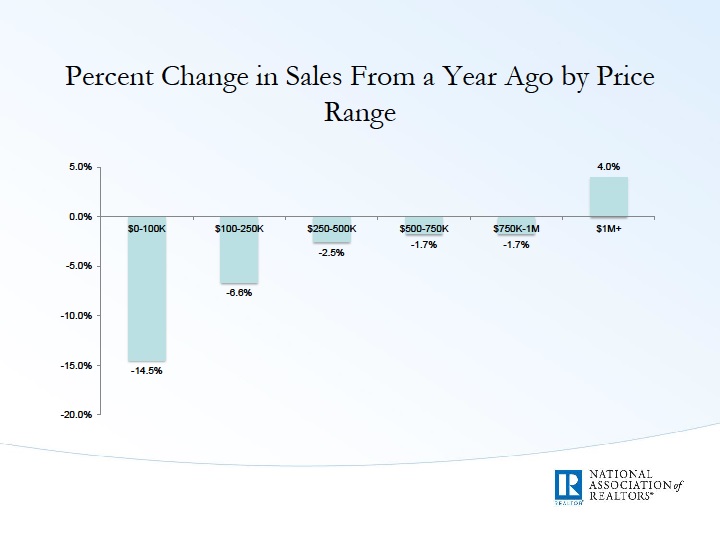
“Needless to say, what the chart showed was the symptomatic, and schizophrenic, breakdown of US housing into two camps: the housing market for the 1%, those costing $750K and above, where the bulk of transactions are mostly between non-first time buyers, and typically take place as all cash transactions, and the market for “everyone else” which continues to deteriorate.

Moments ago the NAR released its May data, which on first blush was widely lauded as bullish: the topline print came at a 4.9% increase, rising from 4.65MM to 4.89MM, above the 4.74MM expected. Great news… if only on the surface. So what happens when one drills down into the detail? As usual, we focused on the last slide of the NAR breakdown, located at the very end of the supplementary pdf for good reason, because what it shows is hardly as bullish.”
“Housing recovery? Maybe for the richest, and even they are far less exuberant about purchasing $1MM+ mansions. For everyone else, enjoy “plunging” hedonically-adjusted LCD TV prices. Everything else is, well, noise.”

Read more:

http://www.zerohedge.com/news/2014-06-23/guess-who-propping-us-housing-market


May jobs data euphoria over floundering ship of state, Recapturing jobs lost boast hides real problems with economy and employment, Citizen Wells warship analogy

May jobs data euphoria over floundering ship of state, Recapturing jobs lost boast hides real problems with economy and employment, Citizen Wells warship analogy

“Nearly half of U.S. companies are reluctant to hire full-time employees because of the ACA. One in five firms indicates they are likely to hire fewer employees, and another one in 10 may lay off current employees in response to the law.

Other firms will shift toward part-time workers. More than 40 percent of CFOs say their companies will consider switching some jobs to less than 30 hours per week or targeting part-time workers for future employment.”…Duke University Fuqua School of Business December 11, 2013


“Over the last six months, of the net job creation, 97 percent of that is part-time work,”…Keith Hall, former BLS chief

“Freedom is the freedom to say that two plus two make four. If that is granted, all else follows.”…George Orwell, “1984″


The low information and/or biased media has been reporting the following:

“U.S. has finally regained the jobs lost to the Great Recession”

The low information voters and many investors appear to be buying it.

A simple analogy:

A warship is struck by a torpedo.

Believing the ship to be in imminent danger of sinking, the captain orders most of the crew to abandon ship.

They are picked up.

Much to his amazement he discovers that a sand bar is preventing the ship from sinking.

The remaining crew members repair the hole and pump out the water.

The captain reports to the admiral, we have pumped out all of the water. We are ship shape.

Sounds good except that most of the crew is missing, the ship is still stuck and enemy submarines are lurking nearby.

The same with our ship of state.

We have patched the original problem but we are dead in the water.

The employment situation in this country is reaching critical mass.

We have record numbers dropping out of the labor force and record numbers relying on government assistance paid for by the remaining workers. Many of whom are working part time jobs.

Here is one small example of data not being reported by the mainstream media.

In just one month, from April to May, almost 300,000 more people wanted jobs who were not in the labor force.

Damn the torpedoes.