
State employment rates lower in 2014 than 2007, Pew Charitable Trust Aug 19, 2014, Employment rates for 25 to 54 year olds lower, 3.7 percent drop, Safety net programs strained
“11.4%: What the U.S. unemployment rate would be if labor force participation were back to January 2008 levels.” …James Pethokoukis, American Enterprise Institute, June 2013
“For now, the absence of young adults from the housing market continues to put a dent in the homeownership rate, which dropped to 64.8% in the first quarter, compared with 65.2% in the fourth quarter of 2013, according to U.S. Census statistics. The rate was as high as 69.2% in the fourth quarter of 2004. For those younger than 35, the rate has fallen noticeably faster. It slipped to 36.2% in the first quarter, from 36.8% in the fourth. The homeownership rate for this group was as high as 43.6% in the second quarter of 2004.”…Market Watch May 12, 2014
“Freedom is the freedom to say that two plus two make four. If that is granted, all else follows.”…George Orwell, “1984″
From the Pew Charitable Trust August 19, 2014.
“Percentage-point Change in Employment Rate, CY 2007 to FY 2014”
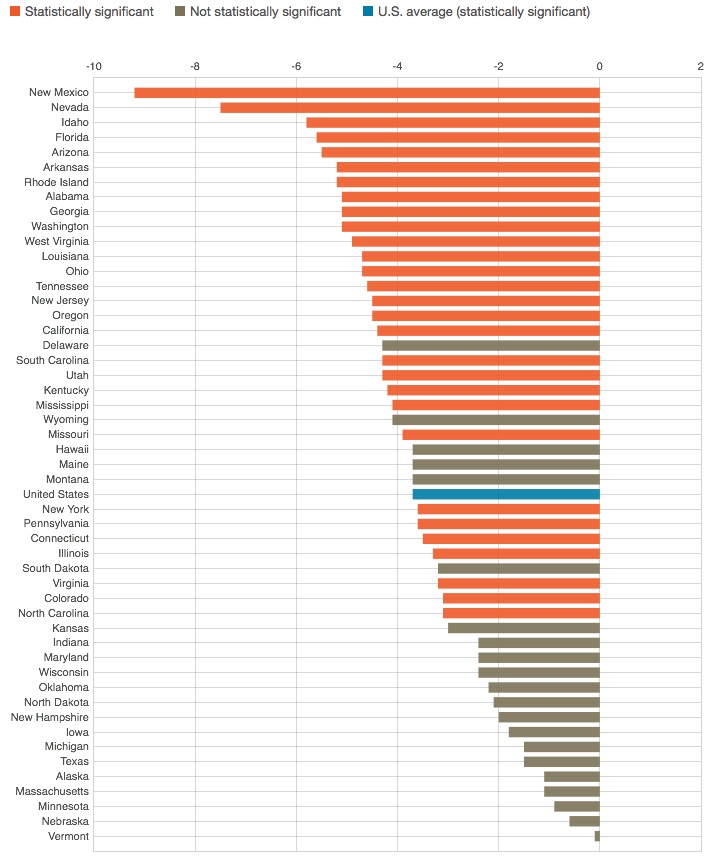
“In 2007, leading up to the Great Recession, 79.9 percent of people ages 25 to 54 in the United States had a job. In the 12 months ending June 2014, five years after the recession ended, only 76.2 percent of people in that age group were working.
The latest rates show a slight improvement from fiscal 2013, when 75.9 percent of people in their prime working years had a job nationally. At that time, employment rates were below prerecession levels in 35 states.
Still, at 3.7 percentage points lower than before the recession, the employment to population ratio for prime-age workers shows that the U.S. labor market remains weak. This finding has significant budgetary consequences for states:
Without paychecks, people pay less income tax and tend to buy less, reducing sales and business income tax revenue.
Unemployed people frequently need more services, such as Medicaid and other safety-net programs, increasing costs at a time when state governments may have less tax revenue.
A state-by-state comparison of calendar year 2007 with fiscal 2014 shows:
No state reported employment rate gains for 25- to 54-year-olds.
29 states had statistically significant decreases.
The largest decline in the employment rate was in New Mexico, where 69.9 percent of prime-age workers had jobs in fiscal 2014 — 9.2 percentage points lower than in 2007.
Among the least affected were Vermont and Nebraska, which recorded the smallest observed changes in their current employment rates of 83.3 and 85.2 percent, respectively.
Although unemployment figures receive more media attention, the employment rate is a preferred index for many economists because it provides a sharper picture of changes in the labor market. The unemployment rate, for example, fails to count workers who stopped looking for a job. By focusing on 25- to 54-year-olds, trends are less distorted by demographic effects such as older and younger workers’ choices regarding retirement or full-time education.”
Read more:
http://www.pewtrusts.org/en/multimedia/data-visualizations/2014/fiscal-50#ind3
Thanks to commenter bob strauss.


 Citizen WElls